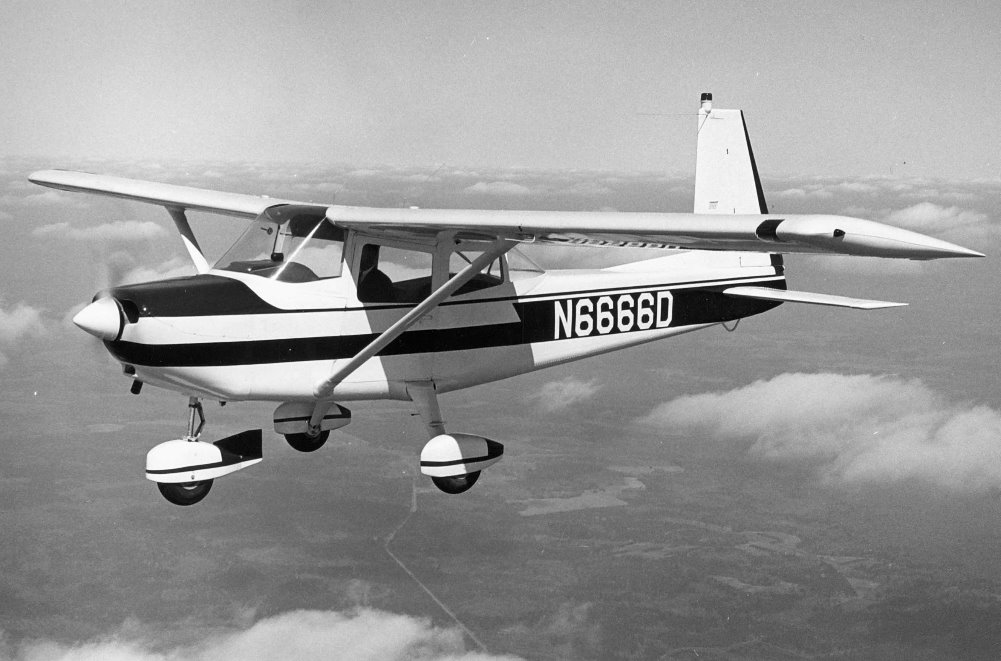
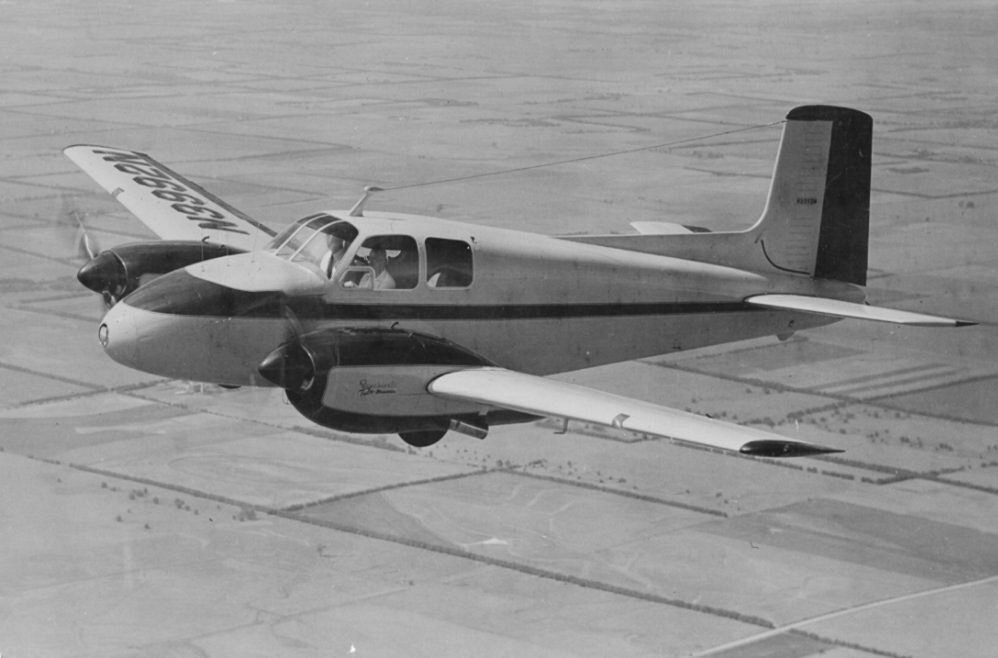
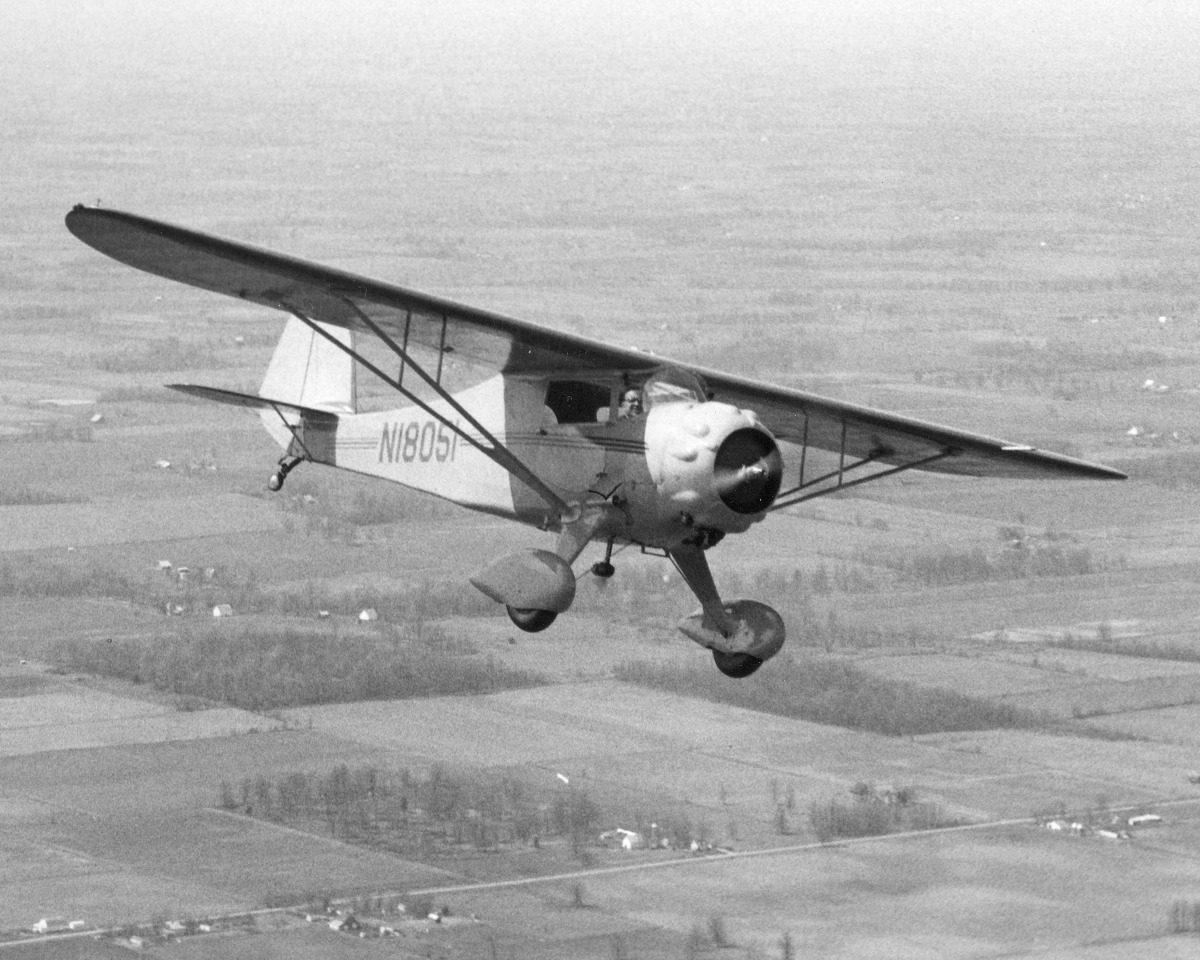
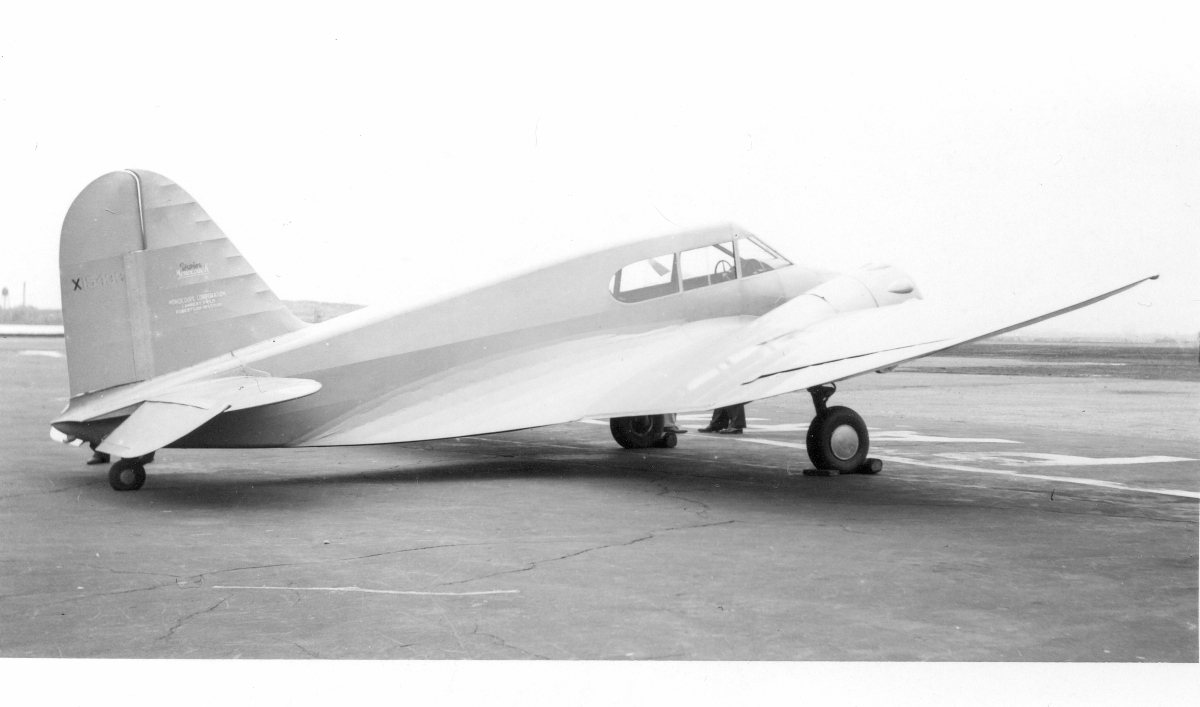
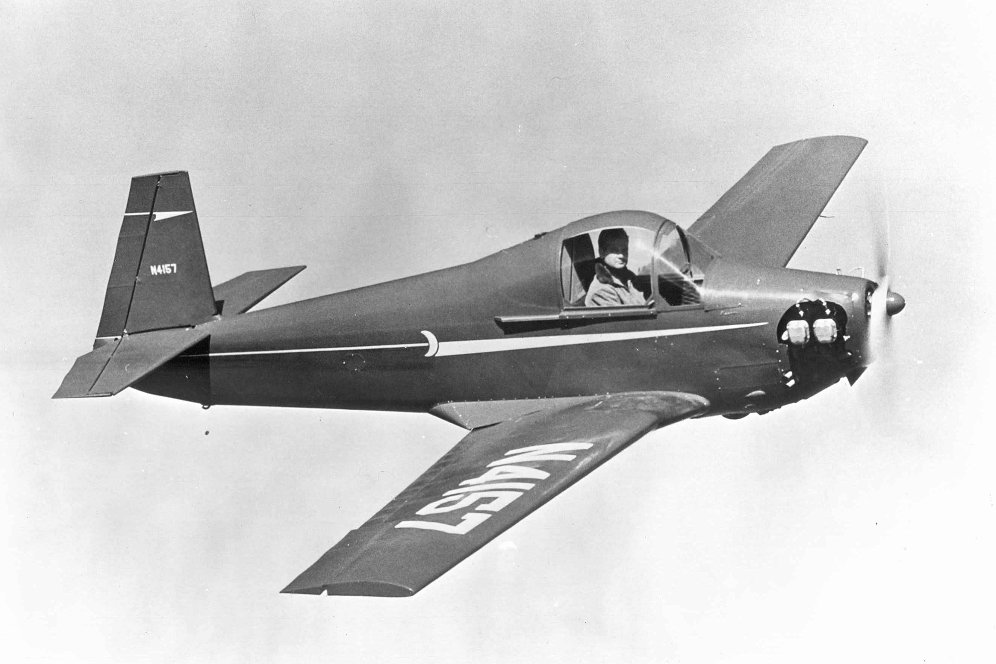
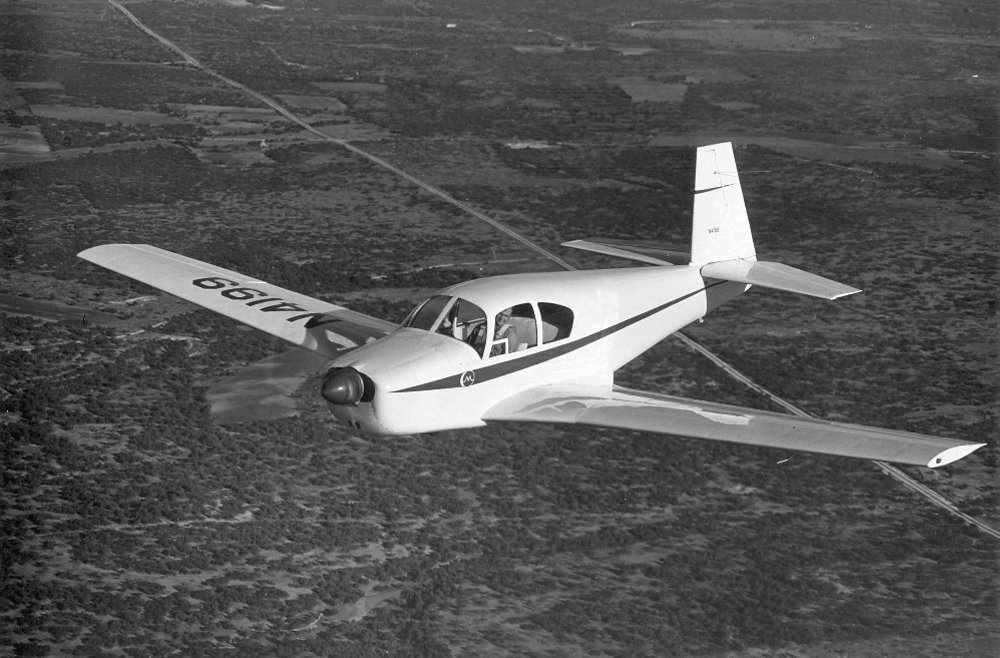
Inflight view of Aero
Commander 100 Darter Commander, N6666D. Originally built by the
Volaircraft company as the model 10, later the model 10A. This airplane
is currently on the FAA register as a Volaircraft model 10A, serial
number 10A-026. North American Rockwell purchased the rights to
this airplane in 1965 for manufacturing by their Aero Commander
divison. Aero Commander named it the Darter Commander, with 150
HP Lycoming engine. Later Aero Commander developed the airplane
with a 180 HP Lycoming engine, renaming it the Lark Commander.
B&W, about 103K,
Added 11/11/08.
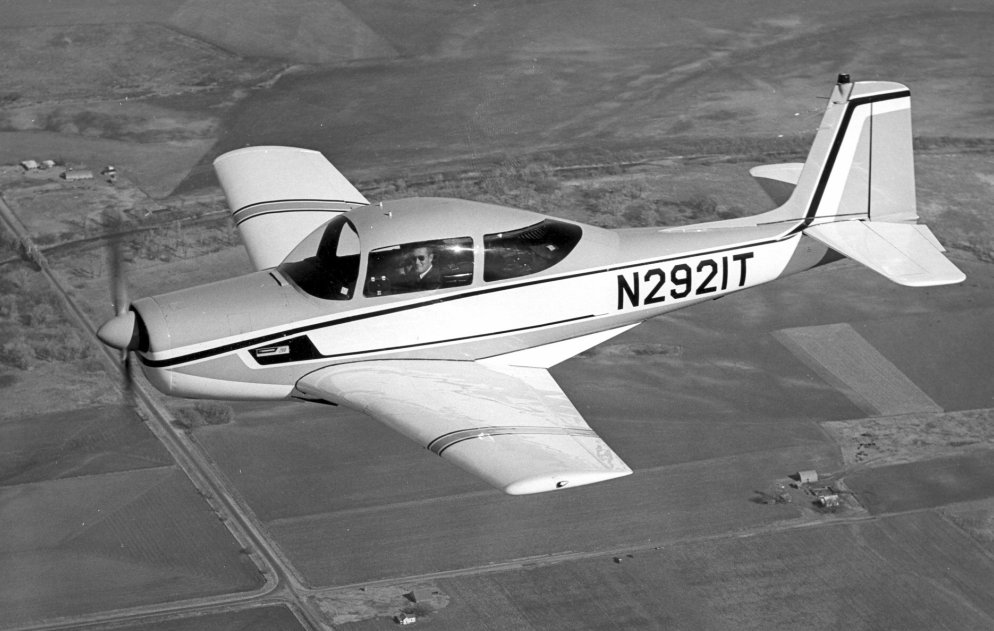
Inflight view of Aero
Commander 200,
N2921T. The Aero Commander 200 was originally the Meyers 200 (see
below for a ground view of the Meyers 200). One difference
between the Meyers 200 and the Aero Commander 200 is the engine.
In the Meyers 200 the engine is a Continental IO-470 of 260 HP,
in the Aero Commander 200 the engine is a Continental IO-520 of
285HP. This example is serial number 326, and is current on the
US register. B&W, about 101K,
Added 11/02/05.
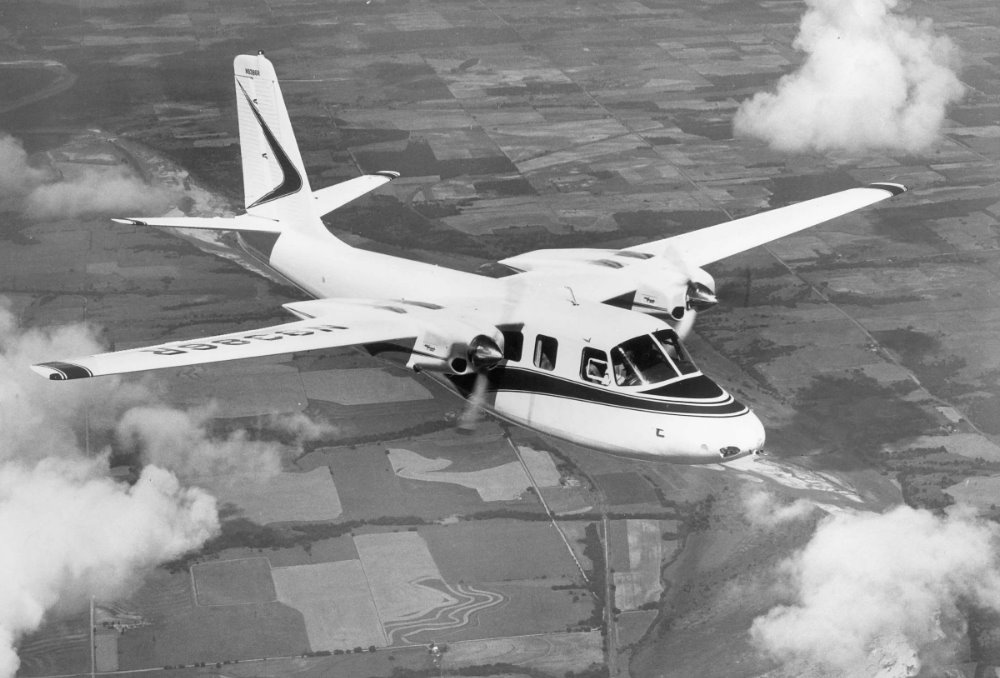
Inflight view of an Aero
Commander 500-B,
registration N9386R. This is the 1960 model which was the first
Aero Commanders to use the slimmer engine nacelles. In 1960 the
models 500A and 500B were both manufactured, and look very
similar. The 500A uses Continental IO-470 enines, the 500B uses
Lycoming IO-540 engines. A major change was needed to allow the
slimmer nacelles. With the slimmer nacelles it became necessary
to rotate the landing gear 90 degrees so it could lay flat whena
retracted. With the earlier larger nacelles there was adequate
room for the landing gear to retract straight back. B&W,
about 105K,
Added 04/01/09.
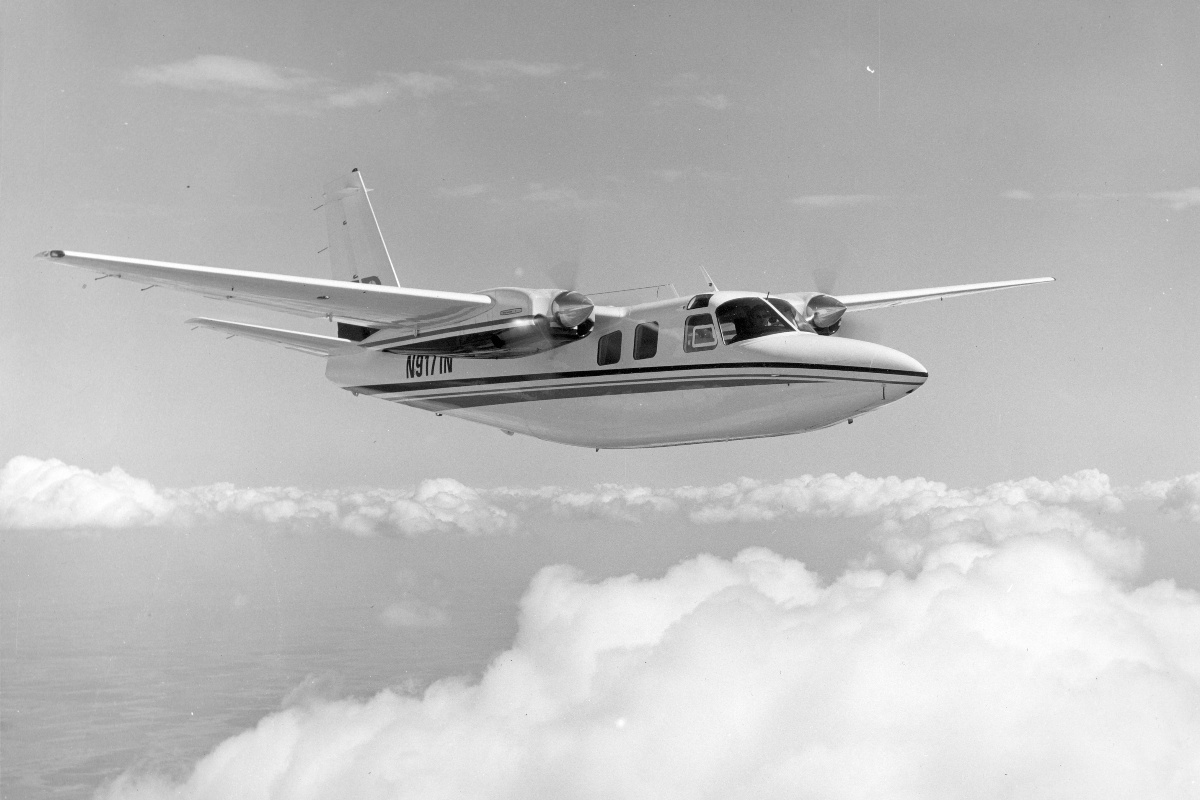
Inflight view of an Aero
Commander 500-S Shrike Commander,
registration N7171N, c/n 3119, built in 1972. Along with the
slimmer nacelles, the Shrike Commander has a longer more
pointed nose. B&W,vabout 237K,
Added 03/01/21.
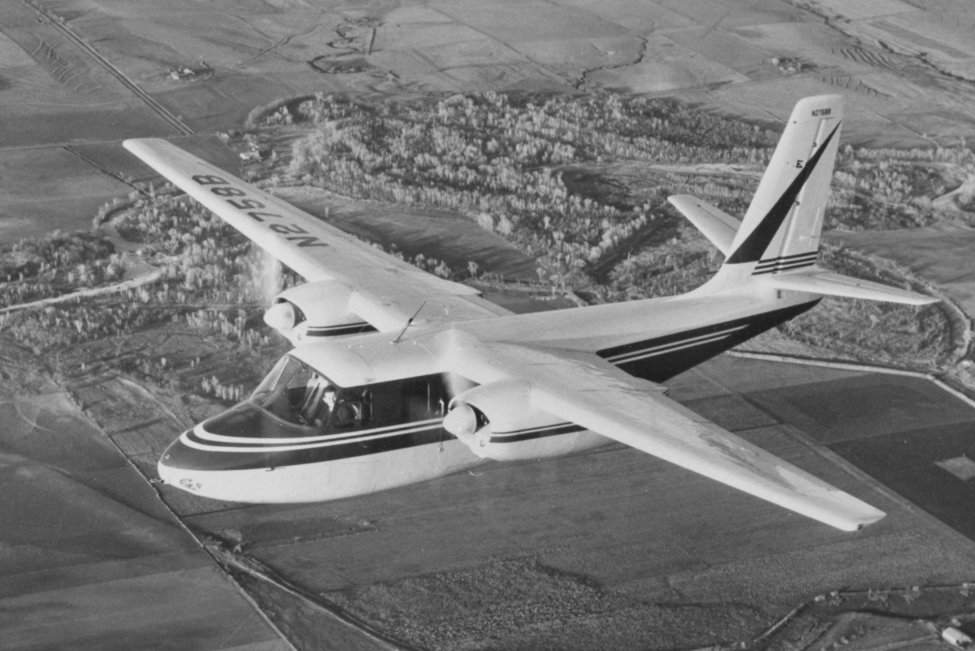
Very nice Inflight view of an Aero
Commander 560-A,
registration N2758B. The images of the Aero Commander 560 shown
here represent the original design with the larger engine
nacelles. Using the same fuselage design, Aero Commander would
make a significant change to the engine nacelle beginning with
the 1960 year. N2758B was built in 1955, serial number 258.
B&W, about 112K, Added 02/18/06.
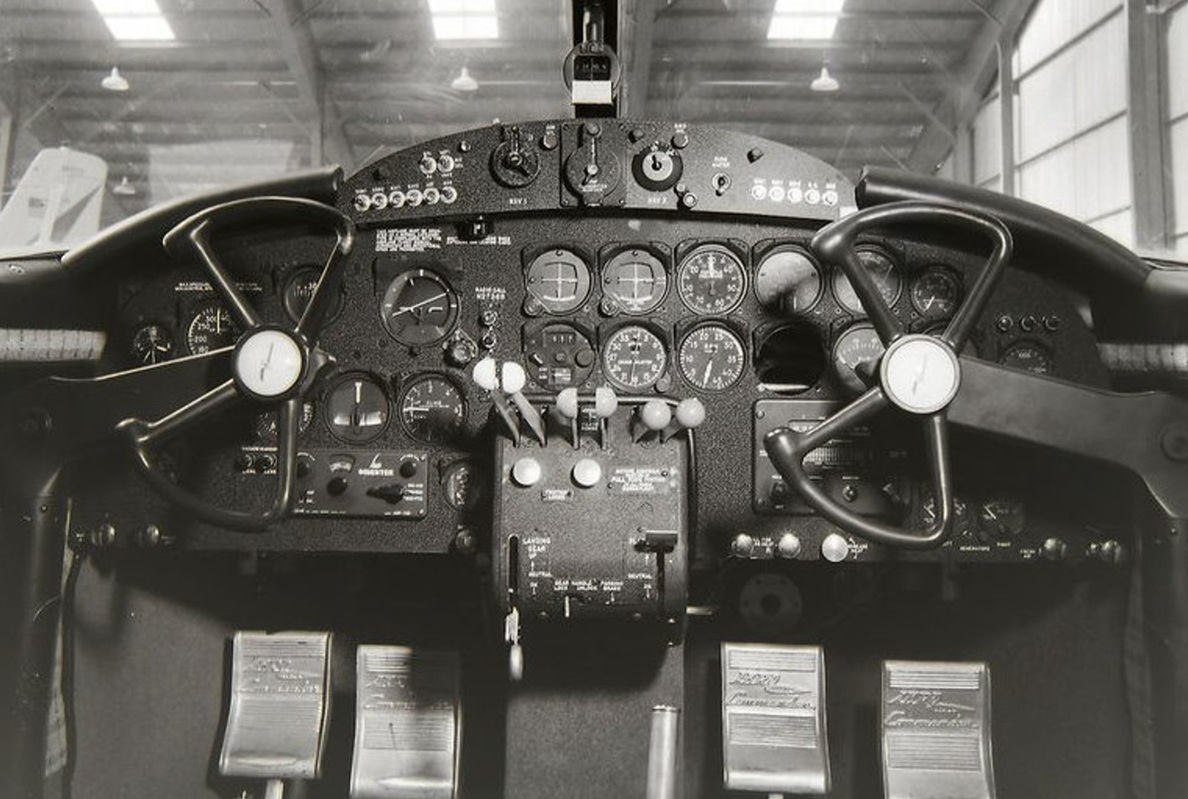
Instrument Panel of Aero Commander
560-A, believed to
be N2744B. To the left of the throttle quadrant is a Lear ADF-12,
to the right a Narco VC-27 Simplexer. On the glare shield are 3
additional radio control heads. On the right of the 3 appears to
be an ARC tunable navigation radio. B&W, about 260K,
Added 03/01/12.
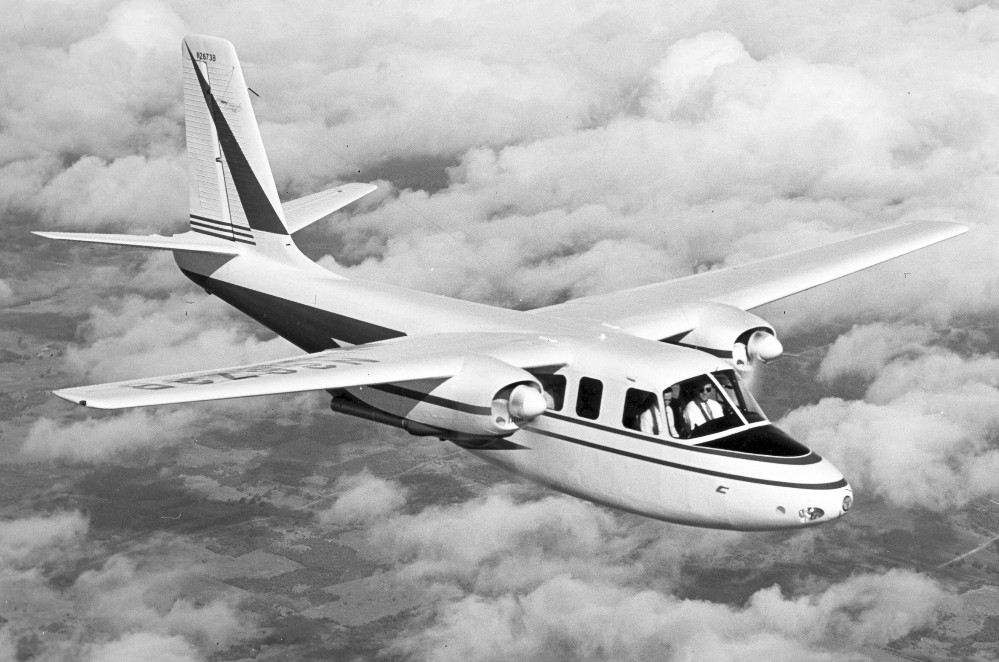
Very nice Inflight view of an Aero
Commander 560,
registration N2673B. This is serial number 173, built in 1954.
B&W, about 154K, Added 11/18/05.
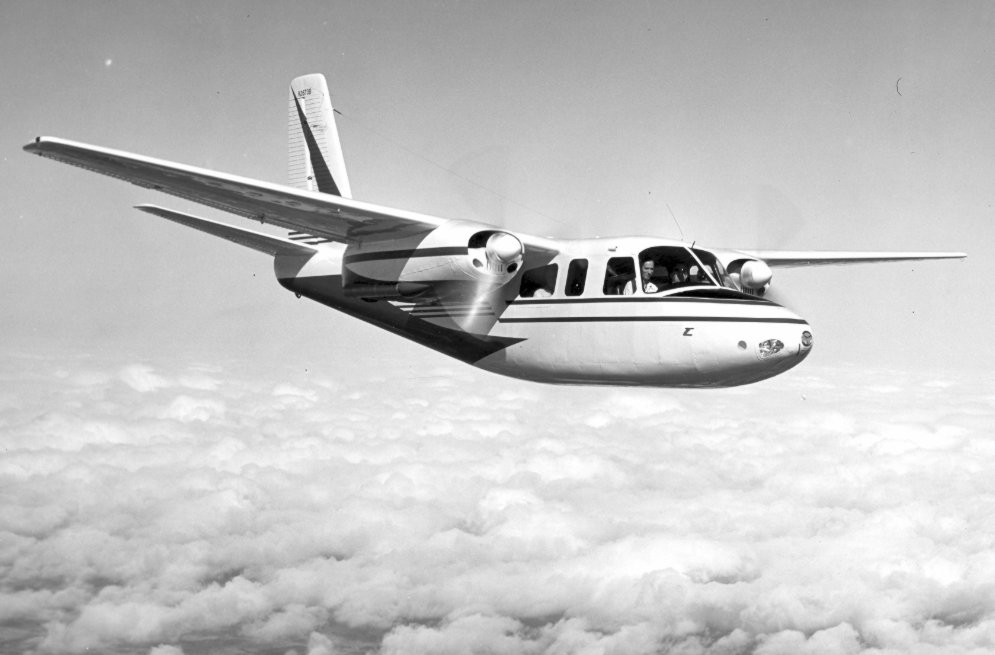
Here is another very nice view of Aero
Commander 560 N2673B, again inflight, this time from a slightly
different, lower angle. B&W about 70K.
Added 02/18/06.
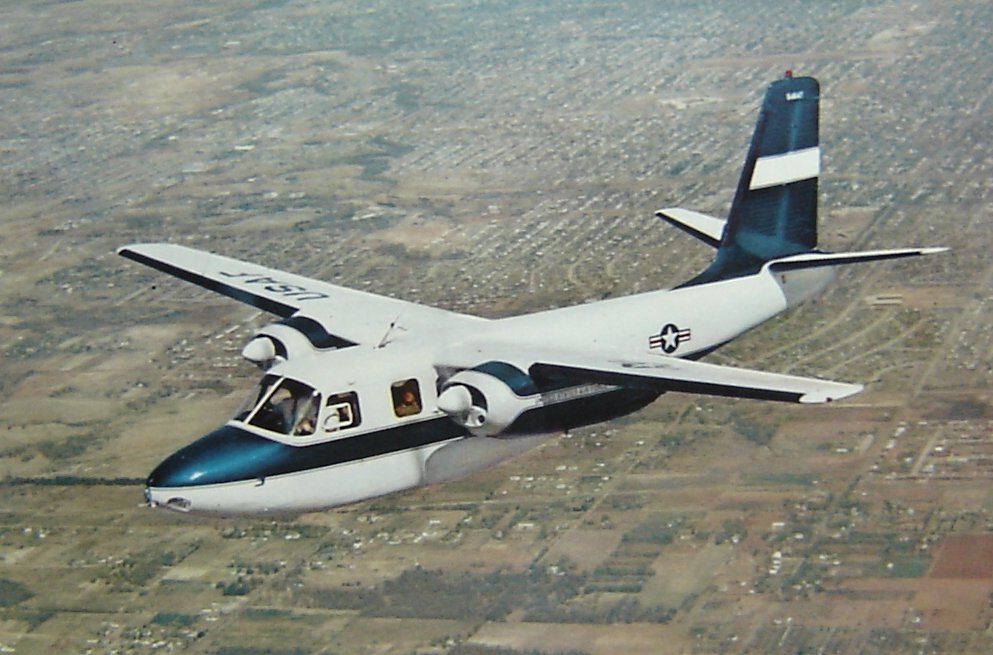
Inflight view of an Aero
Commander 680 as the USAF L-26C-AD serial number
55-4647. Aero
Commander serial number 680-315-10. This aircraft was for used as
a presidential aircraft. President Eisenhower did fly in it. It
was later redesignated as U-4B. Color, about 135K,
Added 07/07/05.
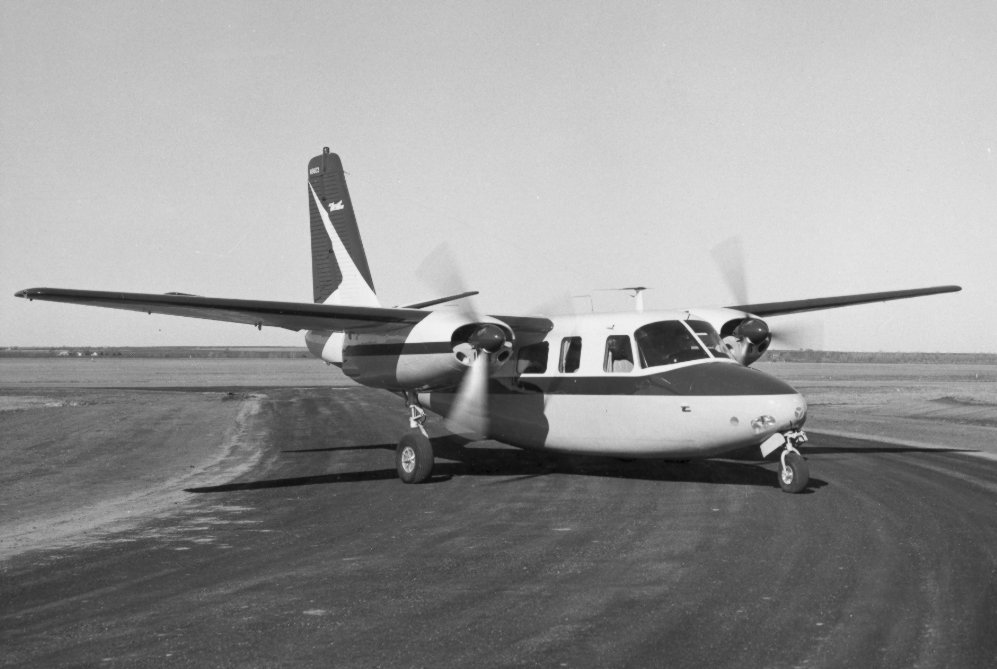
Ground view of an Aero
Commander 680 N9602. B&W, about 81K,
Added 02/23/06.
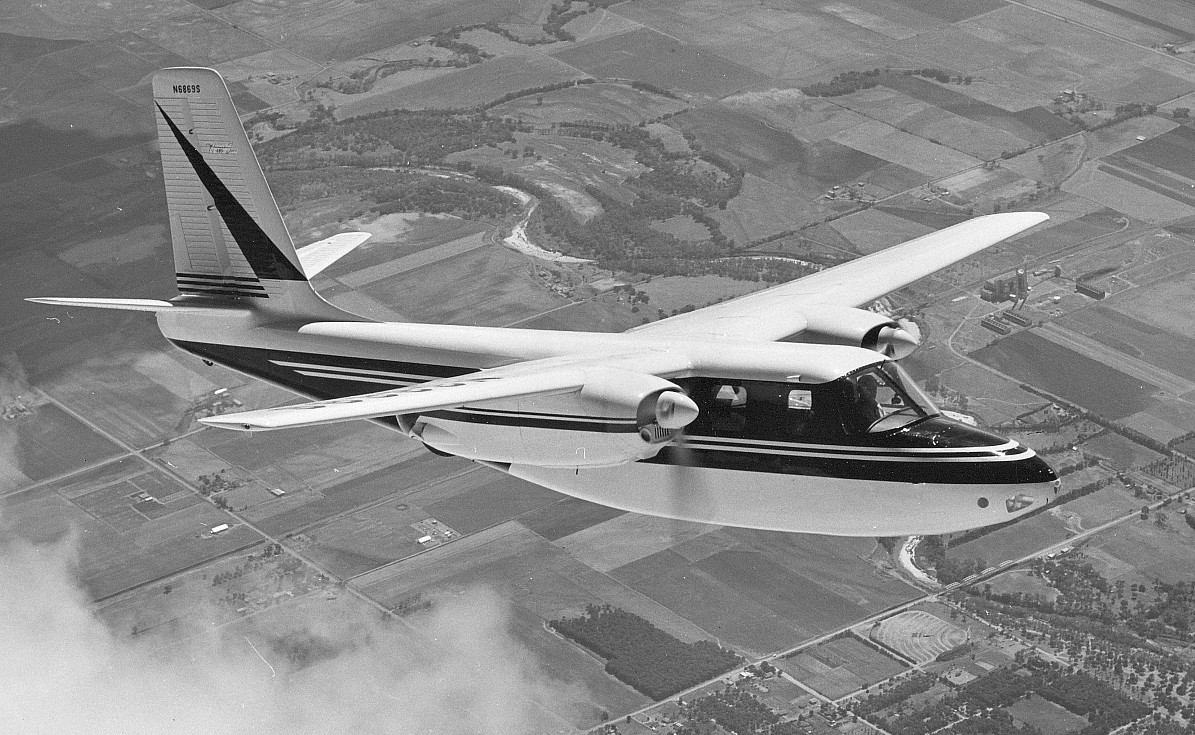
Very nice inflight view of Aero
Commander 680 N6869S, c/n 680-388-69, manufactured in 1956.
B&W, about 307K, Added 05/07/15.
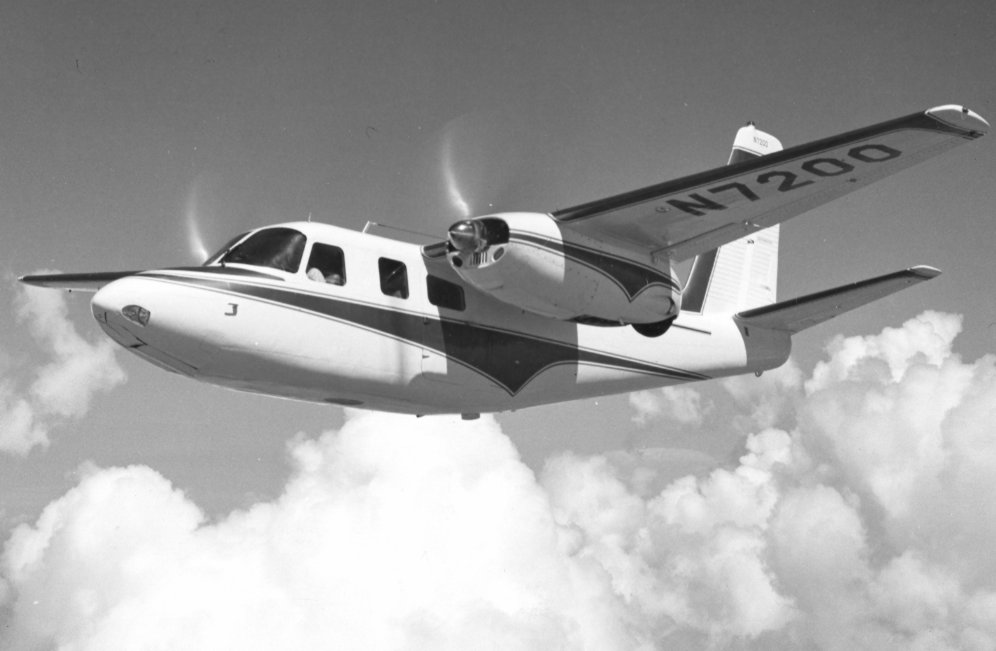
Inflight view of an Aero
Commander 720 Alti Cruiser. Registration N7200. The Aero Commander 720
was, I believe, the first production light aircraft to be
pressurized. Certainly airliners had long had pressurization, but
not light general aviation aircraft. Only about 30 of the model
720's were manufacutred. B&W, about 63K,
Added 02/23/06.
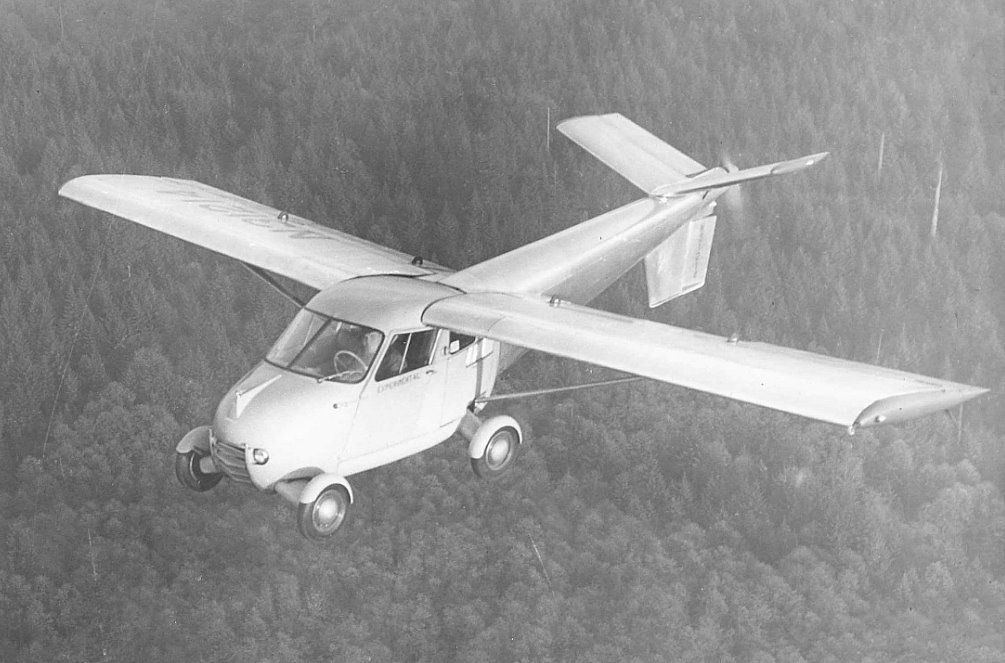
Inflight view of an Aerocar
Model I, N31214.
This combination car/airplane first built in 1949 by designer
Moulton B. Taylor. Some sources say the airplanes had a Lycoming
O-290, others say a Lycoming O-320. The wings and tail can be
removed and towed behind when used as an automobile. Believe 5 of
the model 1's were built. B&W, about 113K,
Added 03/30/02 09/02/10.
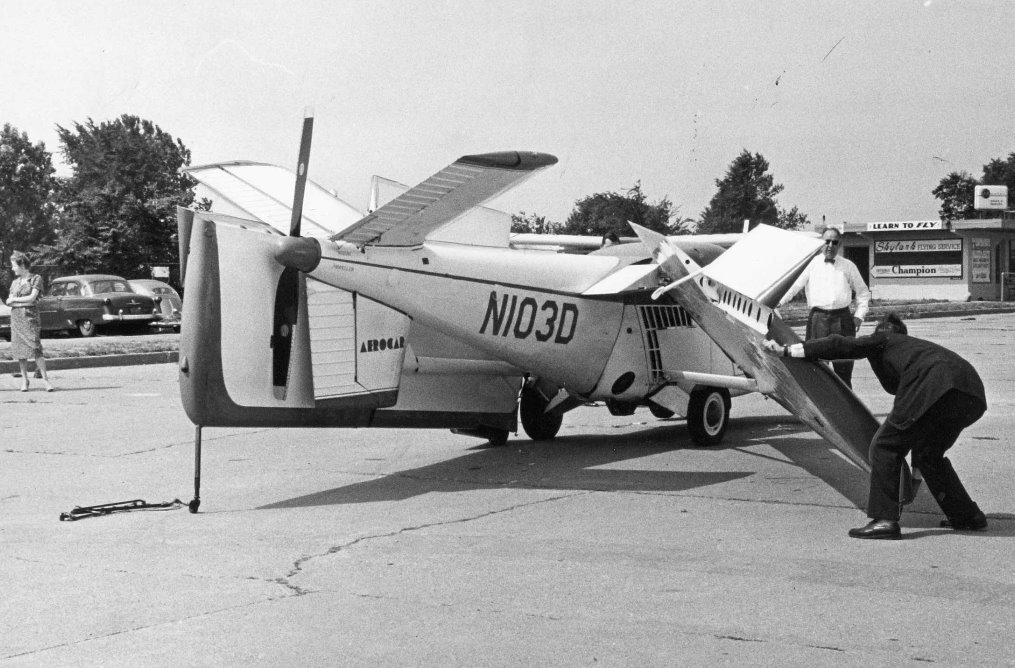
Ground view of an Aerocar
Model One, N103D,
construction number 2. This view shows how the wings folded back
during ground travel. B&W, about 143K,
Added 04/22/11.
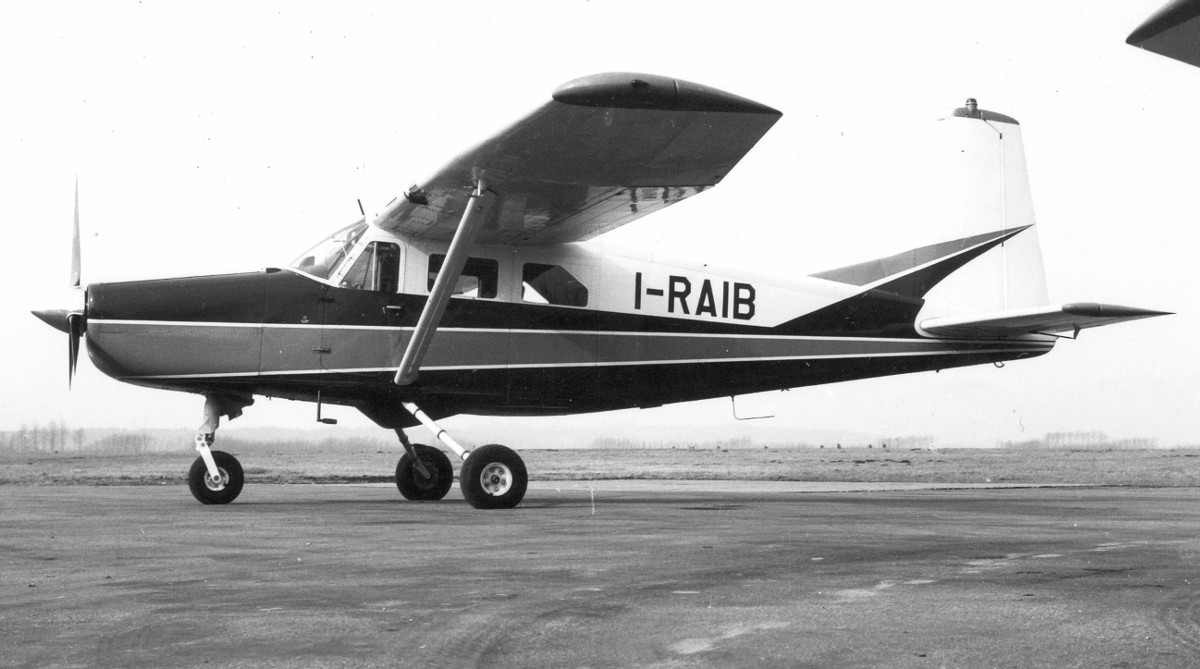
Ground view of an Aeronautica Macchi
S.p.A. AL.60C-5 Conestoga, registration I-RAIB. Lockheed Georgia designed the
Lockheed LASA-60 building two prototypes with first flight September 16, 1959. Later built in Mexico,
Italy and South Africa. The Conestoga version was built specifically for the Central African Republic.
The LASA-60 is approximately equivilant to the Cessna 182 with a higher horsepower engine used.
B&W, about 137K, Added 02/15/15.
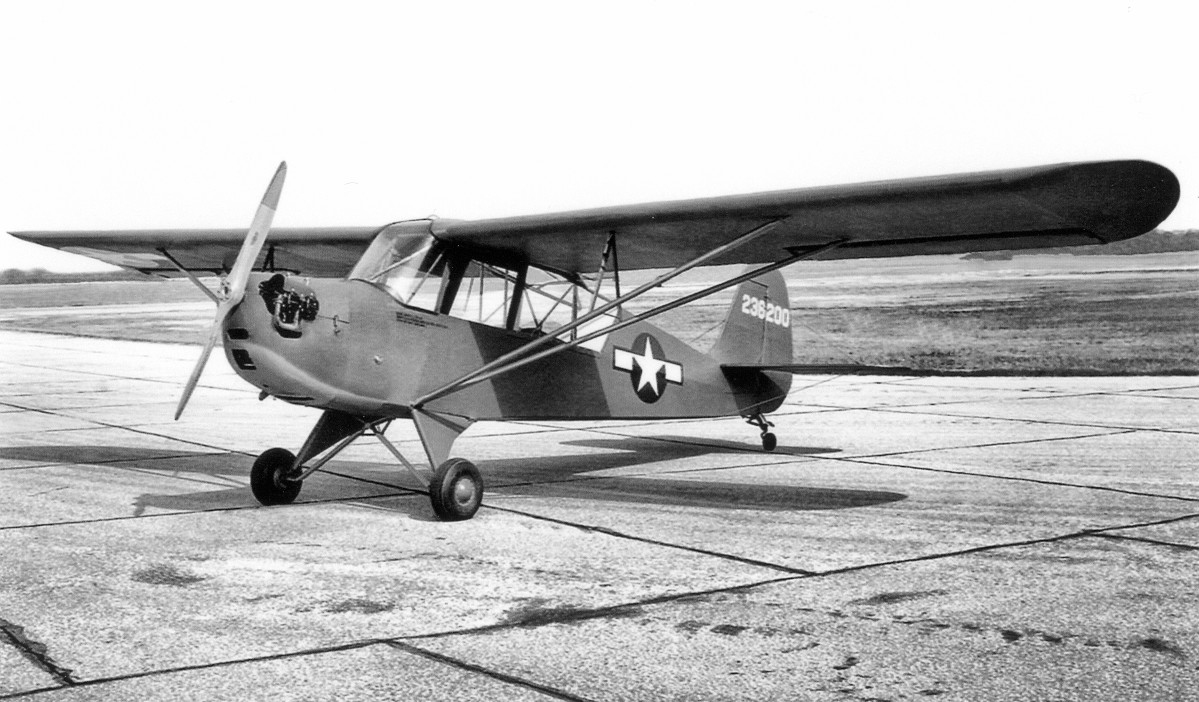
Ground view of an Aeronca
L-3B Grasshopper, USAAF serial number 42-36200. Originally
designated the O-58B the designation was later changed to L-3B-AE.v
The name "Grasshopper" applied to Aeronca, Piper and Taylorcraft
light aircraft purchase by the USAAF immediately prior to and
during WWII. This aircarft is now displayed at the National Museum
of the United States Air Force at Wright-Patterson AFB, Dayton,
Ohio. Aeronca built 1,798 L-3's for the military. B&W, about 211K,
Added 10/18/14.
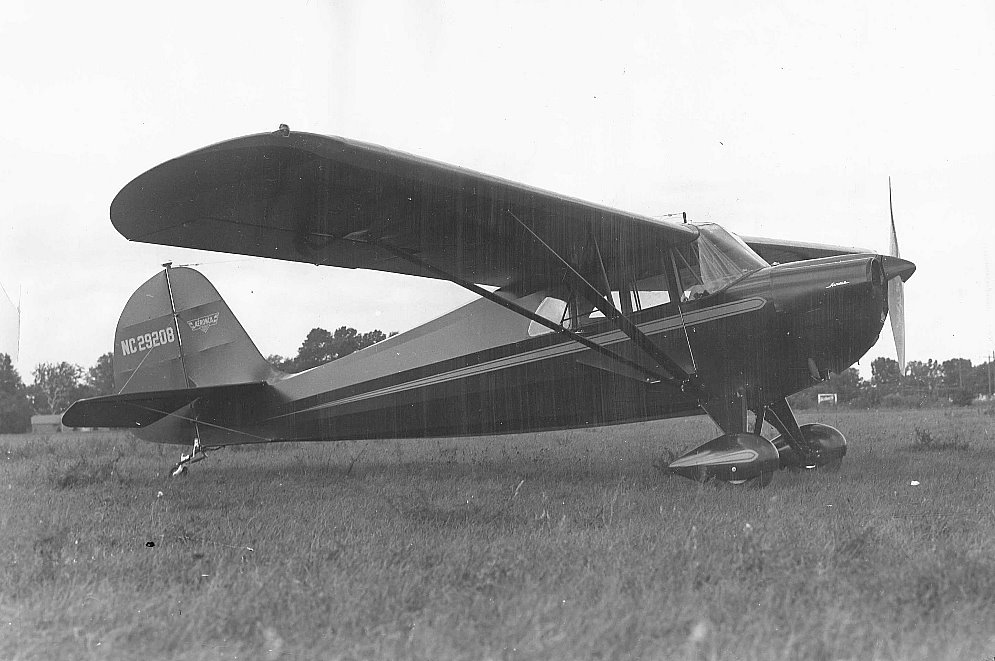
Ground view of an Aeronca
65-CA Chief,
NC29208, c/n C10080, a 1940 model, current on the FAA register.
B&W, about 113K,
Added 12/01/11.
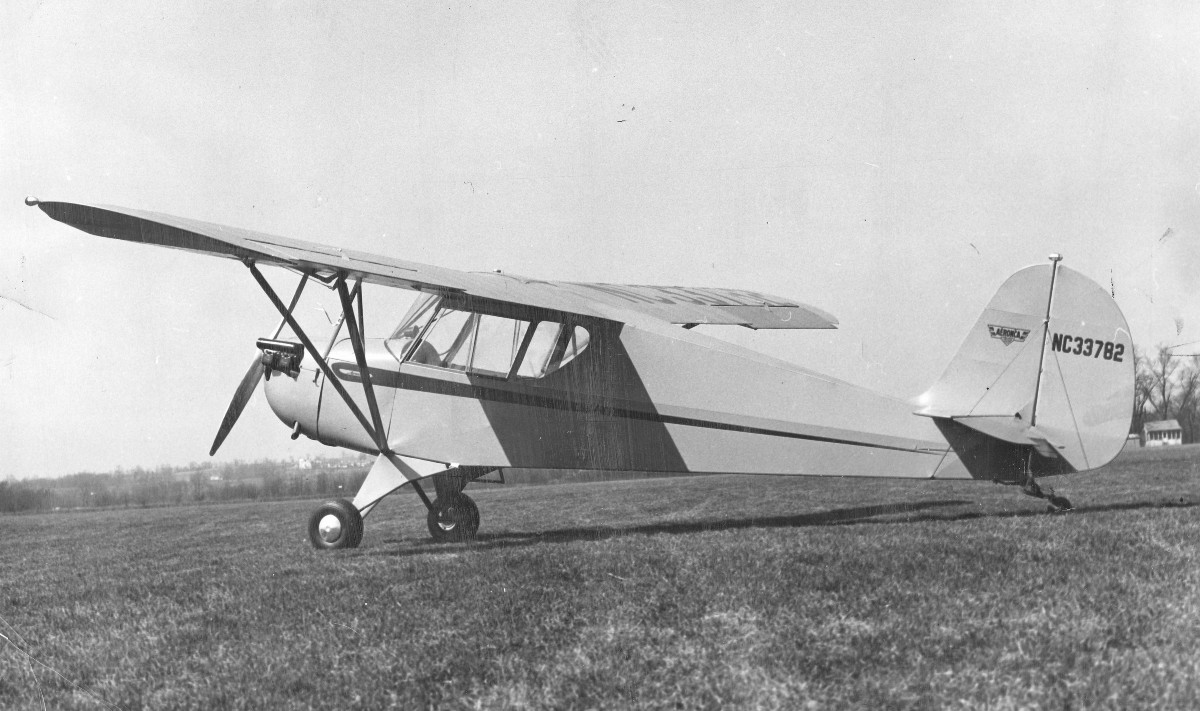
Ground view of an Aeronca
65-TL Tandem Trainer,
NC33782, c/n L9341T, a 1941 model, current on the FAA register.
B&W, about 201K,
Added 04/02/16.
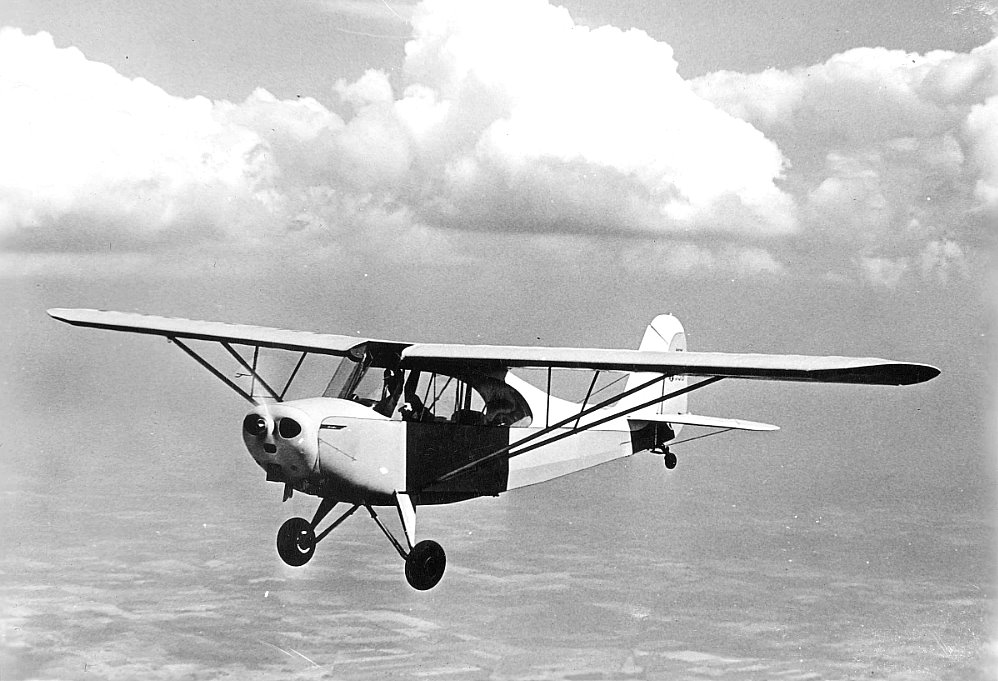
Inflight view of an Aeronca
7AC Champion,
believe this is N81412, c/n 7AC-5, current on the FAA register.
The Aeronca model 7AC uses a Continental A-65 engine of 65HP. B&W, about 128K,
Added 01/01/02.
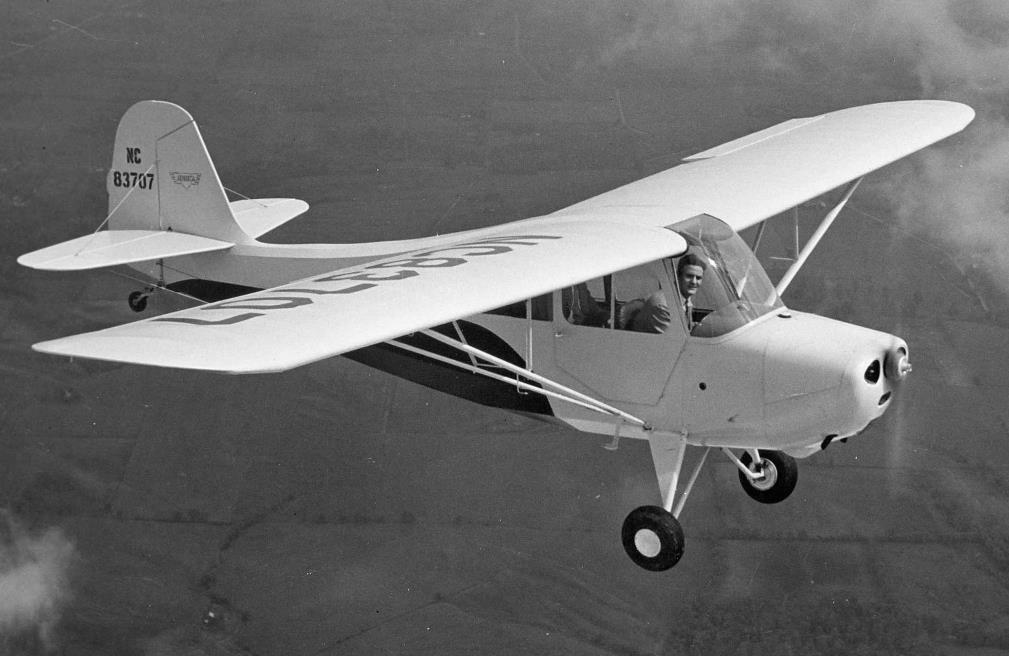
Beautiful inflight view of Aeronca
7AC Champion,
NC83707. This airplane is a 1946 model, serial number 7AC-2385.
B&W, about 68K,
Added 10/17/10.
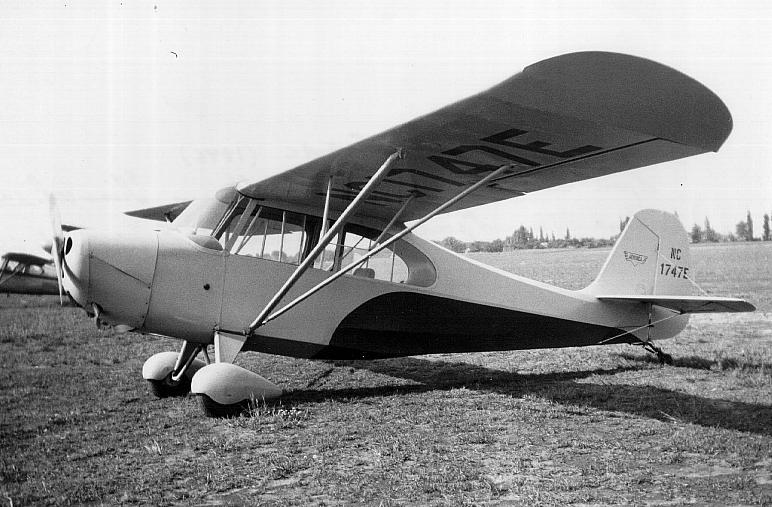
Ground view of a Aeronca
7AC Champion,
NC1747E. This particular airplane has wheel pants on, which was
not too common for the Aeronca 7AC. Airplane shown is a 1946
model, serial number 7AC-5314. B&W, about 78K,
Added 01/01/02.
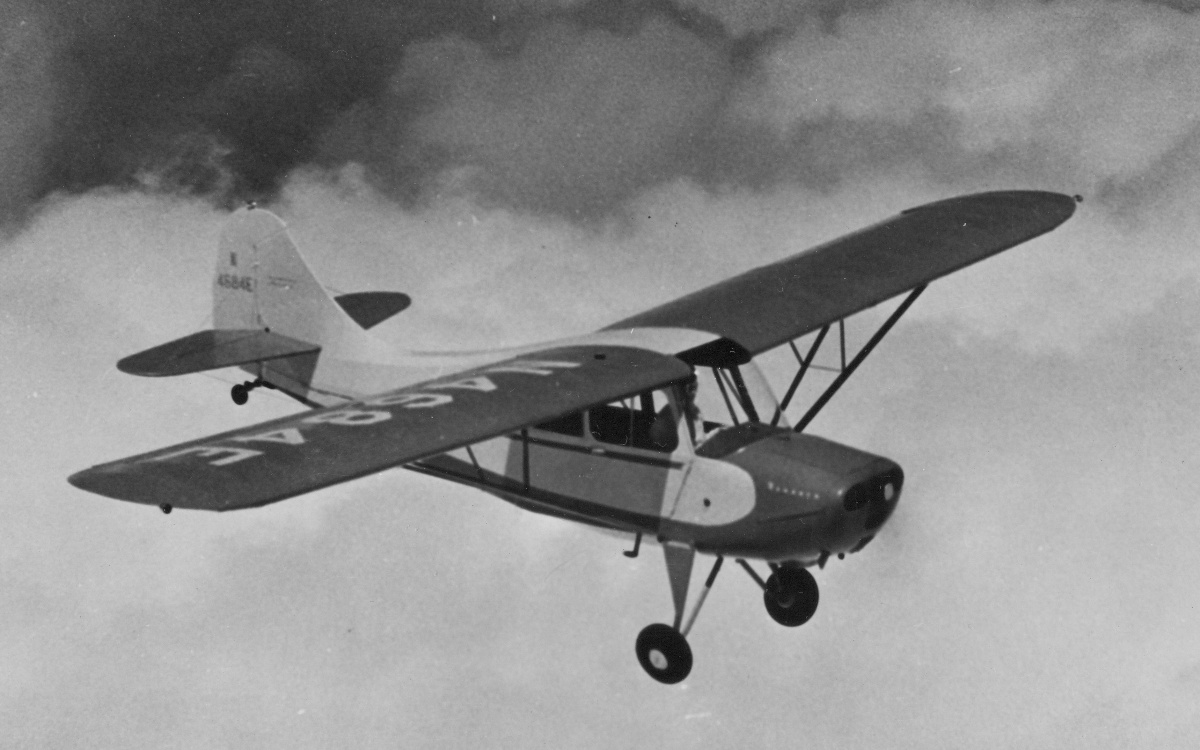
Inflight view of a 1947 Aeronca
7DC Champion, N4684E, C/N 7EC-32. While the c/n says
7EC, the FAA database says this is an Aeronca model 7DC. The
7DC uses a Continental C-85 engine of 85HP. The 7DC also has
an enlarged vertical stabilizer over the model 7AC. B&W, about 228K,
Added 10/01/19.
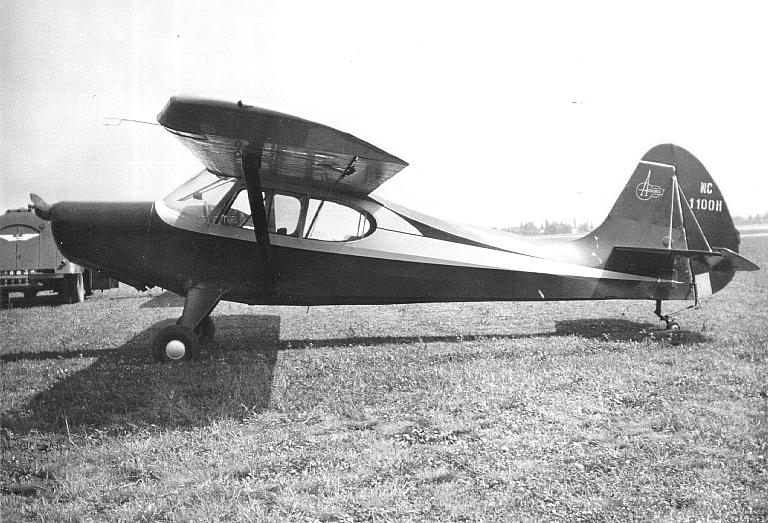
Ground view of a Aeronca
15AC Sedan,
NC1100H. The Sedan is a four place airplane. B&W, about 87K,
Added 03/30/02.
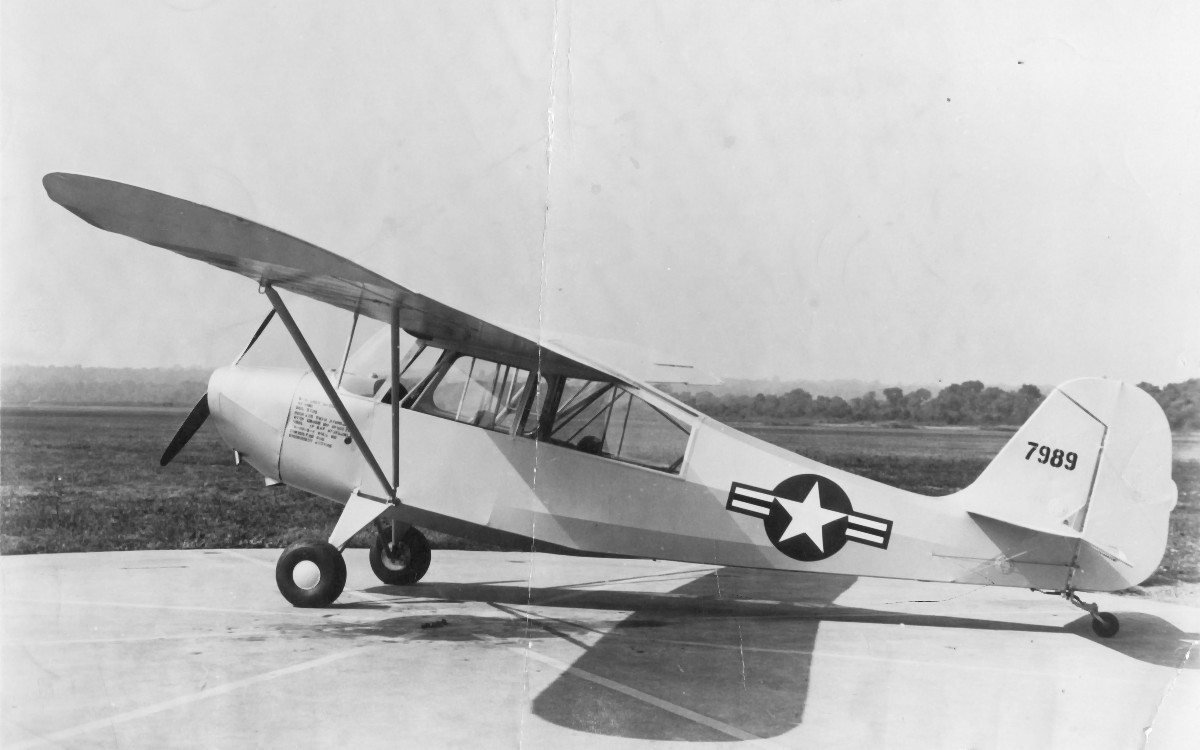
Ground view of a Aeronca
L-16A, USAF serial number 47-989, MSN 7BCM-203. B&W, about 123K,
Added 07/01/18.
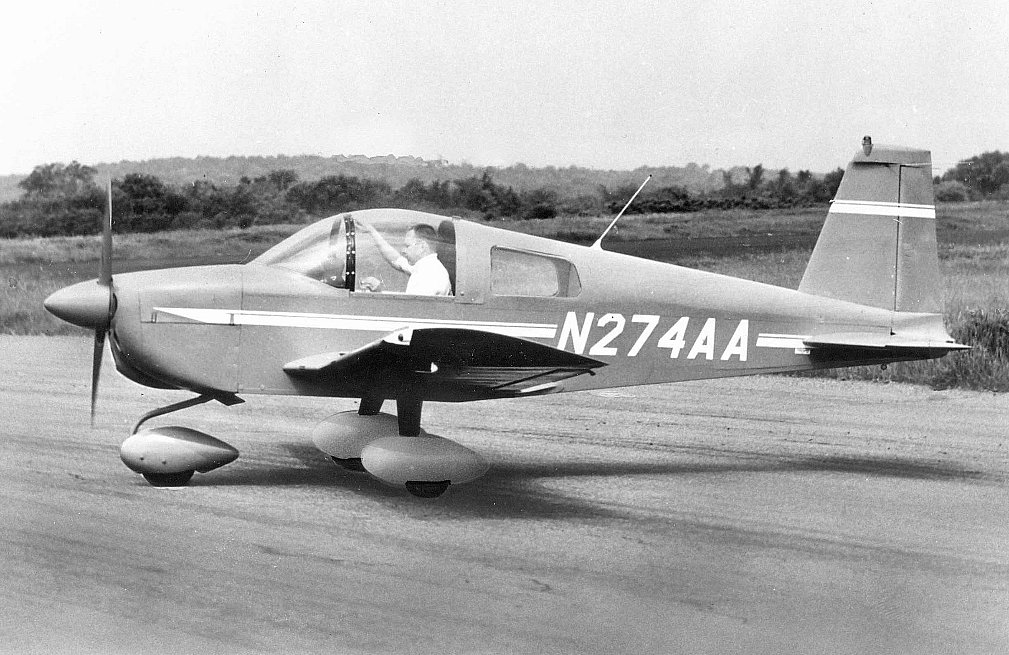
Ground view of a American
Aviation AA-1 Yankee,
N274AA. Jim Bede designed this airplane in 1962 as the BD-1. Before
going into production the company was renamed American Aviation. Some
929 AA-1 airplanes were built by American Aviation, which was then sold
to become Gumman American Aviation. Another 891 AA-1 series airplanes
were sold bringing total production to 1,820. Production ended in 1978.
B&W, about 160K,
Added 06/12/13.
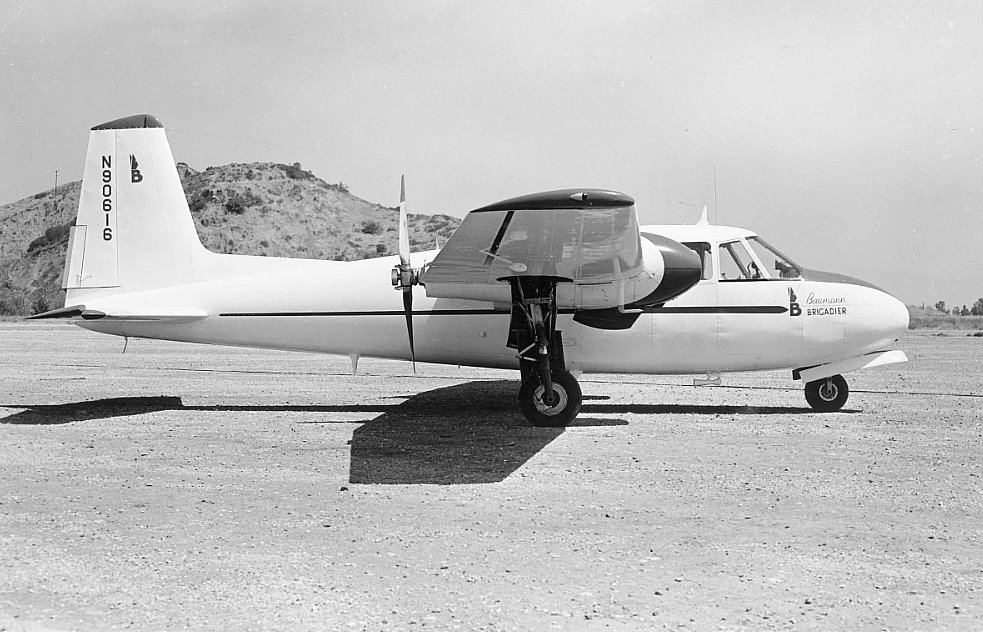
Ground view of a
Baumann Brigadier B-290, N90616.
The first Baumann Brigadier was the B-250 with two Continental
C-125 125 HP engines. This was sold to Piper for possible
production, however Piper did not manufacture the airplane. This
is the second Baumann Brigadier, a model B-290, with two
Continental C-145 145HP engines (total of 290 HP). Airplane was
designed in Pacoima, California, and I believe this photo was
taken at Whiteman Airpark. This airplane was at one time in the
EAA Museum at Oshkosh, WI, uncertain of current location or
condition. I understand there was a second B-290 airplane, which
at some time was rengined with 165HP Franklins. The Baumann
Brigadier became the basis of the Custer CCW-5 Channel Wing.
B&W, about 139K,
Added 08/02/12.
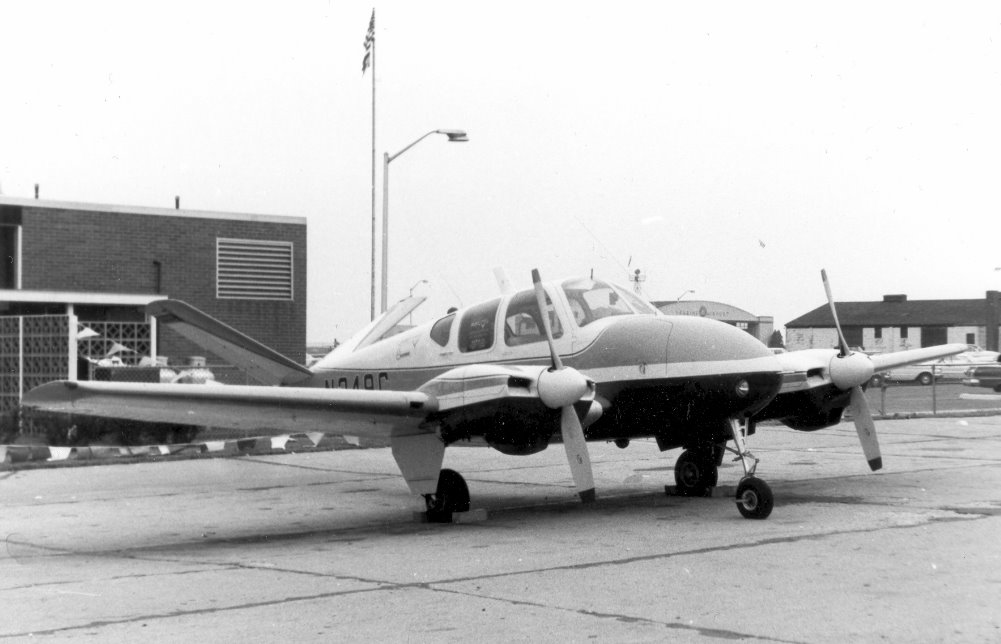
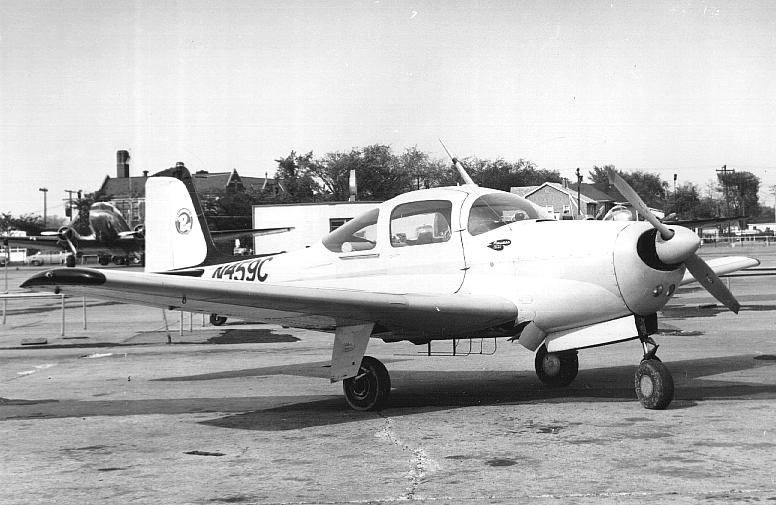
Ground view of a Bay
Aviation Super V,
N249C? (maybe N349C). The Super V is a Beech Bonanza modified to
twin engine configuration. There are differing reports on this
airplane. One incorrect report is the conversion is of the Beech
C-35 Bonanza. The Super V serial numbers have both an original
Beech Bonanza serial number plus a Super V serial number. Those
serial numbers indicate most existing conversions were from
straight 35 Bonanzas, with others from an A-35 model. Originally
converted by David Peterson of Tulsa, then Oakland Aviation,
later Bay Aviation Services, then Pine Air Ltd., and finally
Fleet Aircraft Co. Some sources say 9 aircraft were converted,
other sources say 5 aircraft were converted, however serial
numbers go to 16. Some are on the FAA register as Bay Aviation,
others as Pine Air Ltd. Power by two Lycoming O-360 engines, each
of 180HP. B&W, about 80K,
Added 04/10/08.
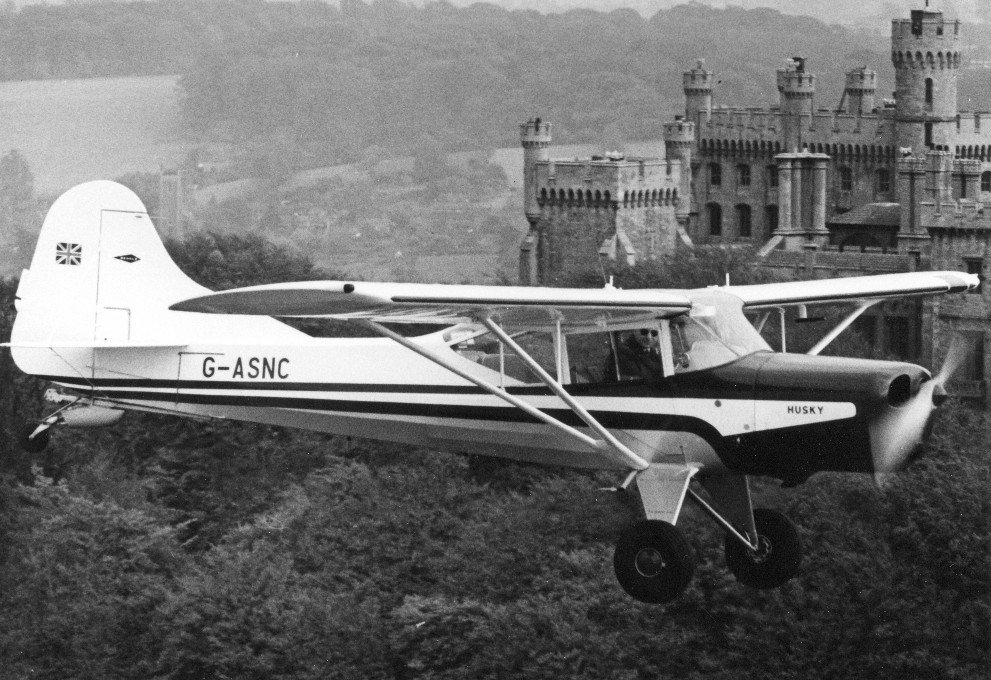
Inflight view of Beagle D5/180 Husky
registered G-ASNC. Origin of the Husky is the Auster Aircraft Limited which was
merged into Beagle Aircraft in 1961. This airplane is c/n 3678 built in 1963.
Engine is a Lycoming O-360-A1A of 180 HP. You may sometimes find this type airplane
identified as the Beagle A.113 Husky, with the A.113 being the Beagle model
number. B&W, about 198K,
Added 08/24/14.
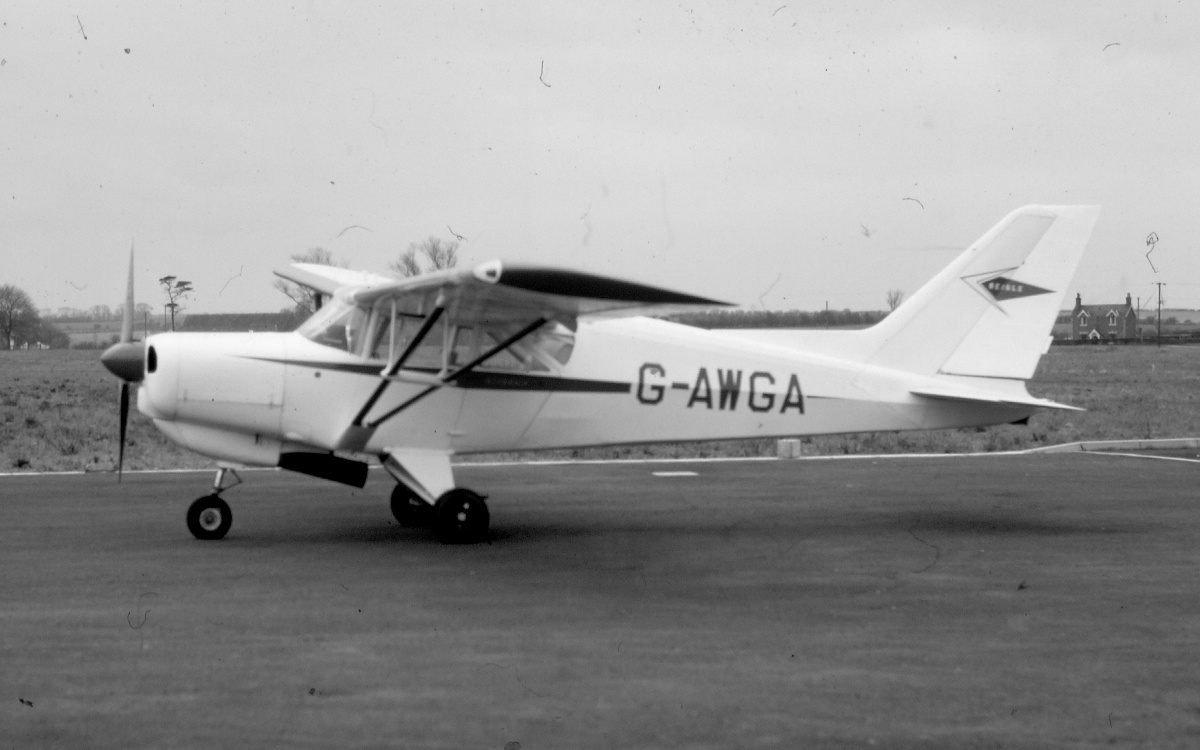
Ground view of Beagle A-109 Airedale
registered G-AWGA, c/n B.535. Forty three airplanes were built between 1961
and 1965. Powered by a Lycoming O-360 180HP engine, it carries a pilot and
3 passengers. B&W, about 204K,
Added 01/05/18.
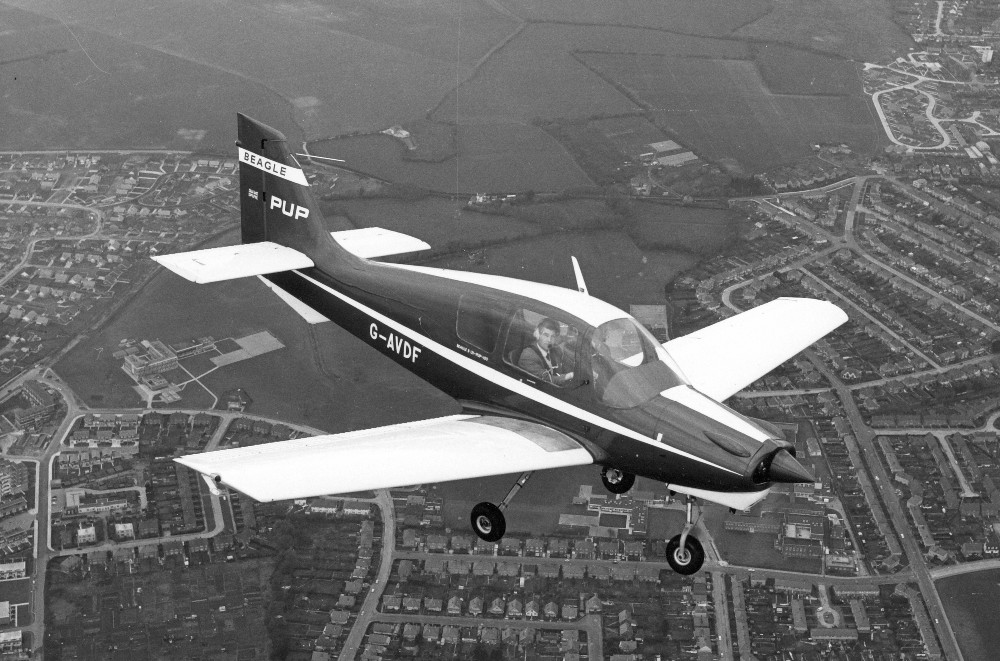
Inflight view of Beagle 121 Series 1
registered G-AVDF, c/n B121-001, manufactured in 1967. Often this Beagle is referred
to as the model 100 Pup. Engine is a Continental Motors O-200-A of 100 HP. Beagle
manufactured 176 through 1970. The Beagle Pup was developed into the Beagle Bulldog
with more power, which was used by several air forces for basic training. B&W, about 205K,
Added 08/24/14.
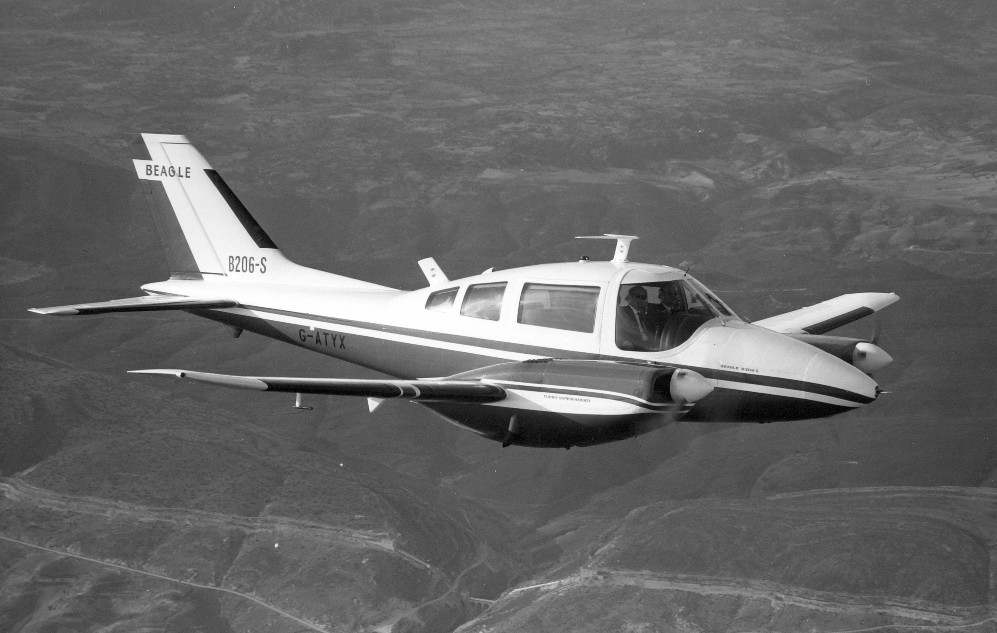
Inflight view of Beagle 206 Series 2
registered G-ATYX, c/n B043, manufactured in 1966. The model 206 can be configured
with up to 8 seats. Engine is a Continental GTSIO-520. Beagle manufactured a total
of 80 model 206 aircraft between 1964 and 1969. Beagle developed this into the
Beagle B.206R used by the Royal Air Force as the Basset CC.1, which the RAF used to
move "V" Bomber crews around England. B&W, about 130K,
Added 08/24/14.
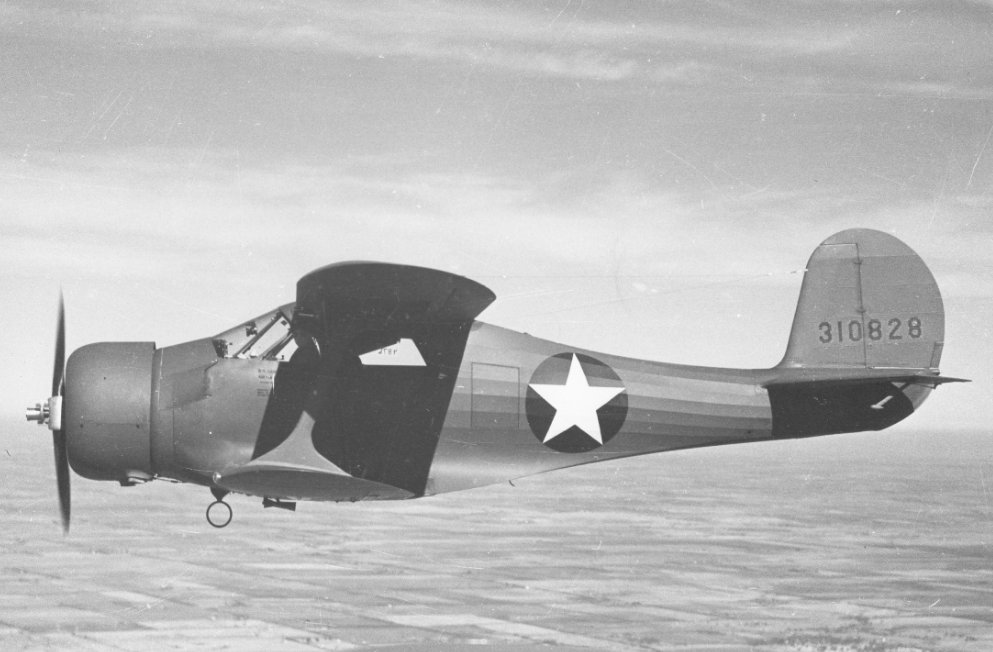
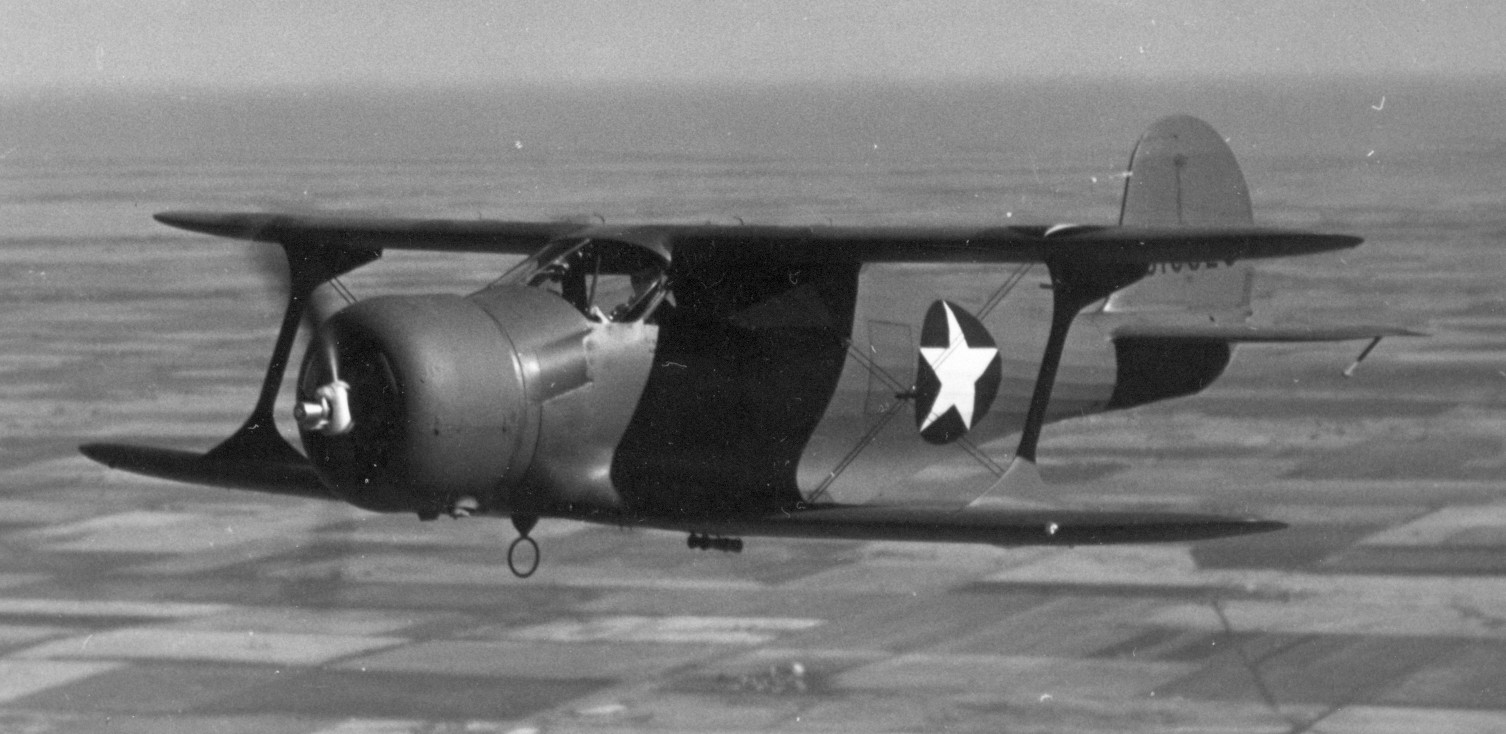
Inflight view of Beech UC-43, USAAF
43-10828. The UC-43 is the same as the Beech D-17S. The Beech 17
is a true classic. B&W, about 84K,
Added 07/07/05.
A second inflight view of Beech UC-43 shown above, USAAF
serial number 43-10828, Beech C/N 4876. The UC-43 is the same as the Beech D-17S. The
Beech 17 is a true classic. B&W, about 211K,
Added 01/21/16.
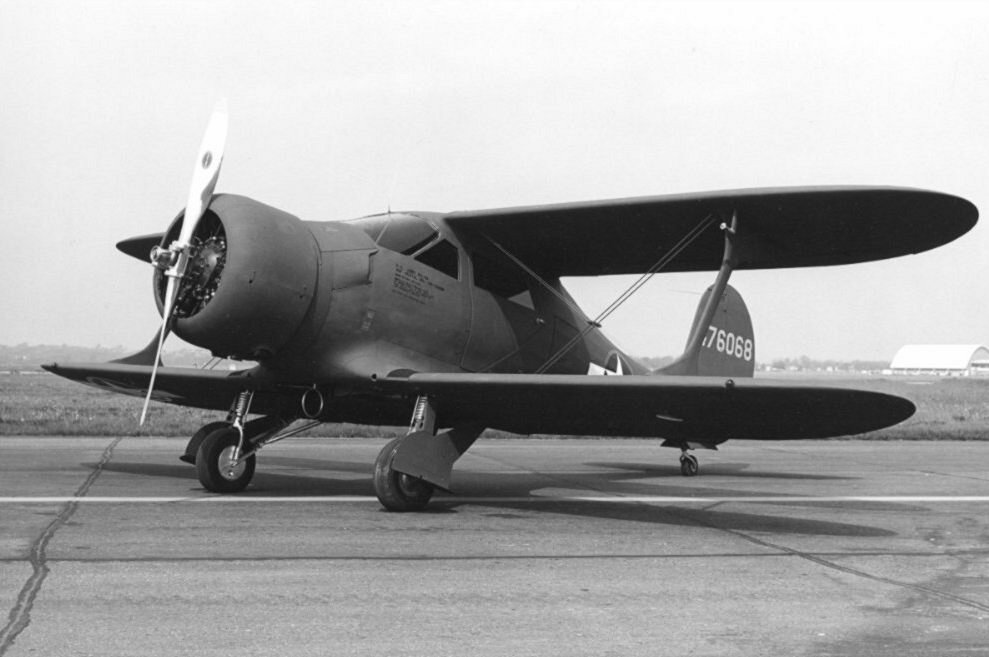
Ground view of Beech
UC-43, USAAF
44-76068. This is Beech construction number 6913, which was
delivered to the U.S. Navy as a GB-2, bureau number of 23733. The
Navy then transferred the airplane to the USAAF as 44-76068.
Aircraft is now part of the National Museum of the United States
Air Force, Wright-Patterson AFB, Ohio. B&W, about 72K,
Added 03/17/07.
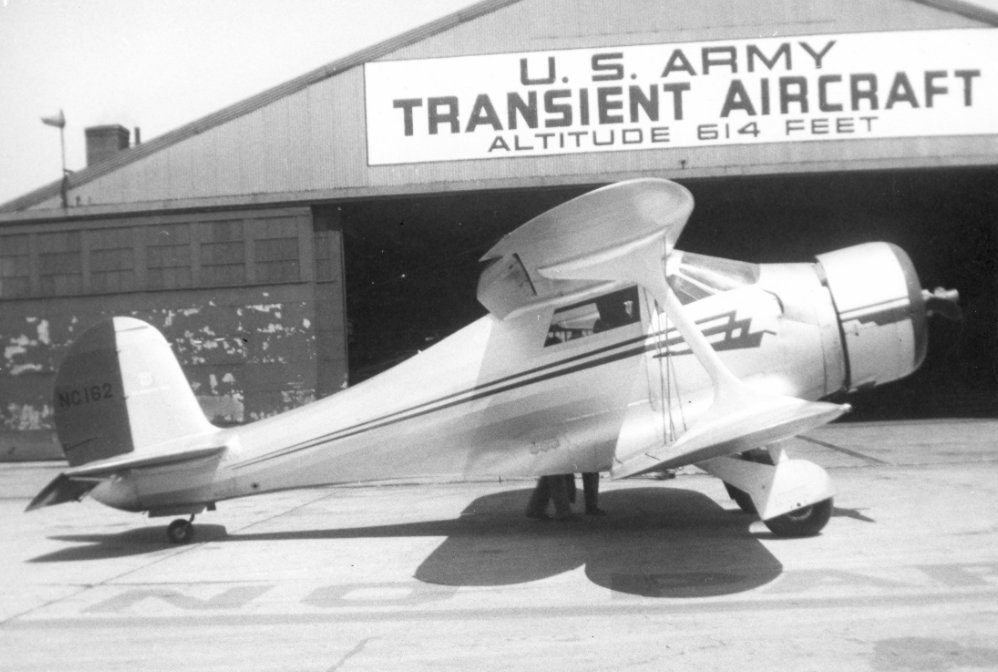
Ground view of Beech
D-17S,
registration NC162. This photo was taken in 1949. The Beech 17 is
a true classic often referred to as the "Staggerwing
Beech" because the top wing is positioned behind the lower
wing. The wing position relationship is seen well in this view.
B&W, about 92K, Added 12/24/05.
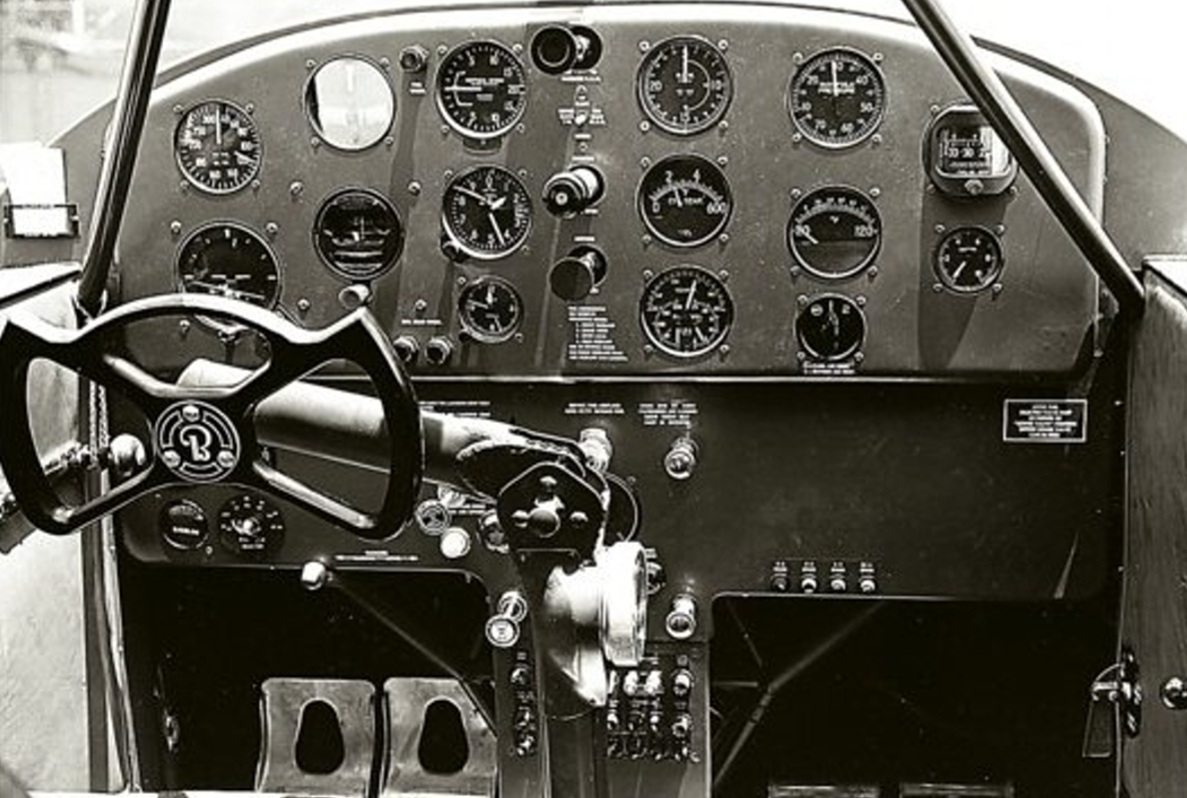
View of a Beech
D-17S Instrument panel. B&W, about 271K,
Added 02/14/07.
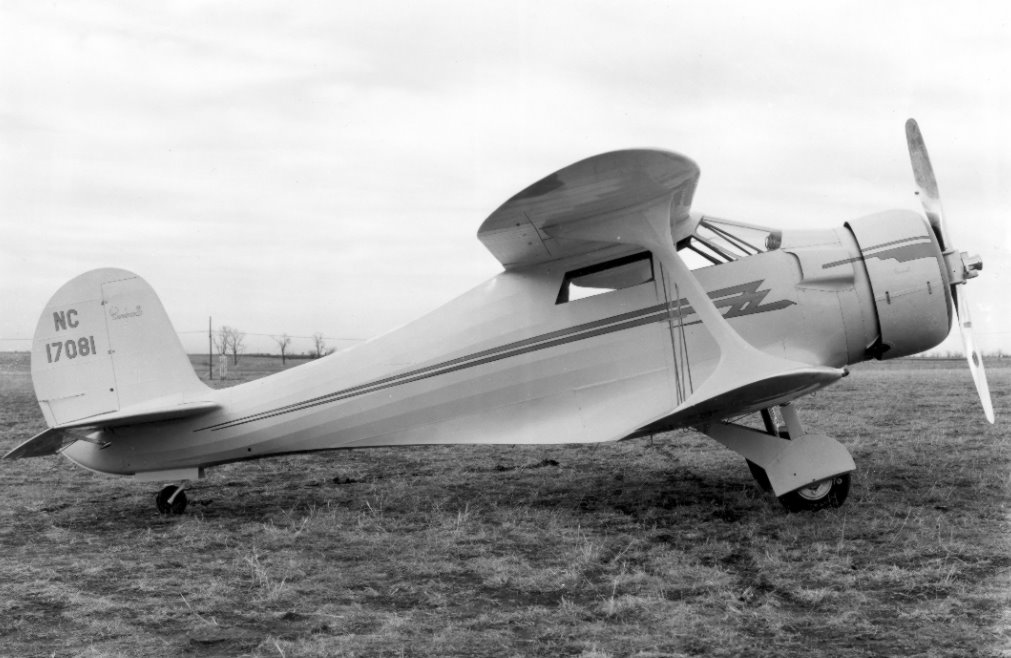
Ground view of Beech
D-17W NC17081.
This is the first of 2 Beech D17W's built, construction
number 136. This airplane was used by Jacqueline Cochran to set a
woman's speed record of 203 mph in June 1937. Later
Jacqueline Cochran flew the other Beech D17W, NX18562, cn 164 to
set a altitude record of 30,052 feet in 1939, as well as other
records. NC17081 was converted by Beech in October 1937 to D17S
standard. B&W, about 99K,
Added 03/01/08.
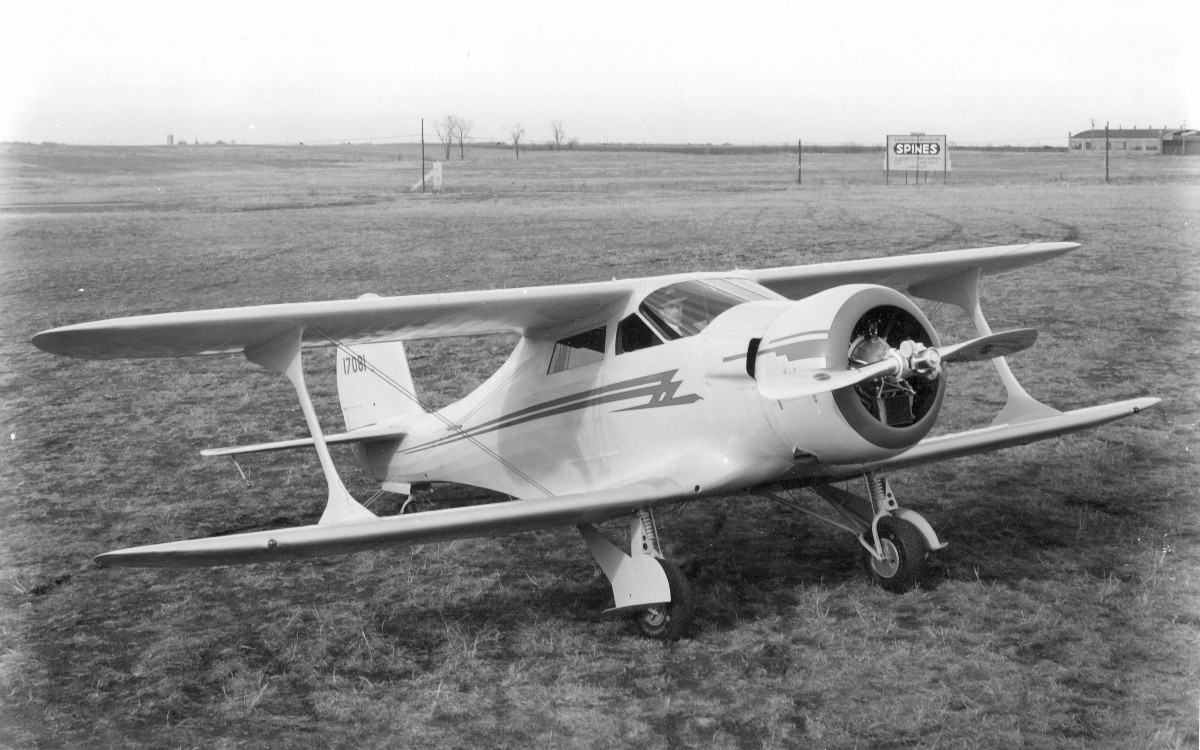
Front 1/2 front ground view of Beech
D-17W, later D-17S NC17081. This airplane was originally built as a Beech
D17W, construction number 136. The D17W used a 600HP P&W R-985 engine.
Note the large scoop on the rear side of the cowling. The Beech photograph I
scanned the image from says the airplane is a D-17S. After this photograph
was taken Beech converted the airplane from a D-17W to a D-17S which uses
a 450HP P&W R-985 engine, same as other D-17S aircraft. B&W, about 221K,
Added 08/01/19.
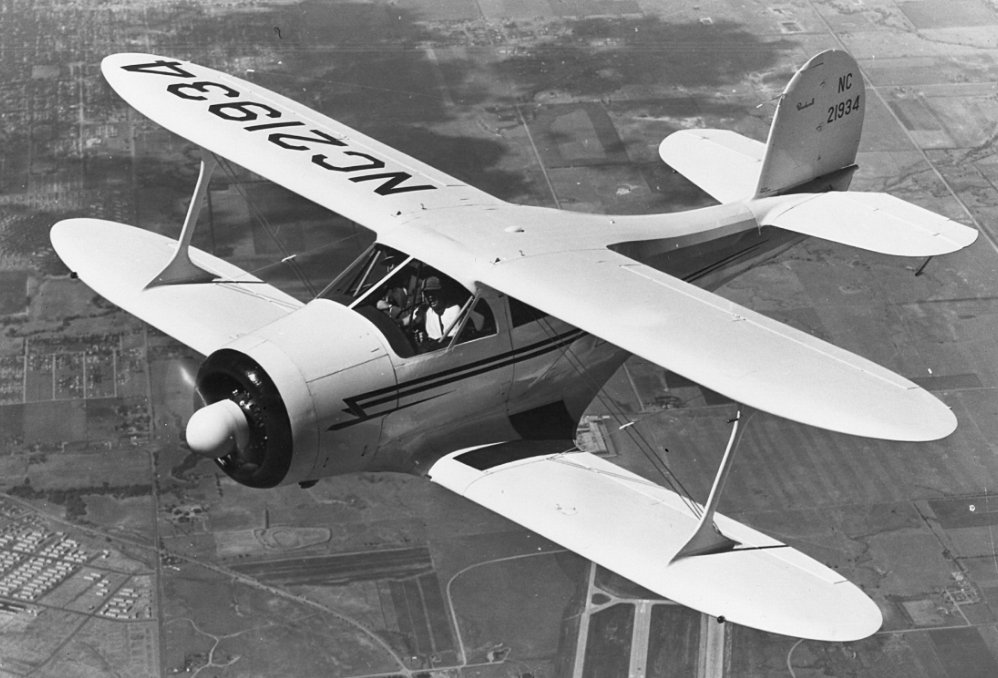
Nice in flight view of Beech
G-17S,
registration NC21934. This airplane began as the last D-17S and
was converted into the prototype G-17S, construction number 424,
still active on the FAA register. B&W, about 118K,
Added 02/02/07.
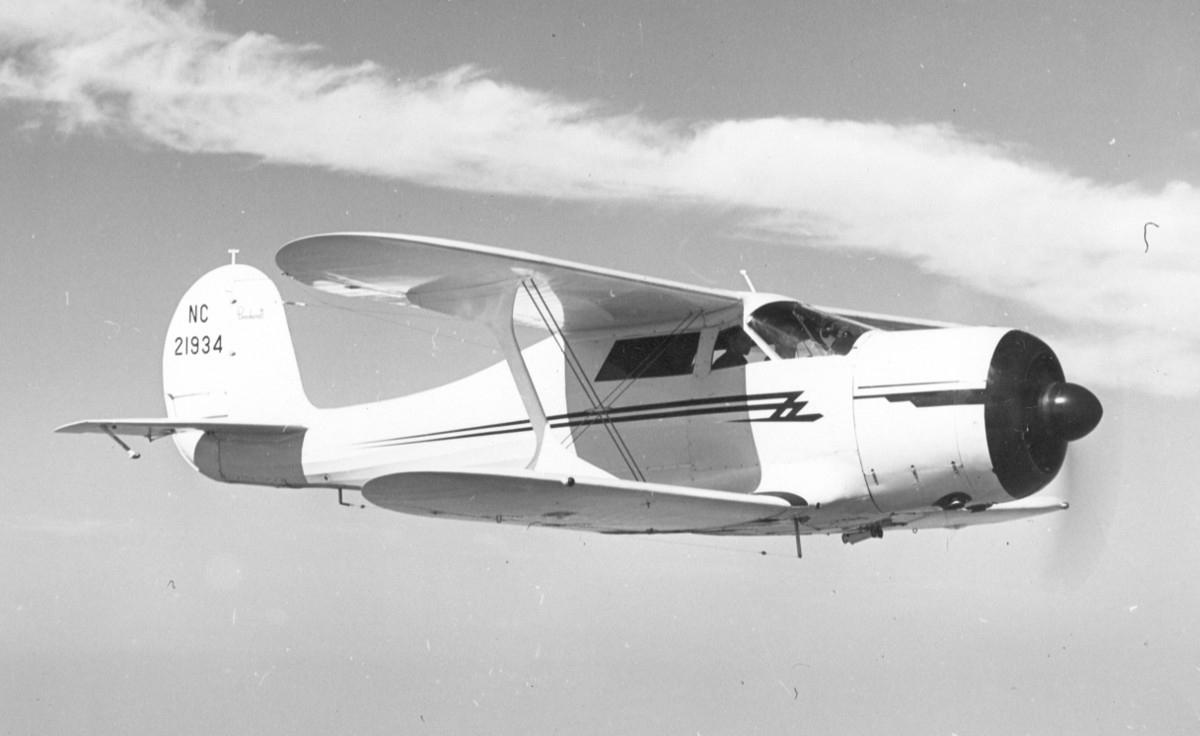
Another in flight view from a different angle of Beech
G-17S,
registration NC21934, c/n 424. B&W, about 111K,
Added 10/01/14.
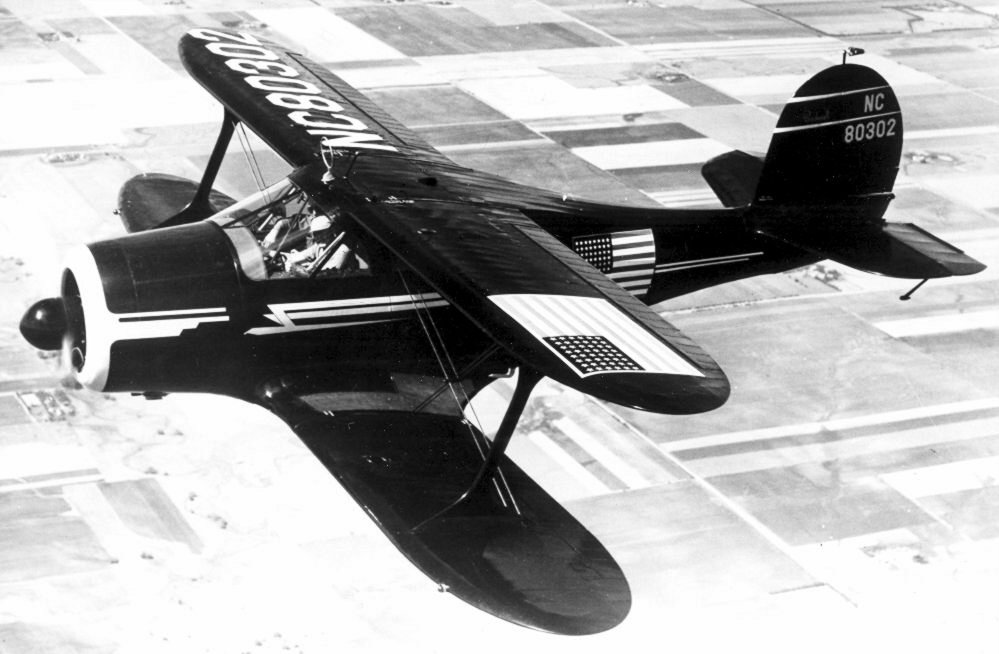
In flight view of Beech G-17S-B1,
registration NC80302. This airplane is the first production Beech
model G-17S, serial number B-1. B&W, about 92K,
Added 05/26/07.
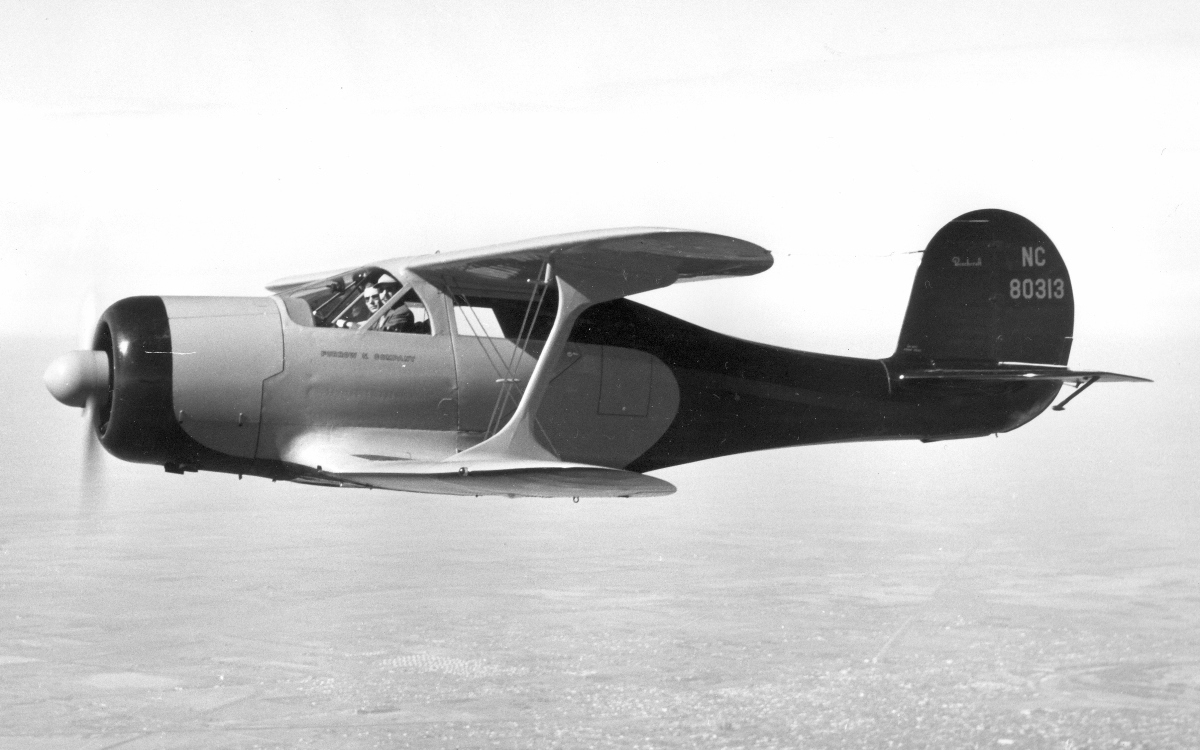
In flight view of Beech G-17S-B12,
registration NC80313. This airplane is Beech model G-17S. B&W,
about 338K, Added 06/01/20.
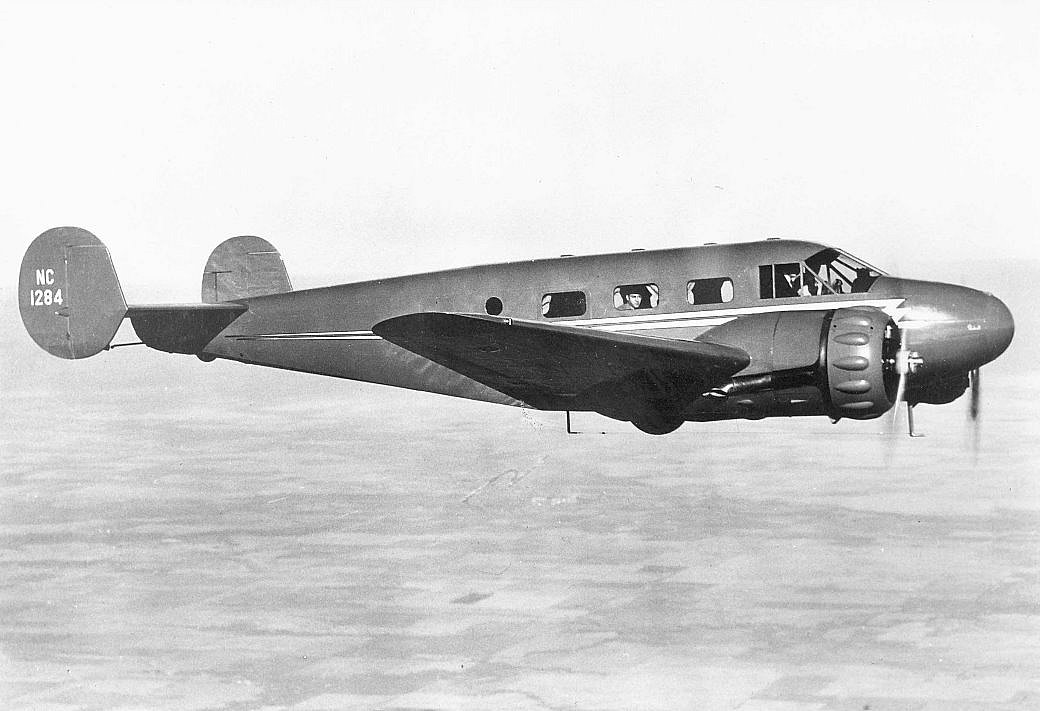
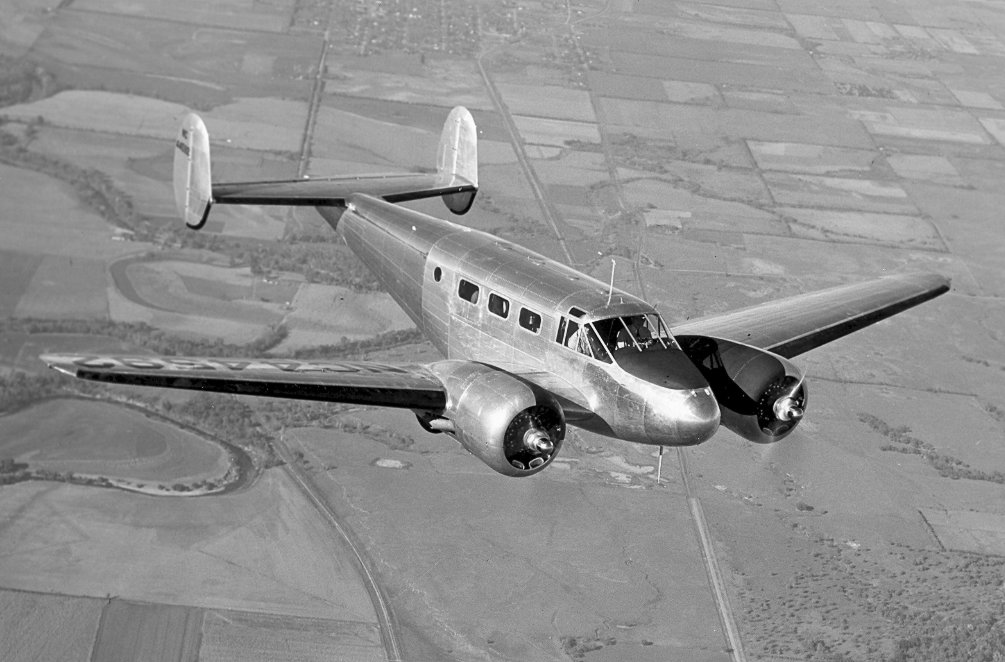
In flight view of Beech
18B, registration
NC1284. This airplane is the fourth of four Beech model 18B
aircraft built by Beech, completed in January 1938. This is
serial number 18B-174. In this view the airplane is equipped with
Jacobs L-5 engines 285HP engines (note the short nacelles). Later
this airplane became a model 18D equipped with Jacobs L-6 engines
of 330 HP each (which have longer engine nacelles). Difference
between this early model 18 and later
aircraft are rounded vertical stabilzers with a longer
aerodynamic balance on the top of the rudder, later model
18's have an elliptical vertical stabilizer/rudder, with a
smaller rudder balance. Early model 18's with Wright and
Jacobs engines have nacelle bumps for the rocker arms. Pratt
& Whitney engined models 18's all have smooth nacelles.
Image is B&W, about 97K,
Added 03/31/10.
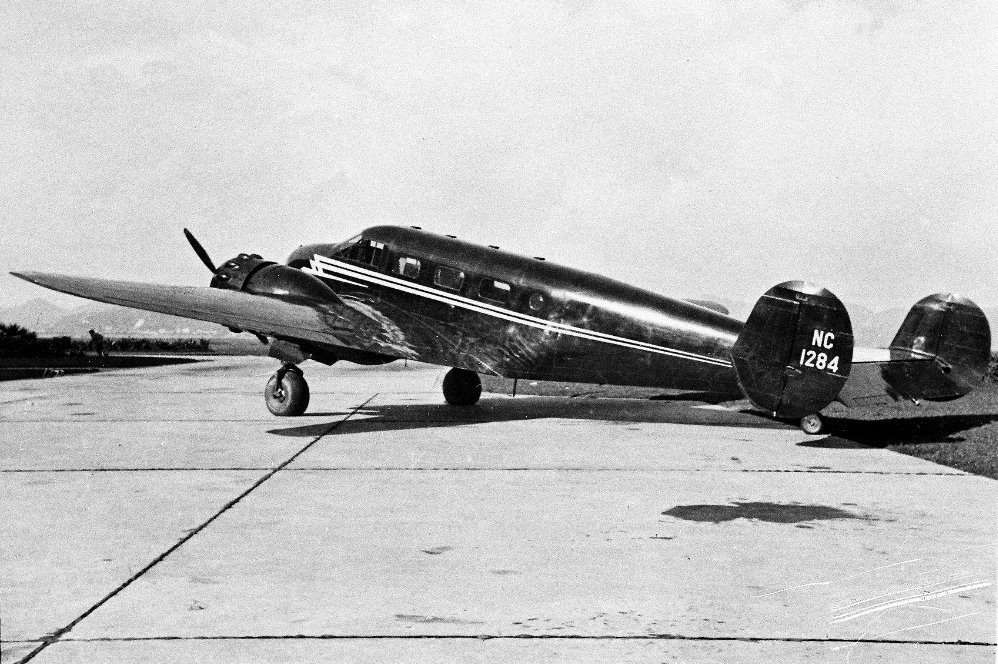
Ground view of Beech
18D, registration
NC1284. This airplane was the fourth of four Beech model 18B
aircraft built by Beech, completed in January 1938. Serial number 18B-174.
Originally this airplane was equipped with Jacobs L-5 engines 285HP engines,
note the short nacelles on the view of this airplane above while still a model
18B. It was involved in an accident on July 11, 1938 in Pennsylvania. When
the airplane was rebuilt it became a model 18D with Jacobs L6 330 HP engines,
keeping the same serial number 174. Note the sightly longer nacelles on this
image versus the image above as a model 18B. Rebuild was complete by January 1939.
On May 18, 1939 the CAA (now the FAA) approved a flight to Rio de Janiero.
The airplane was demonstrated to Brazilian officials until July 17, 1939.
When the airplane got ready to depart back to the U.S. on July 17, 1939, it
hit a fence taking off from Santos Dumont Airport and force landed in Rio de
Janiero Bay with no loss of life. The airplane was raised from the ocean, however
it was damaged so much that it was scrapped. This image shows the airplane in
Rio de Janiero. Photo courtesy of Vito Cedrini
Collection, image is B&W, about 211K,
Added 02/01/13.
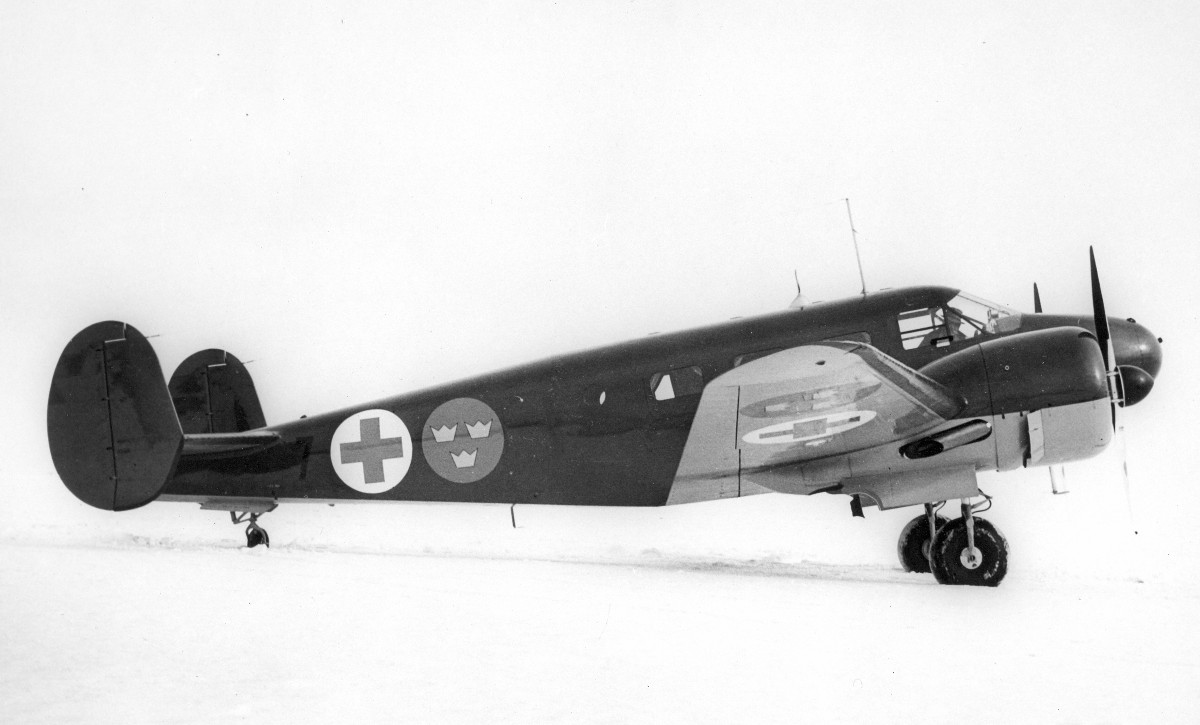
Ground view of Beech model 18R of the Svenska Flygvapnet
(Swedish Air Force), identified in the Swedish Air Force as a Tp 4 with Beech c/n 321.
Airplane was ordered for the Gungliga Flygforvaltningen in late 1939 configured for
medical support. The engines on this airplane were Wright R-975E-3 Whirlwings of 450 HP
each. Airplane could be configured for wheel type landing gear, skis or floats. Photo I
scanned this image from is dated 01/11/1940 indicating this photo was likely taken at the Beech
factory in Wichita. Airplane went by sea to Sweden arriving April 1940. It has wheel landing
gear in this photo and what appears to be about 2 inches of snow on the ground. Later it
received the Swedish civil registration of SE-BTX. Image is B&W, about 117K,
Added 05/01/17.
Ground side view of Beech model 18S-364 the First C-45,
Air Corp serial number 40-180, Beech model 18S-364, c/n 364. Delivered to the Air Corps
January 29, 1940, based at Bolling Field, Washington, D.C. Used by high ranking USAAC
staff, including Henry Harley "Hap" Arnold, Chief of the Air Corps 1938–1941
and later Chief of the U.S.Army Air Force throughout WWII. Beech had earlier built
the Air Corp model F-2 photo reconnaissance version of the model 18. This airplane
was the first of several thousand C-45's for the USAAF and later the USAF.
Fuselage color royal-blue, wings and tail surfaces chrome-yellow.
B&W, about 242K, Added 04/01/20.
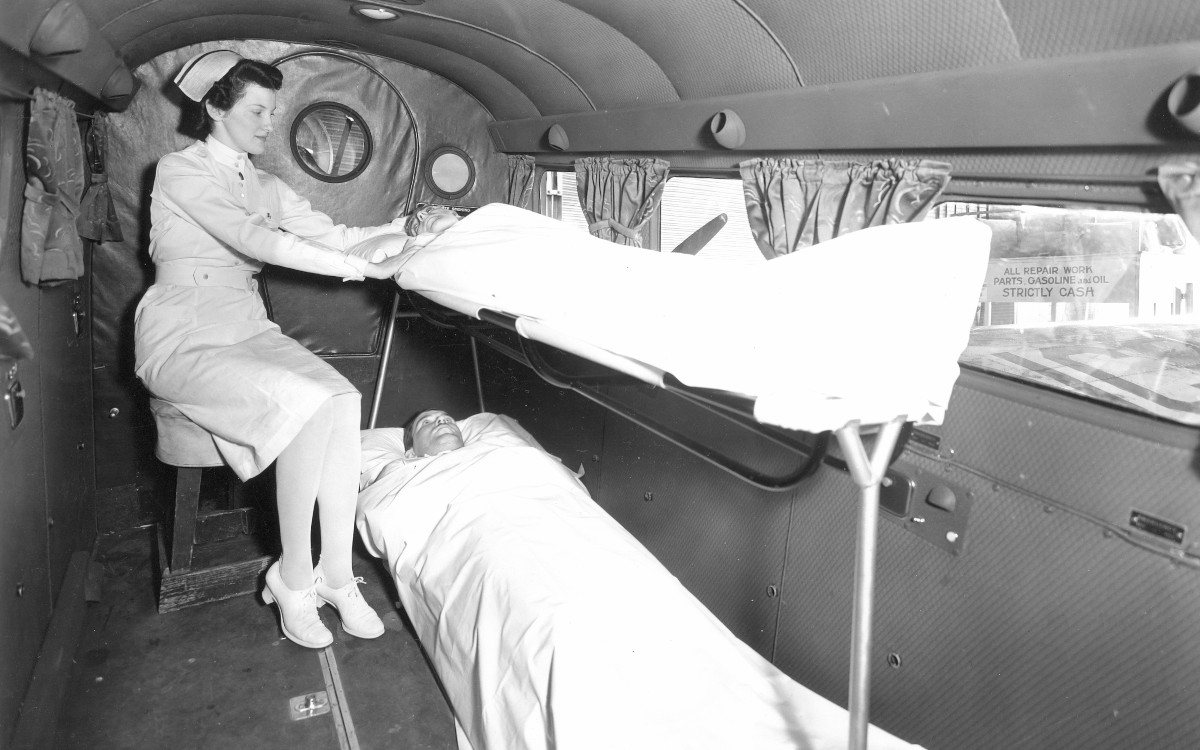
Interior cabin view of Beech model 18 configured as an aerial
ambulance. Registration appears to be NC2????. Two patients on stretchers and nurse
in 1940's nurse dress. Image is B&W, about 176K,
Added 01/27/18.
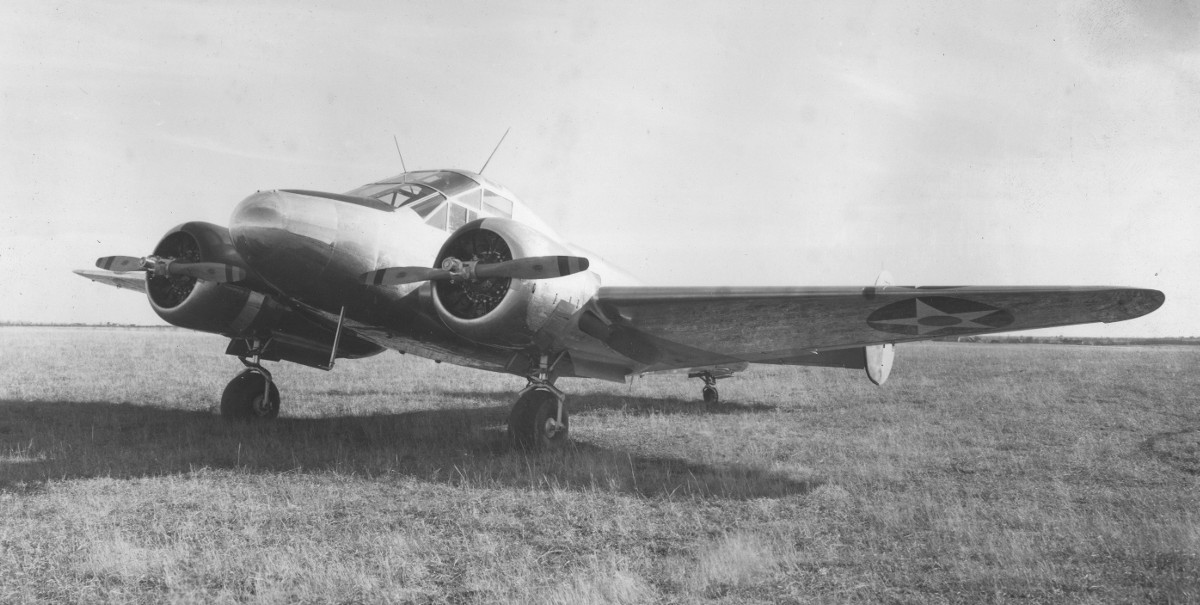
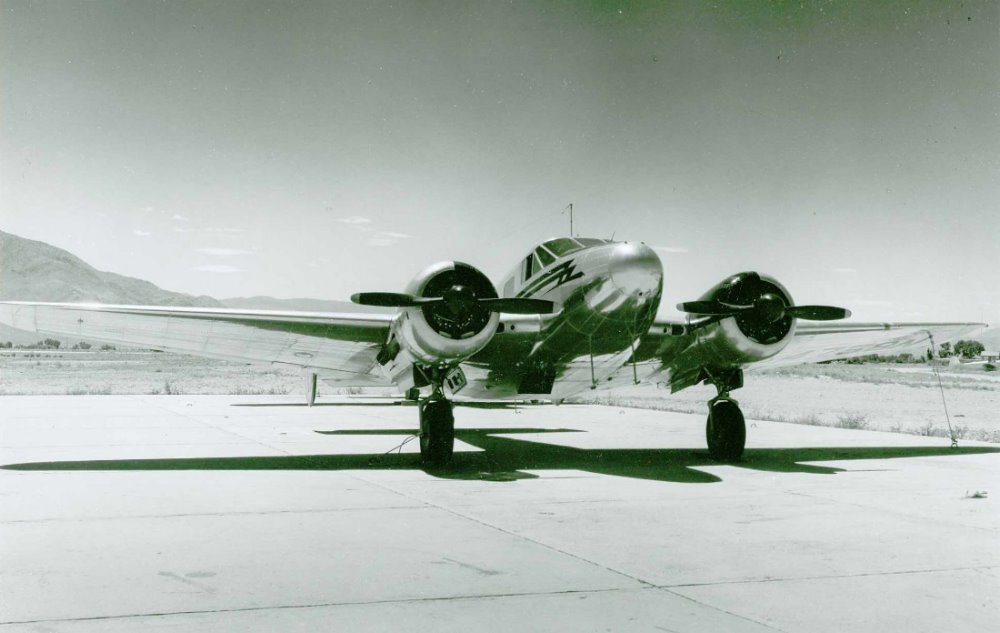
Ground view of U.S. Navy Beech JRB-1. Beech built
11 Navy JRB-1 aircraft with the "cupola" above the cockpit. The cupola was
used so drones could be controlled from JRB-1 with the drone controller having greater
outside visibility. This airplane is part of the first 5 built as it has no spinners
on the propellers. This JRB-1 built in 1940. Image is B&W, about 152K,
Added 04/02/15.
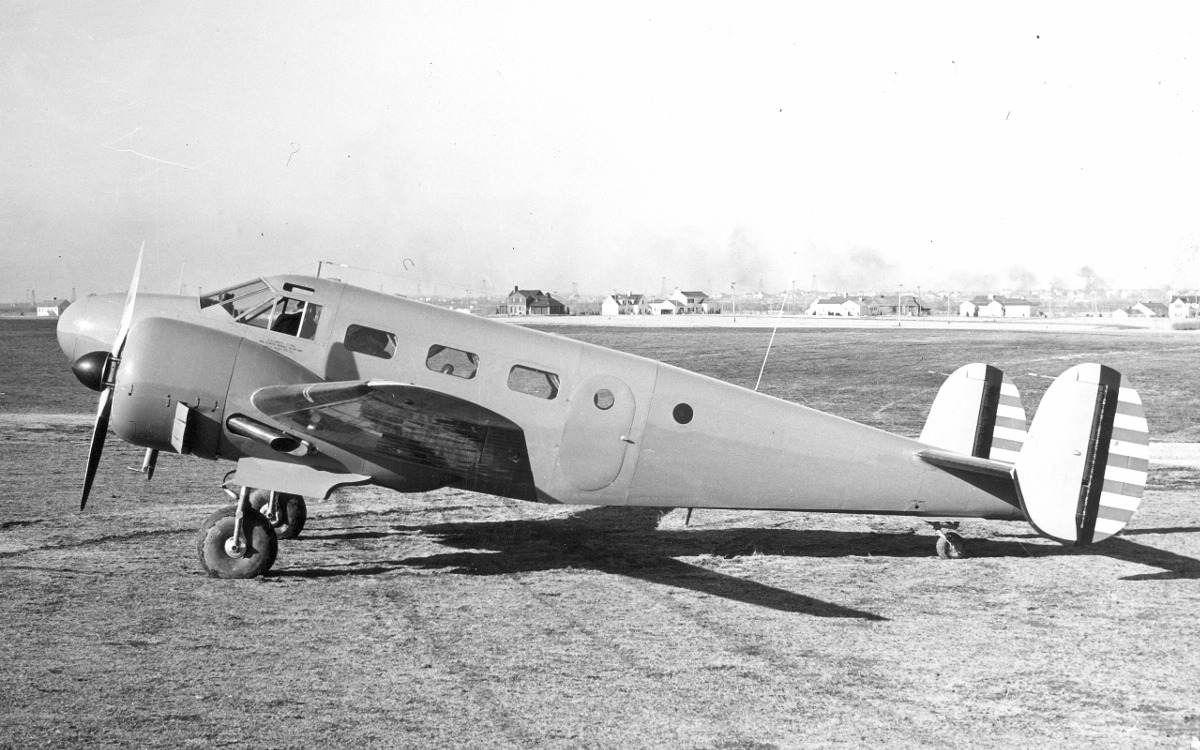
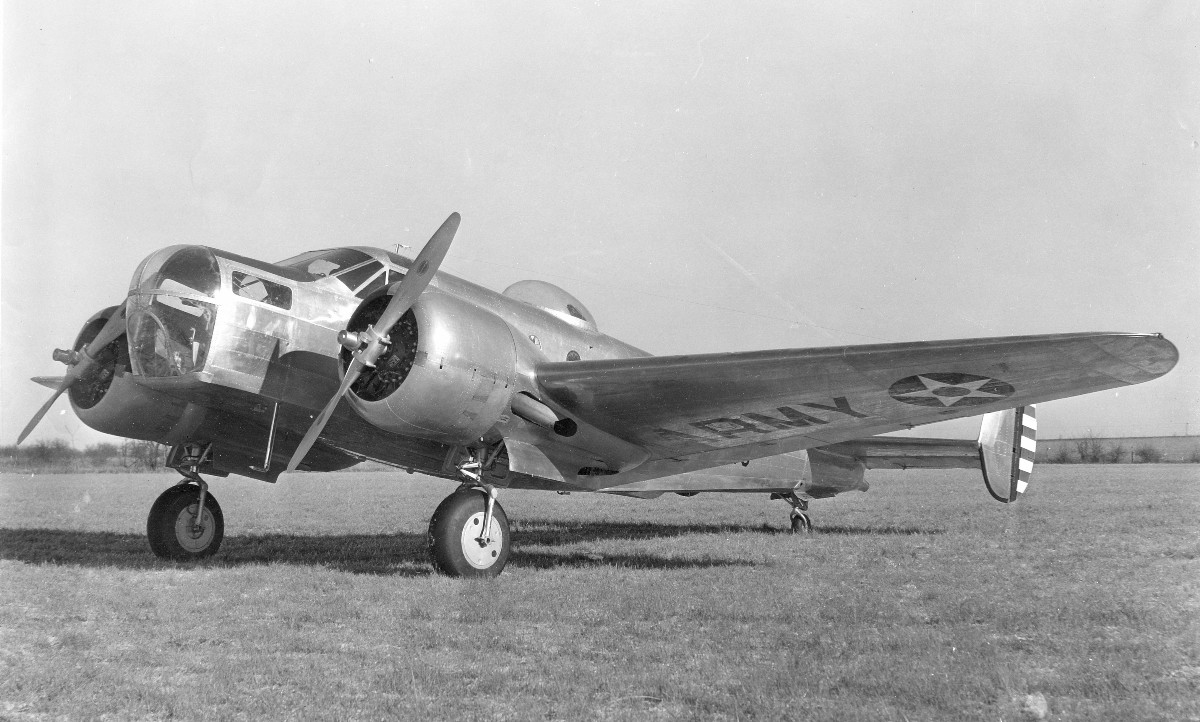
Ground view of U.S.A.A.F. Beech AT-11 Kansan. I'm
unable to see a serial number. Beech first delivered the AT-11 Kansan September 11, 1941,
just before the Japanese attack on Hawaii. The airplane in this photo has rudder stripes
used from 1926 through early 1942. Based on the rudder stripes I believe this is an early
Beech AT-11 Kansan. The tear drop bubble on the top of the fuselage is a Beech machine gun
turrent with a single .30 caliber weapon. The nose of the AT-11 is very different than
most ofther Beech 18's as the primary purpose of the AT-11 was to train bombardiers
during WWII. Image is B&W, about 215K,
Added 05/01/17.
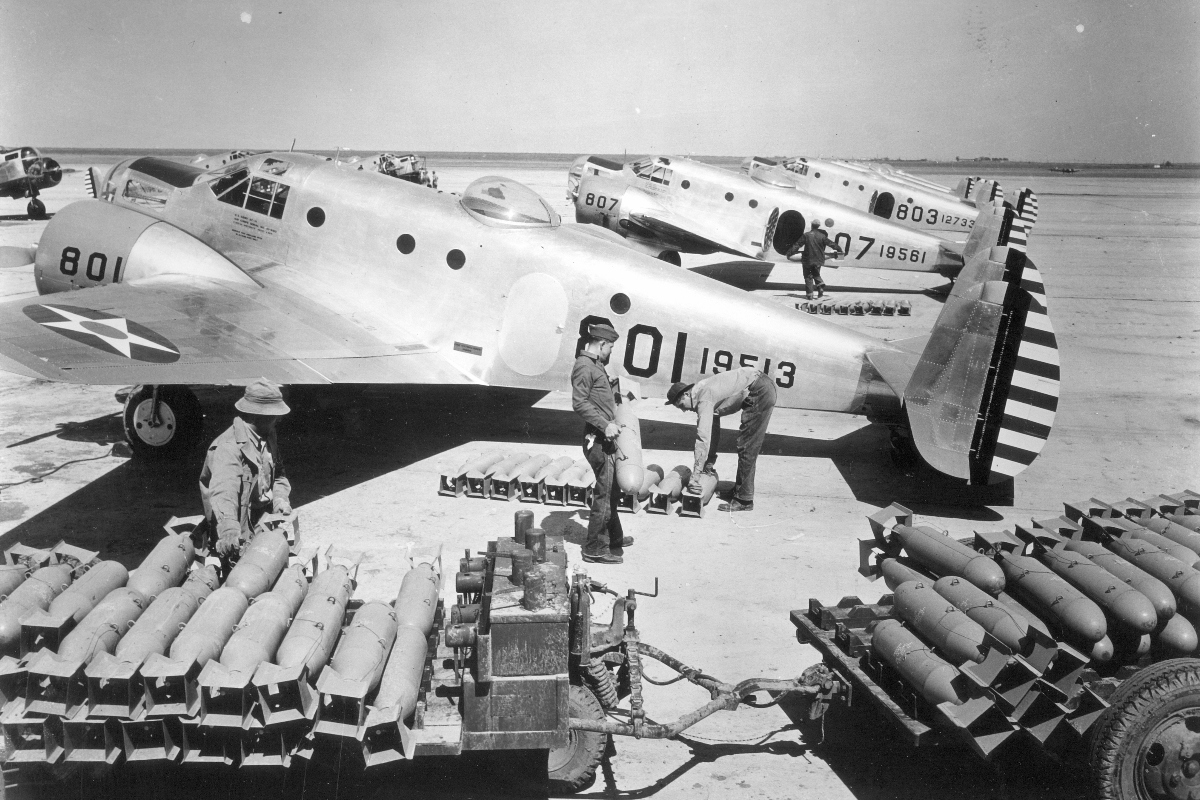
View of Bomb loading a U.S.A.A.F. Beech AT-11 Kansan.
Near airplane is USAAF serial number 41-9513, Beech c/n 939. Believe this photo was taken in
early 1942 at Victorville Army Air Force Base. This airplane survived WWII, then as part of the
program to update USAF Beech model 18's it was rebuilt by Beech into a C45H, USAF serial
number 52-10691, Beech c/n number AF-621. The AT-11 carried 10 of these 100 pound bombs
for bombadier training missions. Image is B&W, about 535K,
Added 07/01/25.
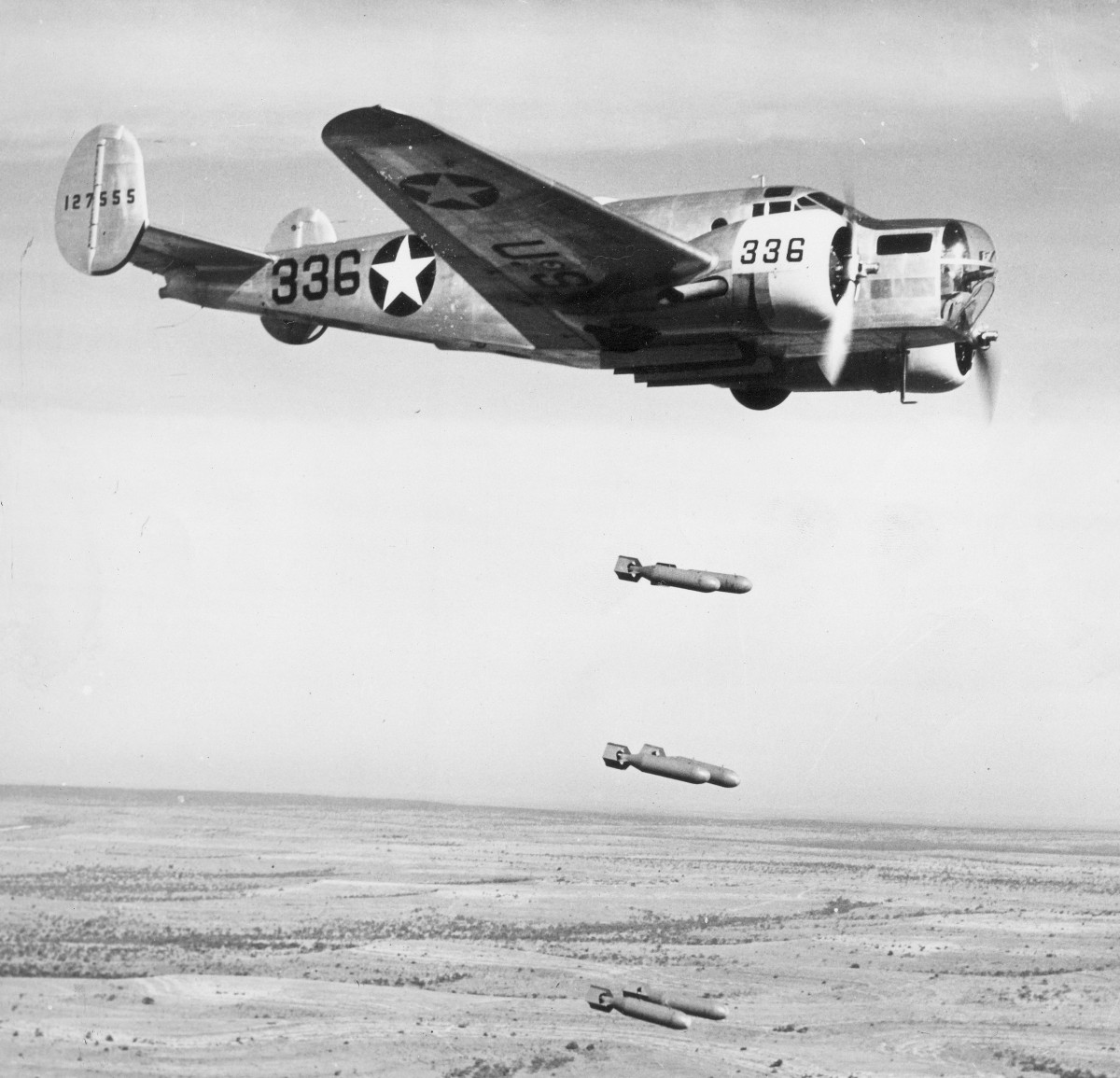
Inflight view of U.S.A.A.F. Beech AT-11 Kansan dropping
practice bombs during WWII. USAAF serial number is 41-27555, Beech c/n 1400. Airplane
has the bomb bay doors open, was droppping the bombs over the Midland Bombardier School bomb
range in West Texas. Image is B&W, about 236K, Added 10/22/18.
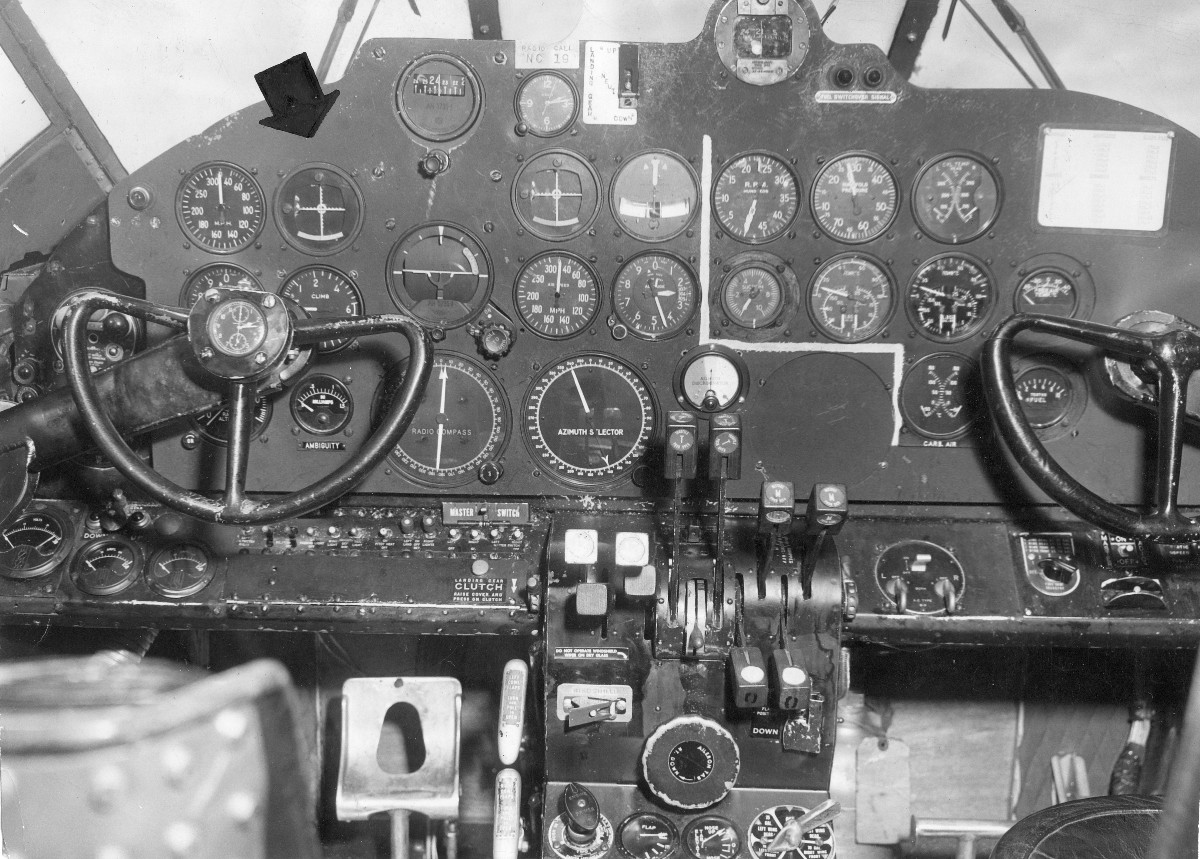
View of Instrument Panel of U.S.A.A.F. Beech AT-7C
Navigator, serial number 43-33628, c/n 6263, manufactured in 1944. When this photo was taken this
airplane was being flown by the C.A.A. registered NC19, later N19. This Beech 18 has the
first type control wheel. Image is B&W, about 307K,
Added 05/01/17.
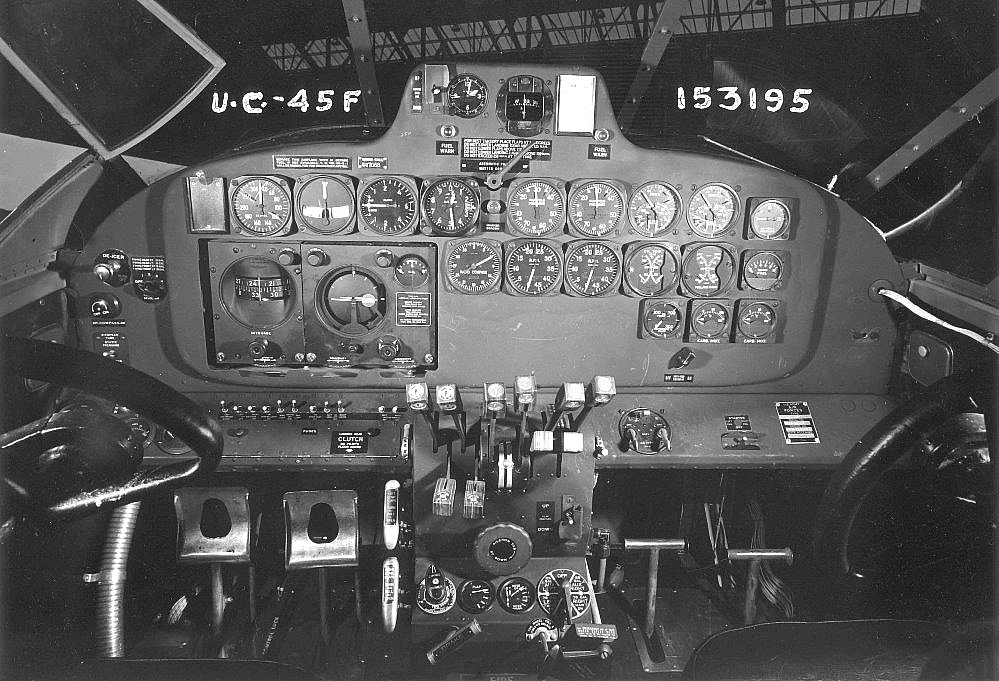
Instrument panel view of
UC-45F USAAF serial number 44-47068. Note this Beech 18 has the original type
control wheel. Beech equipped the C-45's with "Bow
Tie" type control wheels beginning with USAAF serial number
44-47651. The Bow Tie type control wheel then remained the
standard for model 17 and model 18. B&W, about 162K,
Added 08/01/10.
Ground view of a Beech 18 built for the USAAF as a C-45F, with cn
8440, USAAF serial number 44-87181. After WWII ended the airplane
was given to the California Department of Fish and Game, at which
time the civil registration of NC4758N was assigned and the
airplane identified on the registry as a C-18S, the equivilant
civil model to the C-45F. Here is a view of Beech
C-18S N4758N.
This airplane is current on the FAA register, owned by the same
company since 1977. Note the main landing gear forks which are
welded, while later Beech 18's have an arched formed fork.
Also note the large spinners, these were used with Hamilton
Standard constant speed, but not feathering propellers. Some
USAAF Beech 18's had Aeroproducts full feathering propellers,
but the CAA required these be replaced before civil
certification. Later the USAAF, then the USAF, removed the
Aeroproducts propellers and replaced them with Hamilton Standard
Hydromatic full feathering propellers, which became the most
common propeller on Beech 18's. B&W, about 75K,
Added 05/17/09.
Inflight view of the first post WWII built Beech
D-18S, NC44592,
serial number A-1. B&W, about 113K,
Added 02/02/07.
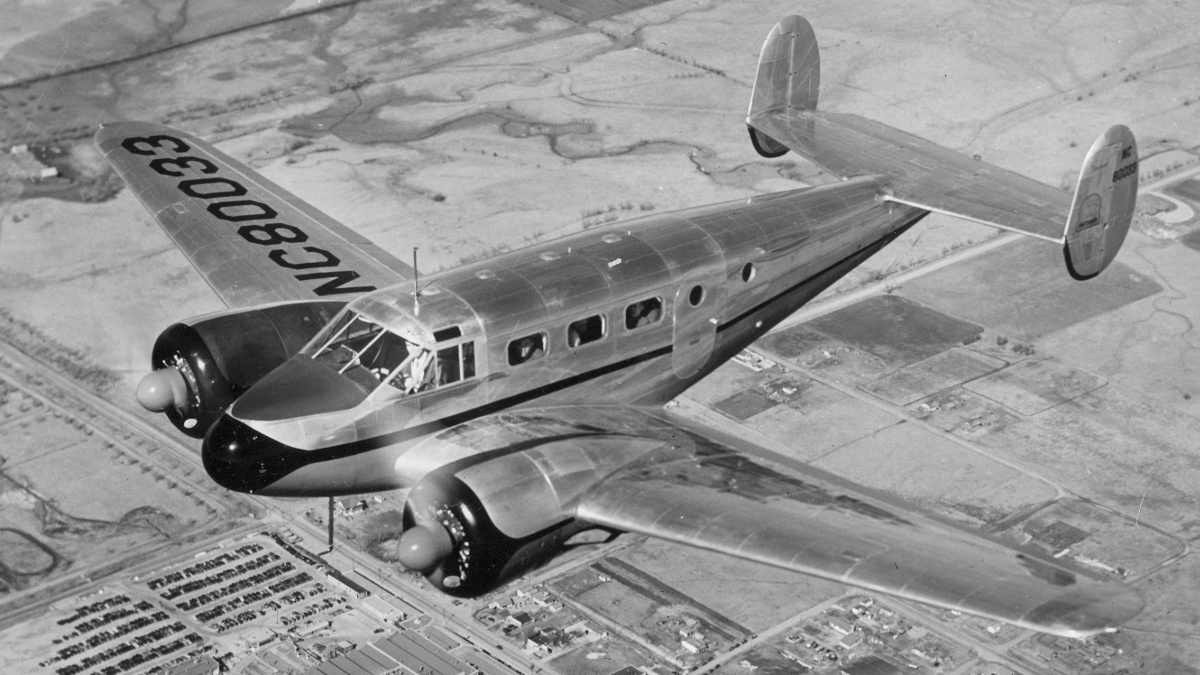
Inflight view of the first post WWII built Beech
D-18S, NC80033, serial number A-93, manufactured in 1946,
photographed over the Beech factory in Wichita, Kansas.
Airplane later registered N84M. B&W, about 412K,
Added 04/01/17.
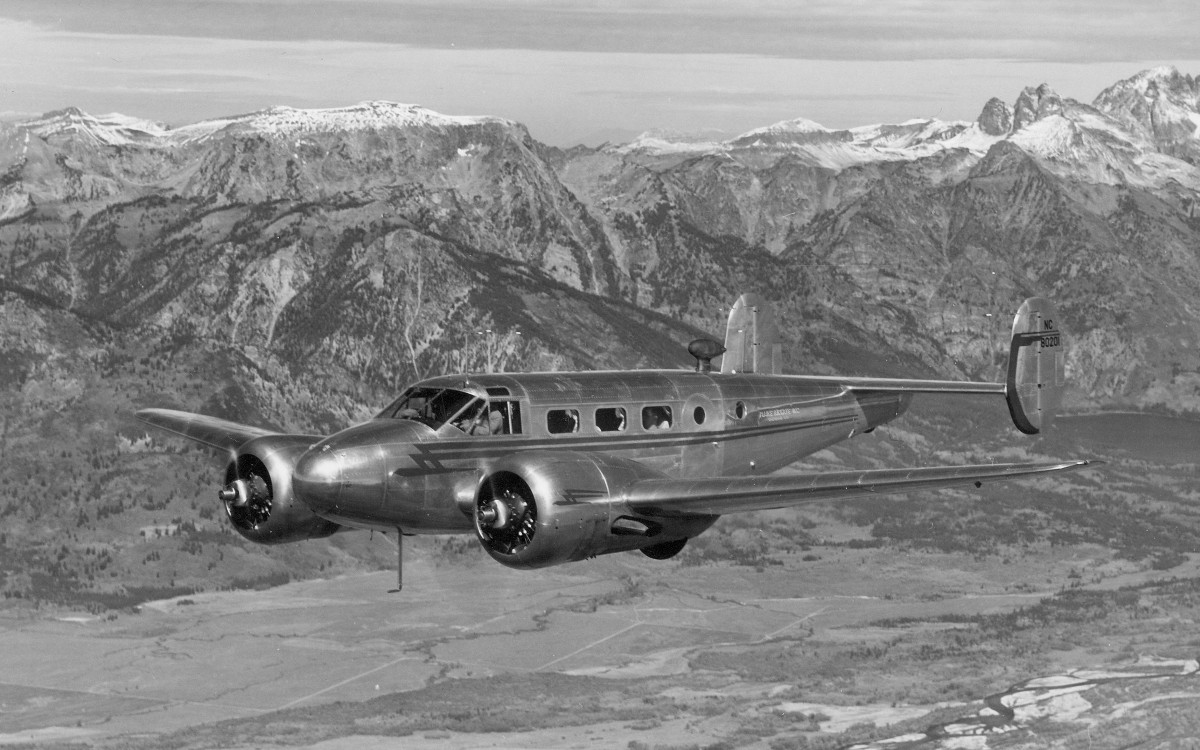
Beautiful inflight view of a Beech
D-18S near mountains, NC80201, serial number A-178, manufactured
in 1946. On the FAA register until Nov. 2012. B&W, about 223K.
Added 01/27/18.
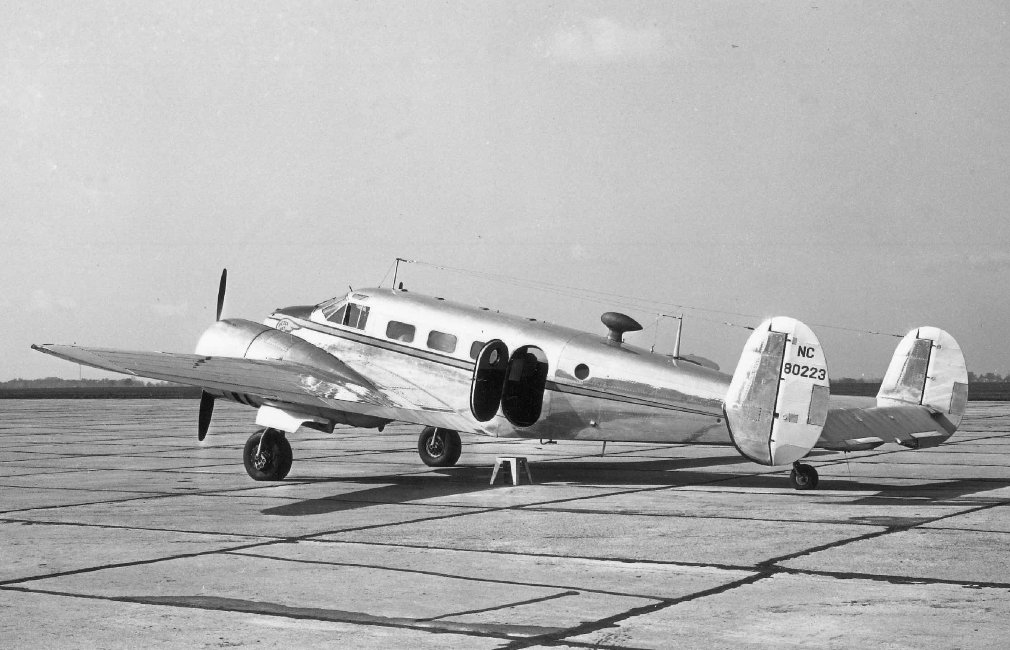
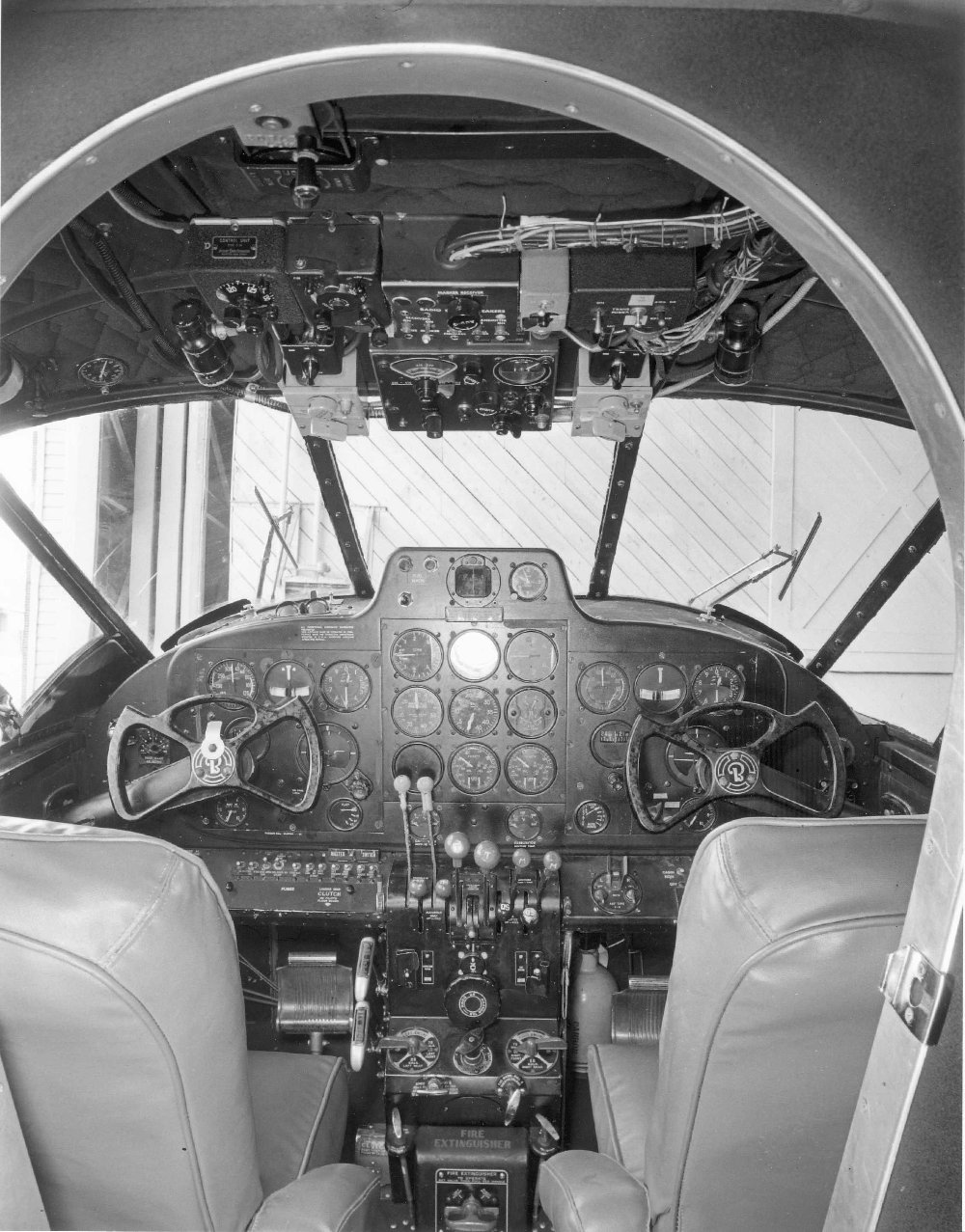
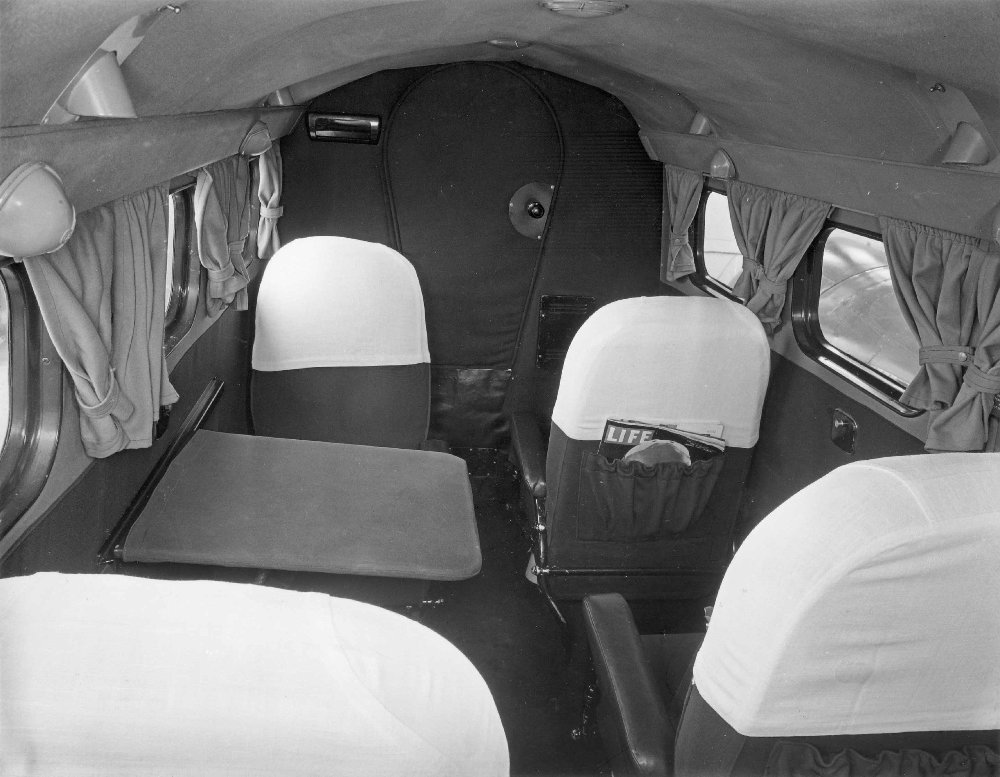
Ground view of Beech
D-18S NC80223,
serial number A-203. This view shows the standard entry door. Frequently
owners installed an "airstair" door in place of the standard door.
Instrument panel view of Beech D-18S NC80223.
This image shows the pilot's control wheels as installed at the
factory. Many times today the control wheels are installed upside
down for better instrument visibility. Radio controls are
overhead, all tunable radios.
Passenger cabin view of Beech D-18S NC80223.
The photographs were taken in 1949.
All images B&W, about 122K, 259K and 116K respectively,
Added 08/19/13.
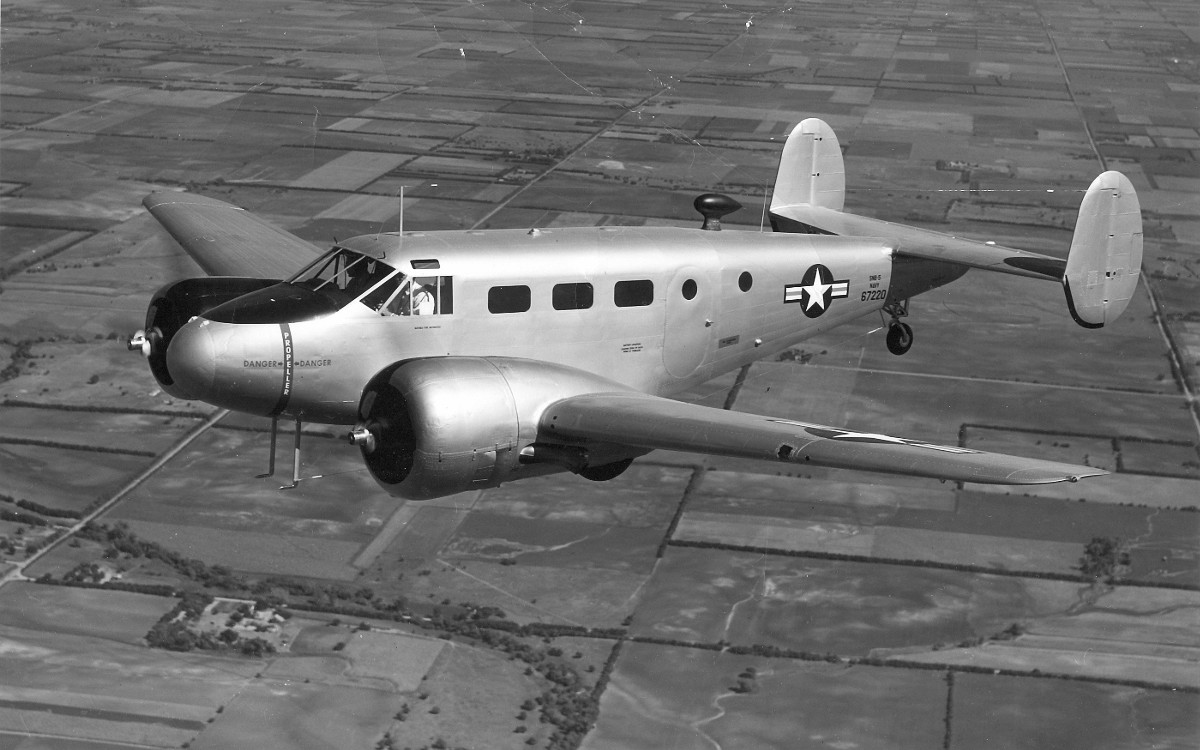
Inflight view of a Navy Beech
SNB-5, bureau number 67220, beech c/n 6209. Airplane was originally
manufactured as a SNB-3, remanufactured to SNB-5 standards Oct. 1950.
Later to the U.S. FAA civil register as N91254, canceled from the FAA
register on 09/25/1970. B&W, about 178K,
Added 01/27/18.
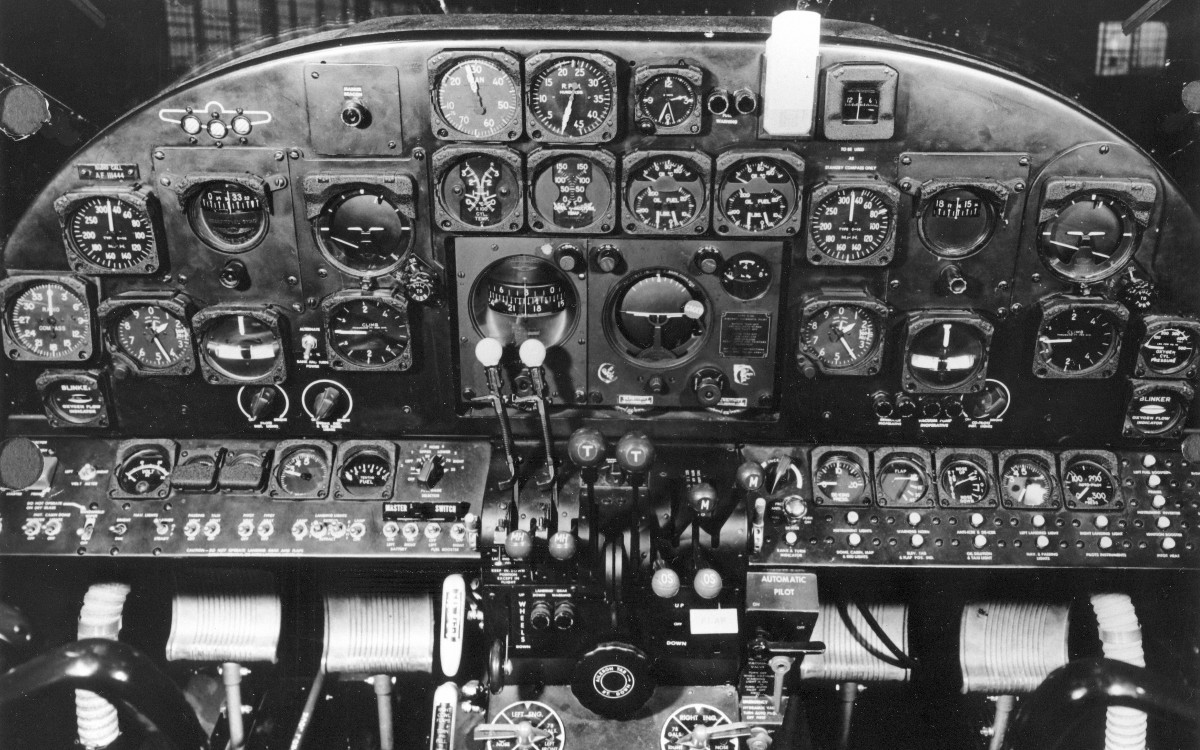
Instrument panel view of a USAF Beech
C-45G, serial number 51-11444, c/n AF-1. Aircraft
originally built by Beech as an AT-7C USAAF s/n 43-33420,
remanufactured by Beech into C-45G with USAF s/n 51-11444.
Later withdrawn from USAF service, first registered N7250C,
then later reregistered N80323 which is still valid on the
FAA register. B&W, about 292K,
Added 12/06/19.
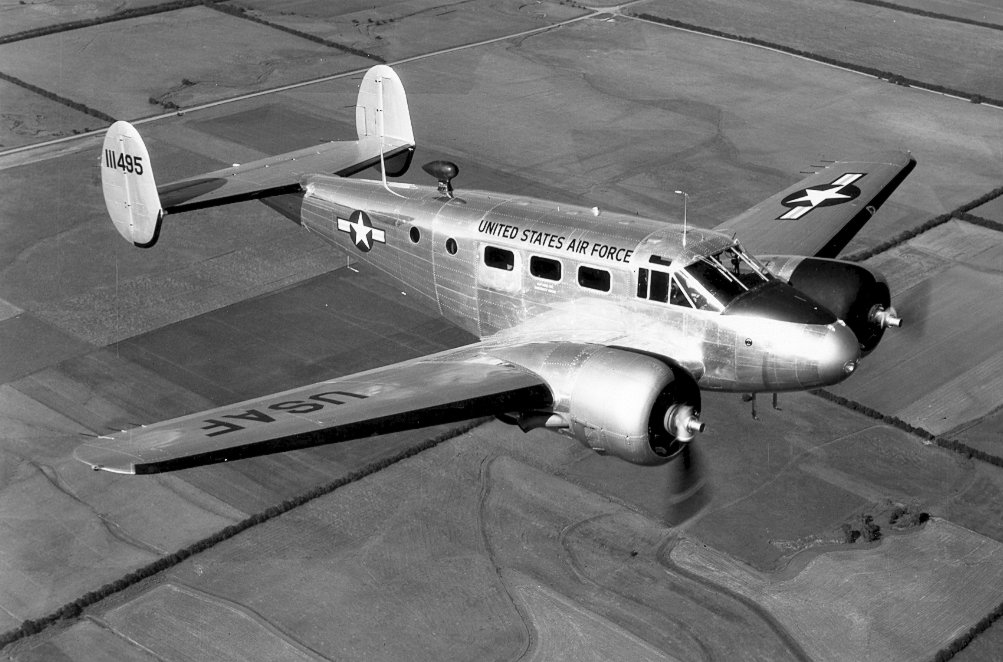
Inflight view of a USAF Beech
C-45G, serial
number 51-11495, serial number AF-52. The Beech C-45G is the
military version of the model 18. The C-45G was a World War II
remanufactured C-45, AT-7 or AT-11. A heavier center section, and
extended upper nacelles distinguished the remanufactured model
18. The C-45G had a Jack and Heinz autopilot, and Aero Products
propellers. Beech remanufactured 372 into C-45G configuration.
B&W, about 128K,
Added 02/03/07.
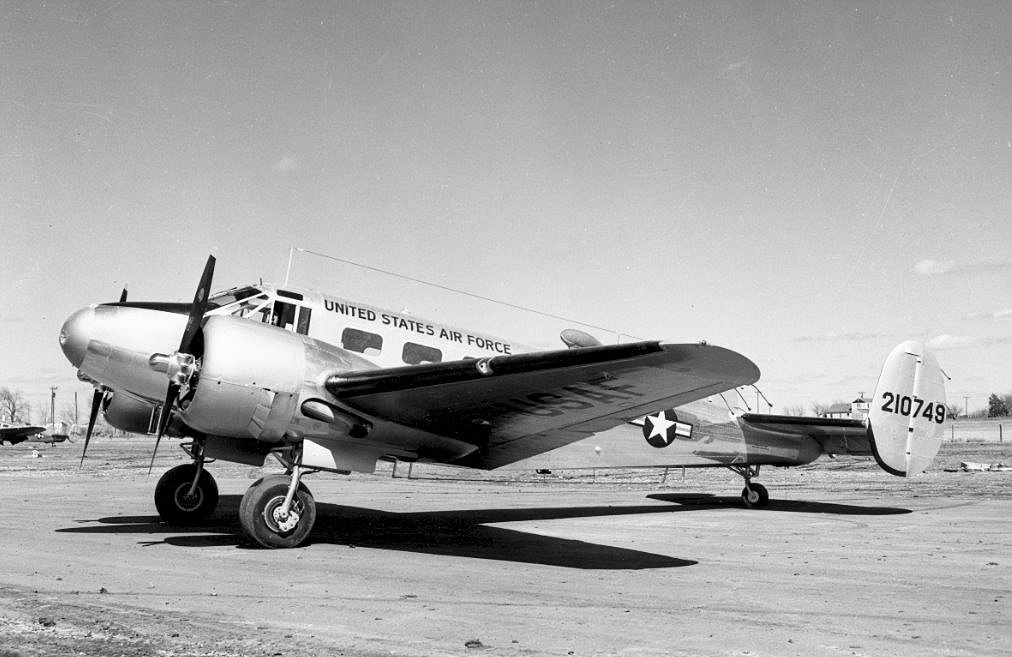
Ground view of a USAF Beech
C-45H, serial
number 52-10749, serial number AF-679. This Beech C-45H is on the
FAA register as N9593Z. Like the C-45G, the C-45H was a
remanufactured World War II C-45. Differences between the G and H
model, the H had no auto pilot, and Hamilton Standard propellers
were used. Beech remanufactured 432 aircraft into C-45H
configuration. B&W, about 94K,
Added 03/01/08.
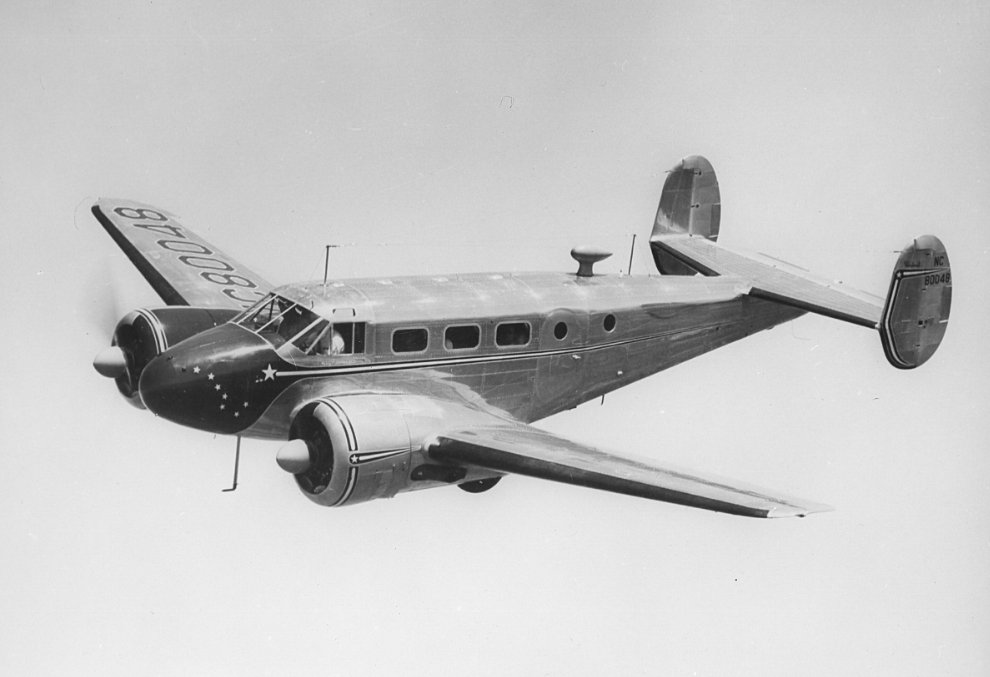
Inflight view of a Beech
D-18S, NC80048,
serial number A-109. Paint scheme has the Big Dipper and the
North Star on the nose. Airplane first owend by Virginia Coal and
Iron Company. A photograph of this airplane appeared on the cover
of the Beech D-18S 1947 brochure. B&W, about 60K,
Added 04/11/99.
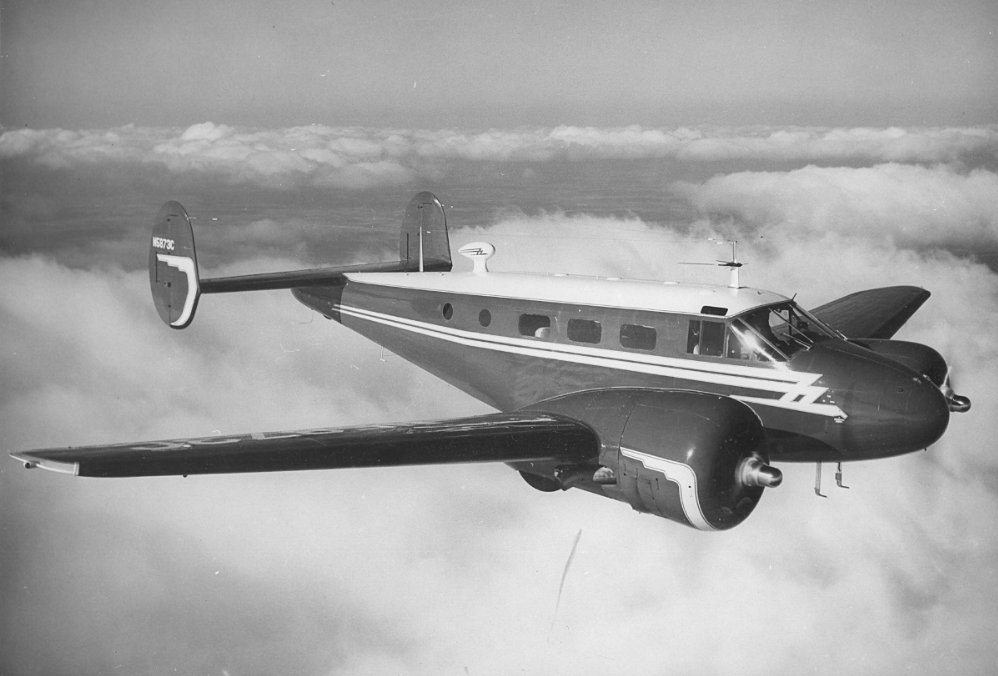
Inflight view of Beech
D-18S, N5873C.
The Beech 18 is a favorite of mine. This is serial number A-578.
Note the top of the cabin which is painted white. This is done to
keep the cabin cooler by reflecting the sun. This airplane is
current on the FAA register as N224A. B&W, about 79K,
Added 04/11/99.
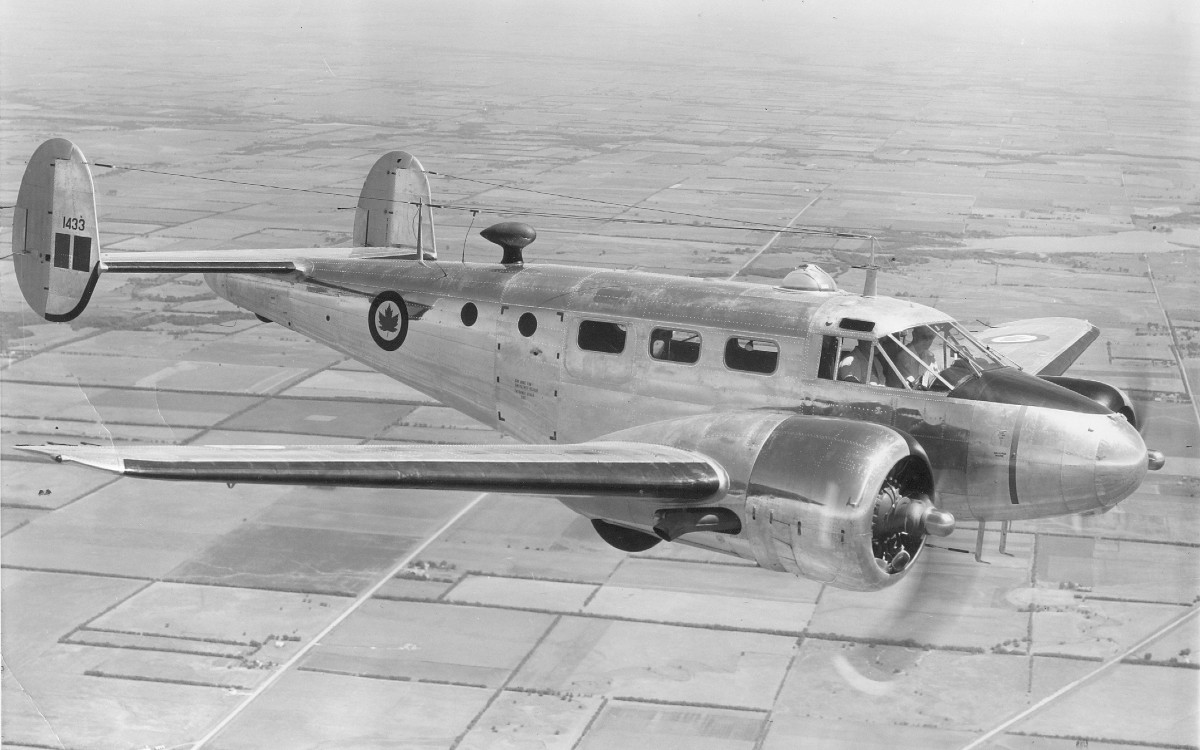
Inflight view of Royal Candian Air Force
Beech 3N Expeditor. RCAF number 1433, Beech c/n A-618, RCAF c/n CA-18,
manufactured in 1951. Beginning in 1951 Beech built 280 model D-18S
aircraft for the RCAF as the model 3N, 3NM and 3TM Expeditor. As shown
in this image the model 3N had an astrodome as a navigational trainer
and seats for two trainees. 99 model 3N were built. The model
3NM with the interior changed so the navigational trainee positions
could be removed and 5 seats installed. 135 model 3NM aircraft built.
Beech built 46 model 3TM with five cabin seats and provisions for
installing the astrodome and wiring installed to easily change the
airplane to a navigational trainer. B&W, about 183K,
Added 08/29/18.
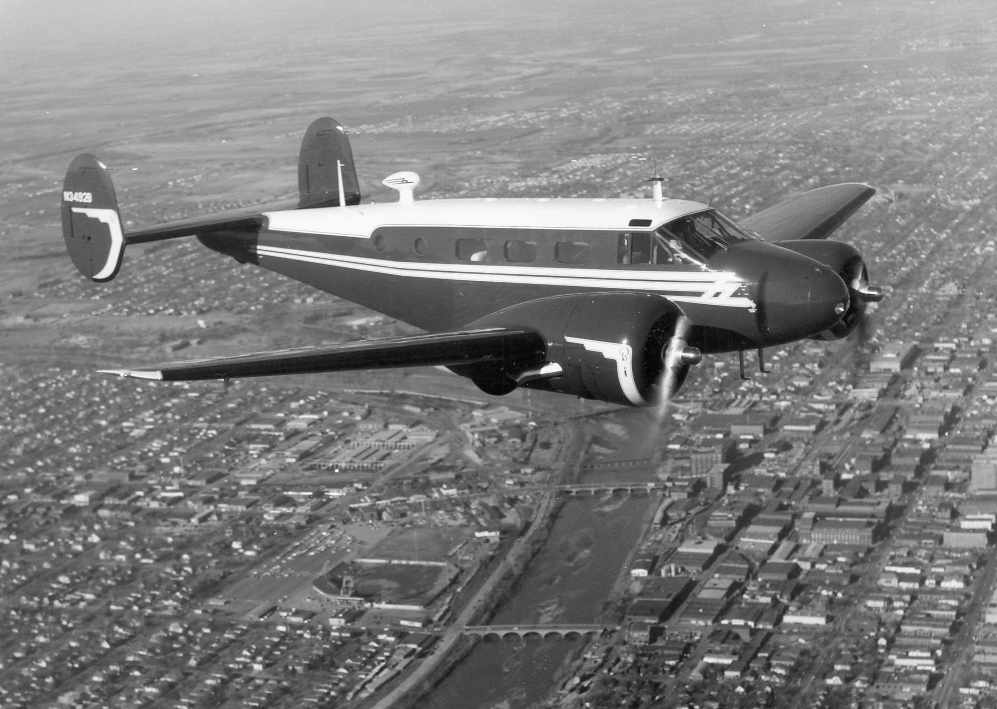
Inflight view of Beech
D-18S, N3492B,
serial number A-992, built in 1953, one of the last D-18S manufactured.
Cabin top continues painted white, although slightly different than
N5873C above. This airplane is current on the FAA register as N171DC.
B&W, about 66K,
Added 03/20/13.
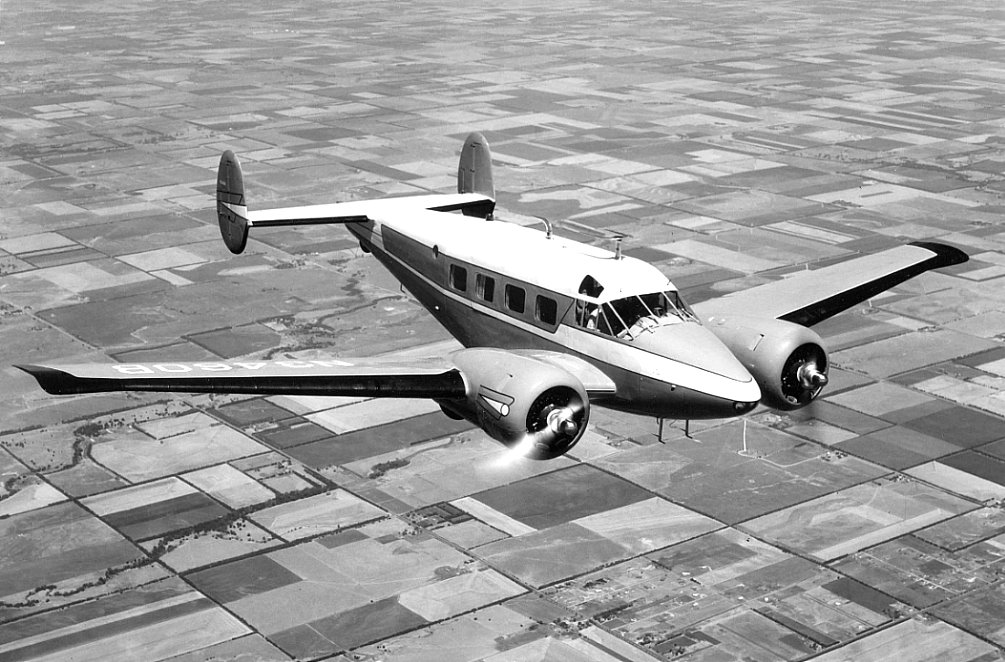
Inflight view of a 1954
Beech E-18S,
N3460B, c/n BA-1. Note the 6 inches of Added height of the cabin introduced
with the "E" model, the first "Super 18." In
addition to the extra cabin height, the E-18S incorporated a
lengthened strut for the tail wheel, raised horizontal
stabilizer, needle nose, with redesigned, lengthened and cambered
wing tips. All these changes made a much better handling
airplane, especially at take-off and landing, with a higher
cruise speed even at a higher gross weight. Serial number is
BA-1, the first Beech E-18S. My thanks to
Mike Ramsey, e-mail
Mikeabi@webtv.net
for providing me with an
understanding of the improvements in the "E" model
Beech 18. B&W, about 155K, Added 1/1/02,
updated 10/13/02.
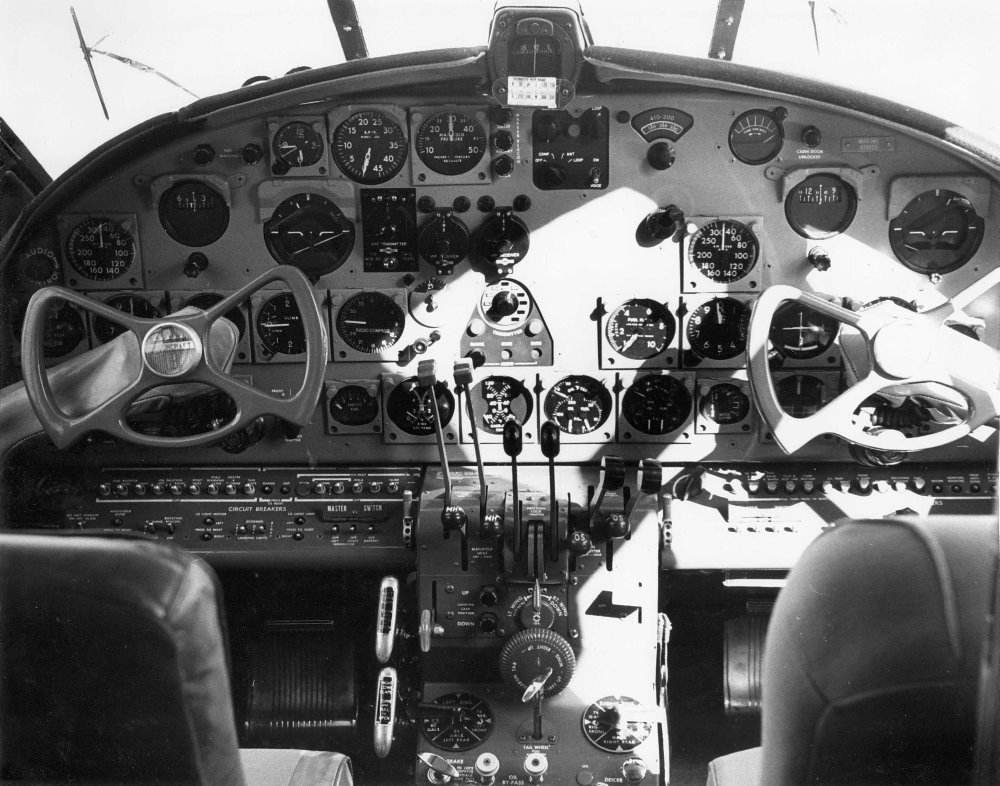
Instrument panel
of the first Beech E-18S, N3460B.
B&W, about 161K.
Added 01/01/02.
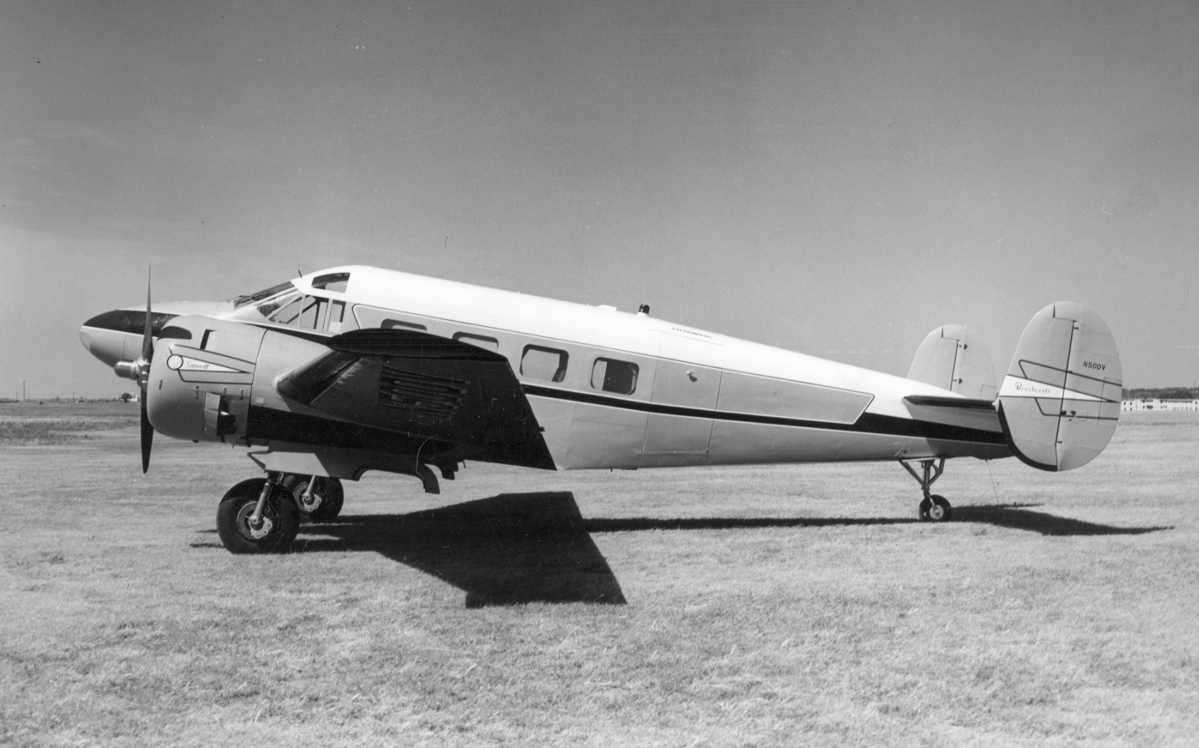
Ground side
view of Beech E-18S, N500V, c/n BA-2. This view shows to good
effect the higher cabin, longer nose, the raised tail wheel, and the
entrance door which is now larger and square of the Super 18.
B&W, about 452K. Added 03/01/25.
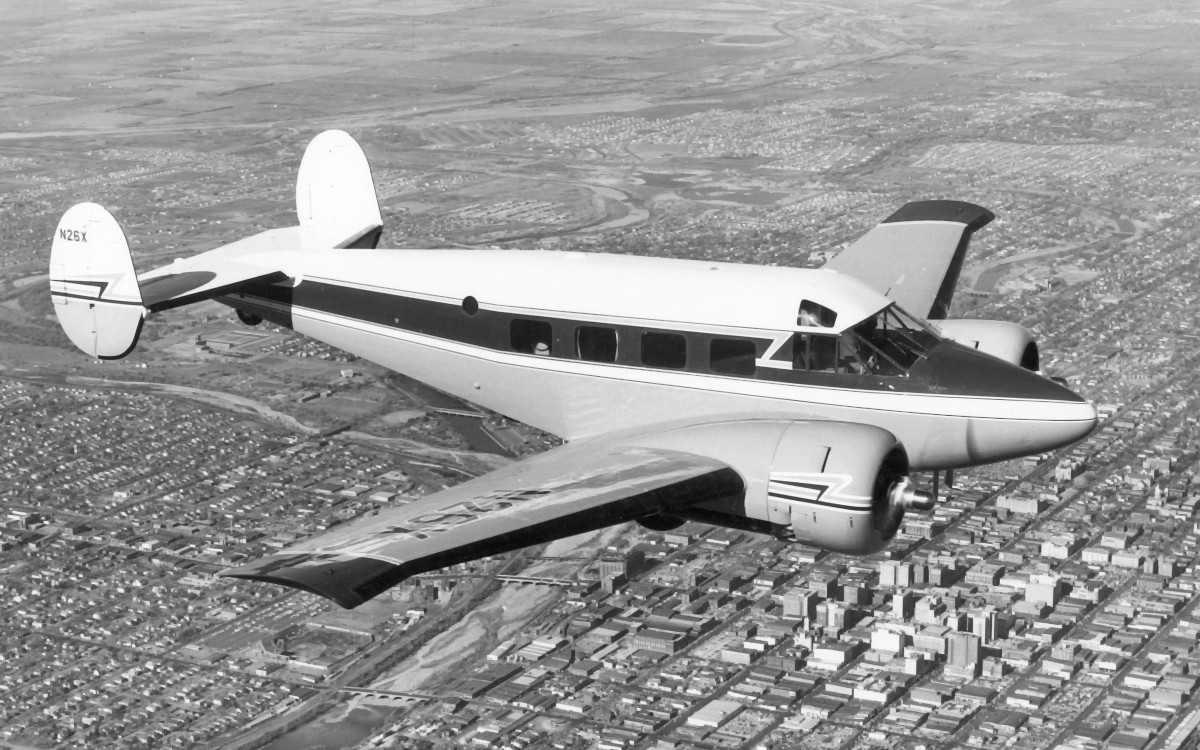
Inflight side view of a 1957
Beech E-18S, N26X, serial number BA-227. This airplane
has carried other registrations as N1400E and the FAA says N418Z at
some point. Airplane carries the 1957 Super E18S paint scheme.
B&W, about 258K, Added 11/01/18.
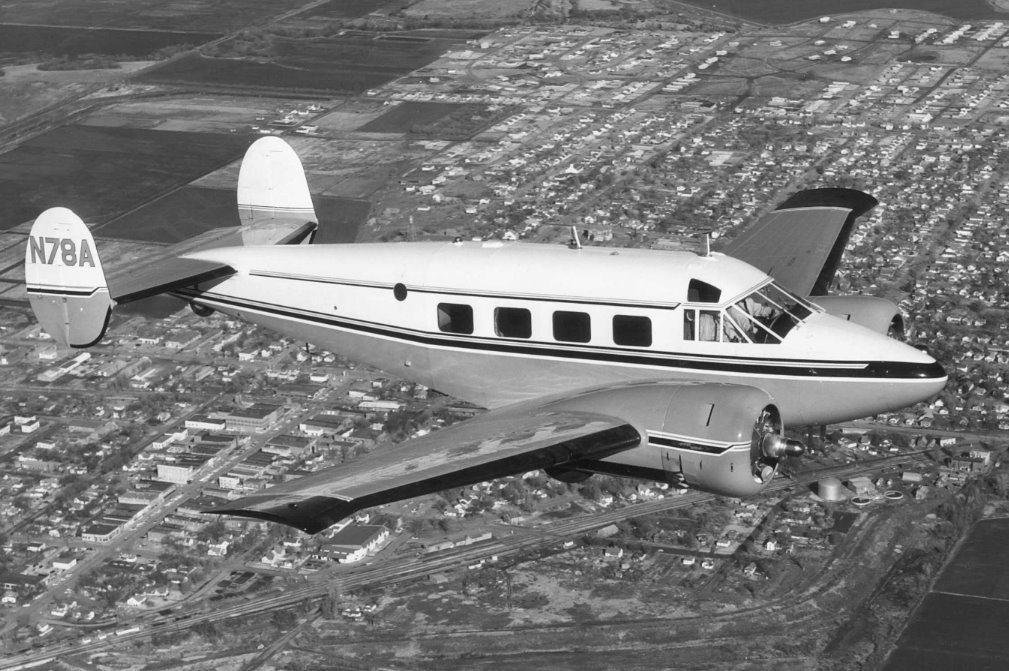
Inflight side view of a 1958
Beech E-18S,
N78A. This airplane was built in late 1957, and shows the 1958
model year Beech 18 paint scheme. Airplane is serial number
BA-330. This Twin Beech is current on the FAA register, now with
registration N446DM. B&W, about 161K,
Added 05/08/10.
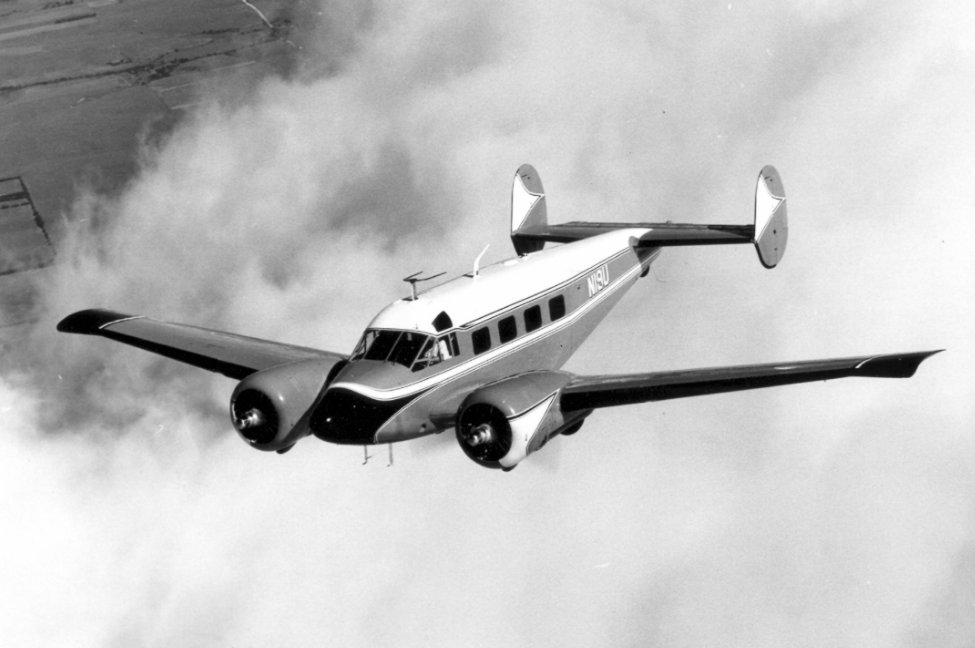
Very nice Inflight view of a 1959
Beech E-18S,
N19U. This view shows the new Horner wing tips well. Airplane
serial number is BA-380. B&W, about 69K,
Added 04/12/06.
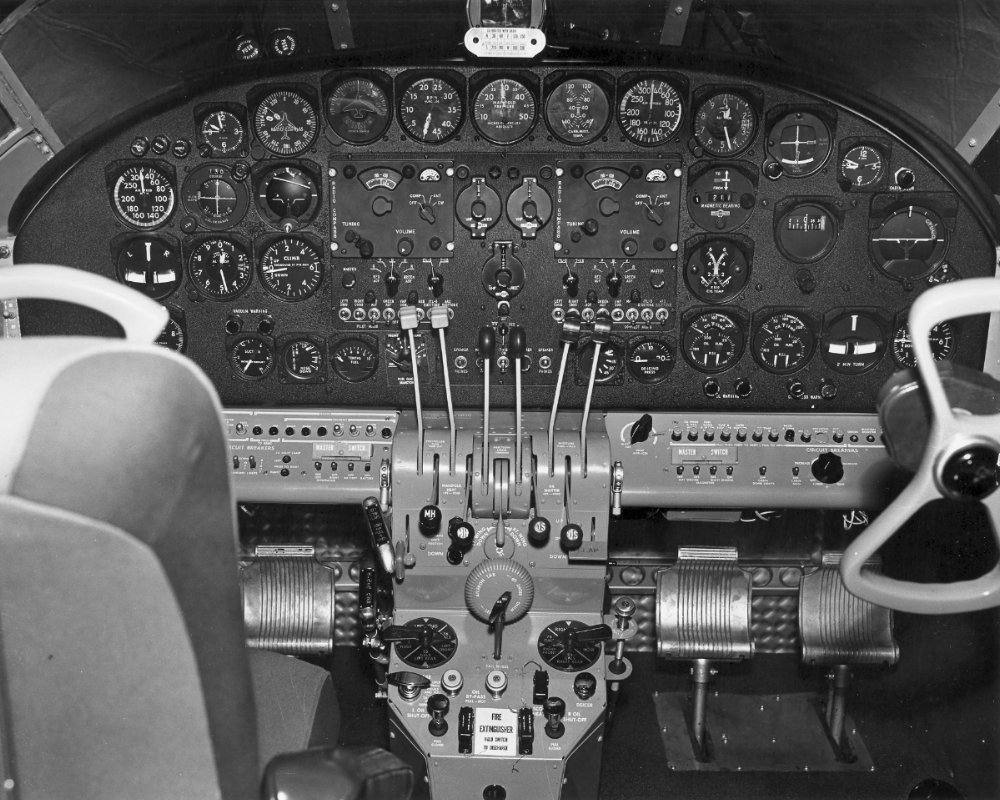
Instrument panel
view of Beech 18, I believe
this is an E-18S instrument panel. The radios give some
indication, 2 ADF's, 2 Collins Omnis, 1 Collins 17L-3 VHF
communications transceiver, a standby ARC T-11B transmitter
(about 6 frequencies). Back of the photo says "Pillsbury
Beechcraft 1955." B&W, about 177K.
Added 10/05/05.
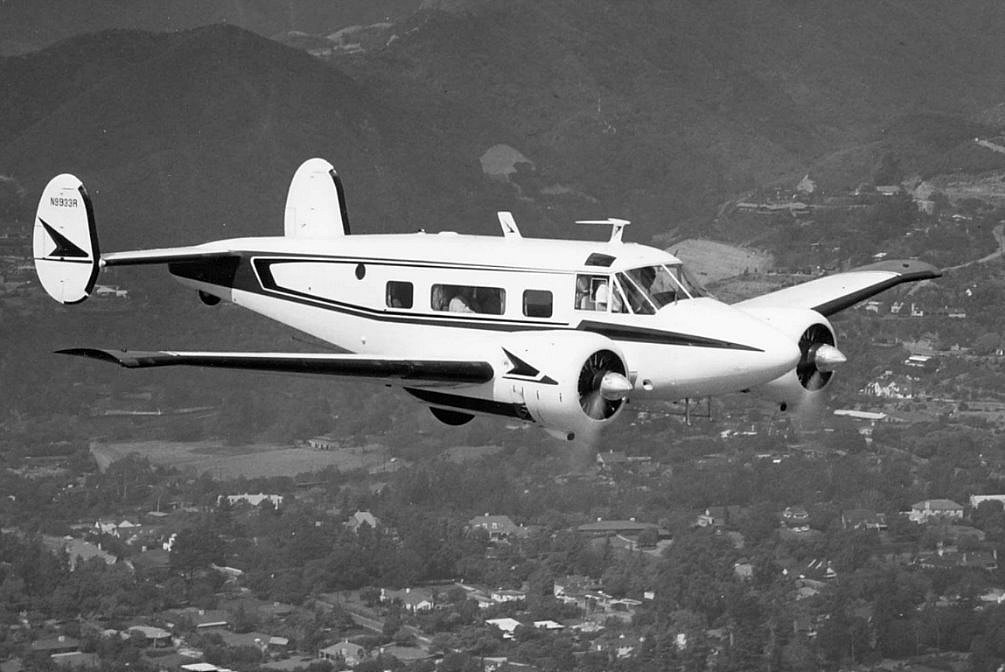
Inflight view of 1961
Beech G-18S,
N9933R, serial number BA-581. This model introduced the panoramic
windows on each side of the cabin. B&W, about 101K,
Added 01/01/02.
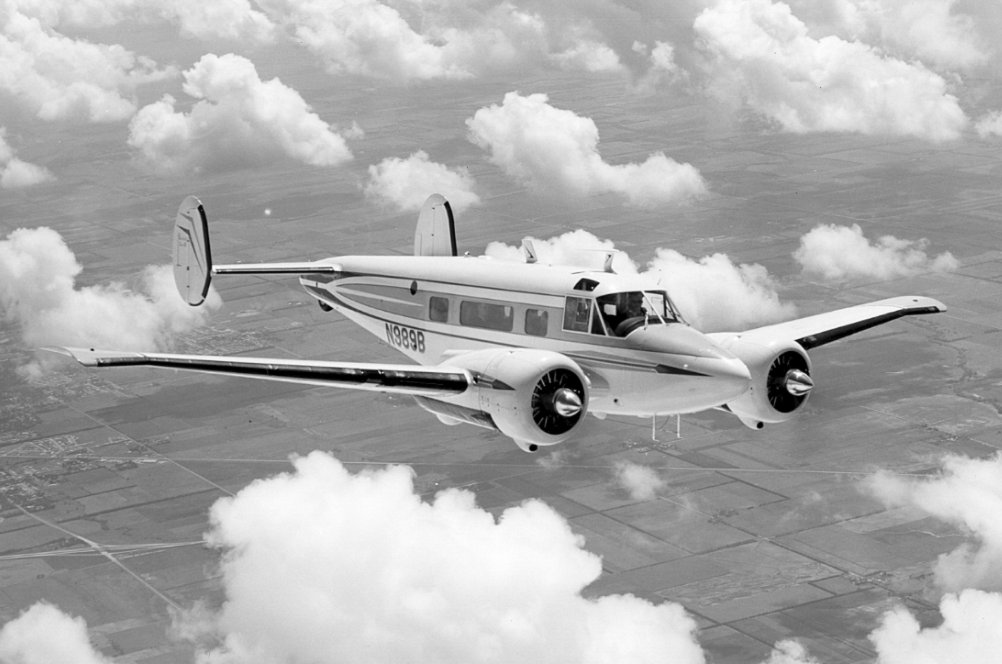
Beautiful inflight view of a 1963
Beech H-18,
N989B. This was the final model 18 built by Beech. Production
would continue until 1969. Later in production Beech would make a
tri-cycle landing gear optional, this image shows the H-18 with
original conventional landing gear. B&W, about 92K,
Added 02/02/07.
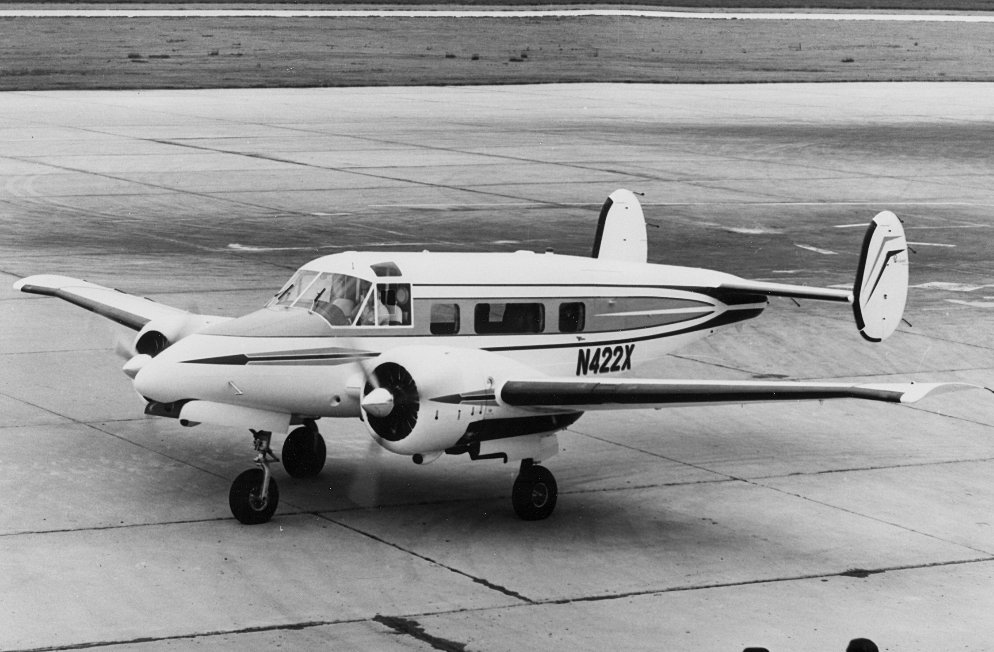
Ground view of a 1963
Beech H-18 with Tri Gear, N422X, serial number BA-652. The Tricycle
gear for the model 18 was developed by Volpar, Inc., at Van Nuys,
California. During 1963 Beech purchased the kit from Volpar to
convert the H18 to a tri cycle gear version. Use of
"trainning wheels" (Tri Cycle Landing Gear instead of
the tailwheel conventional landing gear) made the model 18 much
easier to handle during take off and landing. This conversion was
very popular for the remainder of model 18 production. This
particular aircraft was the first Beech factory production tri
gear H18, delivered to the Govenor of New York in late 1963, with
the registration N22X. B&W, about 118K,
Added 05/26/07.
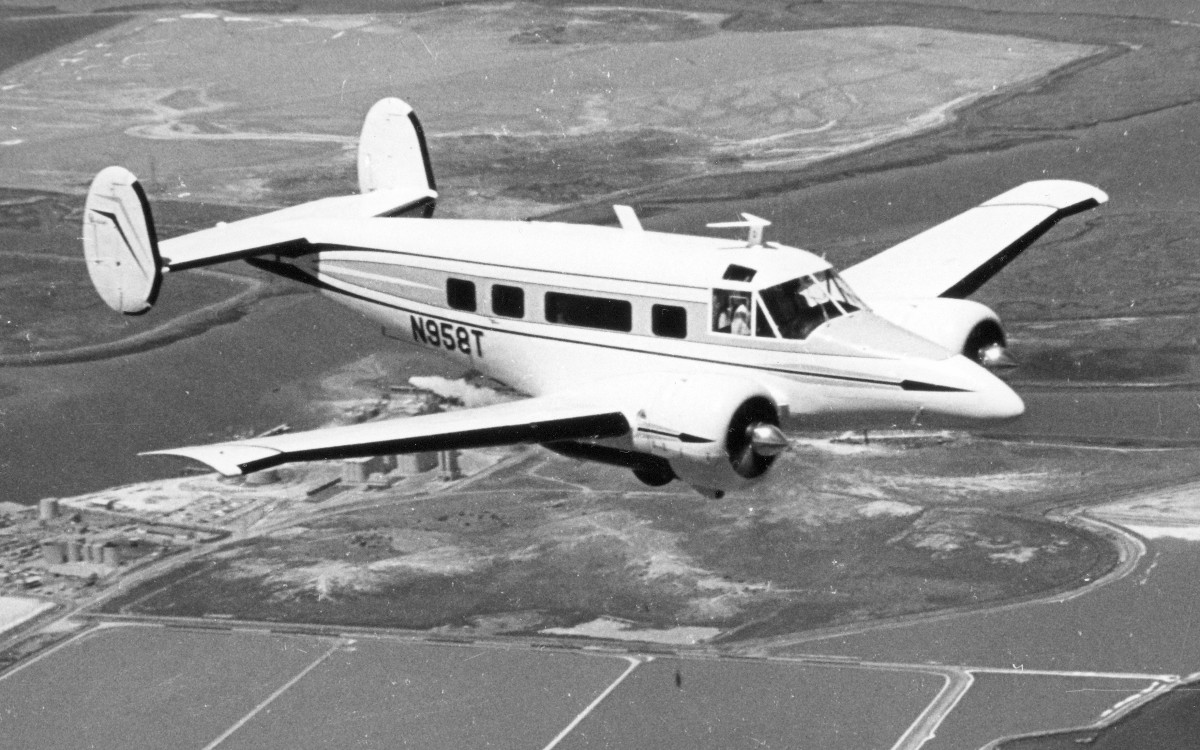
Inflight view of a 1964
Beech H-18 with Tri Gear, N958T, c/n BA-692. The tricycle
gear Beech H-18 has a longer nose than the conventional gear
Beech H-18. B&W, about 237K,
Added 11/01/18.
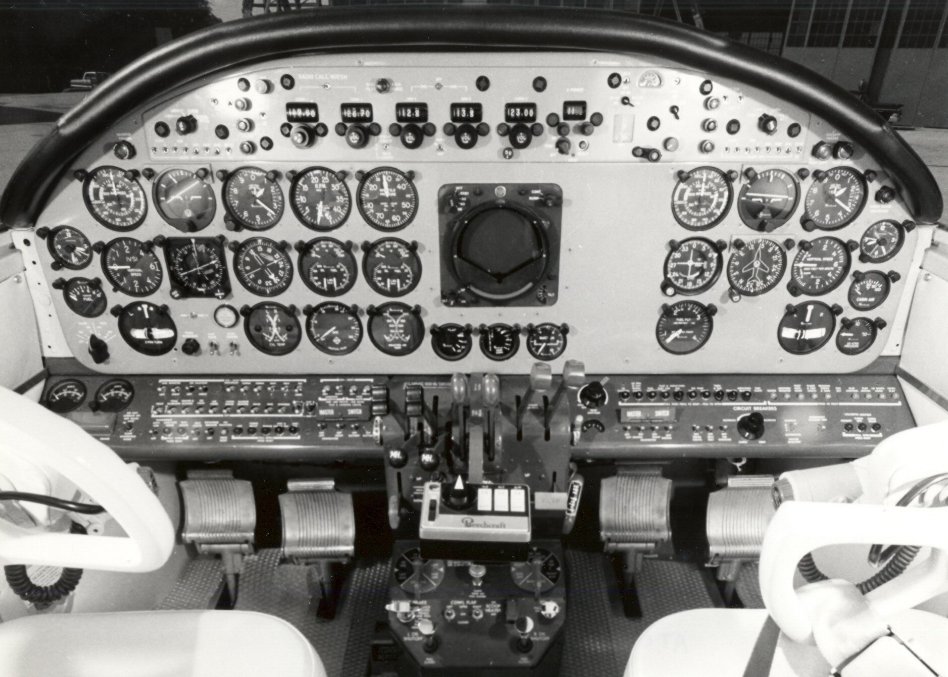
Instrument
panel view of Beech H-18, N925H,
serial number BA-695, a 1964 H-18. B&W, about 135K.
Added 02/18/07.
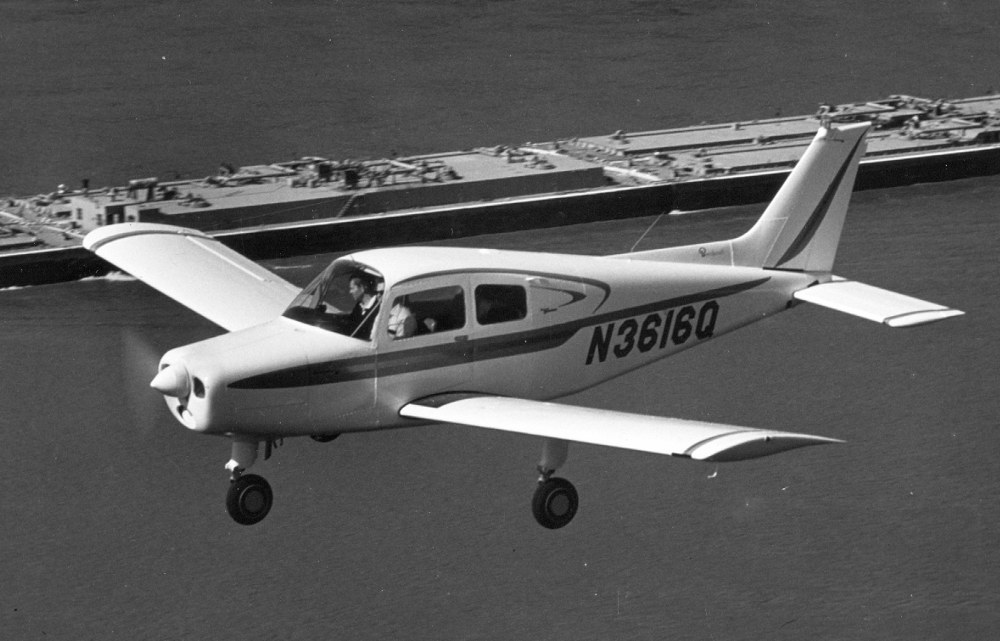
Inflight view of Beech
A23-19 Musketeer,
N3616Q. The Musketeer came out in 1965, this is is a 1967 model. B&W,
about 113K,
Added 04/28/14.
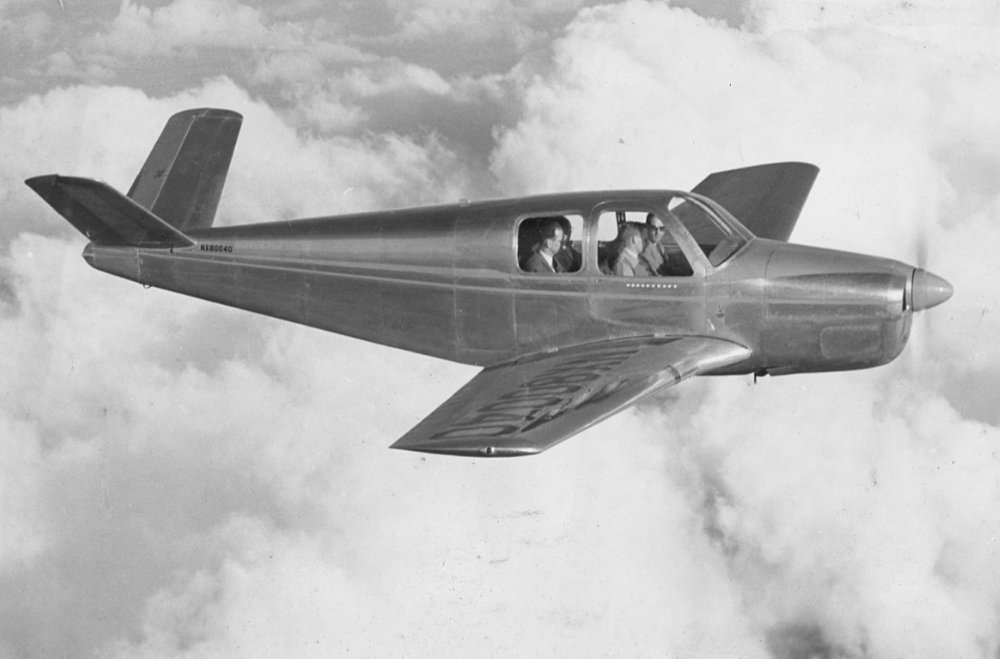
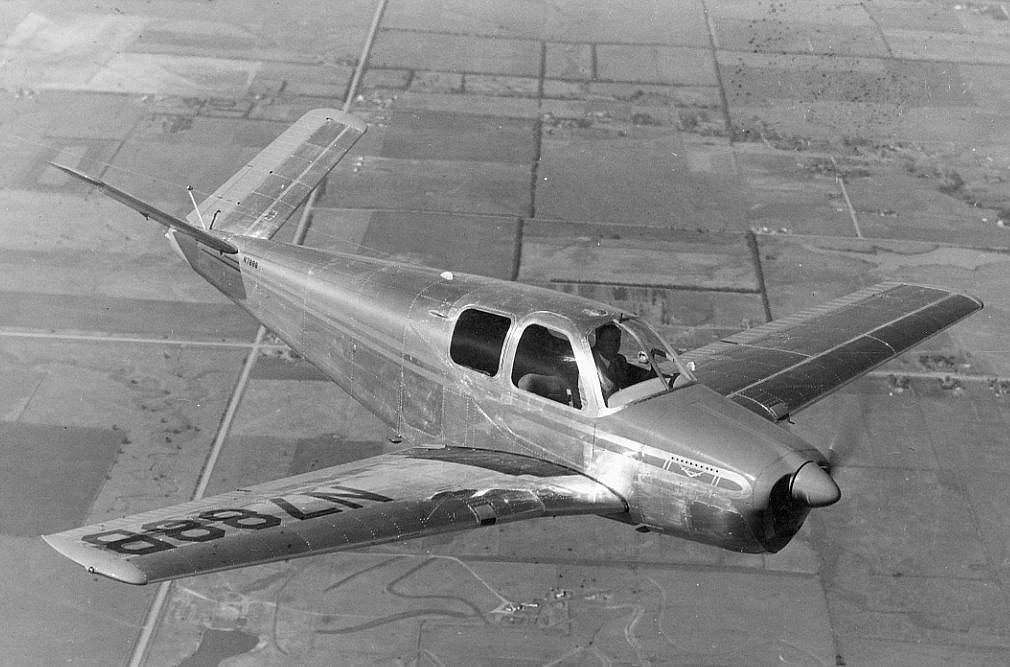
Inflight view of Beech
35 Bonanza,
NX80040, the 4th Bonanza built. Beech built 5 prototypes which
are identified as numbers 1, 2, 3, 4 and 5. Airframes 1, 2 and 5
were not flown, rather used for fatigue testing. Airframe 3 was
the first Bonanza to fly on December 22, 1945. Number 3 used a
laminar flow wing and a 4 cylinder Lycoming engine. This image
shows airframe 4, the second Bonanza to fly, and the first to use
the now familiar NACA 23000 wing and a Continental E Series
engine. Number 4 shown in this image was used for certification
flying, including dive tests to 286 MPH. This airplane has fabric
covered ruddervators. Later this airplane, now certified and
registered N80040, was used by Captain Bill Odom to establish a
light plane long distance non-stop record flight of 4,957 miles
from Honolulu to Teterboro, NJ, in March 1949. Odom named the
airplane "Waikiki Beech." Later the airplane was
renamed "Friendship Flame" and flown around the world
by Representative Peter F. Mack Jr. Today N80040, number 4 is in
the National Air and Space Museum of the Smithsonian, in
Washington, D.C. Preproduction number 4 is the oldest flyable
Bonanza in existence, although not airworthy at this time. NOTE
that all the preproduction Bonanza's are numbered from 1 to
5, however they do NOT have the letter "D" preceeding
the serial number. Once certified, all production Bonaza's
have a serial number with the letter "D" preceeding the
number. My thanks to Ray Johnson,
for correcting my original caption.
Ray Johnson owns Bonanza serial number D-4 (not the 4th
preproduction Bonanza now in the Simthsonian), registered N80404.
B&W, about 71K, Added 05/01/07.
Caption updated 11/07/11.
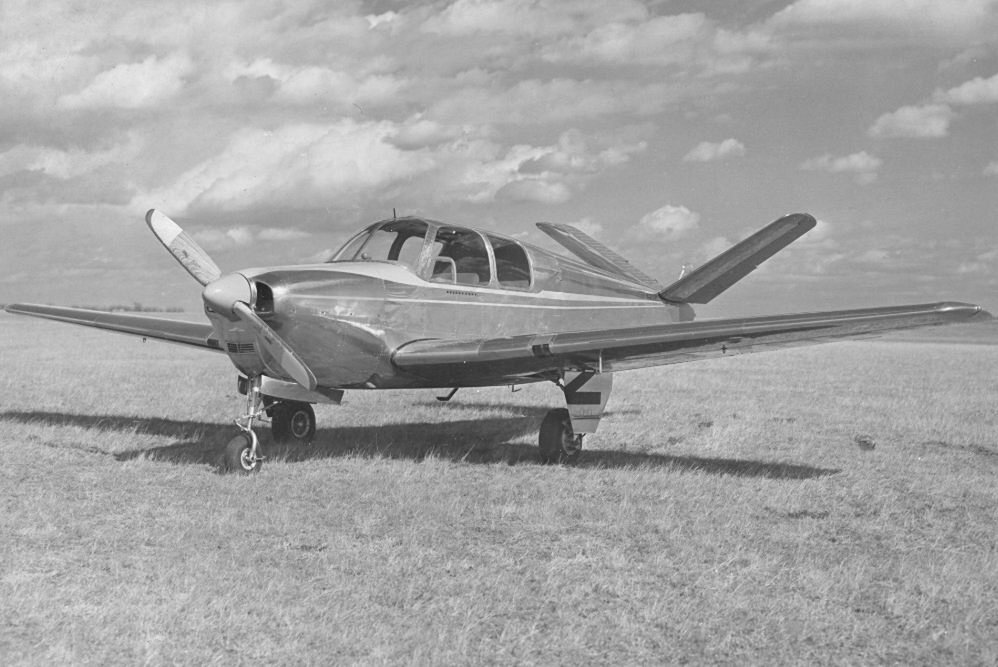
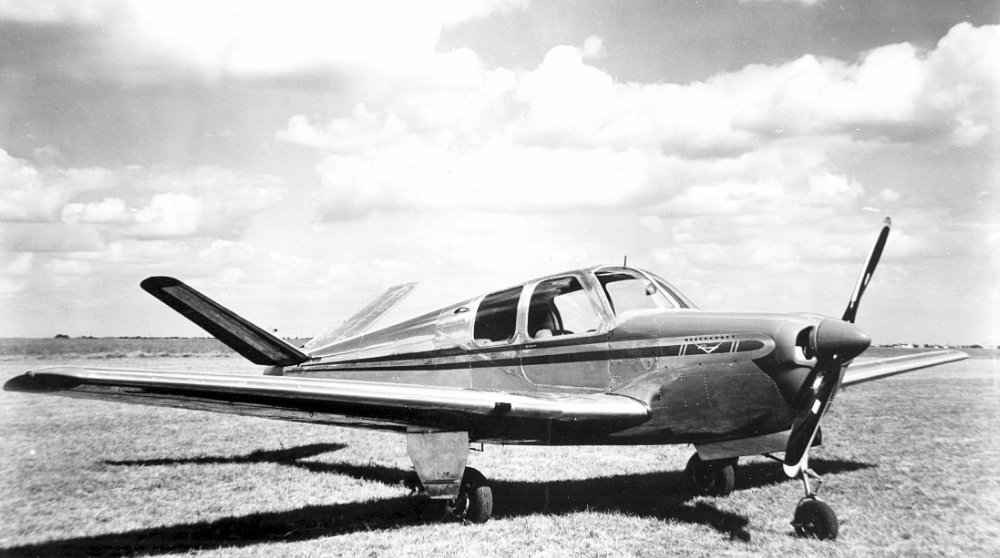
Very nice ground view of Beech
35 Bonanza,
NC2703V. This is a 1947, very early production airplane, serial
number D-79. This view shows the original variable pitch (but not
constant speed) wooden 2 blade propeller. Early Bonanza's had
this high polished wooden propeller. Later Beech changed to a
plastic coated, black in color, wooden propeller. The variable
pitch was controlled in the cockpit by a toggle switch, with the
pitch change mechanism an electric motor. B&W, about 107K,
Added 04/22/07.
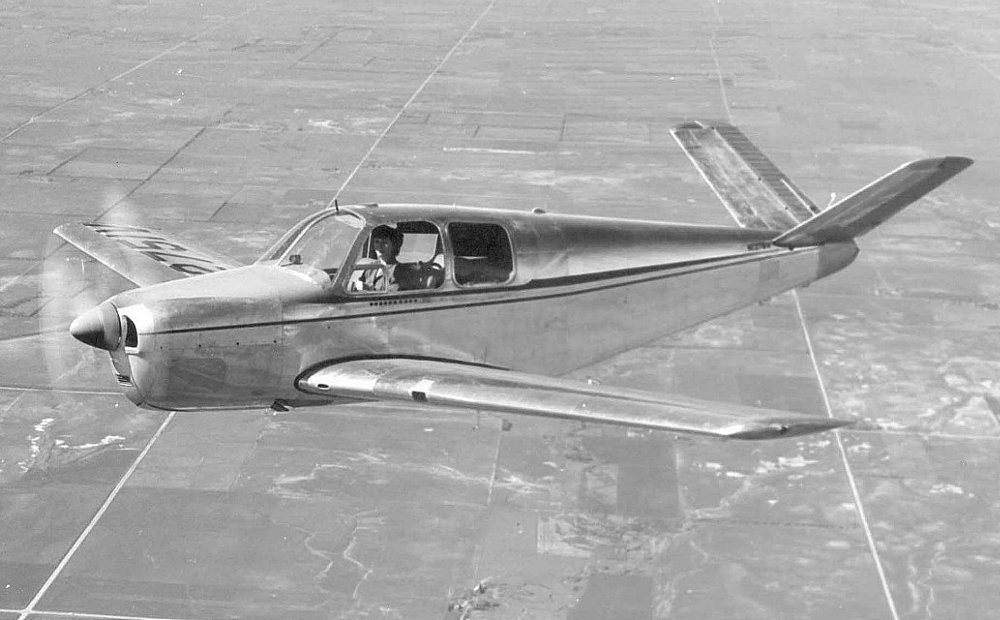
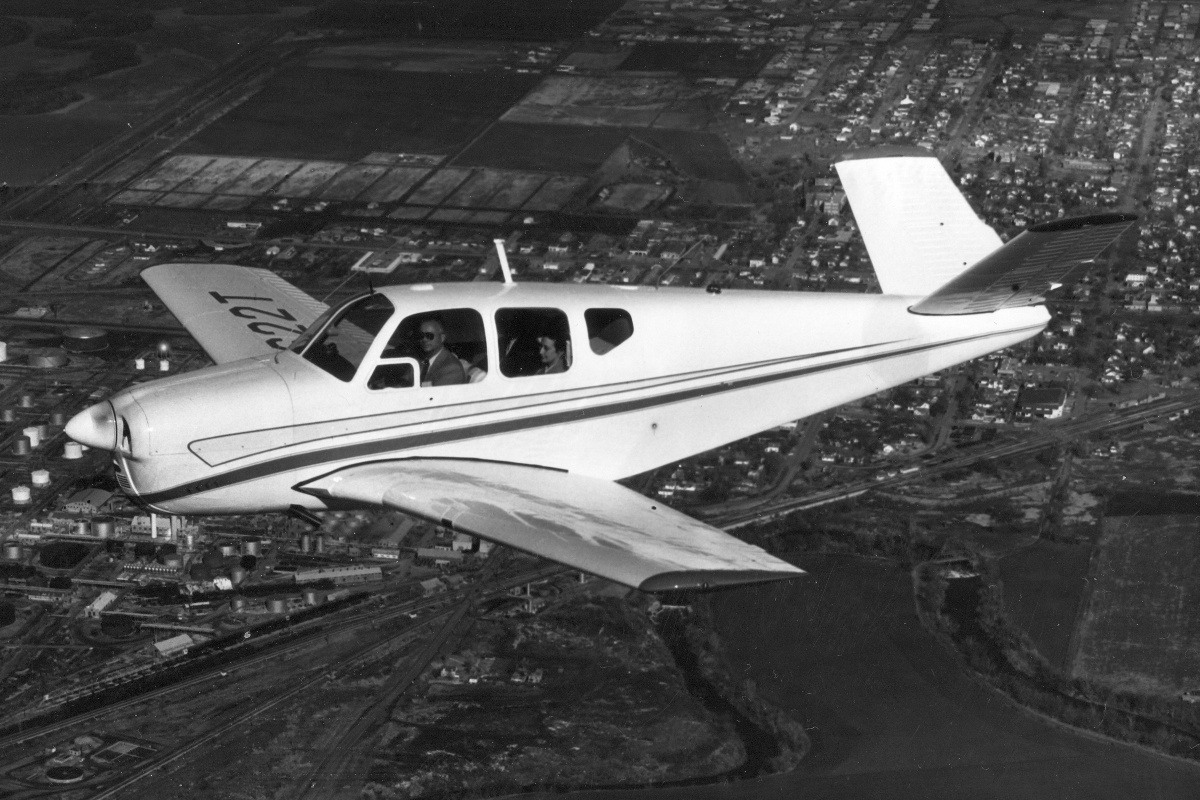
Inflight view of Beech
35 Bonanza,
NC2751V. This is a 1947, very early production airplane, serial
number D-136. B&W, about 98K,
Added 01/01/02.
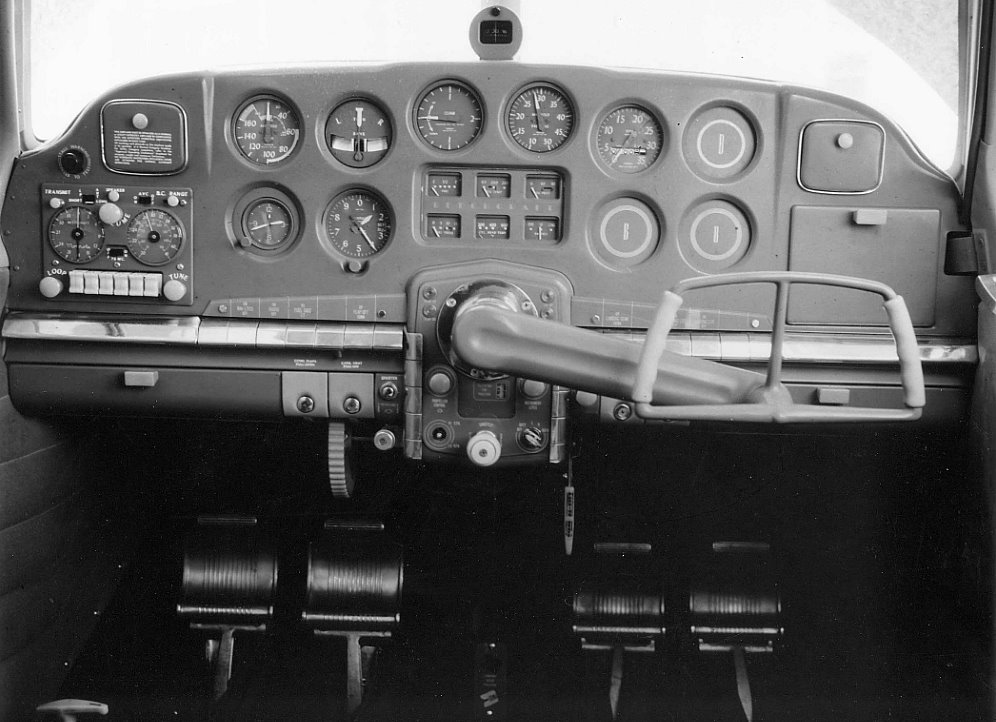
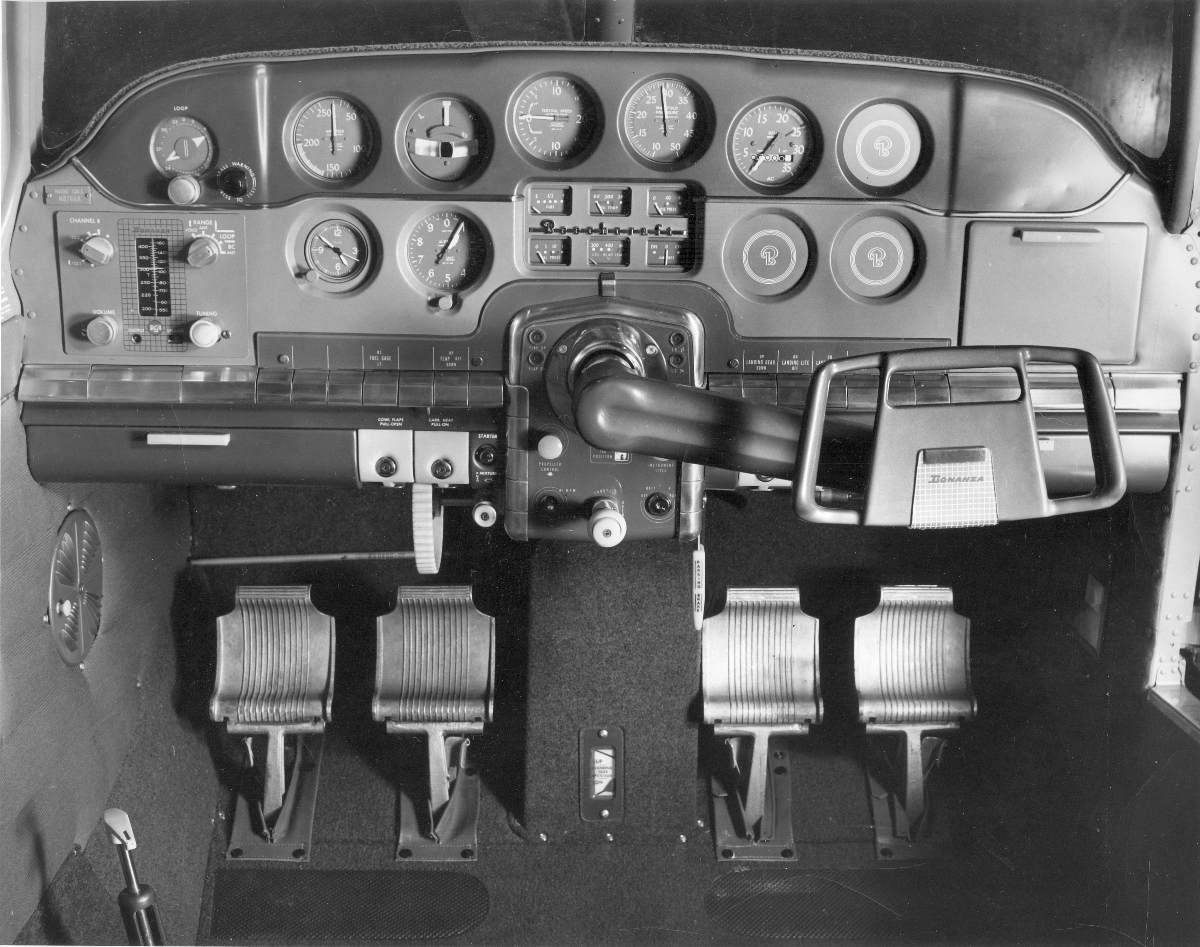
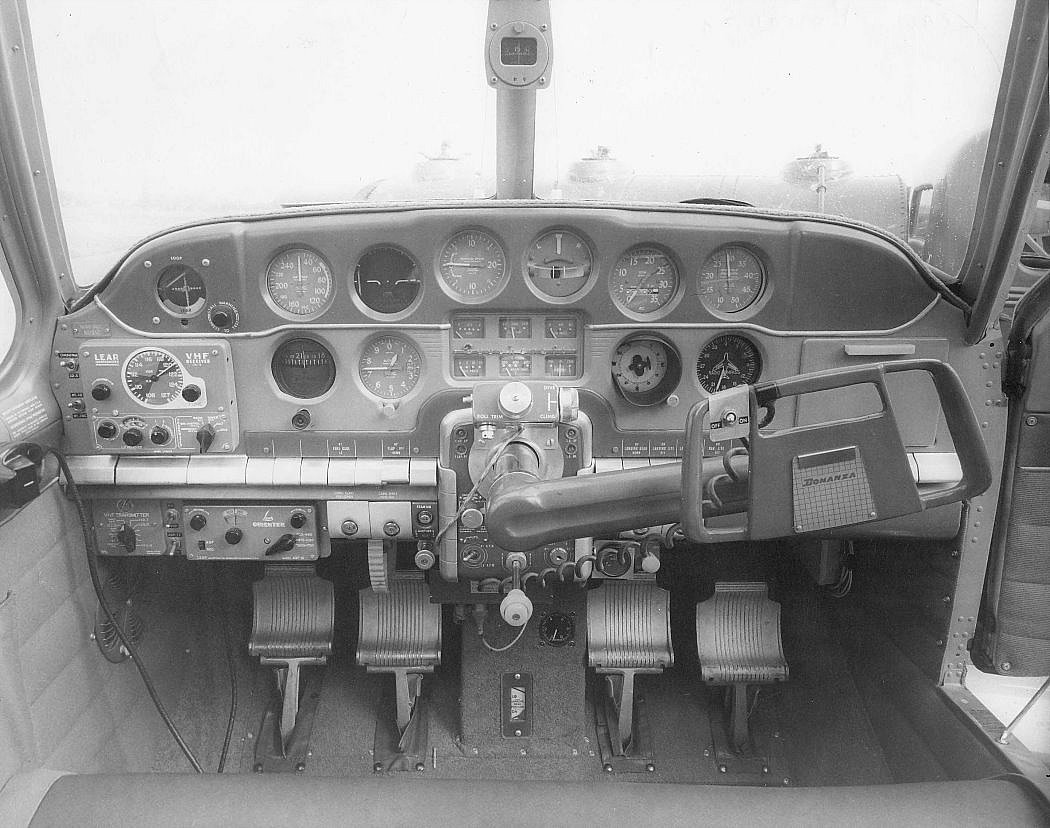
Instrument
Panel view of Beech 35 Bonanza. This
shows the initial Bonanza instrument panel, which included the
Motorola Avigator radio at the left side of the panel as
standard. This was the only aircraft radio I ever saw which
included pre-set push button tunning, although it was quite
common in automobiles of the period. Throw over control wheel is
shown in this photo in the co-pilot position. B&W, about
123K,
Added 01/01/02.
Inflight view of Beech
A35 Bonanza,
N788B. Look carefully and you can see the low frequency trailing
wire antenna which passed through a support between the butterfly
tail surfaces. The antenna retracted in for landing. B&W,
about 106K,
Added 01/01/02.
Ground view of Beech
A35 Bonanza,
N7109. This view shows the plastic covered wooden adjustable (but
not constant speed) Beech propeller. The prop pitch is adjustable
with an electric motor controlled by a switch to the left of the
throttle. B&W, about 92K,
Added 12/24/05.
Standard
Instrument Panel view of 1950 Beech B35 Bonanza,
N8766A, serial number D-2202. Early model Bonanza's
came with a basic standard instrument panel as shown here,
artifical horizzon and directional gyros were an extra cost purchase,
however I've never seen a Bonanza that didn't have an artifical
horizon and directional gyro. The B-35 came standard with a radio
with a VHF transmitter, a RCA radio. VHF has two frequencies 122.1
to contact flight service, and 122.5 to contact tower. The receiver
covers two low frequency bands, 200 to 410 KC, and 550 to 1600 KC
(previous Bonanzas camee from the factory with single freuqency
transmitters either 3105 or 3023.5 KC and tunable receivers). In the lower
left corner of the photo is the first type wobble pump amd fuel
selector. This a Beech photo dated 1949. B&W, about 689K,
Added 09/09/24.
Instrument
Panel view of 1950 Beech B35 Bonanza,
N5135C, serial number D-2420. "B" model Bonanza's
came from the factory with a low frequency radio, so this panel
has been upgraded. This view shows the Lear LTRA-5 at the left
side of the panel. Note the interesting Lear Omni Scope to the
right of the engine instruments. This was a cathode ray tube
instrument which displayed a circular sweep. When the sweep
passed the radial you were on, of the tuned in VOR, there was a
blip on the screen! The Omni Scope was also offered with the
later Lear LTRA-6, but the only installations I ever flew were
with the LTRA-5. Note additionally there is a Lear ADF-12 and a
RT-10C stand by VHF transmitter. Very well equipped for 1950!
Throw over control wheel in the co-pilot position. This airplane
is current on the FAA register. B&W, about 152K,
Added 01/07/02.
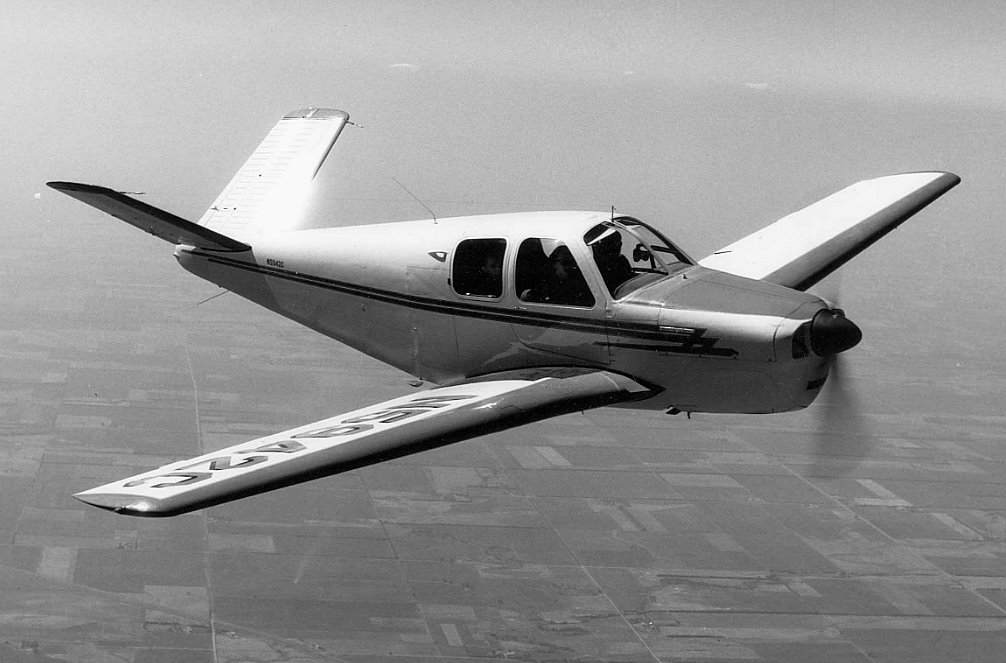
Inflight view of 1952
Beech C35 Bonanza, N5942C, serial number D-3303. This model
introduced 20% wider V-Tail surfaces at a slightly different
angle, and wing root fillets. B&W, about 101K,
Added 01/01/02.
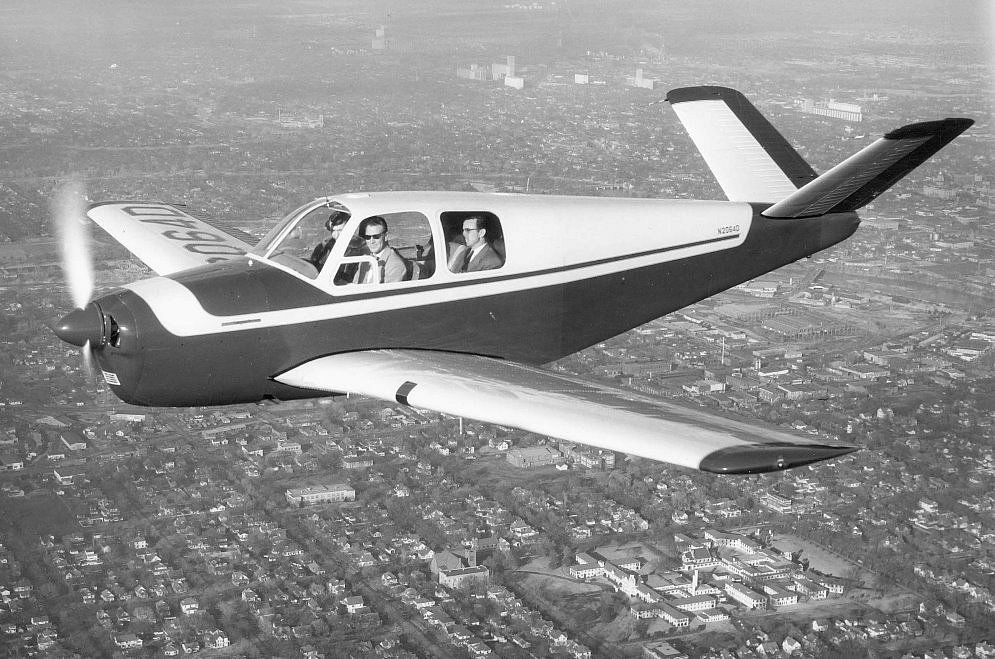
Inflight view of Beech
D35 Bonanza,
N2064D, serial number D-3405, the fifth D model manufactured.
This airplane is current on the FAA register. B&W, about
163K, Added 11/01/08.
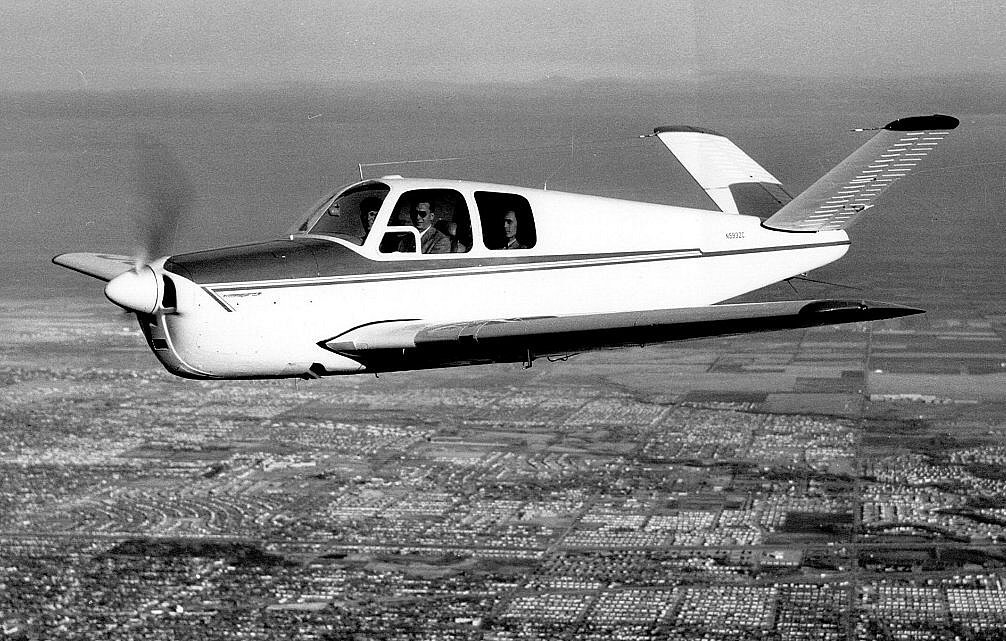
Inflight view of Beech
E35 Bonanza,
N5932C, a 1954 model Bonanza. The standard engine is the
Continental E-185-11, with a 205HP take off rating and 185 HP
continuous. The E model Bonanza was the first year the E-225-8
engine of 225HP was offerred optionally. The E model was the last
year the Bonanza was manufactured with only two side windows.
This airplane has the omni antenna below the tail. Also the
Bonanza has a fiberglass tail cone which often housed the ADF
loop antenna. This airplane has two long wire antennas, one going
to each ruddervator, tied together at the front antenna mast then
entering with a single lead in at the insulator in front of the
windshield. This indicates the airplane is equipped with an ADF
(very common for the period). This Bonanza is serial number
D-3293. My thanks to Ron Davis
for providing the image. B&W, about 168K,
Added 11/24/06.
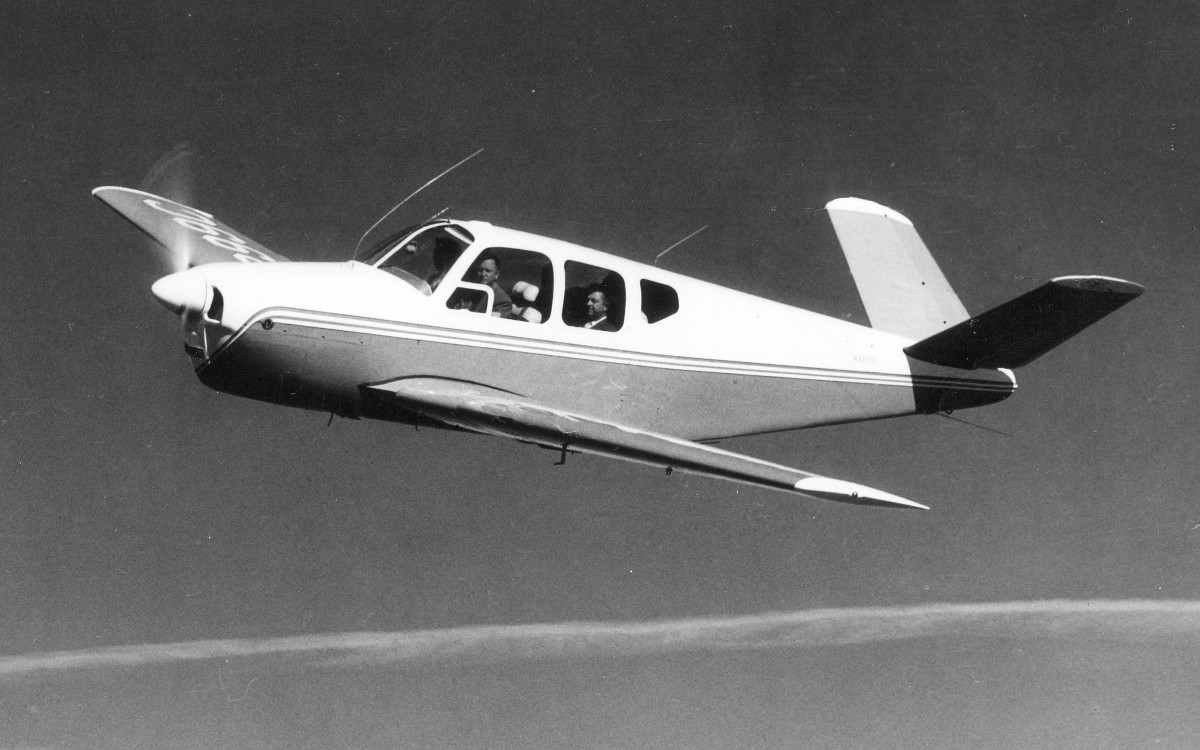
Inflight view of 1955 Beech F35 Bonanza,
N3299C, serial number D-3999. The F35 Bonanza was the first version of
the Bonanza to come with the small third window. Both the Continental
E-185-11 engine of 205 HP for takeoff, and the E-225-8 engine of 225 HP
for takeoff were offered, with the E-225-8 the most popular. Other changes
with the F35 were structual strengthening. B&W, about 194K,
Added 05/26/18.
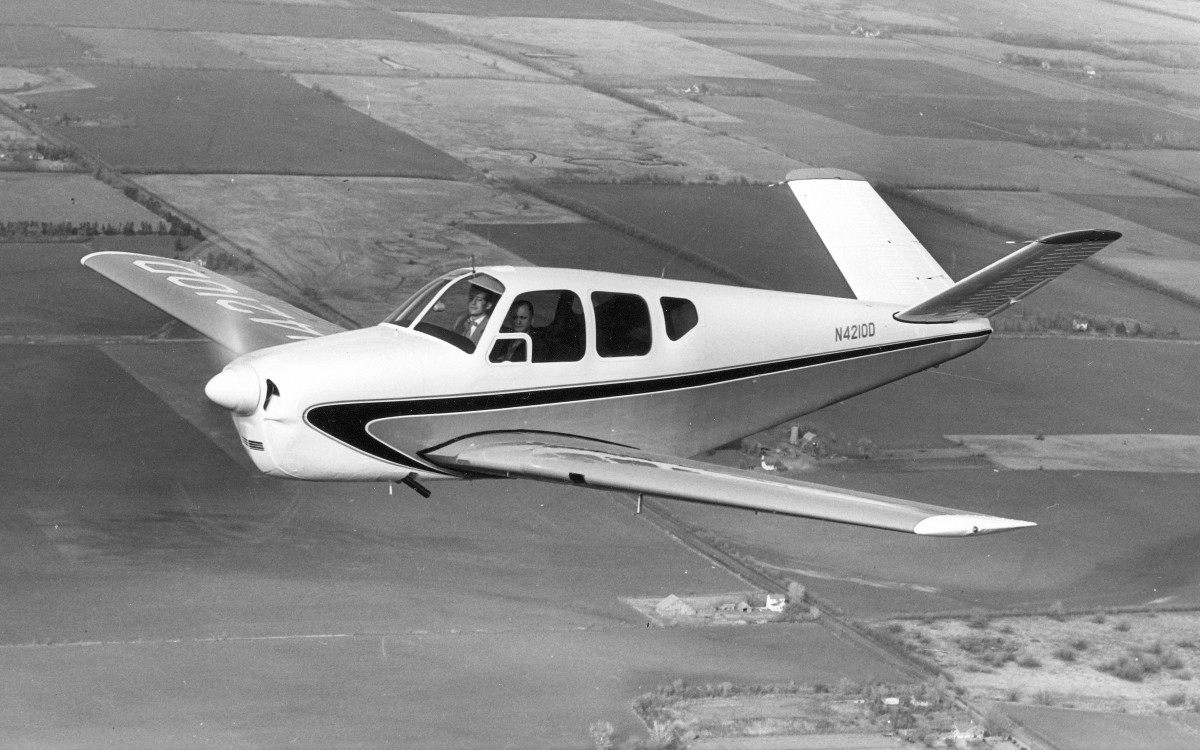
Inflight view of 1956
Beech G35 Bonanza, N4210D, serial number D-4415. The G model was
the last Bonanza to use the Continental E Series engines. The G35
used the 225HP E-225-8 engine as standard. This airplane is
current on the FAA register. B&W, about 198K, added 12/24/05, rescanned
image added 05/26/18.
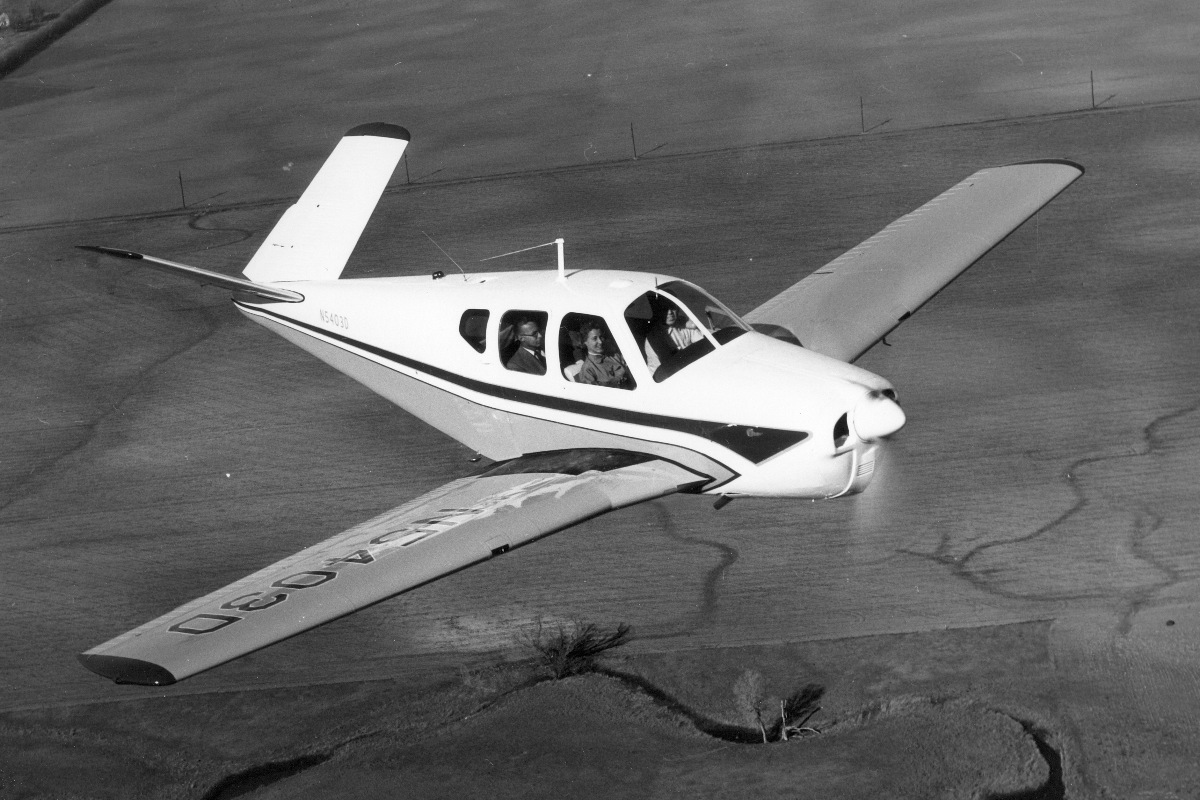
Inflight view of 1956
Beech H35 Bonanza, N5403D, serial number D-4873. The H model Bonanza
switched from the Continental E Series engine to the Continental O-470 engine,
and included some structual strengthening. All Bonanzas before the H model
were approved as Type Certificate A-777. Beginning with the H model this and
all future Bonanzas are approved under Type Certificate 3A15. B&W, about 279K,
Added 09/01/21.
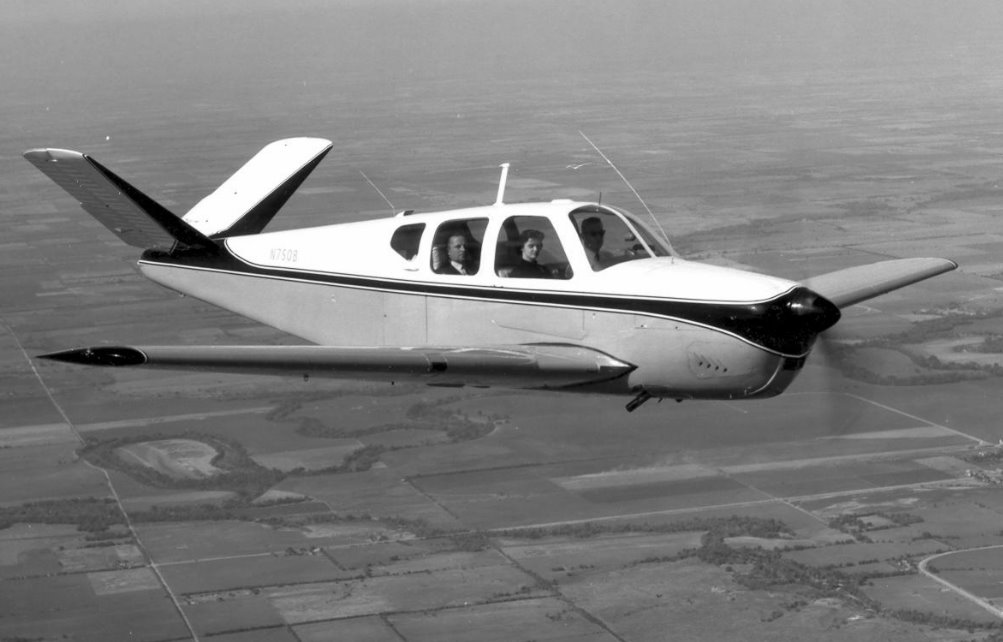
Inflight view of 1957
Beech J35 Bonanza, N750B. The J and K models are my favorite
Bonanza's. This is serial number D-5352. FAA records show this
airplane as a J model 35, however the paint scheme is that of a
1958 K model 35. B&W, about 36K, added 01/01/02, caption
updated 07/01/21.
Inflight view of
a 1957 Beech J35 Bonanza, N622T, serial number D-5355. This
airplane has the standard J35 Bonanza paint scheme. B&W, about 76K,
Added 07/01/21.
Instrument
Panel view of 1957 Beech J35 Bonanza,
N8309D. This "J" model has a Narco VTR-2 Omnigator Mark
II on the left side. Throw over control wheel in the normal pilot
position. There is a Lear ADF-12 hidden behind the control wheel.
Airplane is a 1958 model, serial number D-5428 and is current on
the FAA register. B&W, about 76K,
Added 01/01/02.
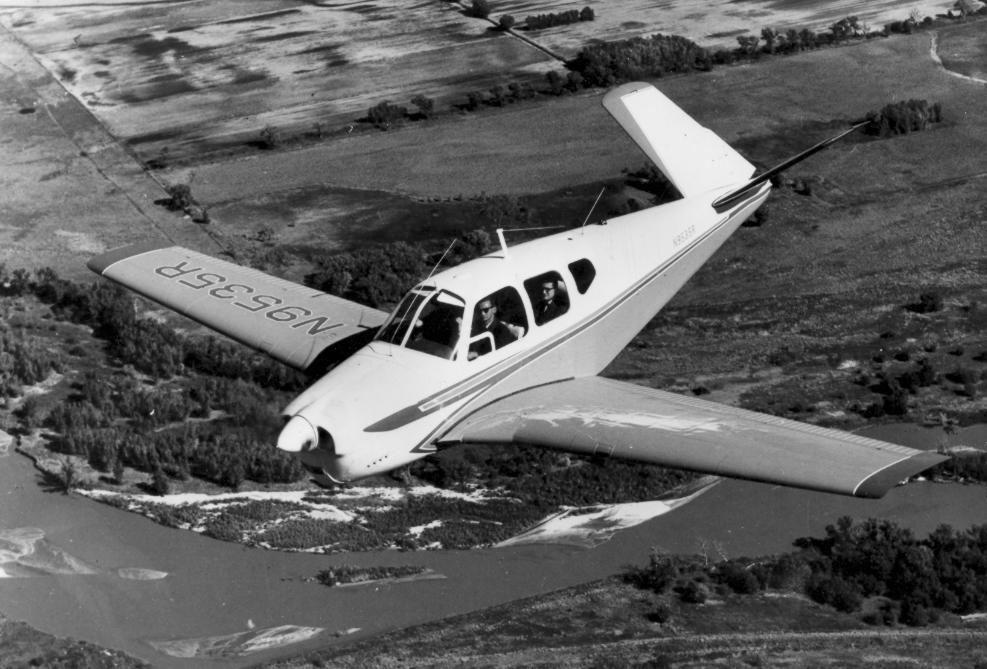
Inflight view of 1960
Beech M35 Bonanza, N9535R. The K and M Bonanzas were very
similar, but one change which occurred on the M model Bonanza was
the factory use of high lift Horner wing tips.These tips are
concave on the lower side. Beech built 400 M model Baonanzas.
This is serial number D-6162, current on the FAA register as
N844R. Beech Bonanzas used 4 different side window types. The
early Bonanazas, through the E model, did not have a 3rd side
window. From the F to the M model the small 3rd window, as with
this airplane, was used. The N and P model Bonanzas used a larger
"long look" 3rd window, and the S and V model Bonanzas
used a 3rd window similar to the N and P models, but squared and
slightly larger at the rear. This image is about 102K,
Added 10/29/06.
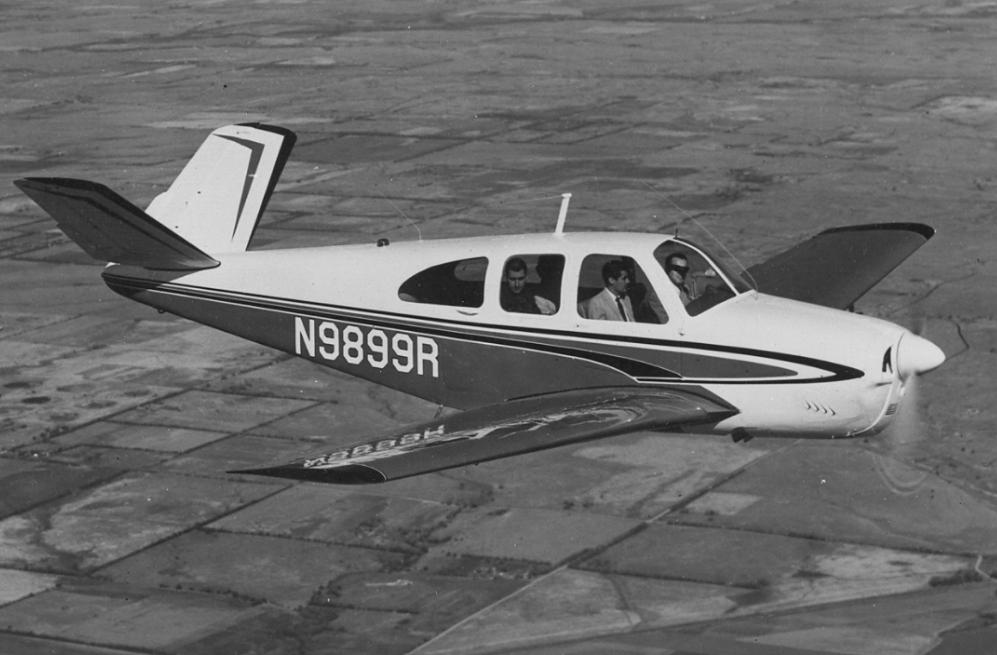
Inflight view of 1961
Beech N35 Bonanza, N9899R, serial number D-6632. While this is a
N model, this airplane actually has the paint scheme used by
Beech on the 1962 P model Bonanza. The extended 3rd side window
used on the N and P model Bonanzas is shown to good advantage.
Image about 70K,
Added 10/29/06.
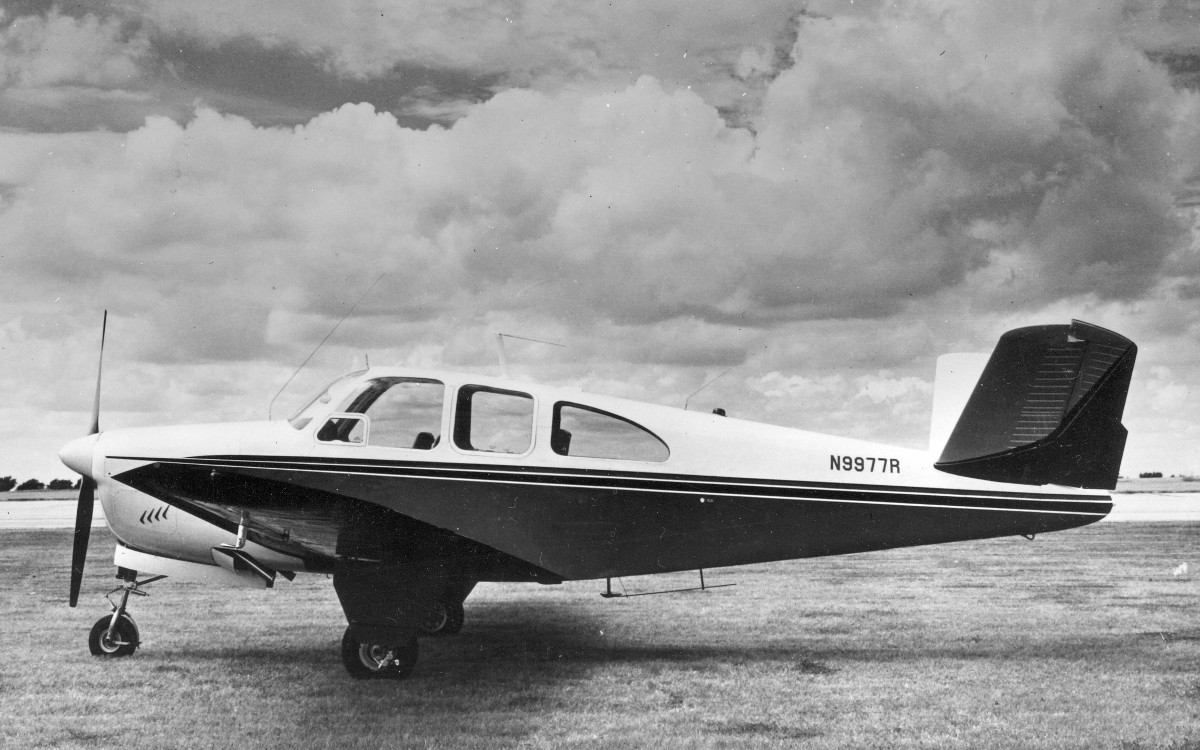
Ground side view of 1961
Beech N35 Bonanza, N9977R, serial number c/n D-6633. This
has the standard N model paint scheme, The extended 3rd side window
used on the N and P model Bonanzas is shown to good advantage.
Image B&W, about 202K,
Added 03/01/18.
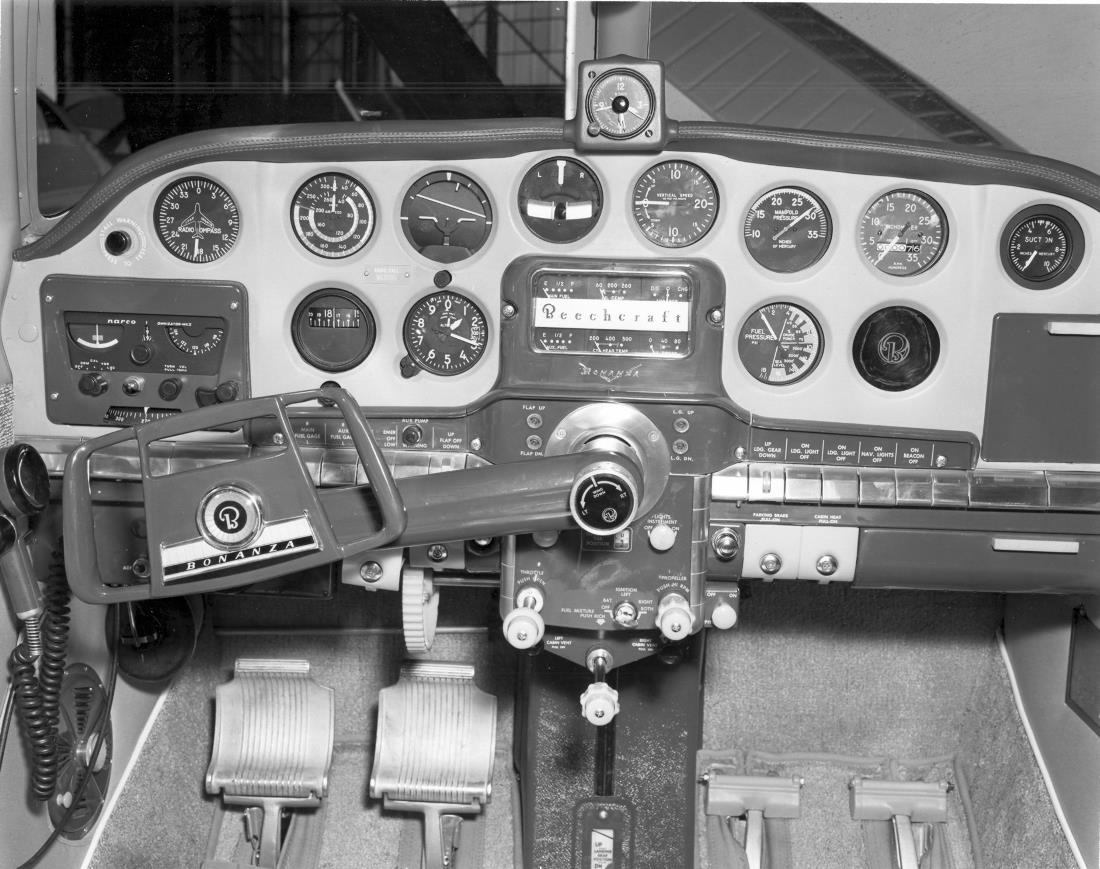
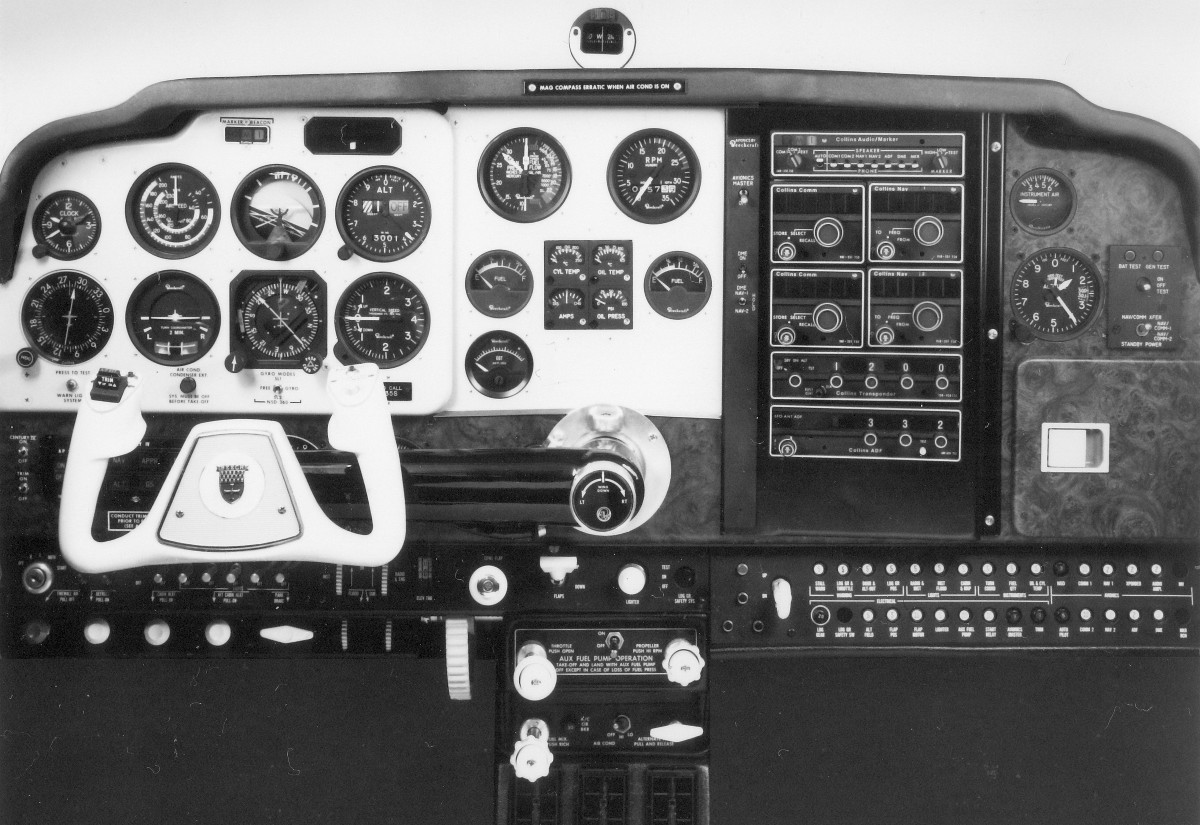
View of
1975 Beech V35B Bonanza Instrument Panel, N4135S, serial number D-9787.
This is one of the last Bonanzas. Compare this V-35B instrument panel and
radios with the 35, B35 and J35 panels and radios above. Radios in this V35B
are Collins Microline, AMR-350 audio panel, two VHF-251 Comm radios, two
VIR-351 Nav radios, TDR-950 transponder, and ADF 650 automatic direction
finder. B&W, about 255K.
Added 01/27/18.
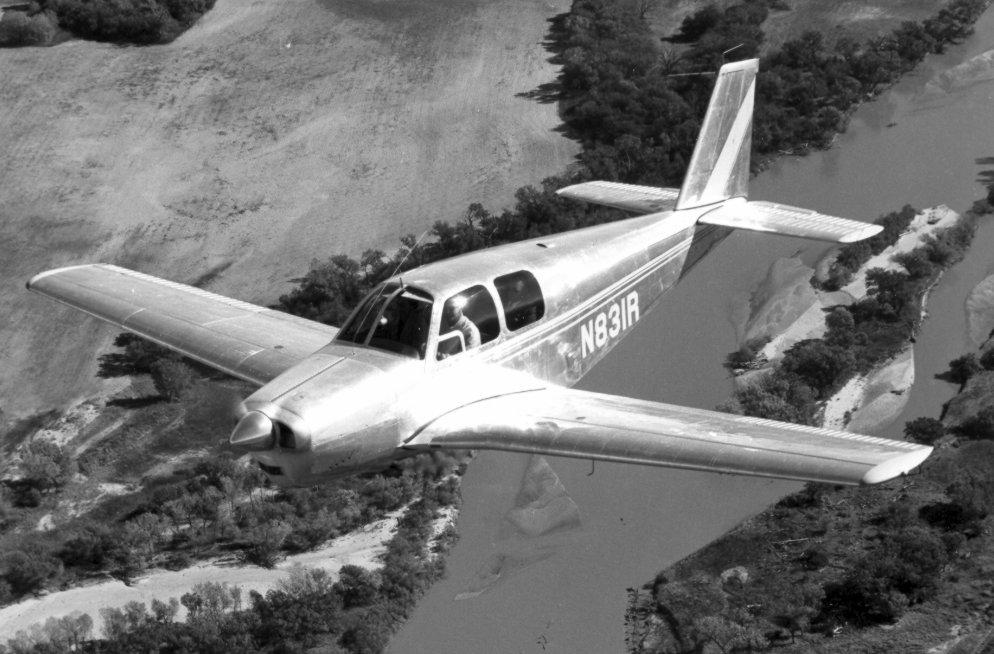
Inflight view of Beech 33 Debonair,
N831R. While the Debonair has a lower Beech model number, it came
later is shown in this order for that reason. Beech model number
is more accurately 35-33. The Debonair was introduced in 1960 as
a lower cost version of the Bonanza. Some Bonanza features, such
opening rear windows were deleted, engine power was reduced, the
interior was more spartan, and outside paint was limited. This is
serial number CD-3, built in 1959, still current on the FAA
register. B&W, about 121K,
Added 12/24/05.
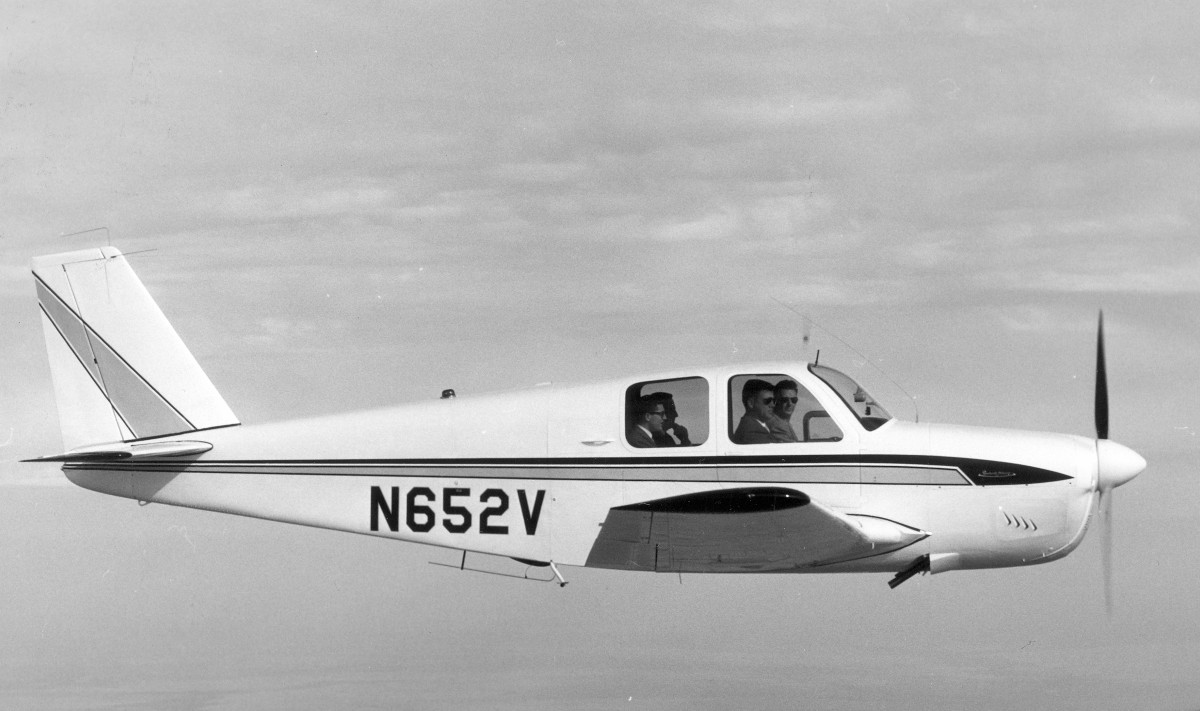
Inflight view of Beech 33 Debonair,
N652V, Beech construction number CD-54, built in 1960. Actual model
designation is 35-33. This side view shows the Debonair during its
first year of production. This airplane has the optional overall paint.
Visible in this view are the fixed cowl flaps of the Debonair, the vertical
stabilizer without the fairing and a fixed entry step. B&W, about 142K,
Added 05/01/16.
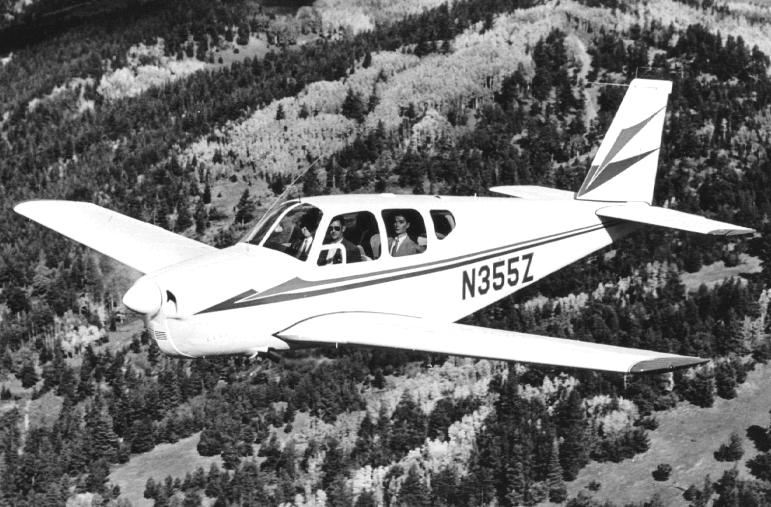
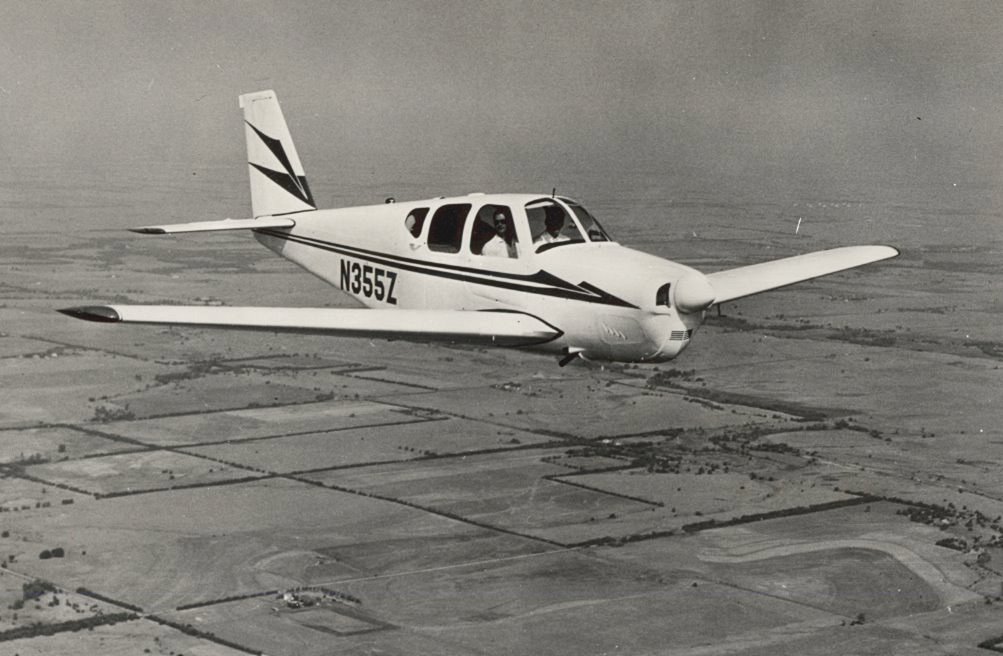
Inflight view of Beech
A33 Debonair,
N355Z. This is a 1961 model A33. Here is a second view of
the other side of N355Z. This Debonair has the optional small 3rd side
window first available on the F35 Bonanza, and used through the
M35 Bonanza. This is serial number CD-387, built in 1960 and
current on the FAA register. B&W, about 82K, and 106K,
Added 06/28/02.
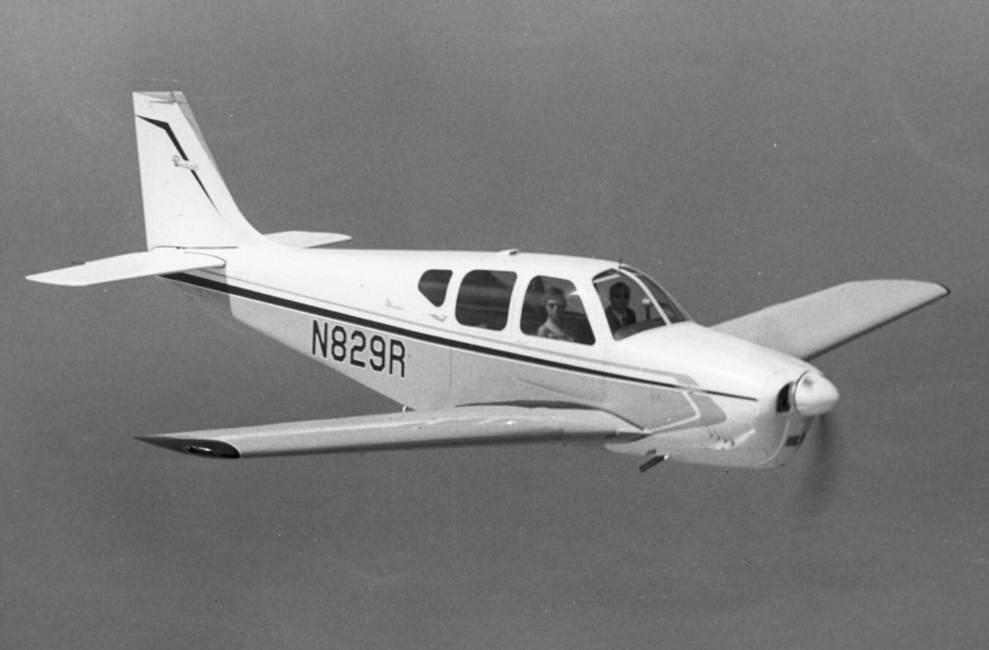
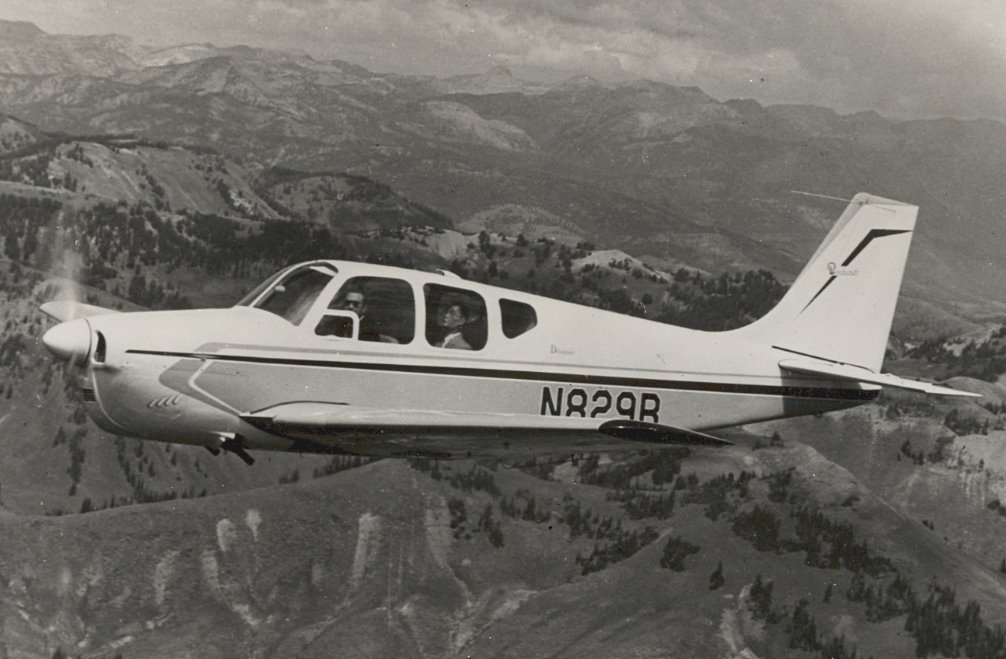
Inflight view of Beech
B33 Debonair,
N829R. Here is a second view
from the other side of N829R. This is a 1962 model B33
and it featured a new
revised instrument panel. Earlier versions of the Debonair had the same
instrument panel as the early Bonanzas. See the J35 instrument
panel above. This airplane has a Motorola ADF-T-12B on top, with
the middle being a King KX-130 Comm/Nav with glideslope, plus a
lower KY-90 Comm. The King radios are tube type, the ADF is
transistorized. At this time the Debonair is changing with
amenities closer to that of the Bonanza. The B33, Beech model
35-B33, was built from late 1961 to 1964. B&W, about 41K,
106K and 131K respectively.
Added 12/06/06.
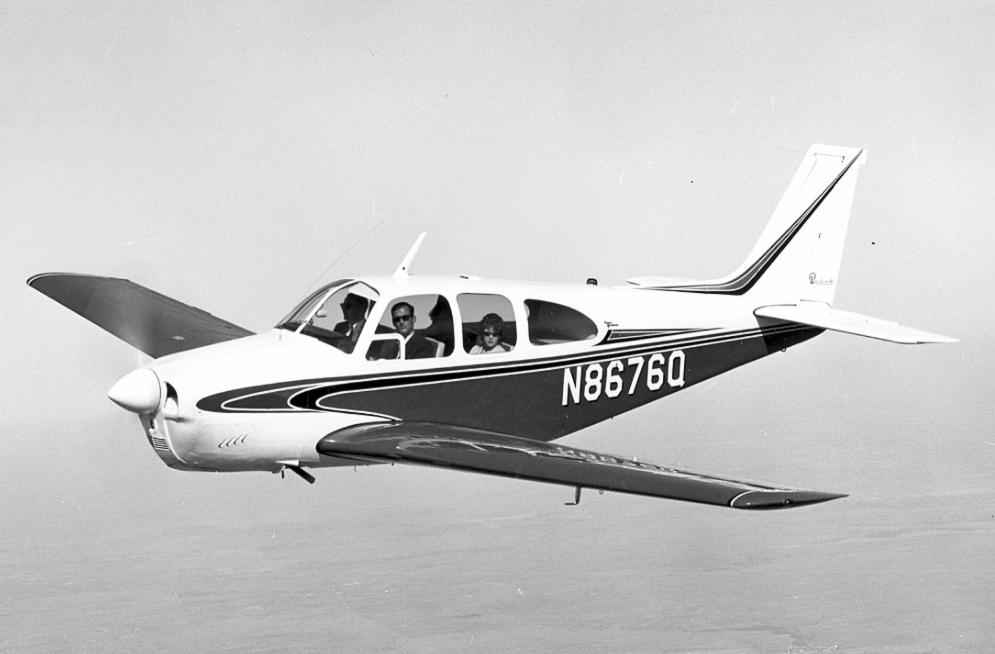
Inflight view of Beech
C33 Debonair,
N8676Q. This is a 1965 model C33. This Debonair has the first
type larger 3rd side window, the same as used on the N & P
model Bonanza's. B&W, about 54K,
Added 09/04/06.
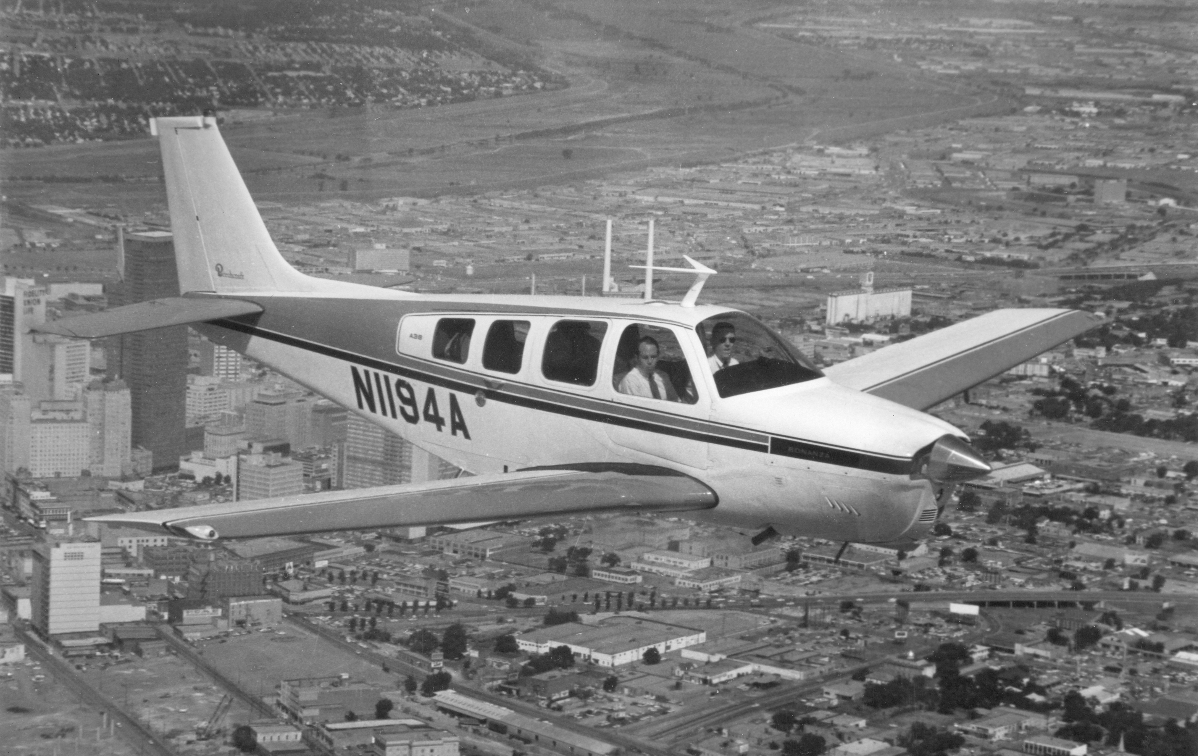
Inflight view of
a 1969 Beech model A36 Bonanza N1194A. The model 36 is an enlarged model
33 Bonanza lengthened 10 inhes designed to carry 6 people, introduced
in 1968. Originally marketed with an utilitarian interior for charter
operators it has four cabin windows each side, starboard rear
double doors with six seats. One 285 hp Continental IO-520-B engine.
To improve sales in 1969 Beech upgraded the interior to match the V35B
interior. This image is, I believe the prototype 1969 model A36 Bonanza.
B&W, about 542K, Added 10/01/25.
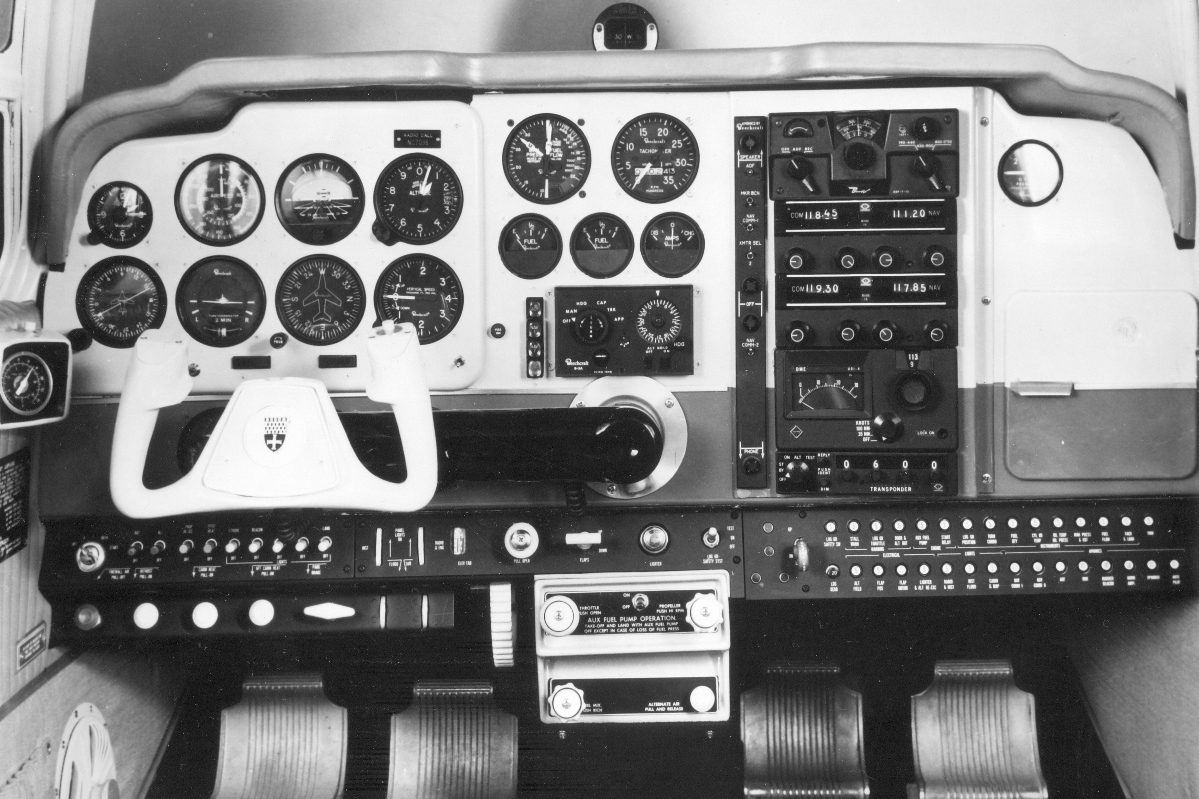
View of a 1969
Beech model A36 Instrument panel N67036. Changes include having
four landing gear position lamps. B&W, about 501K,
Added 10/01/25.
Inflight view of
Beech model 34 Twin Quad prototype feederliner, NX90521. The Twin Quad was
powered by four 8 cylinder Lycoming engines. There was a pair of engines
buried in each wing driving the 2 propellers through a gear box. The engine
power train used clutches so that if any one engine failed the remaining engine
in that wing continued to power the propeller. The Twin Quad was configured
to seat 20 passengers. First flown in 1947, Beech marketing determined that
the cost of the Twin Quad price was too high to compete with surplus Douglas
DC-3's available after WWII. B&W, about 270K,
Added 05/01/16.
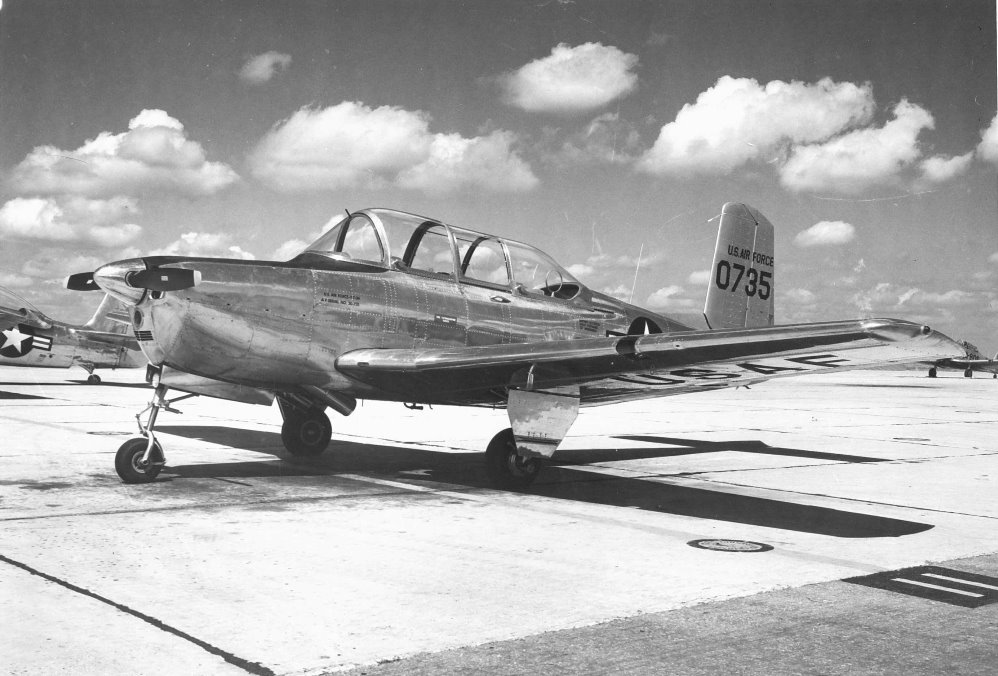
Ground view of Beech
YT-34 Mentor,
USAF serial number 50-735, Beech serial number G-4, the first of
three service test YT-34 Mentors. To the left of the propeller
spinner, you can see the tail of one of the other contenders for
the Air Force trainer, the Fairchild T-31. B&W, about 123K,
Added 07/20/08.
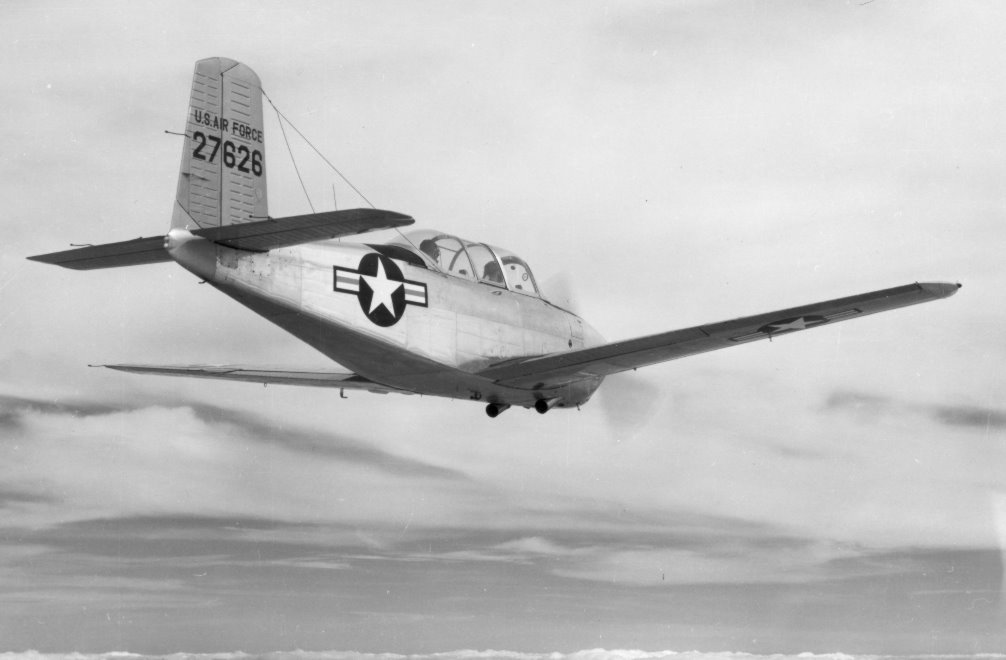
Inflight view of Beech
model 45 - T-34A Mentor, USAF serial number 52-7626, Beech serial
number G-7, the first production T-34A Mentor. View from slightly
below and from the rear. B&W, about 57K,
Added 04/10/08.
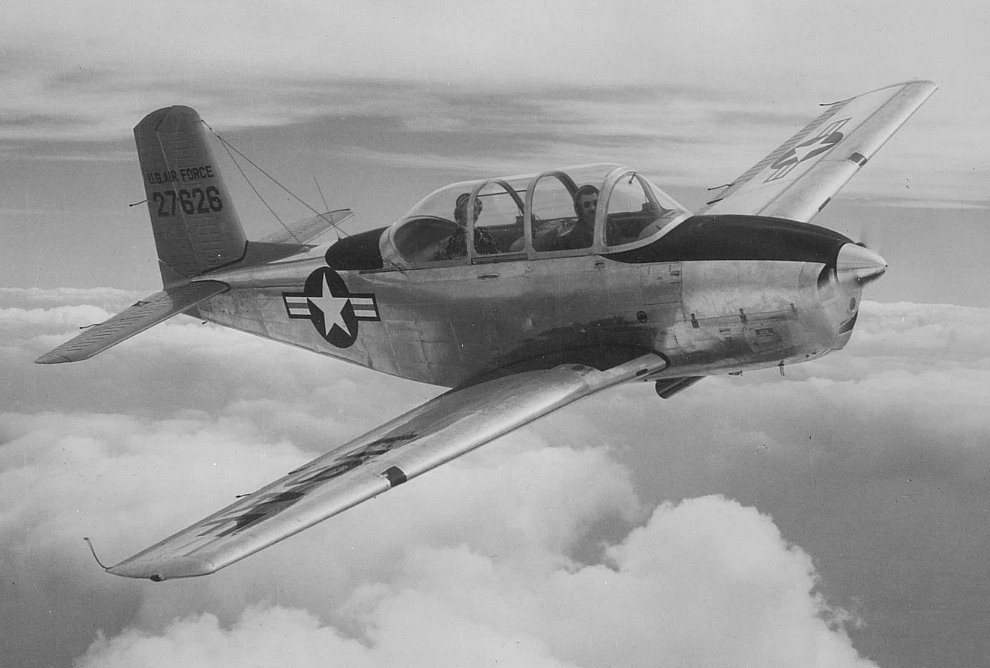
Second inflight view of Beech
model 45 - T-34A Mentor, USAF serial number 52-7626, Beech serial
number G-7, the first production T-34A Mentor. View from about
1/2 front at the same height. B&W, about 86K,
Added 05/31/08.
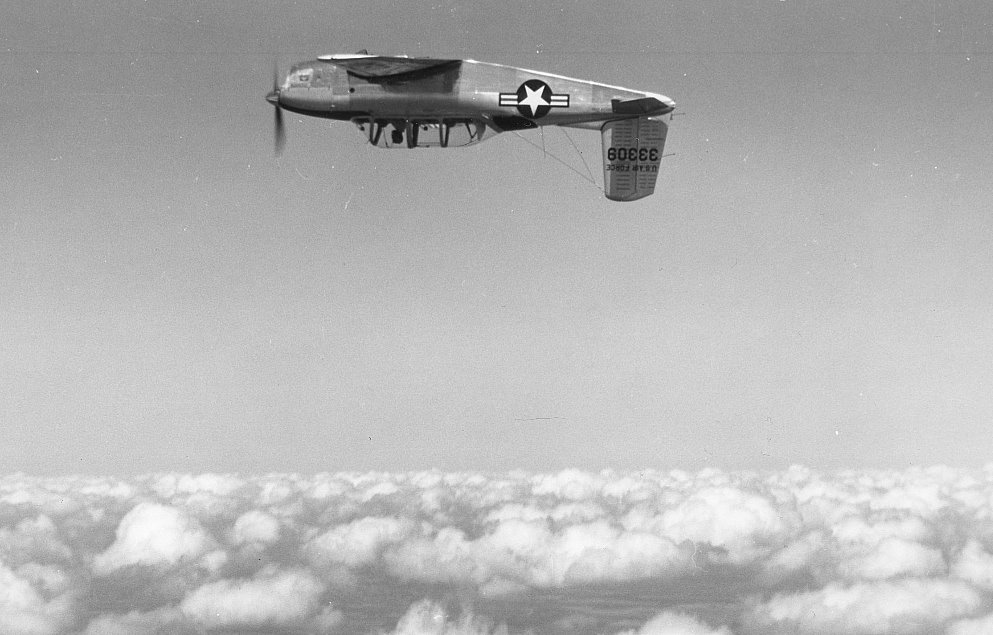
Inflight view of Flying
Upside down T-34A Mentor, USAF serial number 53-3309, Beech serial
number G-70. B&W, about 99K,
Added 04/10/08.
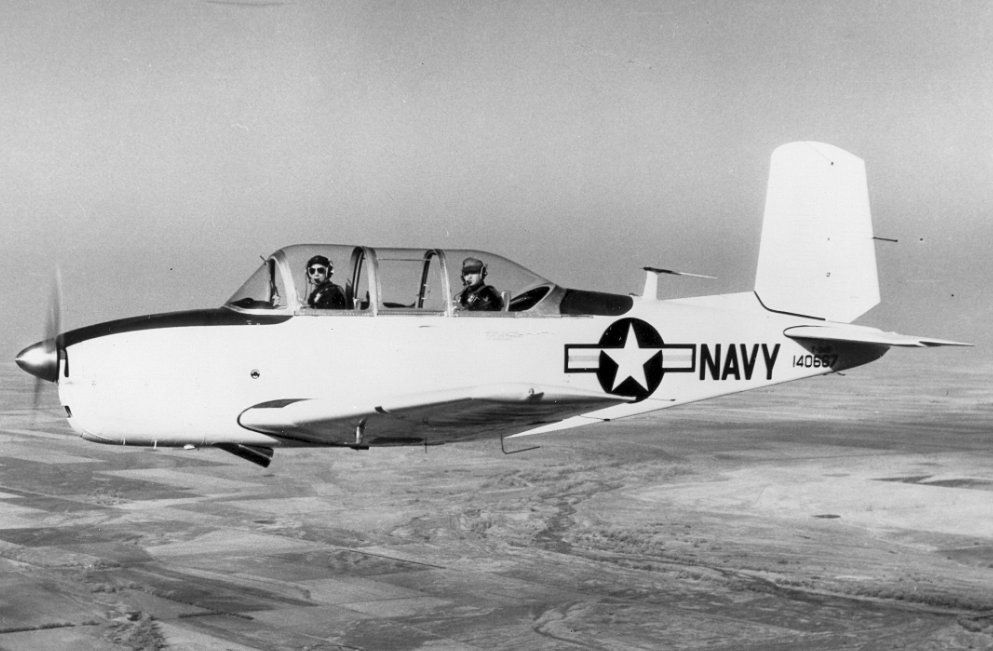
Inflight view of Beech
model 45, also known as the T-34B Mentor
, US Navy bureau number 140667,
Beech serial number BG-1. Differences between the A and B model
are the missing filet below the rudder on the B model, and ARC
omni antenna between the back of the canopy and the vertical
stabilizer. Although originally sold mostly to the US and foreign
military in the mid 1950's, many military Mentor aircraft are
now on the civil register. Much later Beech would change to a
turbine engine and change the designation to T-34C Mentor.
B&W, about 96K,
Added 12/24/05.
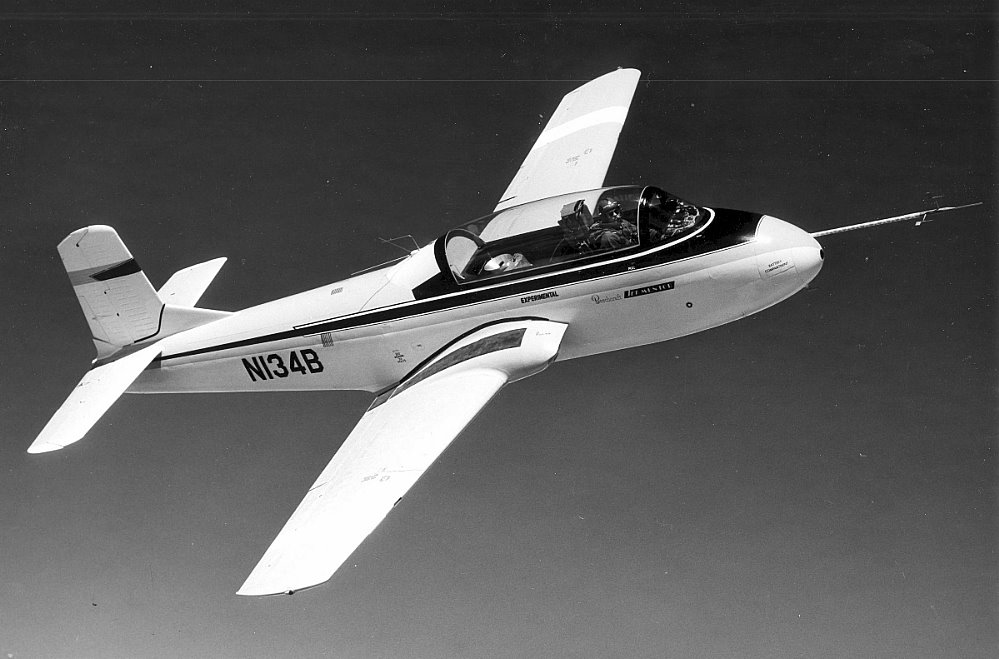
Inflight view of the Beech
model 73 Jet Mentor, on the CAA register as N134B. Although
designed to be a military trainer, the prototype was built as a
private venture. Only one Jet Mentor was built, it used a
Continental J-69-T9 920 pound thrust jet engine. Much of the
airframe of the Jet Mentor directly from the T-34 mentor.
B&W, about 92K,
Added 05/31/08.
Shown here in flight is the Beech
model 50 prototype, registered N3992N. This is Beech serial number
H-1, first flown November 15, 1949. In this photograph the pilot
is Steve Tuttle, and the individual in the right seat is engineer
Ralph M. Harmon. B&W, about 72K,
Added 07/04/06.
Here is a ground view of the Beech
model 50 prototype, registered N3992N. This is Beech serial number
H-1, first flown November 15, 1949. Note the airplane is equipped
with plastic coated wooden propellers. Beech also used this type
propeller on the model 35 Bonanza. B&W, about 129K,
Added 07/11/10.
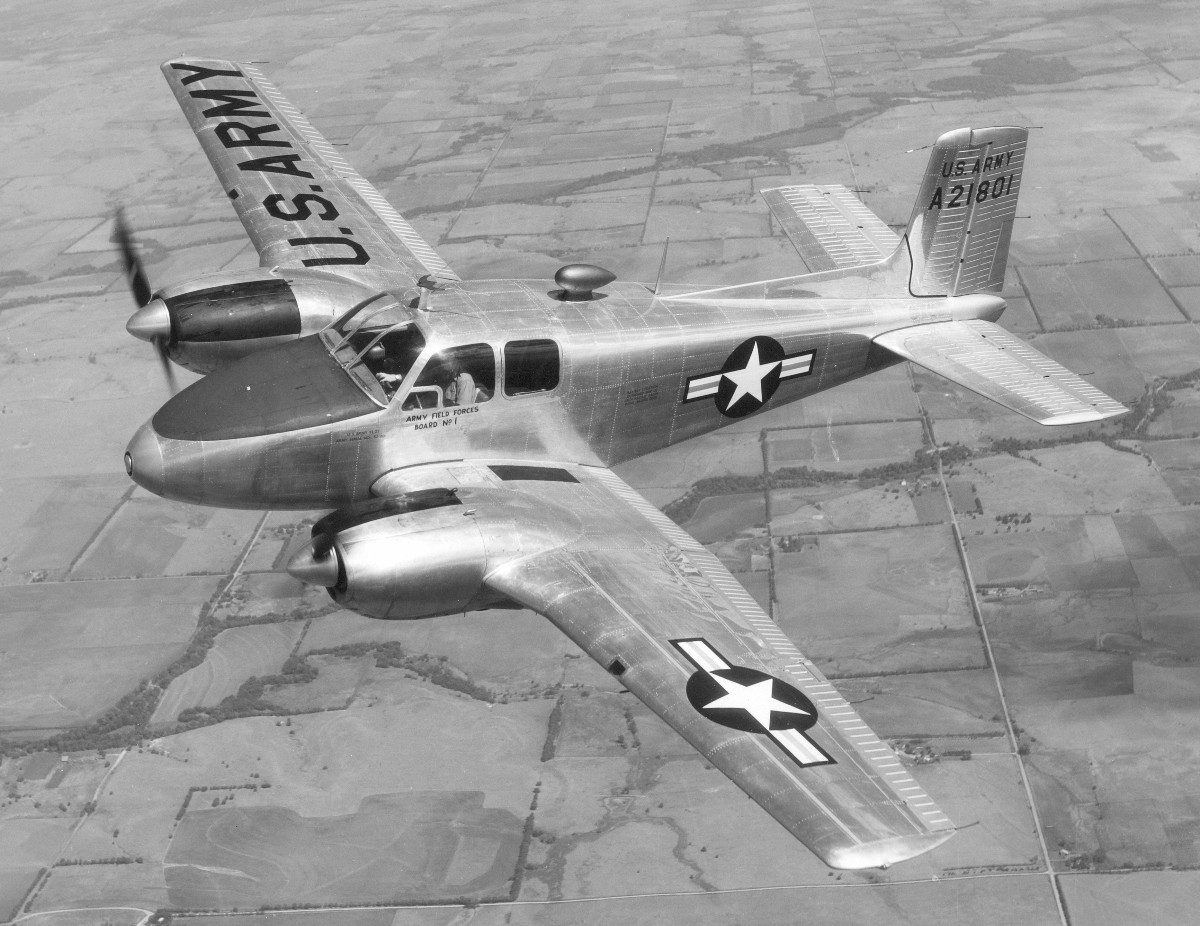
Inflight view of U.S. Army Beech YL-23
Seminole Twin Bonanza, serial number 52-1801, c/n H-9. Later this
airplane was converted to L-23A, serial number 52-6170 with new Beech
c/n LH-9. B&W, about 249K,
Added 01/27/18.
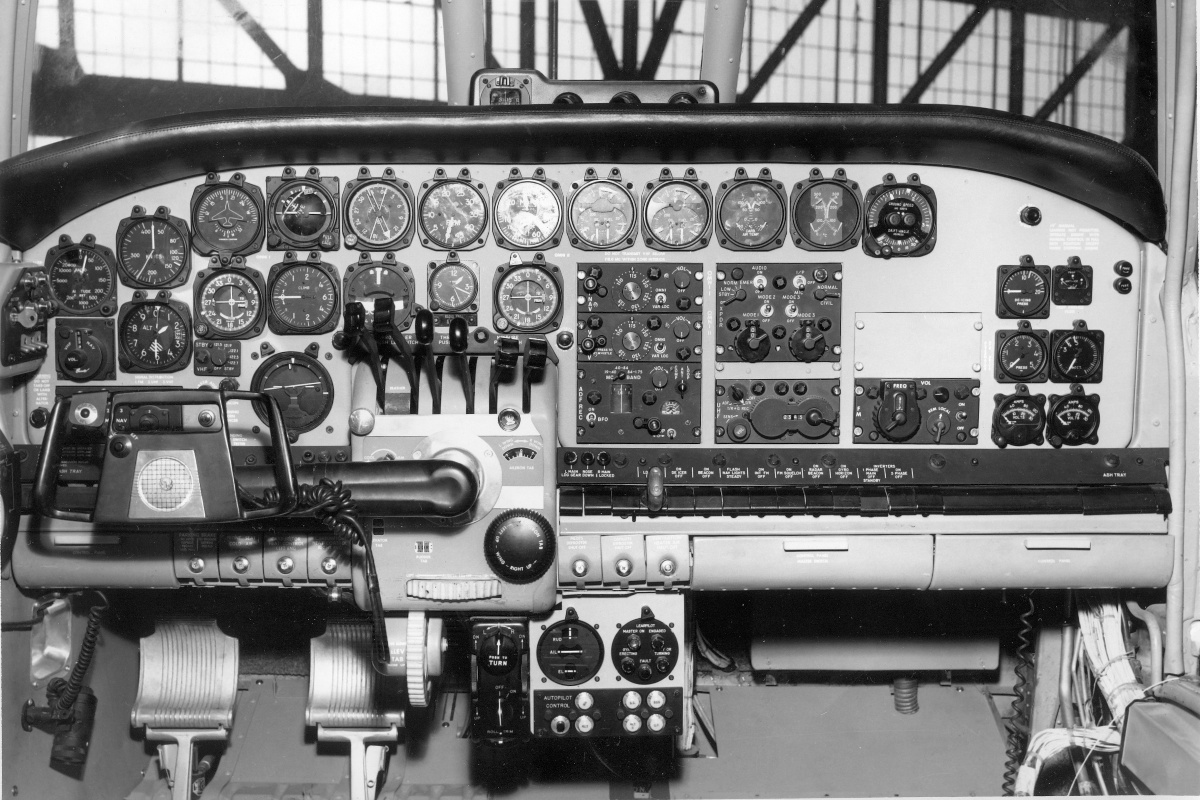
Instrument panel view of U.S. Army Beech YL-23
Seminole Twin Bonanza, serial number 52-1801, c/n H-9. The Beech
model 50 was the basis of the L-23 series of aircraft. The L-23, and
later redesignated U-8, could carry six people on two wide seats each
seating 3 people. View this instrument panel view to get an idea of
the width. The U.S. Army L-23/U-8 aircraft carried military radios
such as UHF communications, the transponders capable to two different
codes, and an FM communications radio to keep in contact with Army ground
personnel. B&W, about 379K, added 05/01/21.
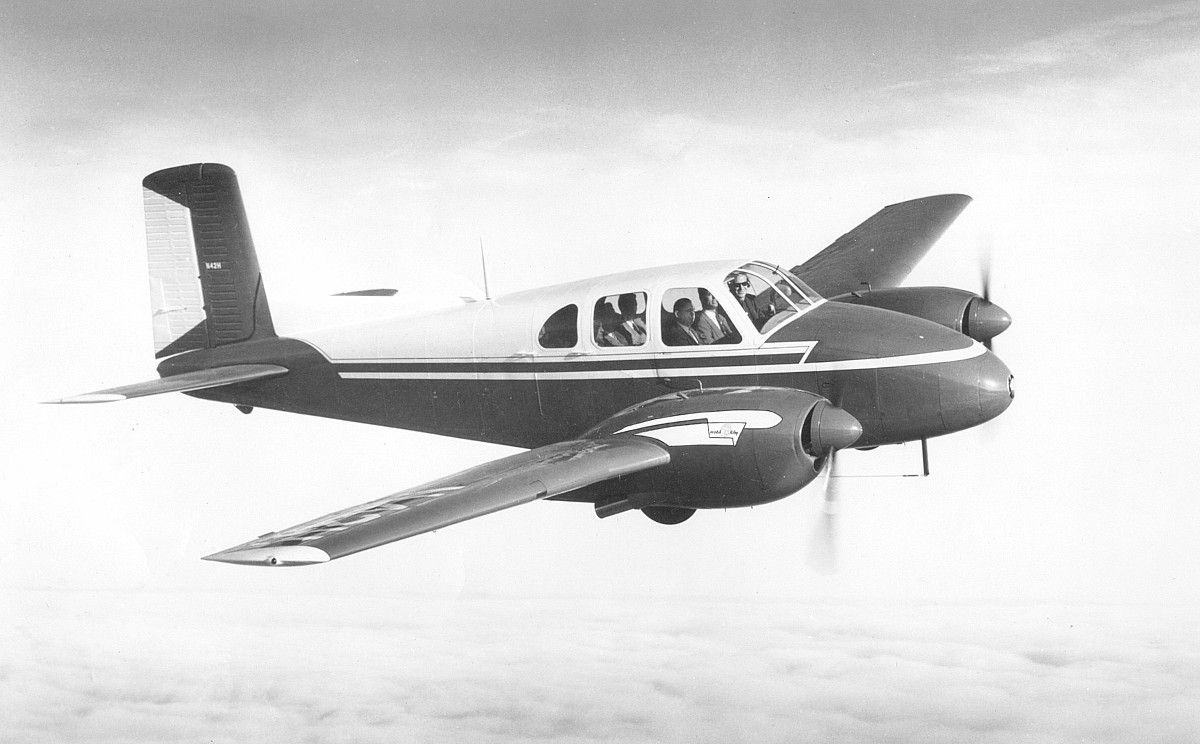
Inflight view of Beech model B50
Twin Bonanza, serial number CH-13, N42H, manufactured in 1953.
Later registered as N75D, later yet as N758. B&W, about 144K,
Added 10/03/15.
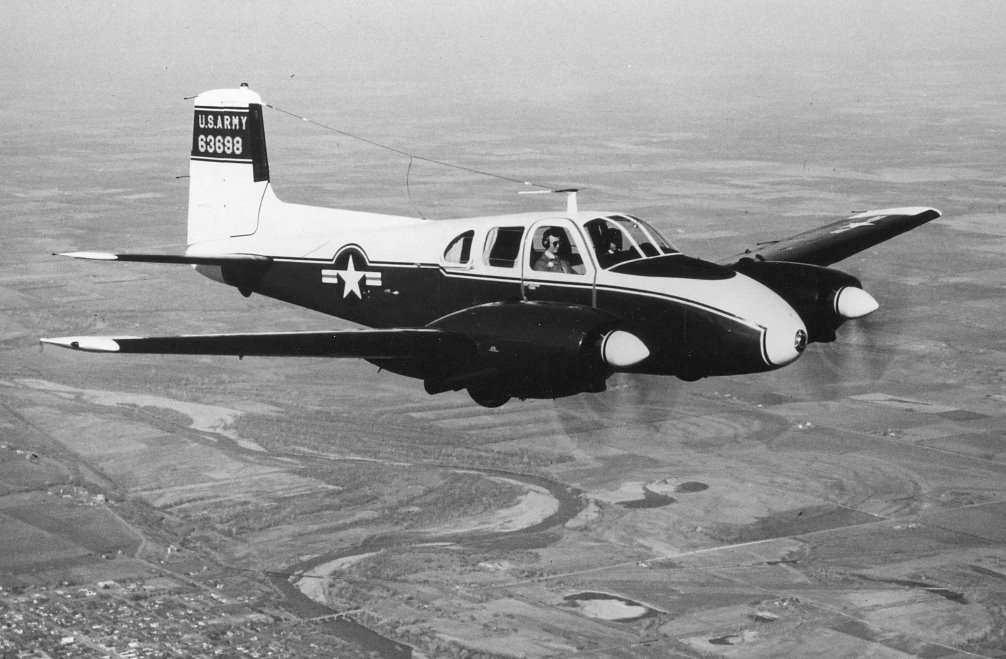
Nice Inflight view of U.S.
Army Beech L23D Twin Bonanza, serial number 56-3698. Photo taken at the
beginning of a 15,500 mile flight to Asia. B&W, about 122K,
Added 07/20/08.
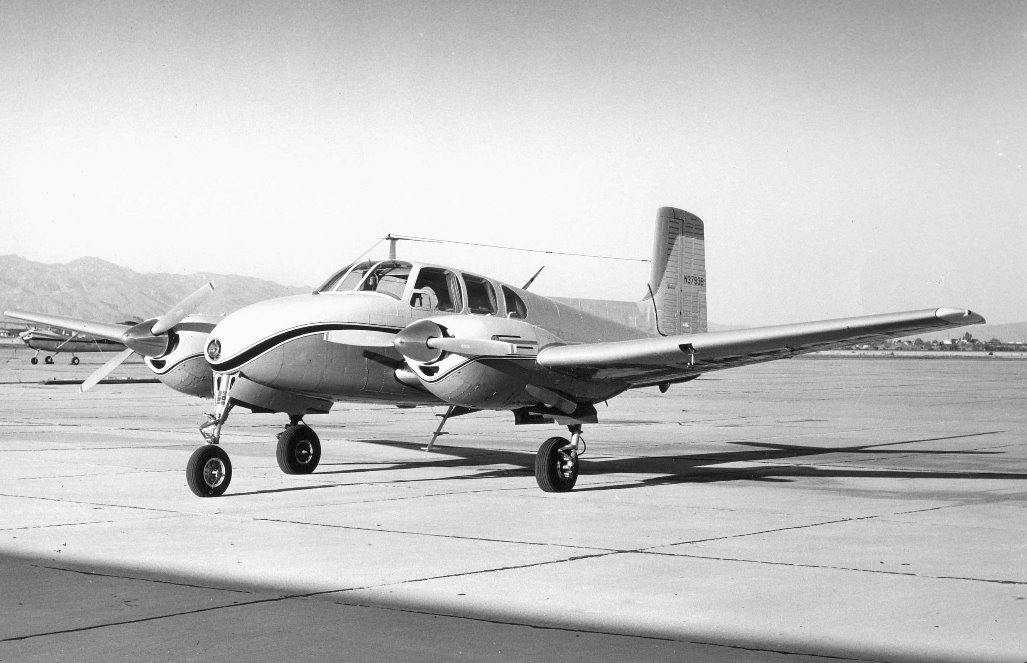
Ground view of 1955
Twin Bonanza C-50, serial number CH-331. Airplane is registered
N3793B in this photo, the registration when manufactured in 1955.
The airplane is currently registered N212G, and is current on the
FAA register. B&W, about 108K,
Added 08/14/10.
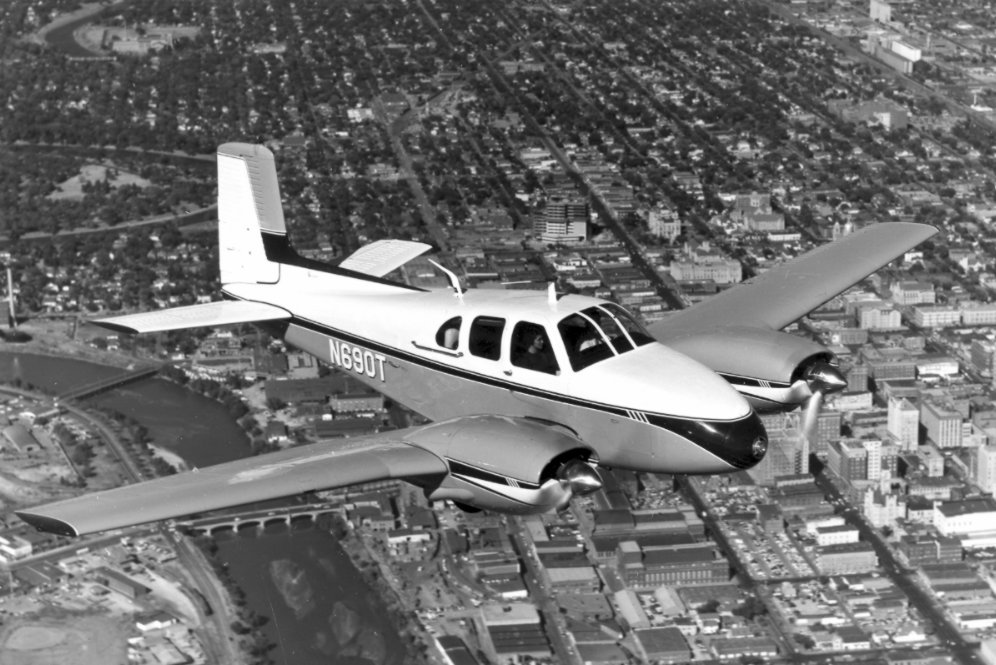
Very nice Inflight view of Beech
G50 Twin Bonanza,
N690T. This is a 1959 model, serial number GH-101, and it is
still current on the US register. This image shows the original
configuration with the cabin entrance door above the wing. Entry
was by climbing up onto the wing as is common with most light low
wing general aviation aircraft. The Twin Bonanza is lovingly
referred to as the "T-Bone." B&W, about 141K,
Added 02/23/06.
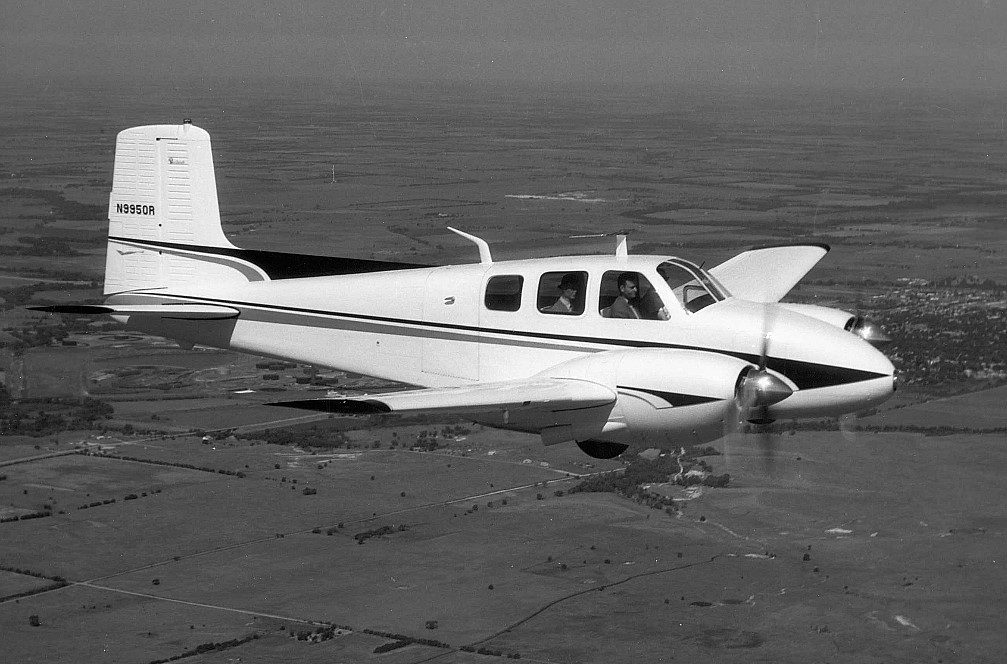
Inflight view of Beech
D50E Twin Bonanza, N9950R. This is a 1961 D50E model, serial
number DH-104. Note that Beech made a significant change with the
D50E and J50 model Twin Bonanza's, in that entry is now via
airstair door behind the wing. B&W, about 157K,
Added 03/30/02.
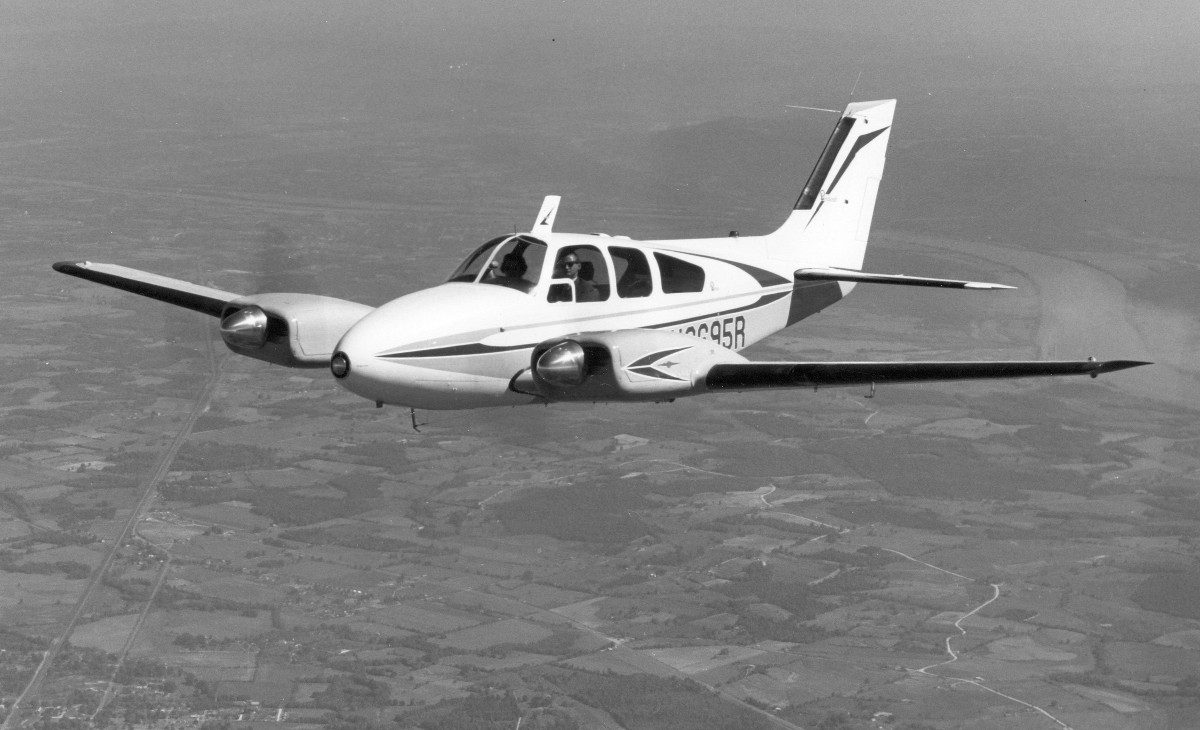
Inflight view of Beech 55 Baron,
N9695R, serial number TC-1, the prototype Baron, built in 1960.
Airplane is still current on the FAA register. B&W, about 168K,
Added 08/05/17.
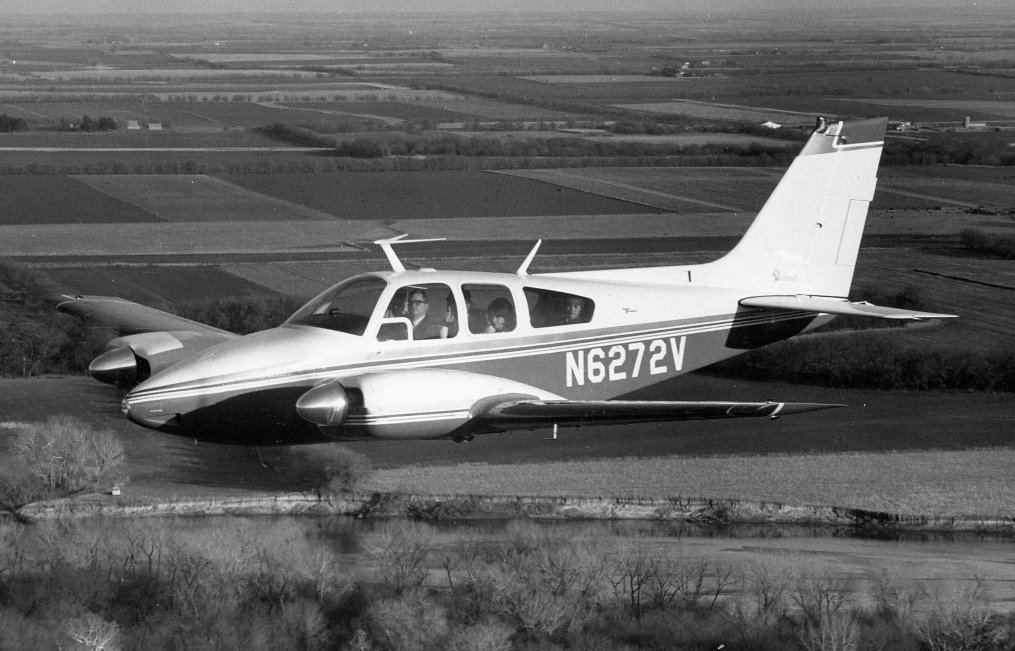
Inflight view of Beech
B55 Baron,
N6272V. This is serial number TC-1043 built in 1967. The B55
Baron has two 260HP Continental engines. This airplane is current
on the FAA register. Believe the Beech Baron has been in
production longer than any other twin piston engine airplane.
B&W, about 128K,
Added 04/22/12.
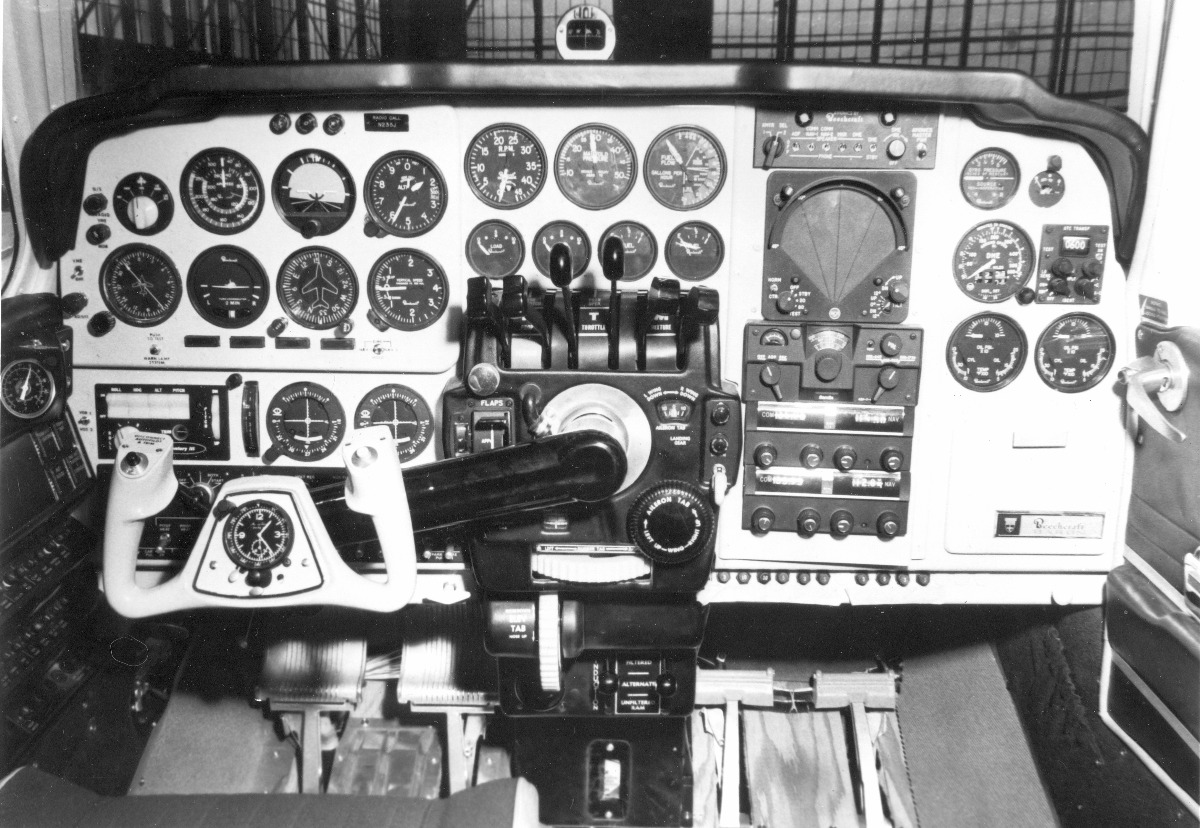
View of a Beech
B55 Baron Instrument Panel, of N235J, a 1970 B55 Baron.
Notice how Beech designed the throttle quadrent with the
propeller levers on the far left, throttles in the middle,
mixture controls on the right. When an engine fails the
procedure is to push the propeller levers full forward to
put the propellers in low pitch, then push the throttles
forward to increase power to the working engine, finally
push the mixtures levers forward to full rich mixture. This
is totally logical as the pilots hand only has to move in
one direction to accomplish the proceedure fast. Other
airplane manufactures assembled the throttle quadrent as
throttle, propeller, mixture left to right and even though
this requires the pilot to move their hand back and forth.
Beech evntually changed their throttle quadrents to what
other manufactures design. B&W, about 304K,
Added 12/01/22.
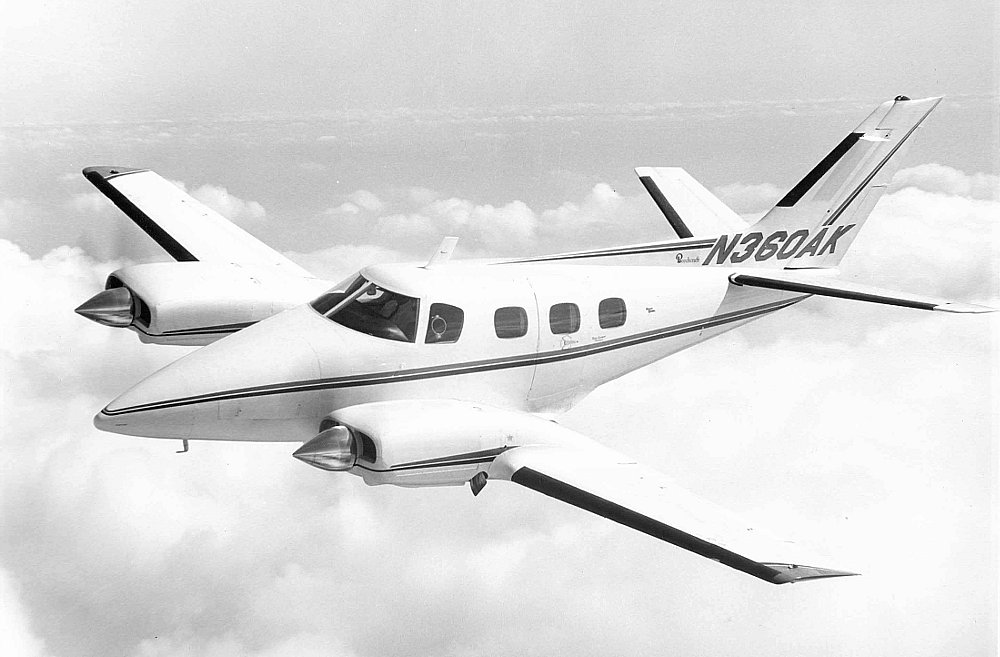
Nice Inflight view of Beech
60 Duke,
N360AK, c/n P-18 a 1968 model. B&W, about 94K,
Added 07/26/13.
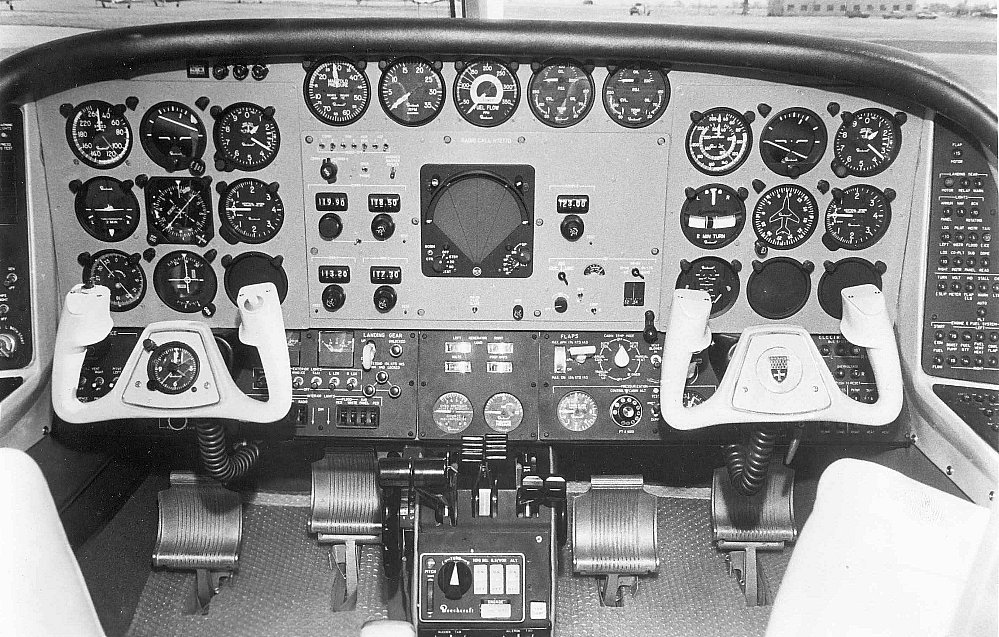
Beech
60 Duke Instrument Panel,
N7277D. Airplane manufactured 1969, c/n P-112, B&W, about 227K,
Added 07/26/13.
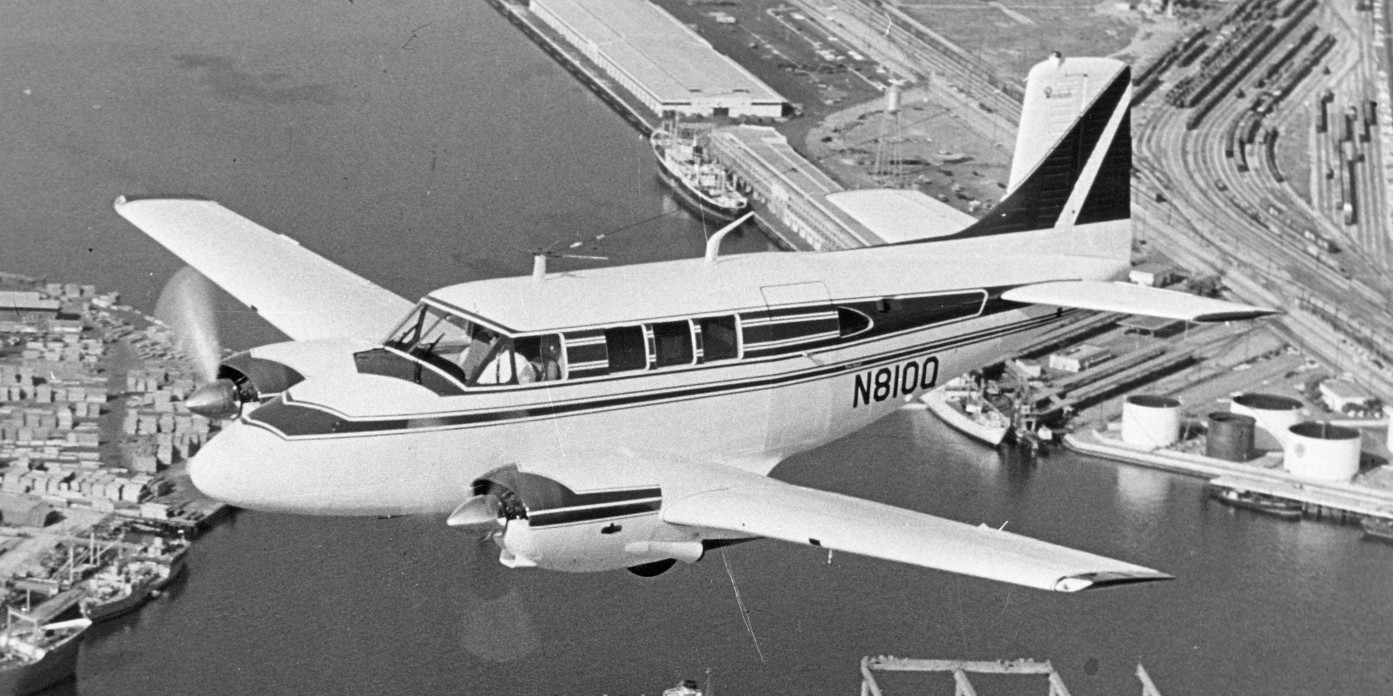
Nice Inflight view of Beech 65 Queen Air,
N810Q, c/n LC-26, a 1960 model. Current on the FAA register. B&W, about 254K,
Added 11/24/15.
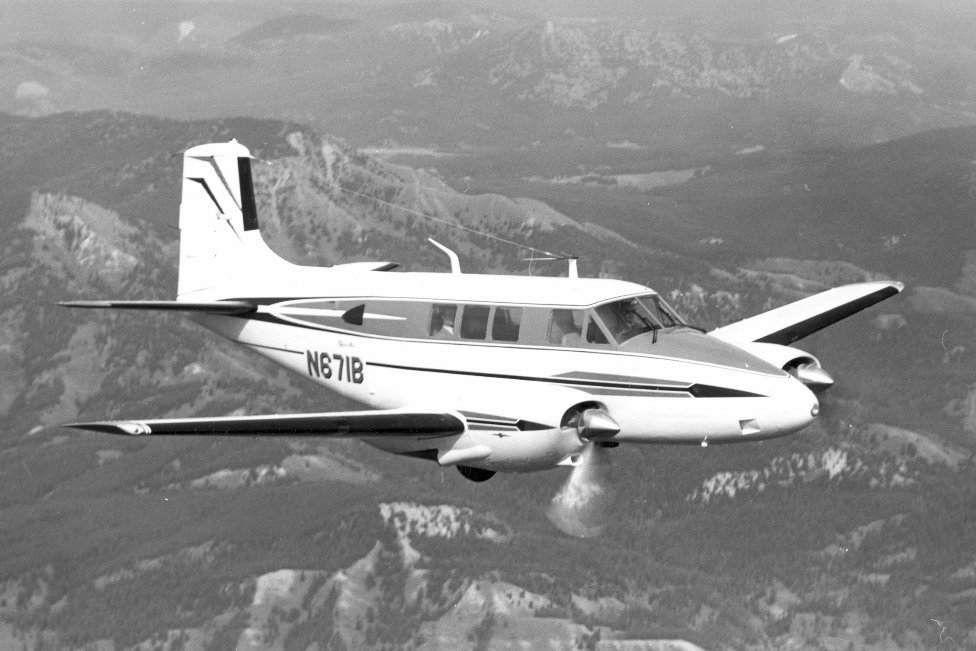
Very nice Inflight view of Beech
65 Queen Air,
N671B. Believe this is a 1960 or 1961 model. B&W, about 101K,
Added 11/28/04.
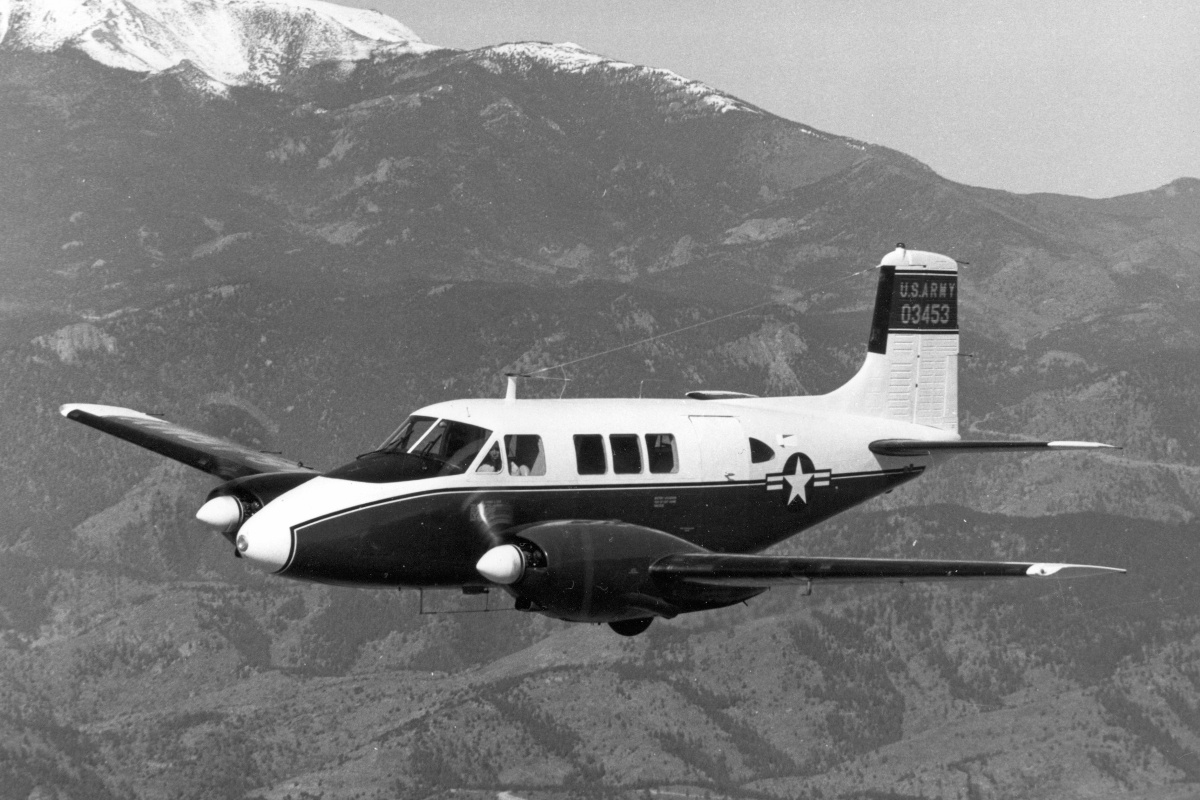
Inflight view of a Beech L-23F/U-8F Seminole,
s/n 60-3453, c/n LF-9. The L-23F/U-8F was the military version of the
Beech model 65 Queen Air. Power by two Lycoming IGSO-480 engines.
B&W, about 336K, added 05/01/21.
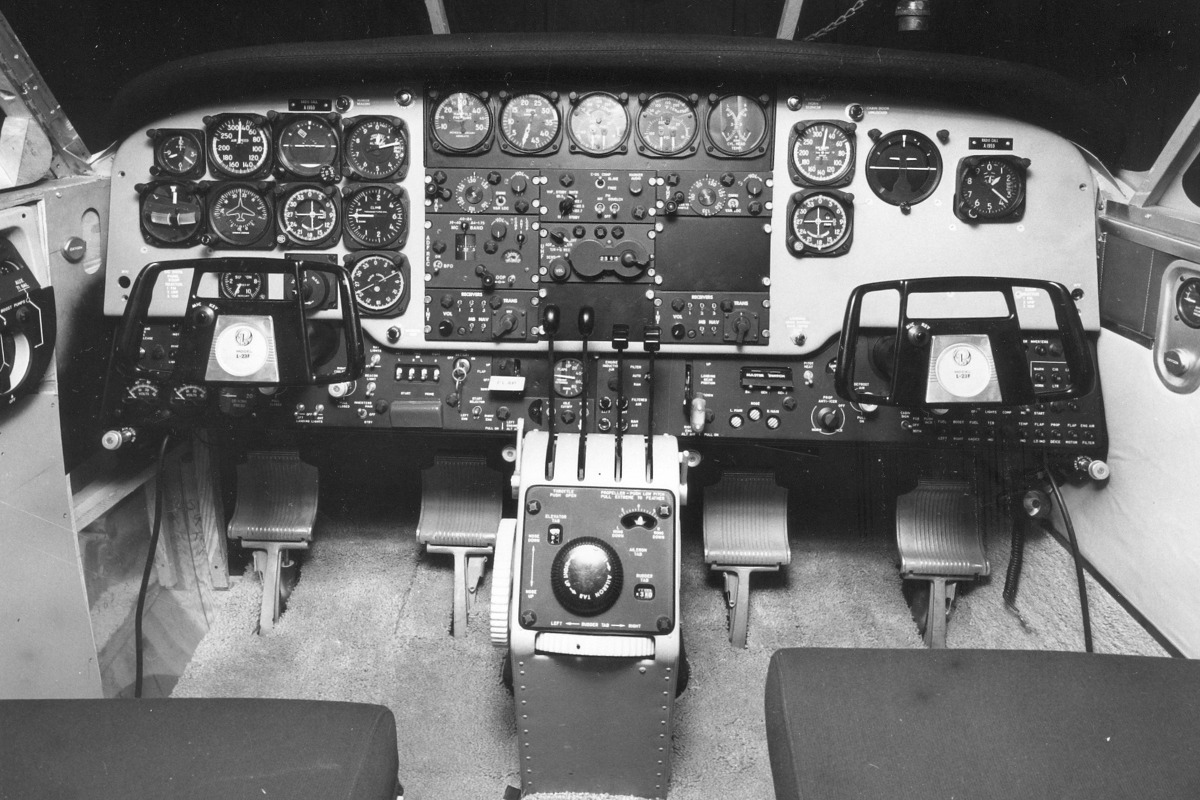
Instrument panel view of Beech L-23F/U-8F Seminole,
s/n 60-3453, c/n LF-9. Co-pilot side has only minimal instruments, military radios.
B&W, about 280K, added 05/01/21.
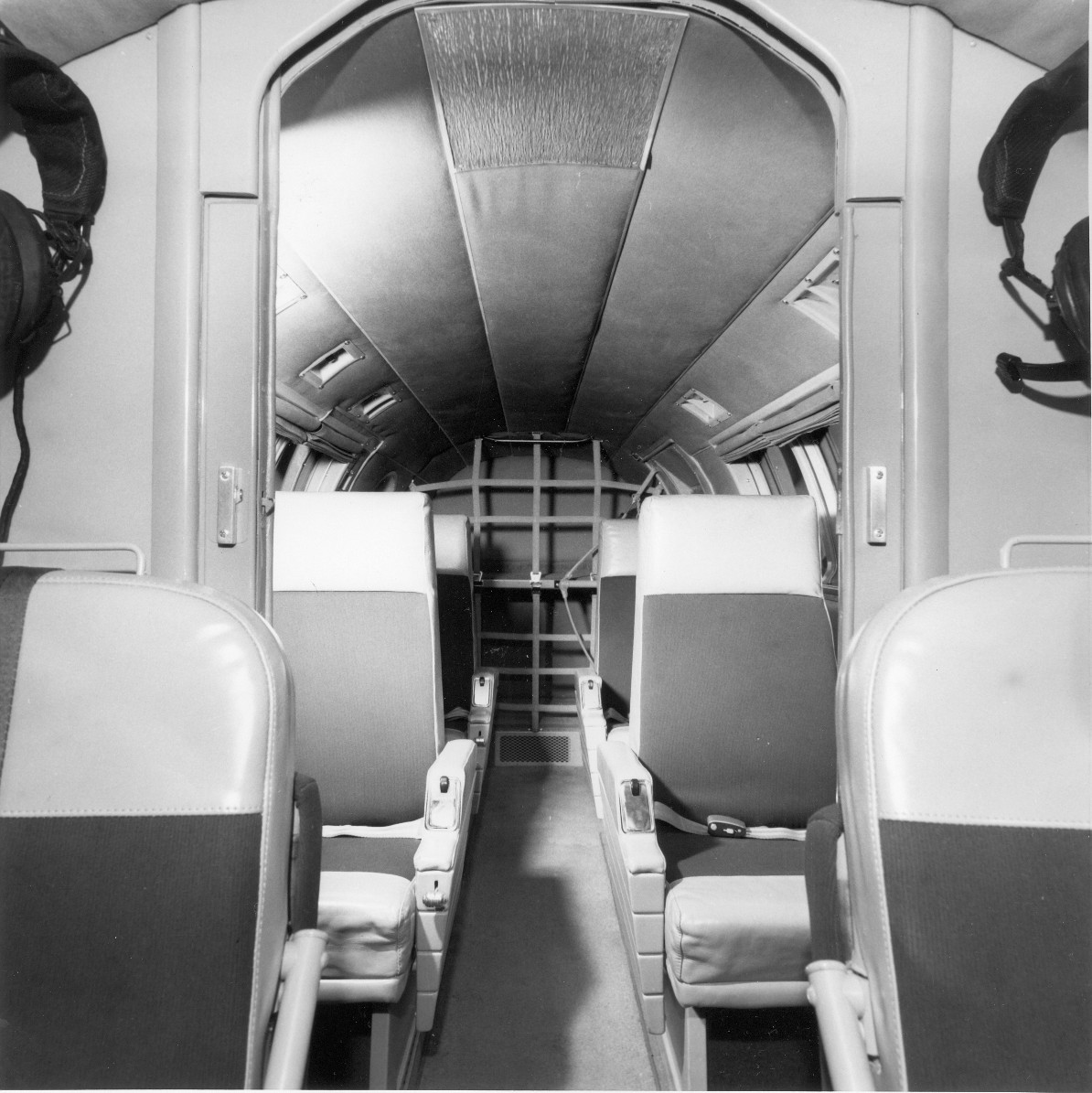
Cabin view of Beech L-23F/U-8F Seminole,
s/n 60-3453, c/n LF-9. Seating for one or two pilots, plus 4 passengers. Basic Interior.
B&W, about 273K, added 05/01/21.
Nice Inflight view of Beech
70 Queen Air,
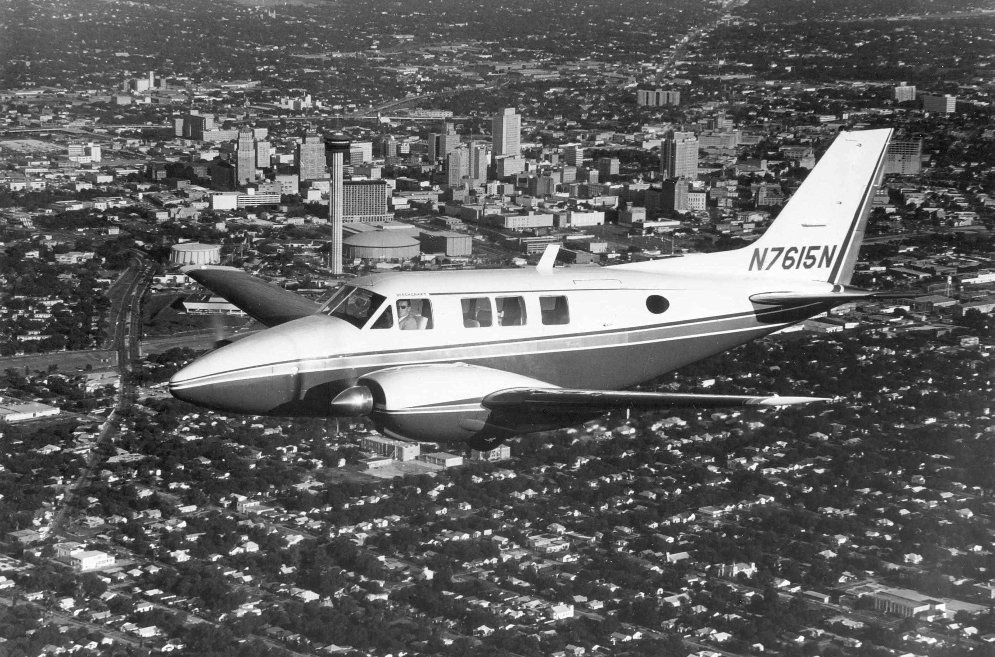
N7615N. Only thirty five model 70 Queen Air aircraft were built. Believe
this is a 1969 model. B&W, about 206K,
Added 07/26/13.
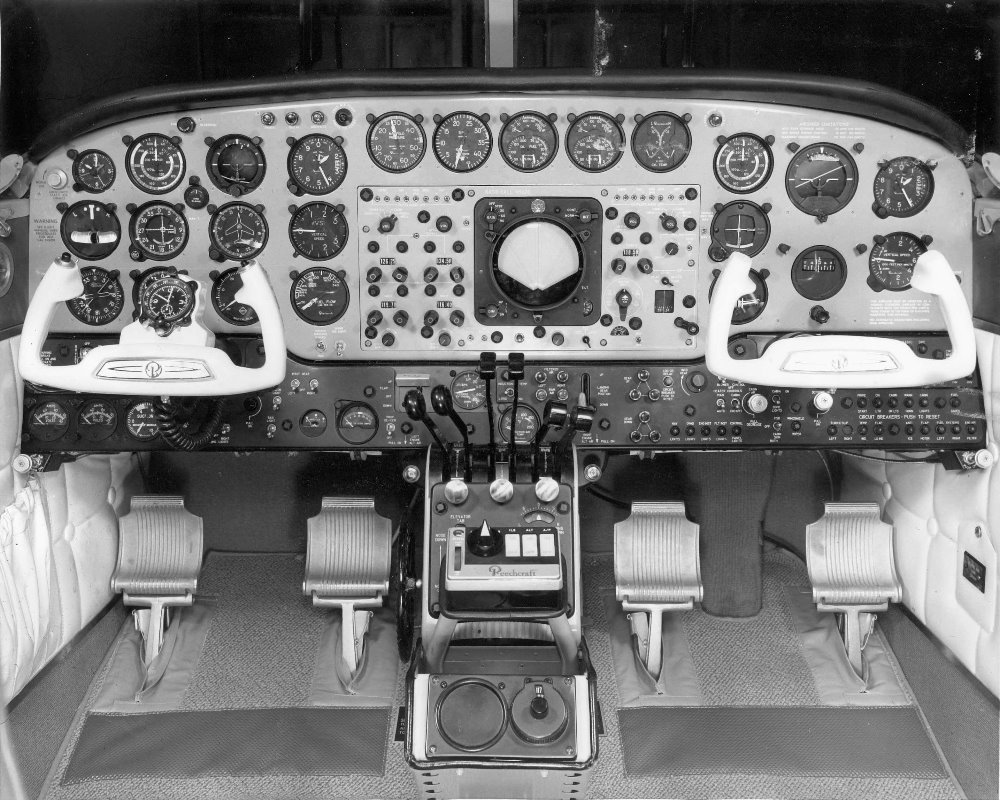
Beech
80 Queen Air Instrument Panel, N362Q when photographed. Serial
number is LD-26, a 1962 model. As you can see a very well equipped
airplane. Radios are ARC, weather radar is RCA. Airplane is
current on the FAA register as N99FA. The pilot's side of the
instrument panel has new production gyros, while the co-pilot's
side of the instrument panel has overhauled WWII gyros. B&W, about 200K,
Added 10/17/10.
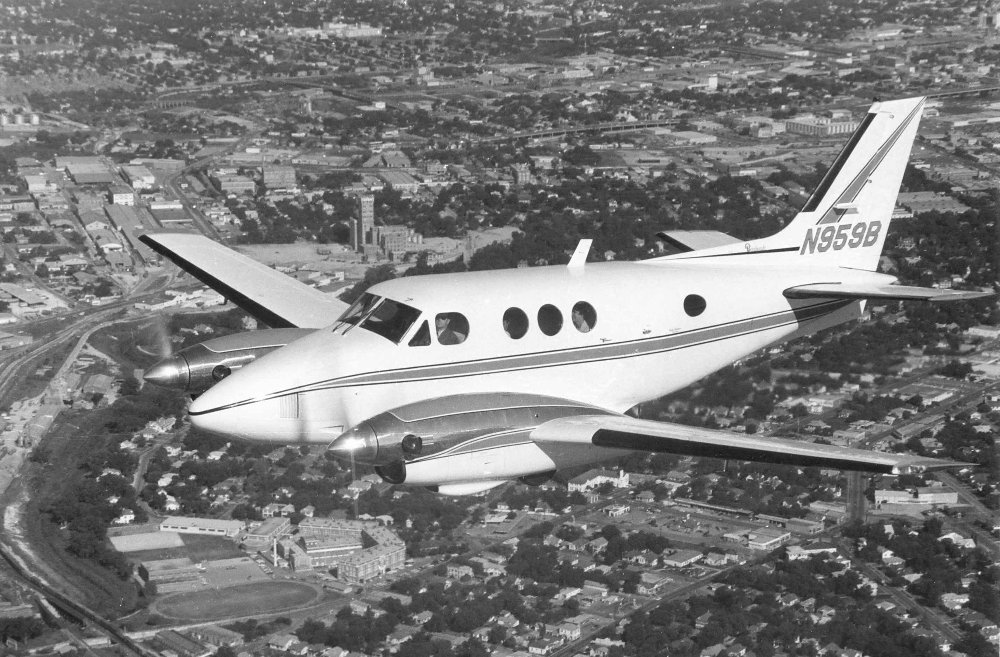
Inflight view of Beech
65-90 King Air,
N959B. The model 90 King Air went into production in 1964, and
Beech continues to manufacture King Air's in 2013. The model 90
King Air has 3 passenger windows on each side. B&W, about 175K,
Added 07/26/13.
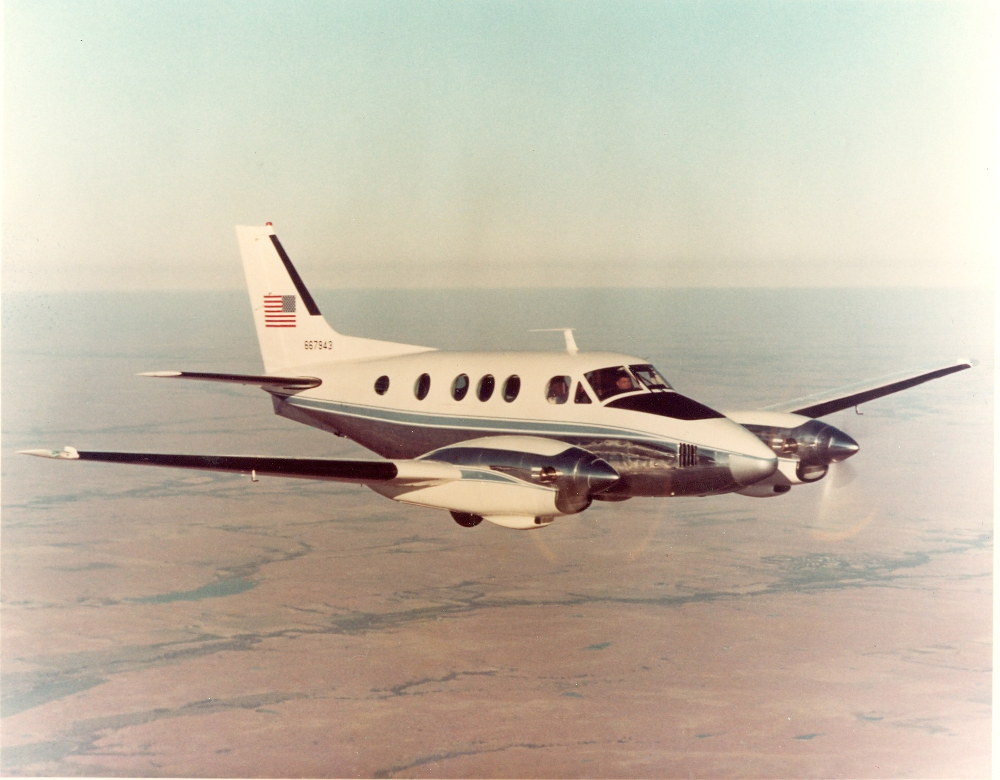
Inflight view of Beech
VC-6A King Air,
USAF serial number 66-7943. This King Air was purchased by the
USAF to support President Lyndon B. Johnson and members of his
family transporting them between Bergstrom Air Force Base, Texas
(near Austin), and the Johnson family ranch (near Johnson City).
During that time, the aircraft became informally known as the "Lady
Bird Special." Today this airplane is at the National Museum of
the United States Air Force, presidential aircraft collection.
Color, about 121K,
Added 04/28/14.
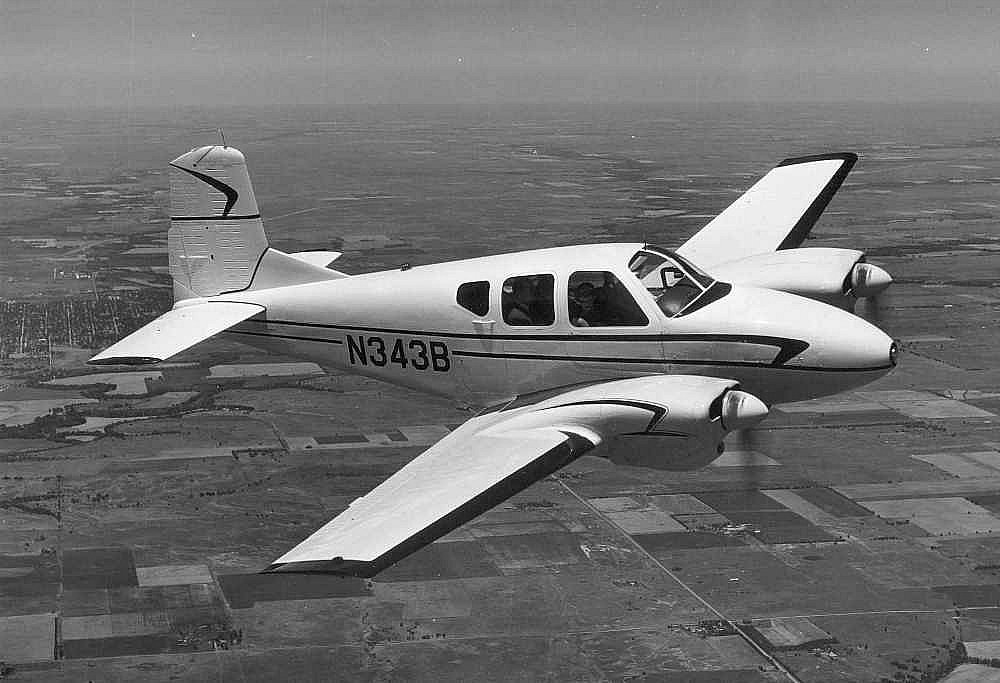
Inflight view of Beech
95 Travel Air,
N343B. This is serial number TD-2 built in 1957. The Travelair
has 2 180HP Lycoming engines. B&W, about 88K,
Added 03/30/02.
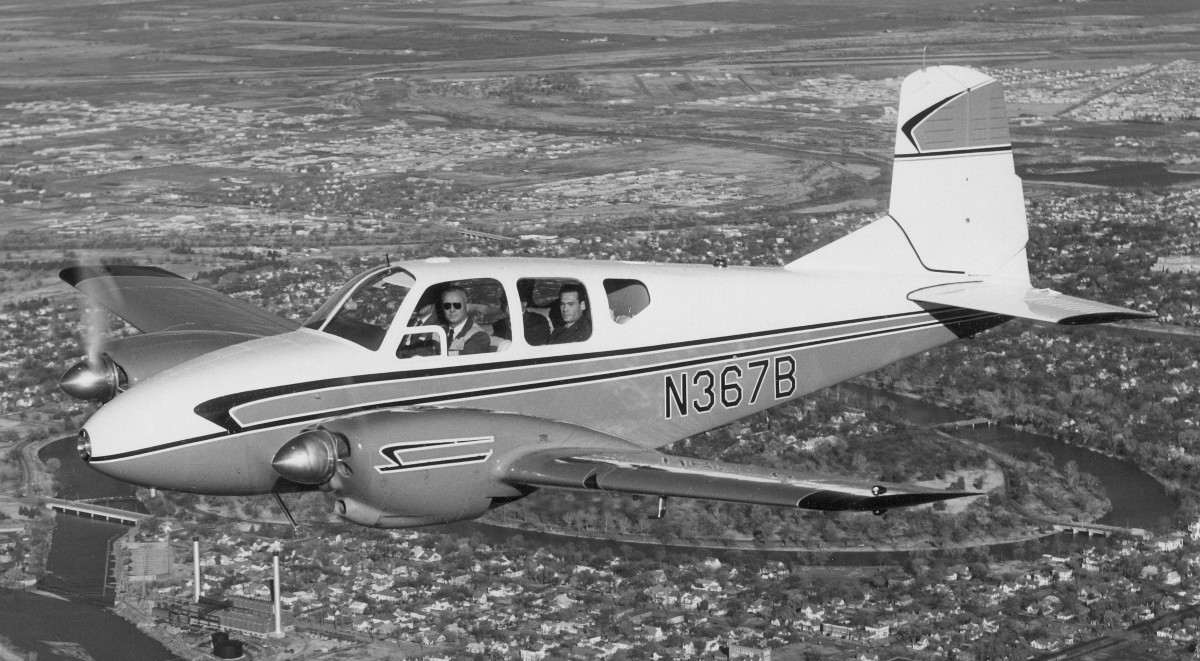
Inflight view of the left side of a Beech
95 Travel Air,
N367B. This is serial number TD-3 built in 1957. The Travelair
has 2 180HP Lycoming engines. B&W, about 236K,
Added 09/28/15.
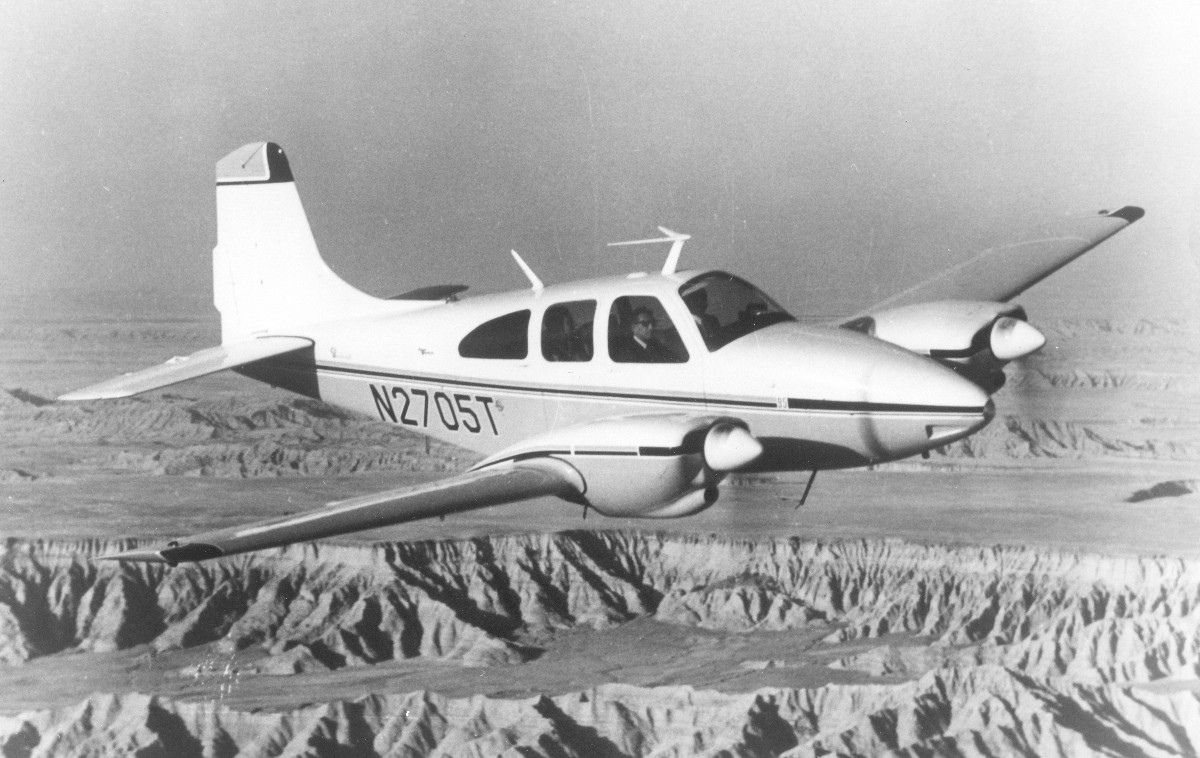
Inflight view of Beech
D95A Travel Air, N2705T. This is serial number TD-690 built
in 1967. The Travel Air now has the longer 3rd window. Current
on the FAA register. B&W, about 206K,
Added 07/20/15.
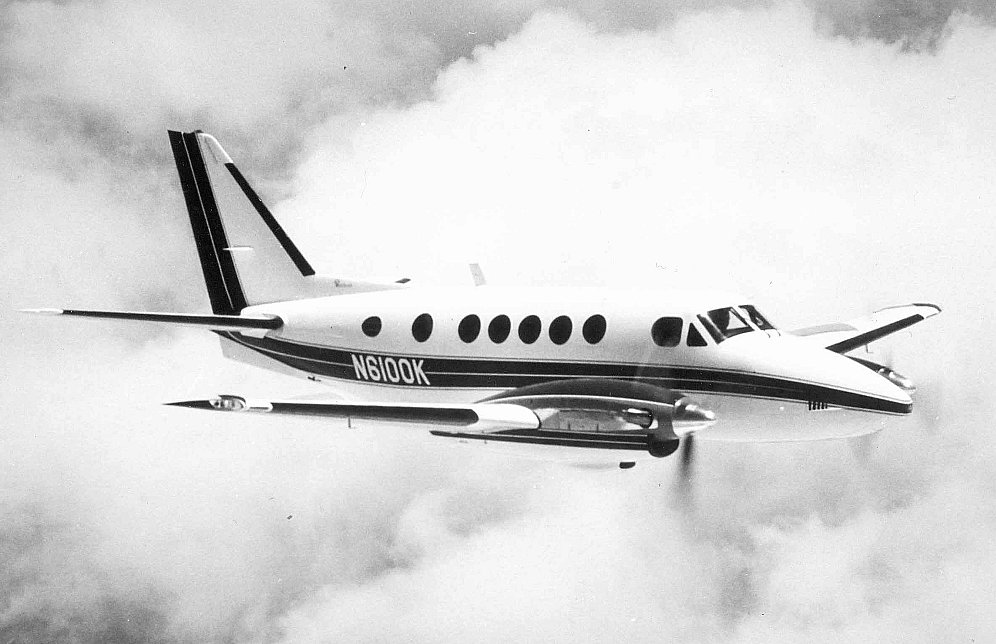
Inflight view of Beech
100 King Air,
N6100K. The model 100 King Air went into production in 1969. The
model 100 King Air is a lengthened model 90 King Air with 5
passenger windows on each side. B&W, about 100K,
Added 07/26/13.
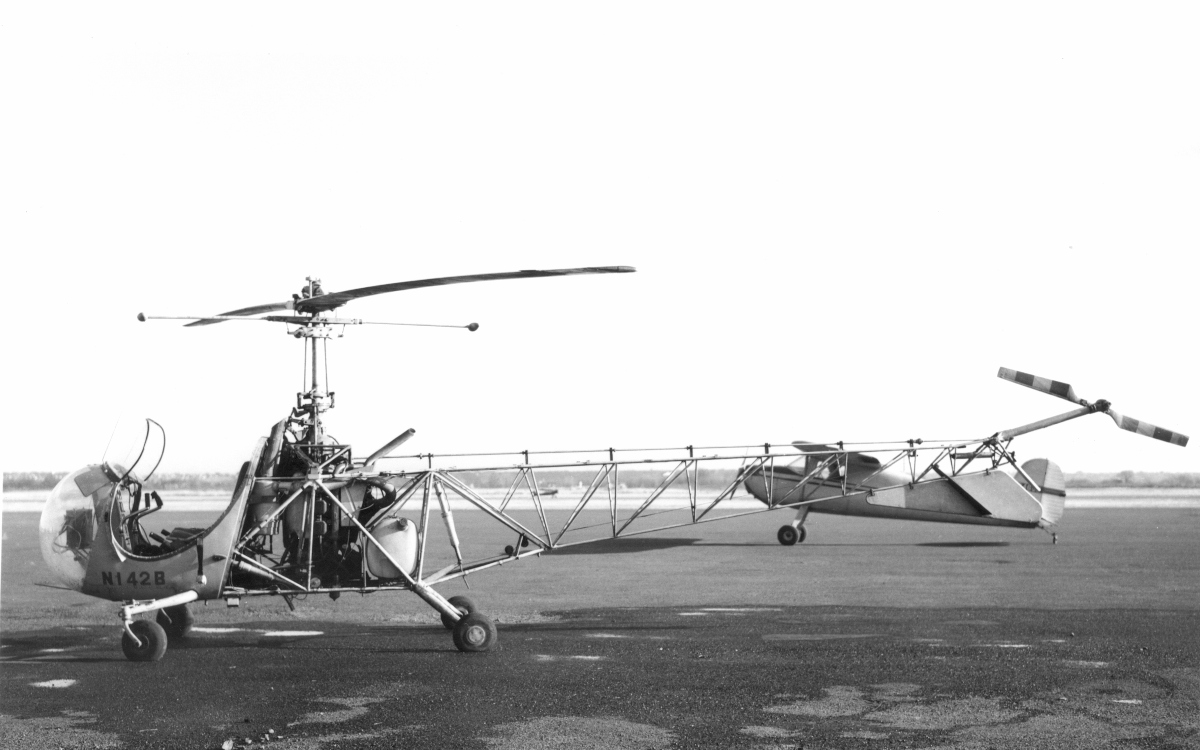
Ground view of of Bell
47B-3, registered N142B, c/n 62, manufactured 1947. This
is an early version of the Bell model 47 with the early type
partial bubble, and the fuel tank near the bottom of the
fuselage frame work. B&W, about 241K,
Added 04/01/21.
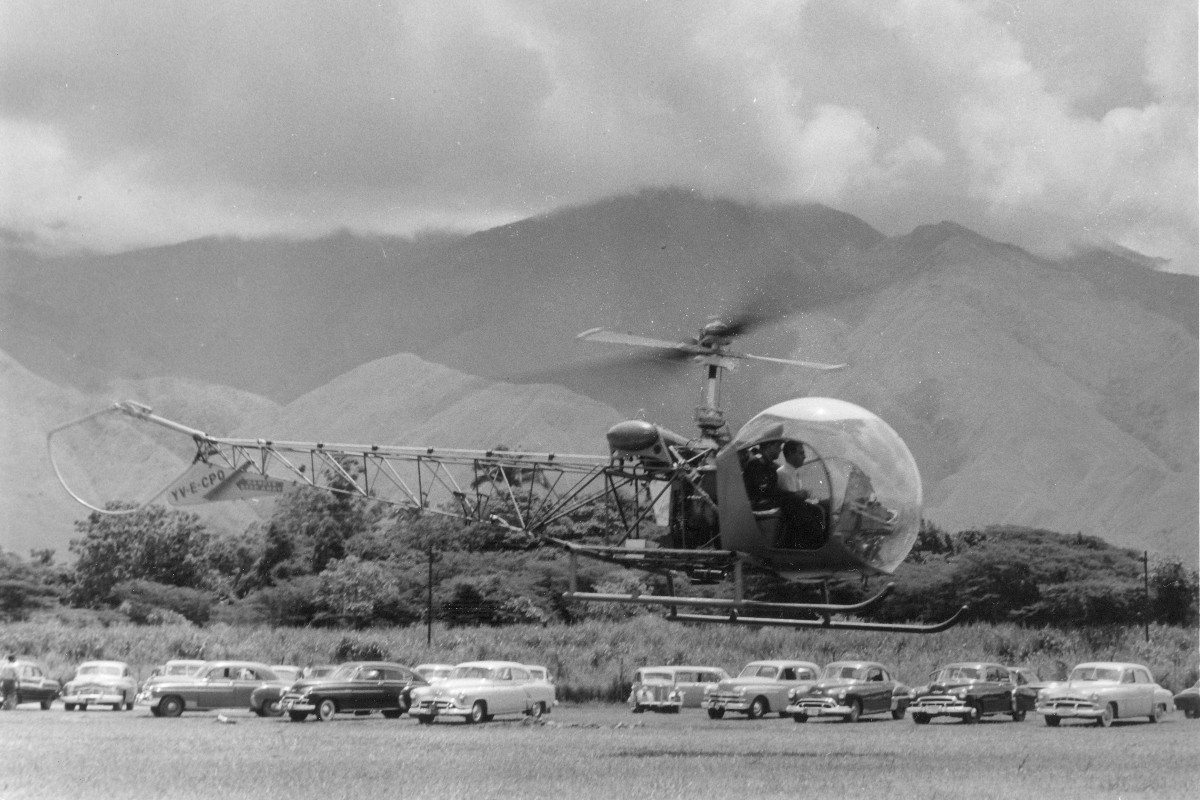
Inflight view of of Bell
47D-1, registration YV-E-CPO, c/n 640, manufactured 1953.
This is the model helicopter made famous by the television
series MASH (Mobile Army Surgical Hospital). The D model now
has a single fuel tank on top of the fuselage frame work
aligned 90 degrees to the line of flight. Beginning with
the 47G model the 47 series helicopters have two fuel tanks
aligned to the direction of flight. B&W, about 221K,
Added 04/01/21.
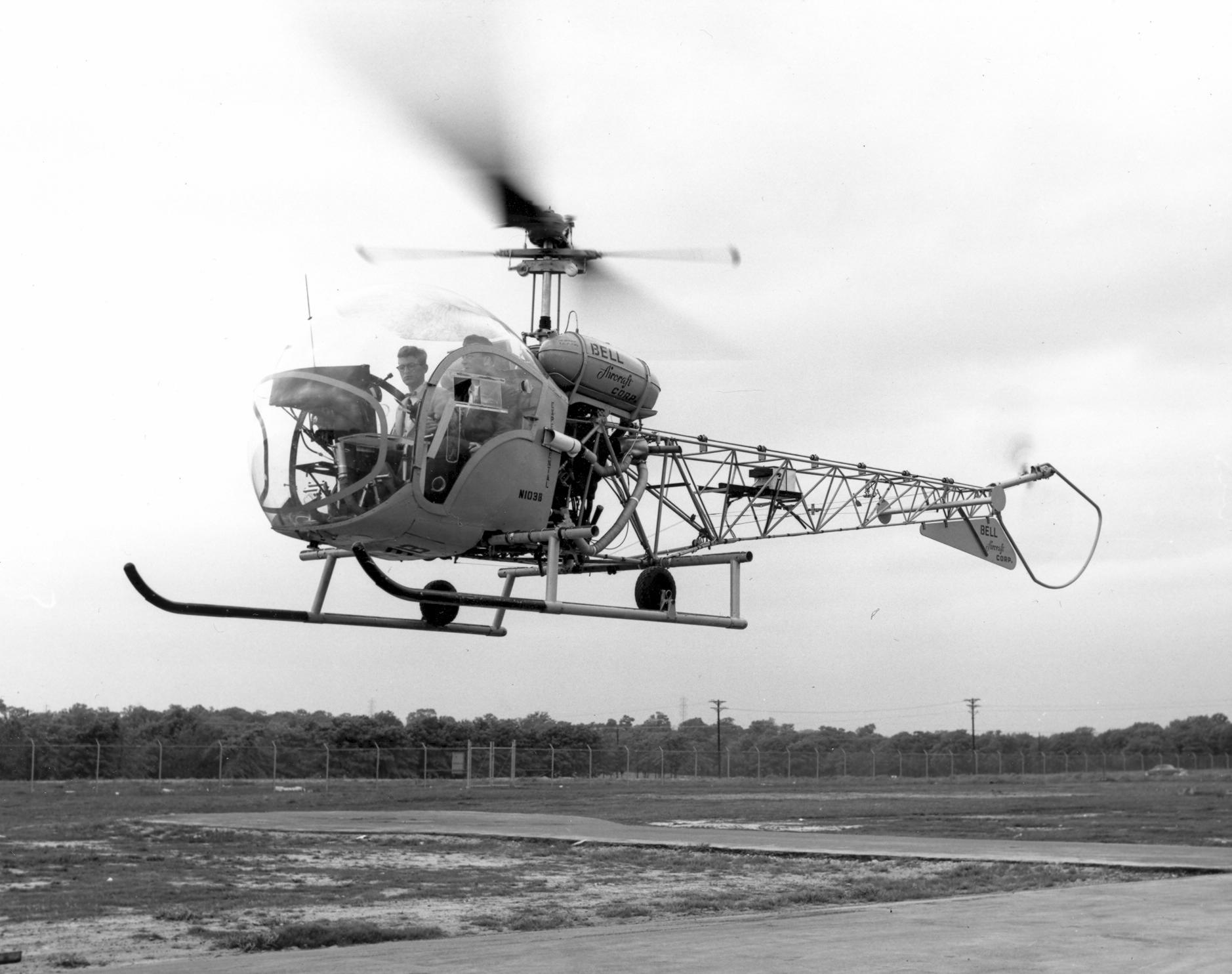
Inflight view of of Bell
47G, N103B. N103B
started out as a 47B s/n 23 at the Bell Aircraft plant in Niagara
Falls, NY. It was later upgraded to a prototype 47D, 47D-1 and
then to a 47G at Bell's Ft. Worth plant in 1953-4. It later
became a 47G-2 and G-3 prototype, a rigid rotor demonstrator and
on and on. This photo was taken at the Hurst plant in Ft. Worth.
The Bell negative number is 203186. My thanks to
Harry Gilliand, a Bell Helicopter
Textron production test pilot for 22 years, for providing information
about this helicopter. B&W, about 208K,
Added 11/24/06.
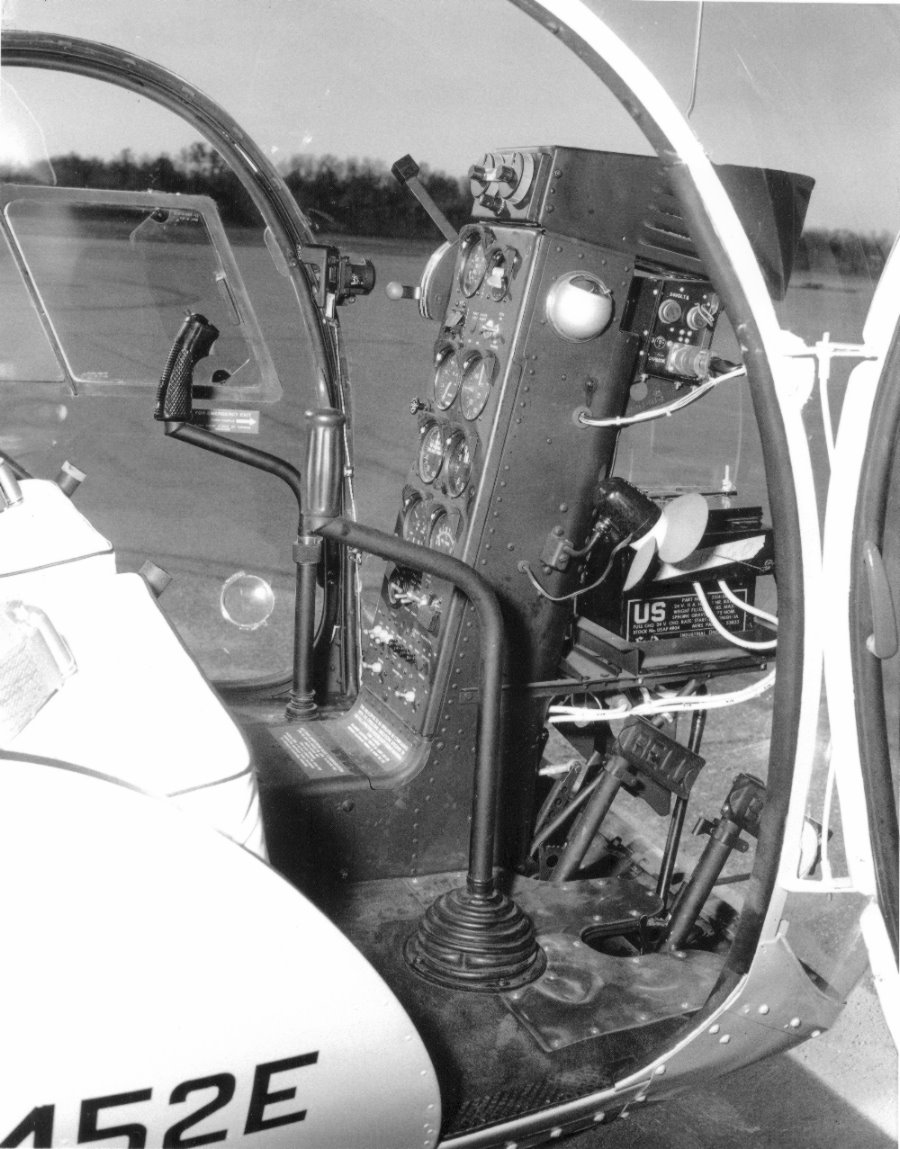
Cockpit view of Bell
47G-2A, believed
to be N8452E. At the time the 47G-2A was built helicopters rarely
had any navigation radio capability. This helicopter is no
exception. There is a Narco Mark 5 radio which has 90 transmitter
frequencies, and 190 receiver frequencies. Althought the radio
could tune the navigation frequencies, it didn't have an omni
head. B&W, about 175K,
Added 10/01/07.
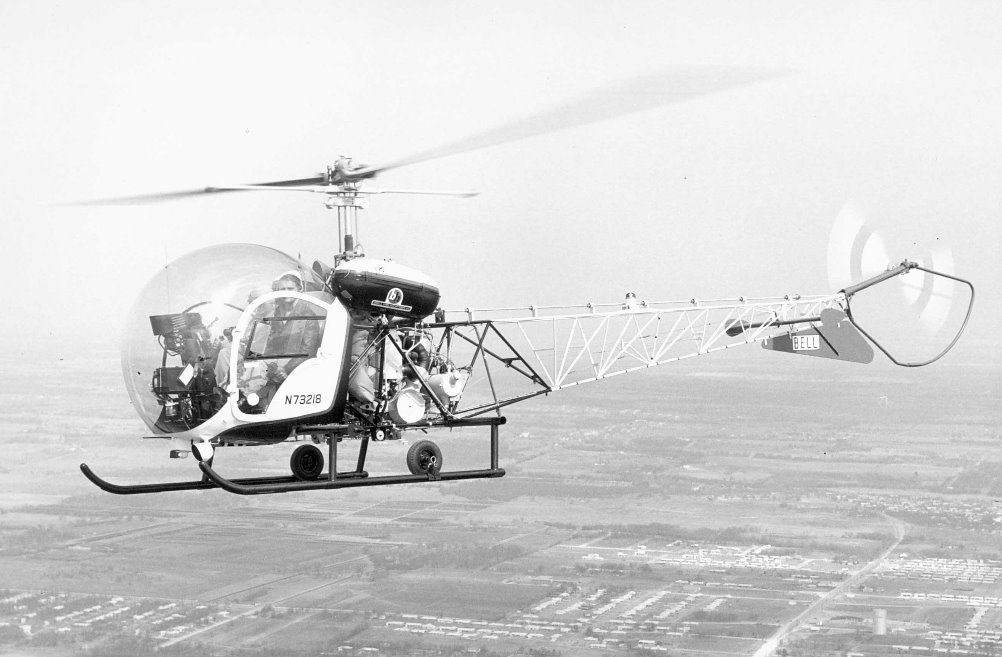
Inflight view of Bell
47G-3B, N73218.
This helicopter is serial number 2750, a 1962 model. It is
currently active on the FAA register. B&W, about 96K,
Added 09/17/08.
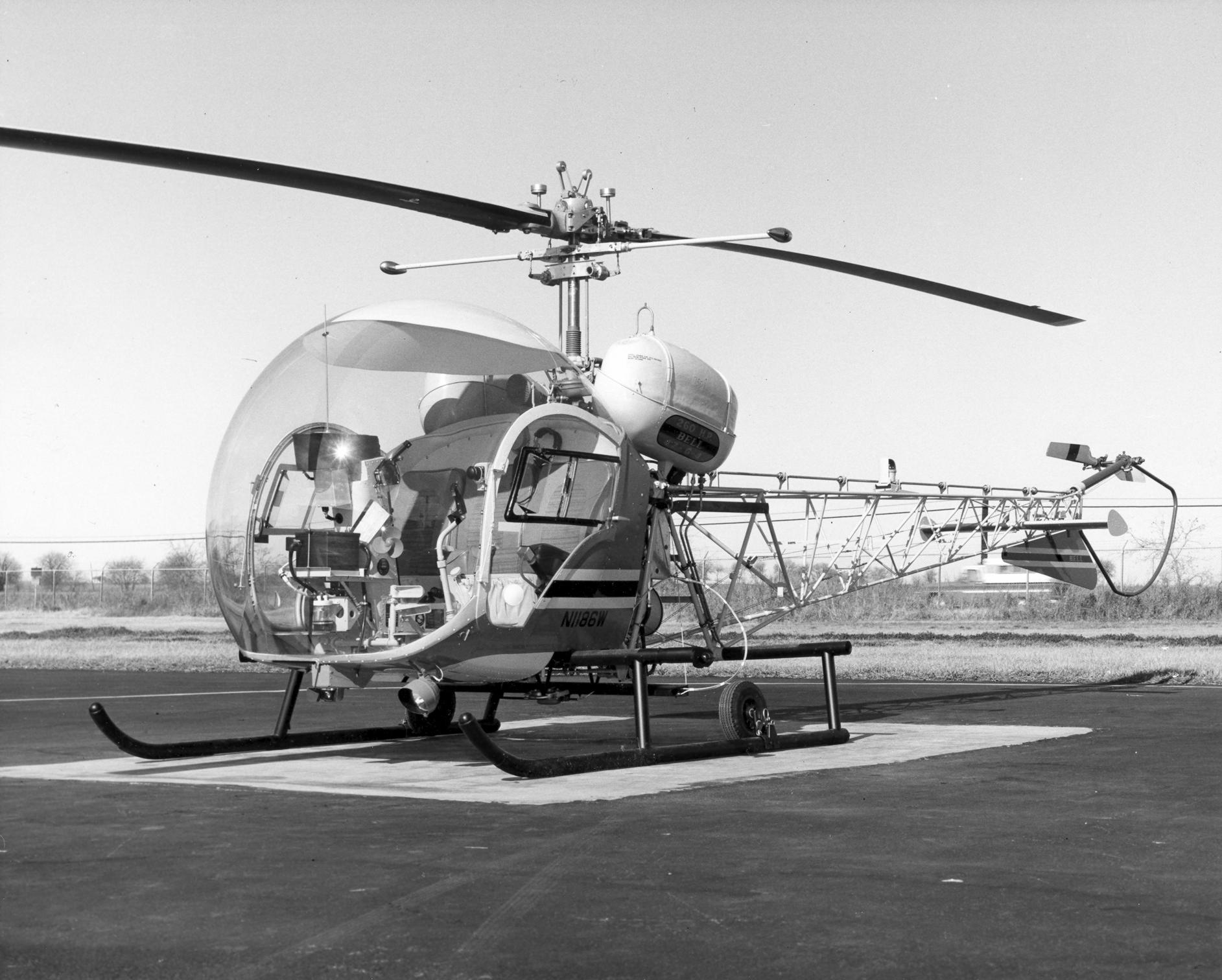
Ground view of Bell
47G-4A, N1186W.
This helicopter is serial number 7501. This helicopter was later
registered in Ecquador as HC-ASQ, then N3236G, and is currently
registered in the U.K. as G-BLGR. B&W, about 283K,
Added 09/04/06.
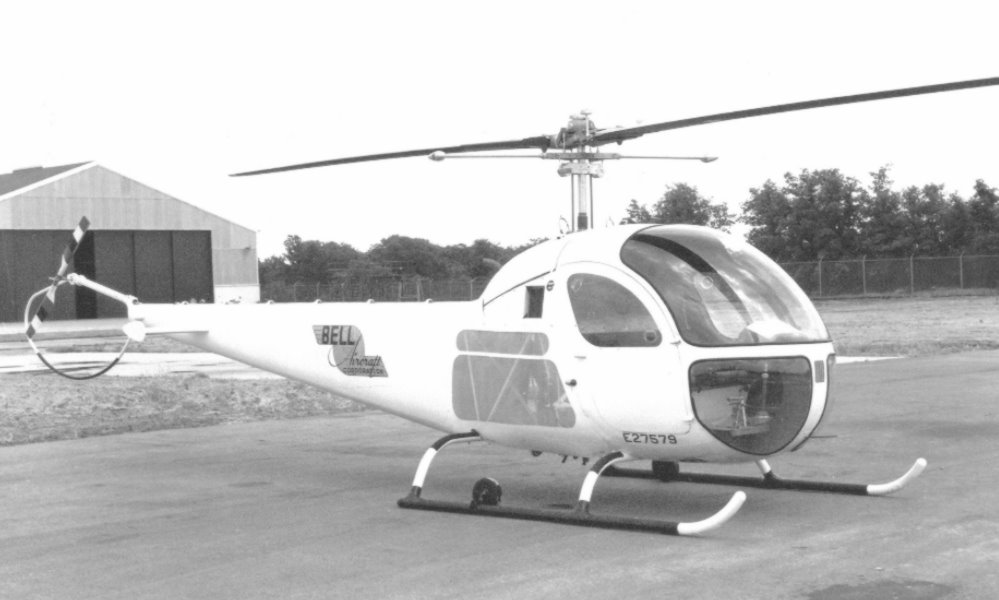
Ground view of Bell
47H, E27579. This
helicopter is serial number 1350, manufactured in 1955. The
"E" registration was used by Bell for helicopters
intended for export. Bell built only 33 of the 3 place model 47H
helicopters, it was quickly replaced by the more capable model
47J. B&W, about 67K,
Added 10/01/07.
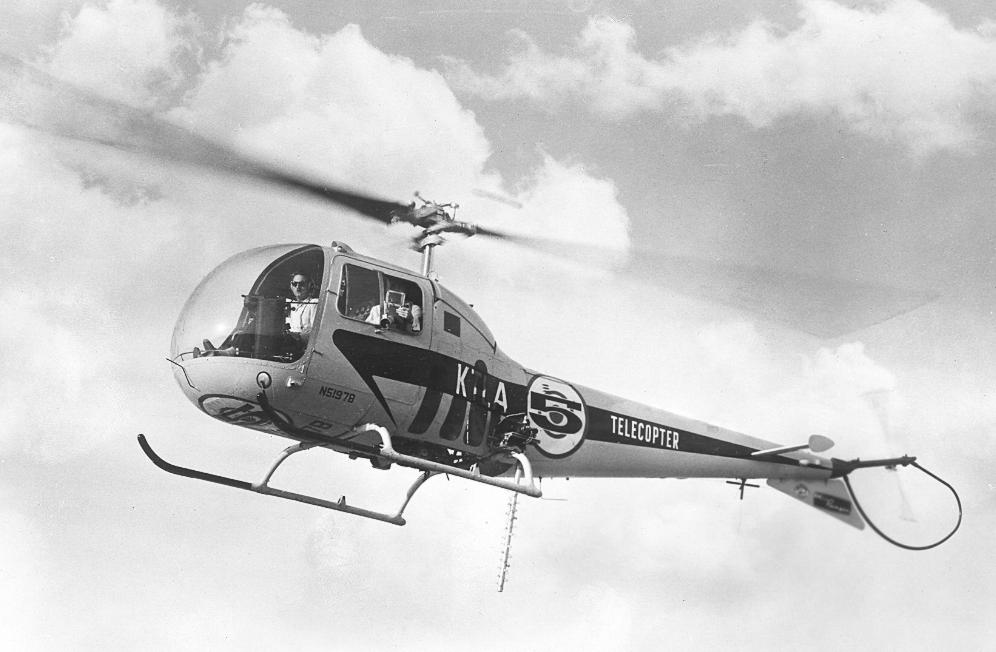
Inflight view of Bell
47J, N5197B,
serial number 1724, first delivered in 1957. This helicopter is
second helicopter configured to send live television signals
while airborne back to the studio and named Telecopter. The first
helicopter was a Bell 47G-2, which was used for only a limited
time. Shortly after tests proved the concept viable, National
Helicopter Service of Glendale, California, converted the more
powerful J model (National Helicopter also configured the G-2
model) for Los Angeles television station KTLA, channel 5. Today
you frequently see airborne live television from helicopter, this
image shows the first practical use of airborne live television.
My thanks to Harry Gilliand,
a Bell Helicopter Textron production test
pilot for 22 years, for corrections to the model, serial number
and delivery date. B&W, about 62K,
Added 09/04/06.
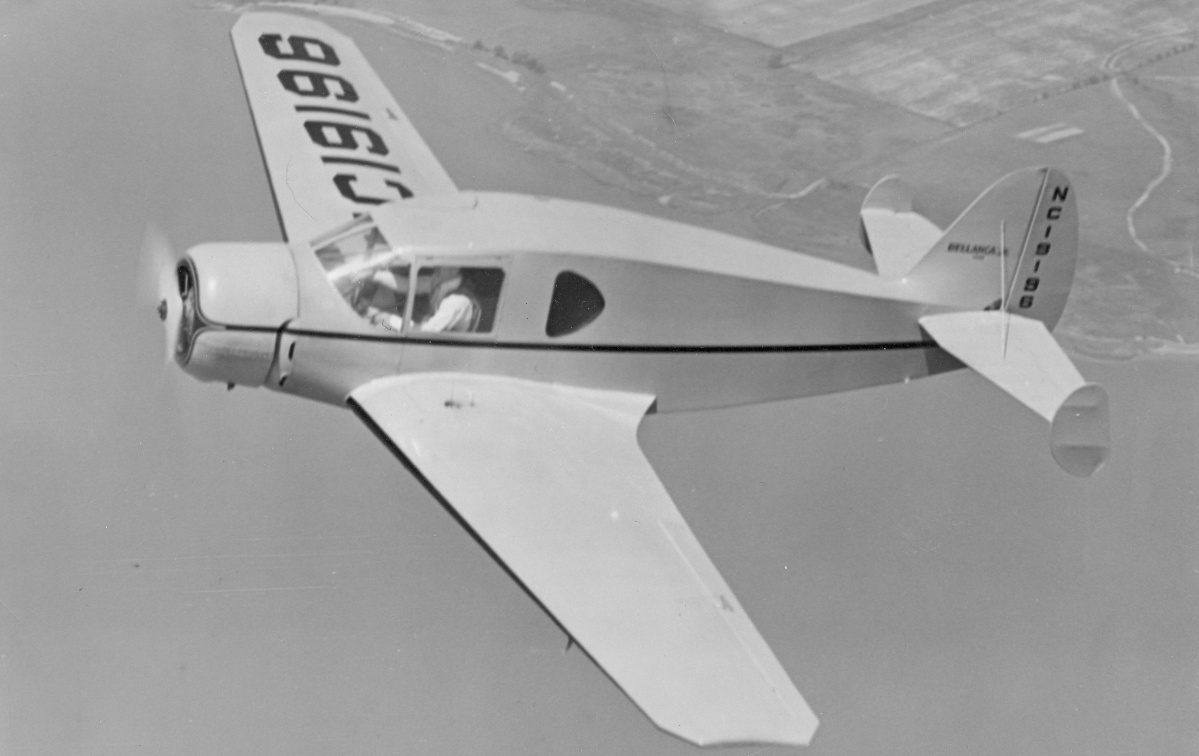
Inflight view of
Bellanca 14-9 Junior, NC19196. This is a 1939 model, c/n 1003. the
first production Bellanca Junior. The Bellanca Junior was the last
Bellanca built with a radial engine, later Bellanca aircraft used
horizontally opposed engines. This airplane was powered by
a 90 HP Ken-Royce 5-F engine. The Junior is shown as a 3 place
airplane, however the limited useful load means the Junior is
practiacally a 2 place airplane. B&W, about 180K,
Added 09/01/19.
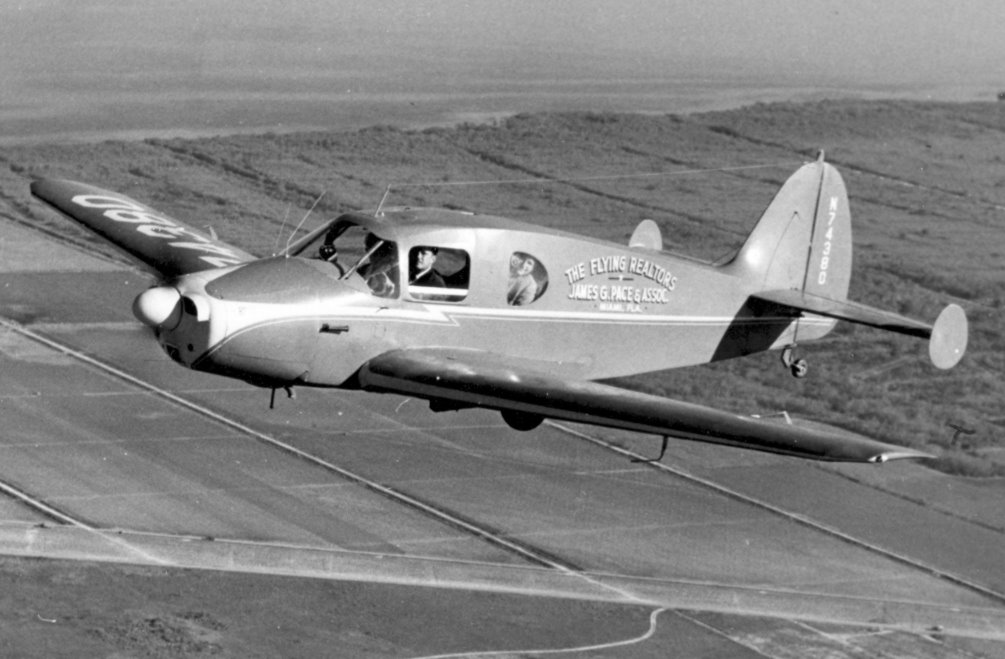
Inflight view of Bellanca
Cruisair, NC74380. This is a 1947 model
14-13-2, serial number 1493, current on the FAA register.
B&W, about 100K,
Added 11/23/07.
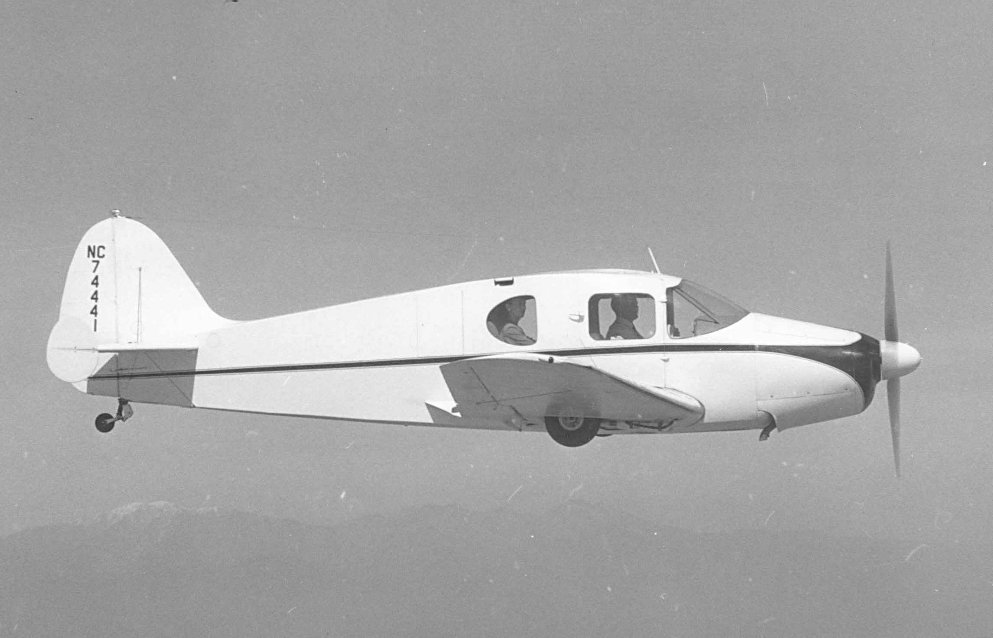
Inflight view of Bellanca Cruisair,
NC74441. This is a 1947 model
14-13-2, serial number 1554, current on the FAA register.
B&W, about 75K,
Added 01/01/02.
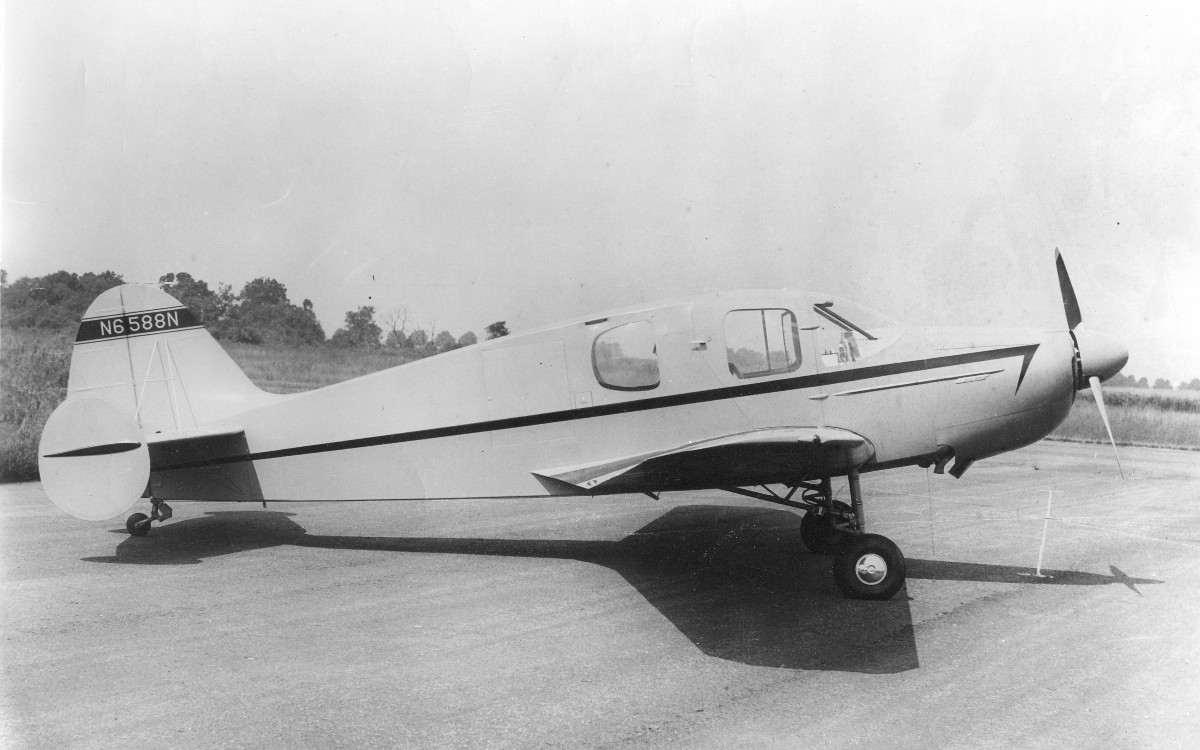
Ground side view of Bellanca Cruisair 14-19,
NC6588N. This is c/n 2041, built in 1952. The model 14-19 was different
from the 14-13 in a Lycoming O-435A engine of 190 HP was now used in
place of the 150 HP Franklin used in earlier models. Also the horizontal
end plates on the horizontal stabilizer are larger on the 14-19. B&W,
about 176K, Added 03/24/19.
Bellanca for a time owned the rights to the former Champion
Aircraft, and later sold the rights to American Champion. Click
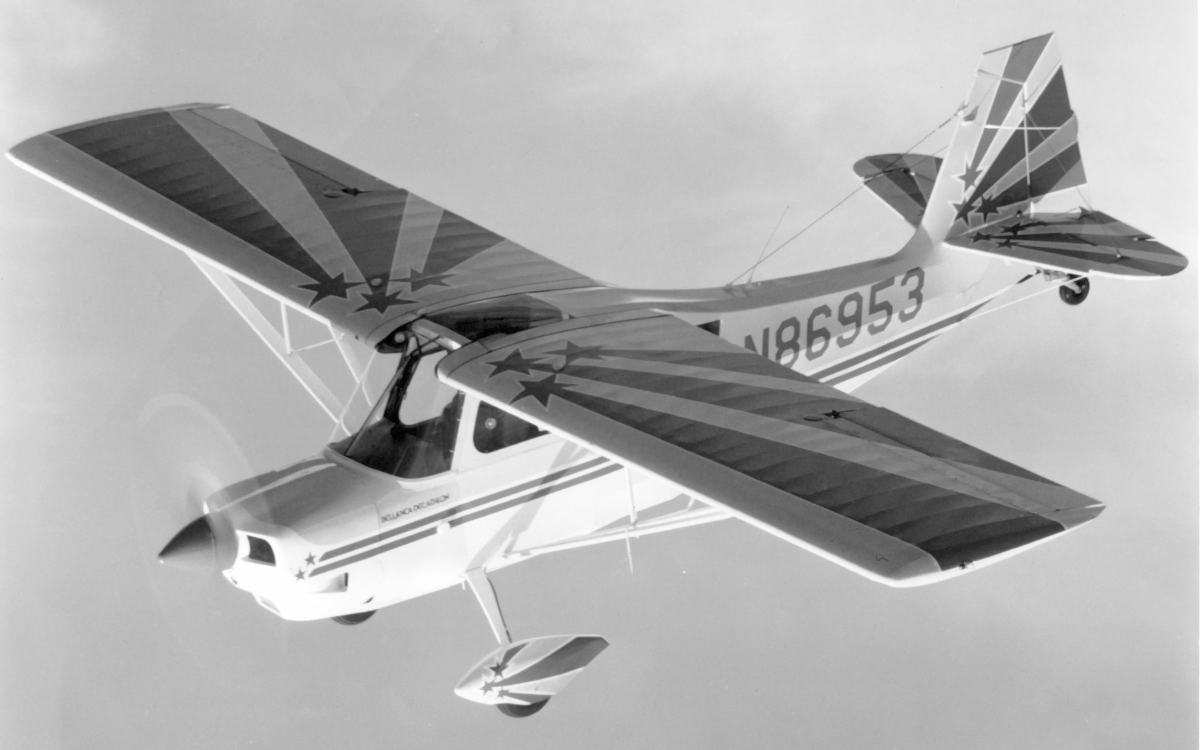
here for the Bellanca 8KCAB Decathlon.
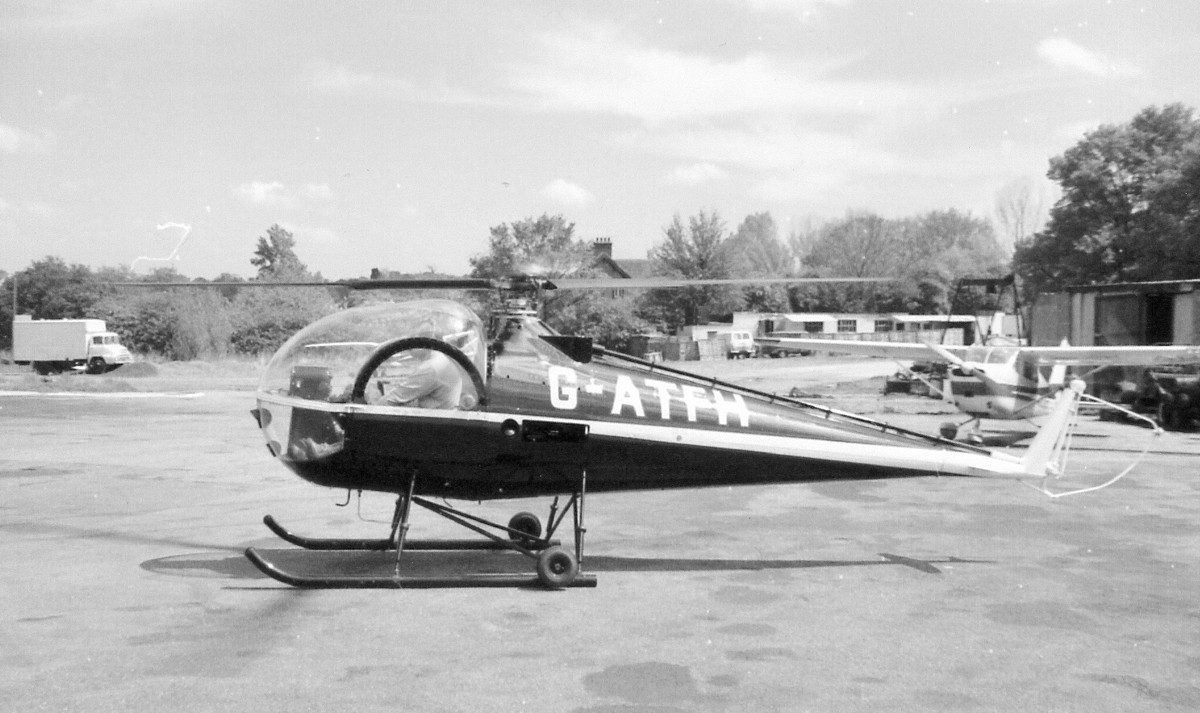
Ground view of
Brantley B-2B Helicopter,
G-ATFH, c/n 449, manufactured in 1965. B&W, about 178K,
Added 08/20/16.
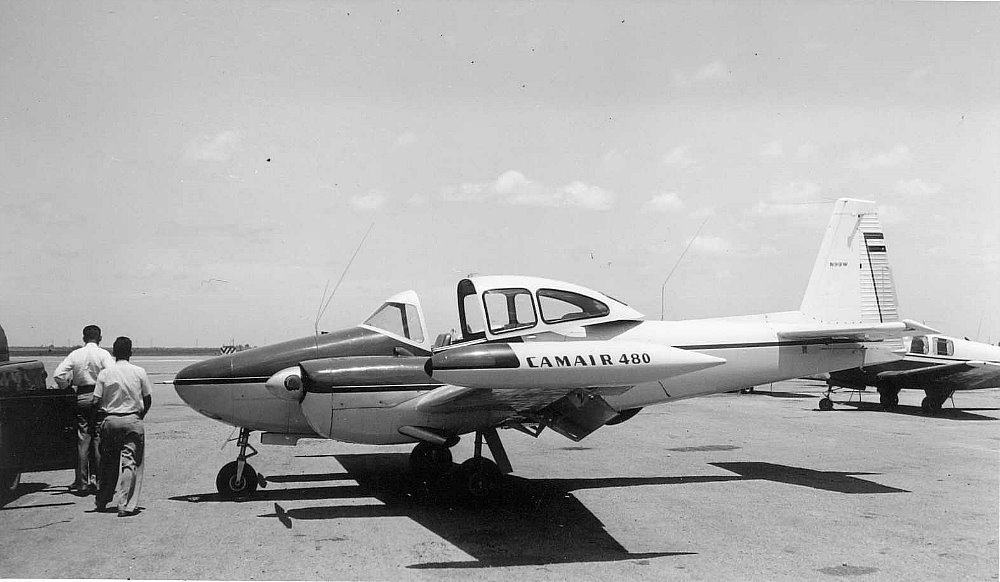
Ground view of Camair 480 Twin
Navion, N99W. The
Camair 480 is a modification of either a North American, or Ryan
built Navion. The original single engine is replaced with two
Continental 240 HP engines. There are about 33 Camair 480's
which were converted. Conversion began in 1952, although the date on
the FAA register is the original single engine Navion build date.
B&W, about 92K,
Added 08/02/12.
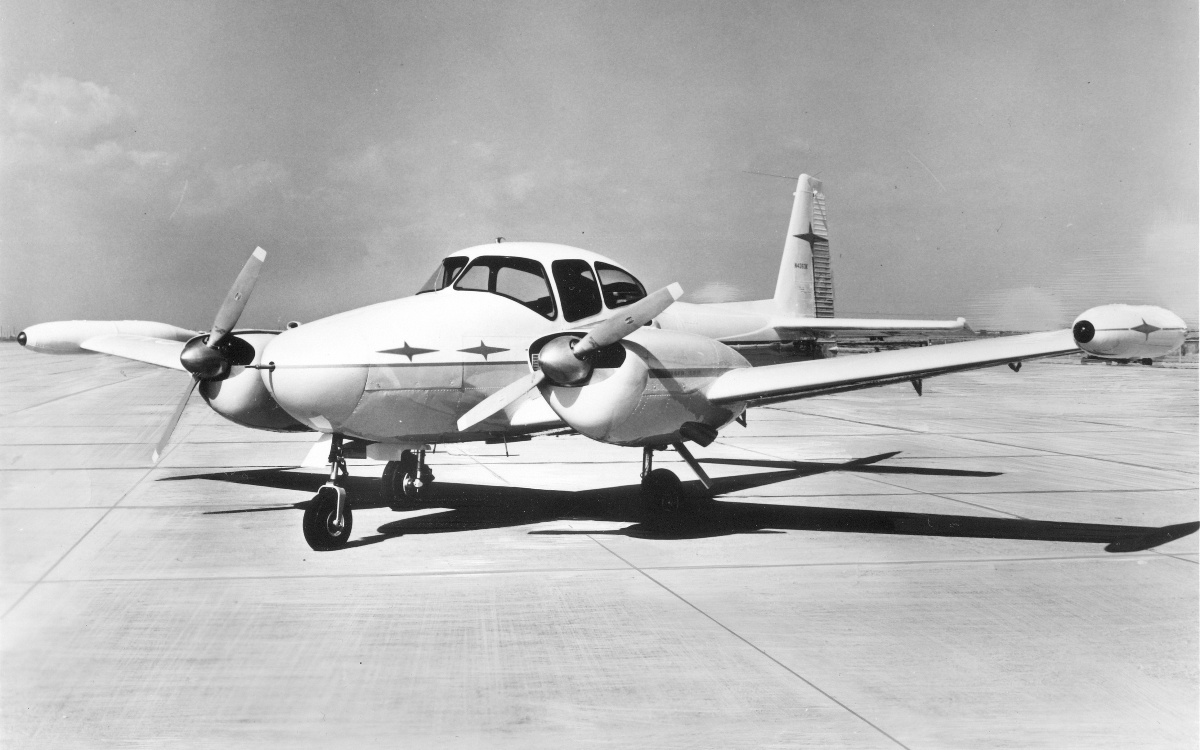
Ground view of Camair 480 Twin
Navion, N4363K, c/n 1-050. This Camair 480 started life before
conversion as 1948 Ryan Navion, NAV-4-1363. On the FAA database the
airplane is listed as manufactured in 1948, however that is the date
the original Navion was manufactured. Estimate the airplane was
converted to a Camair 480 Twin about the mid 1950's. B&W,
about 257K, Added 10/01/19.
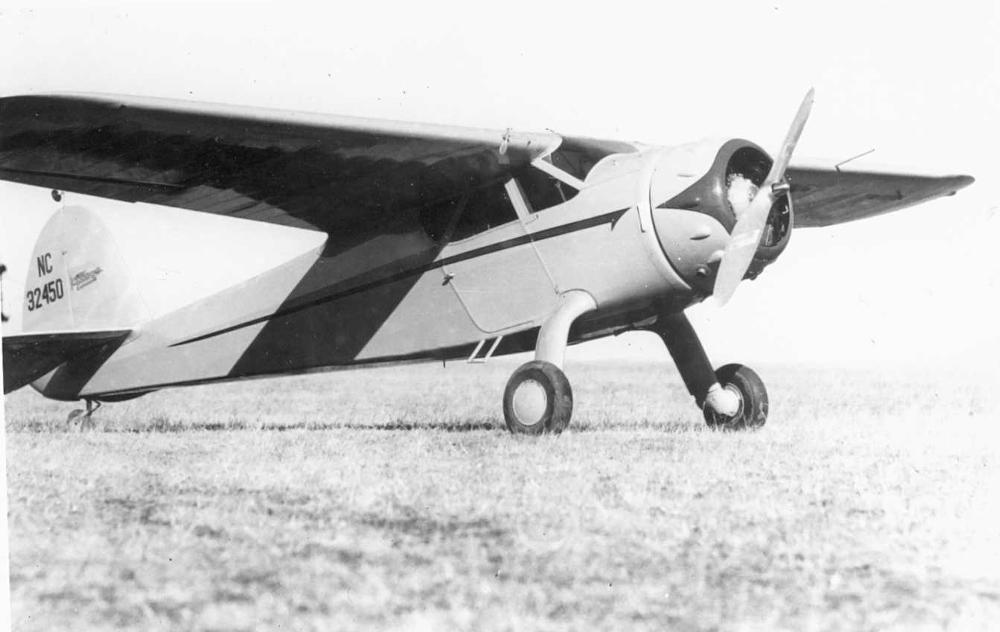
Ground view of Cessna
C-165 Airmaster, NC32450, c/n 583, built in 1941. Due to poor depression
era sales, Cessna was forced to cease operations by the board of directors
in early 1931, even though the company was not bankrupt. Cessna did not
build any airplanes from 1931 to 1933. Dwayne Wallace, nephew of Clyde Cessna,
with his brother Dwight, helped get Cessna back to building airplanes in 1934.
First airplane from Cessna was the C-34 Airmaster (1934 model year). Cessna
built the C-34, C-37, C-38, C-145 and C-165 series of Airmaster aircraft. Power
for the Airmaster C-165 is the Warner Super Scarab 165HP eninge. This particular
airplane was known as "Dwane's airplane." Dwayne Wallace was
president of Cessna from 1936, when Clyde Cessna retired, until 1964. He then
became chairman of the board of Cessna until 1975 when he retired, continuing
as a consultant until 1983. Wallace died in 1989. This airplane is registered to
Velma (Lunt) Wallace, widow of Dwane Wallace and currently located in the
Mid-America Air Museum, Liberal, Kansas. Cessna built 38 C-165 Airmasters.
B&W, about 58K, Added 04/21/13.
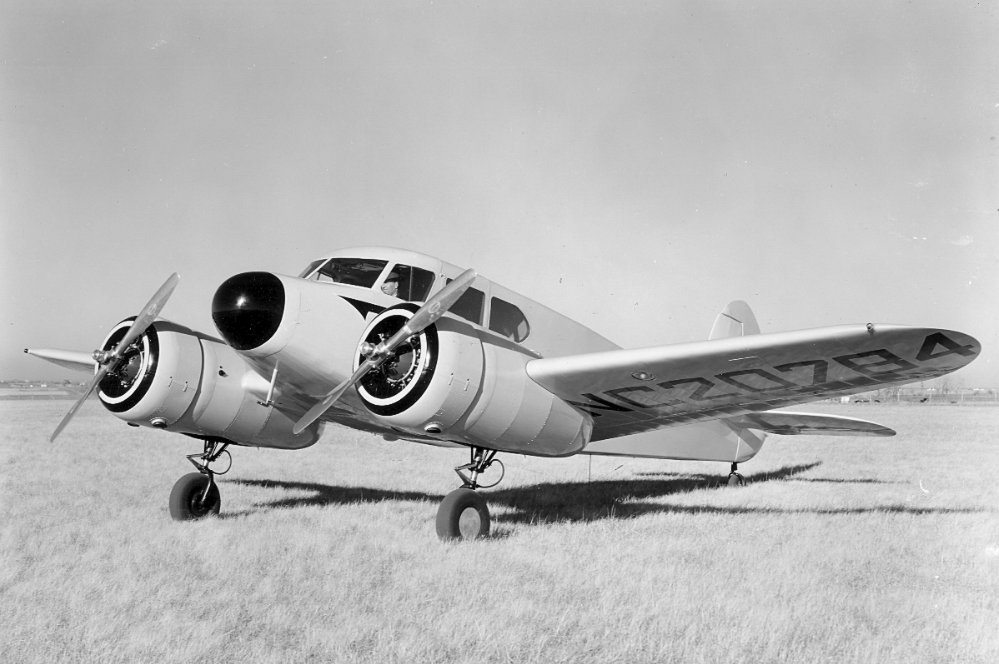
Very nice ground view of the Prototype Cessna
T-50. This view
shows the airplane after changes were made to bring it to
production standard. This airplane is Cessna construction number
1000, NC20784. B&W, about 93K,
Added 06/29/07.
List
of the Cessna T-50 Airplanes manufactured both civil and military. From
my research shows that Cessna built 5,265 T-50 aircraft. File includes model
as delivered, military serial, Cessna C/N and Quantity, and bibliography.
File in PDF format, about 26K in size,
Added 08/01/22.
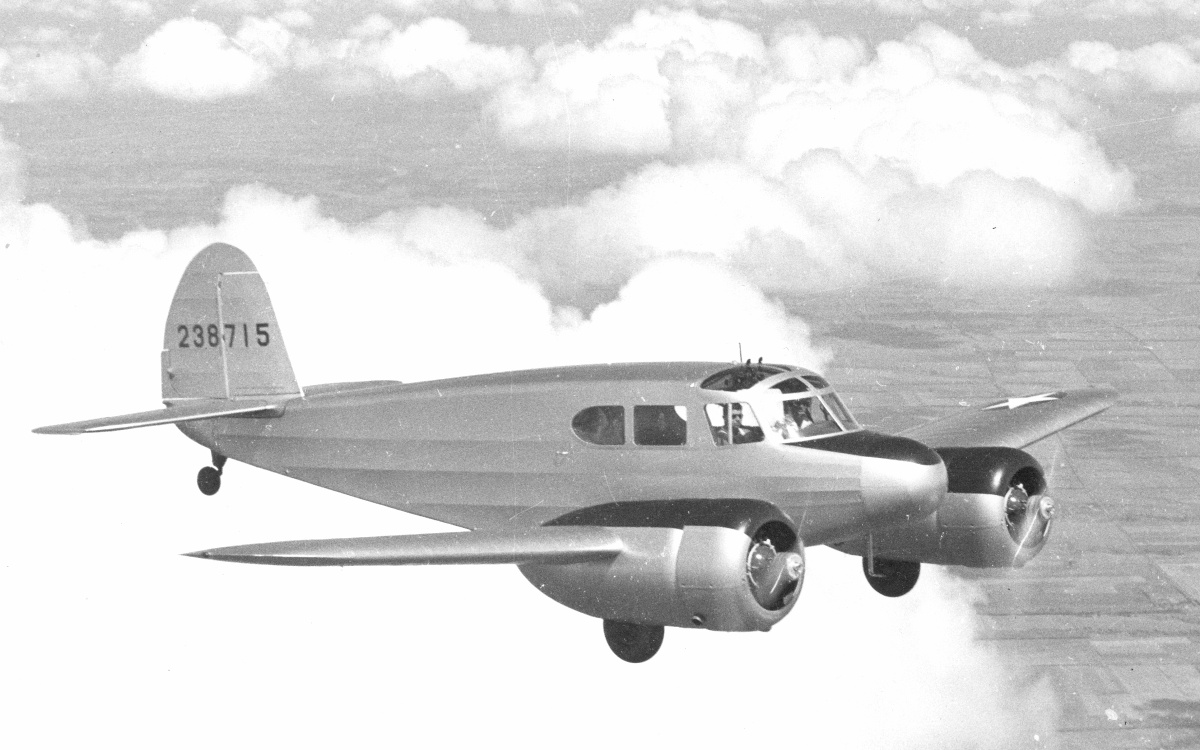
Inflight view of Cessna
AT-17B Bobcat, 42-38715, c/n 2924. The USAAF flight manual says
this airplane has a 5,300 pound gross weight, while later Cessna T-50
versions have a 5,700 pound gross weight. AT-17B airplanes with c/n 3011
and up have 5,700 gross weight. Cessna normally used Hamilton Standard
controllable meteal propllers. This airplane is equiped with Hartzell
wood fixed pitch propellers, used on Bobcat aircraft when Hamilton
Standard controllable pitch constant speed propellers were not available.
B&W, about 247K, Added 06/01/20.
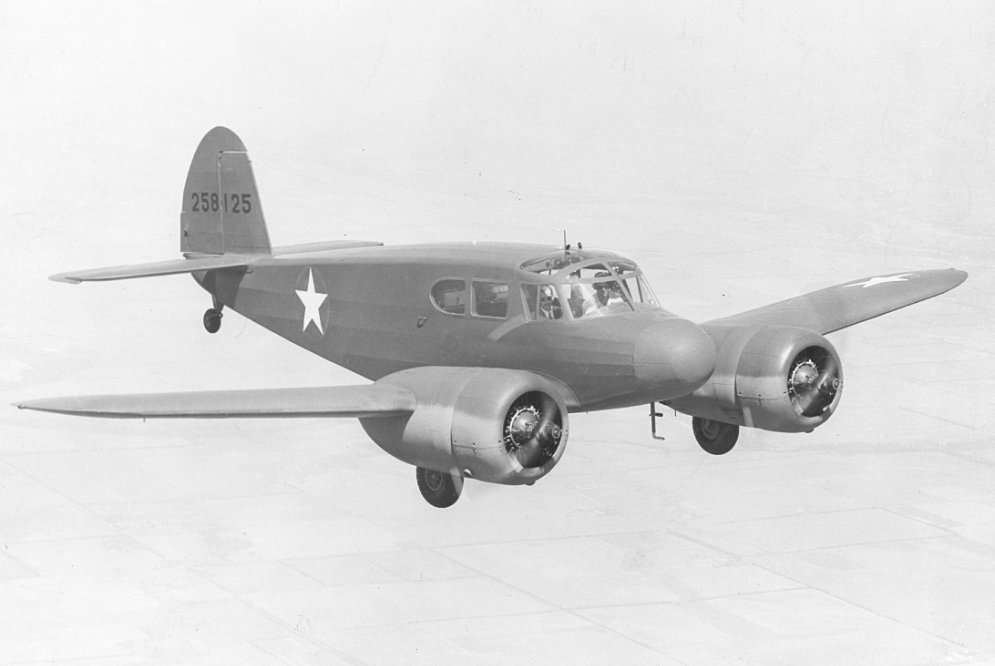
Inflight view of Cessna
T-50 Bobcat,
42-58125, Cessna c/n 3616. Actually this is the military version
of the Cessna T-50, known as the C-78, later redesignated as the
UC-78. A large number of these wartime Cessna UC-78's found
there way into civilian hands after WWII. Most famous of the
civilian Cessna T-50's was Sky King's "Song
Bird." If anyone knows where I can purchase an 8x10 print of
Sky King's T-50 please contact me at westin@westin553.net. B&W, about 59K,
Added 01/01/02.
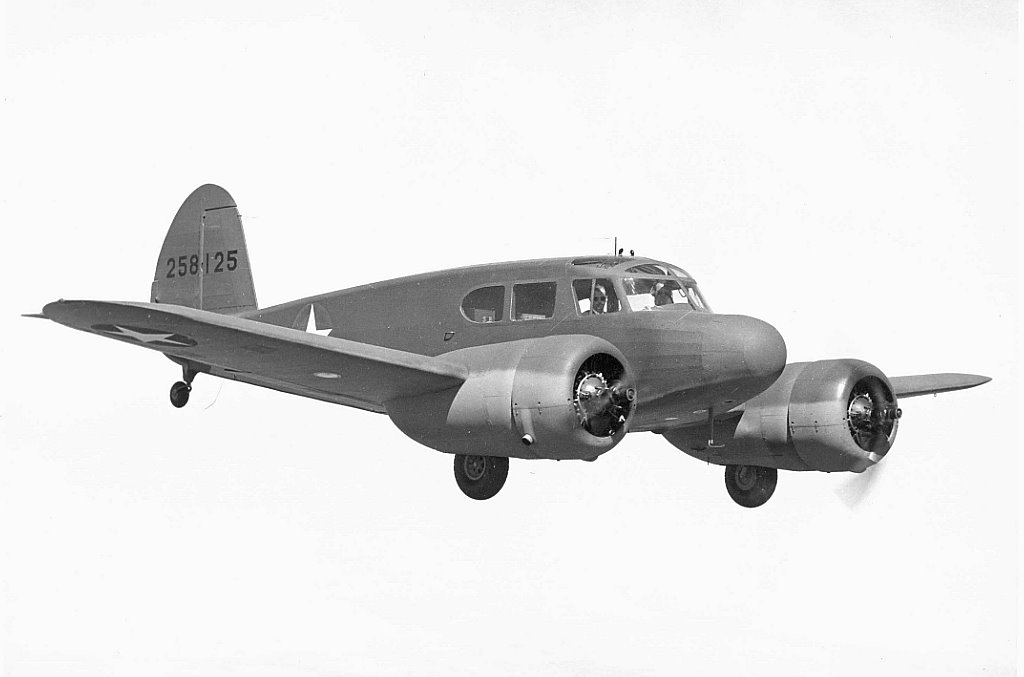
A second inflight view of Cessna
T-50 Bobcat,
42-58125, Cessna c/n 3616. This view is from a lower angle than
the image above. B&W, about 49K,
Added 05/01/12.
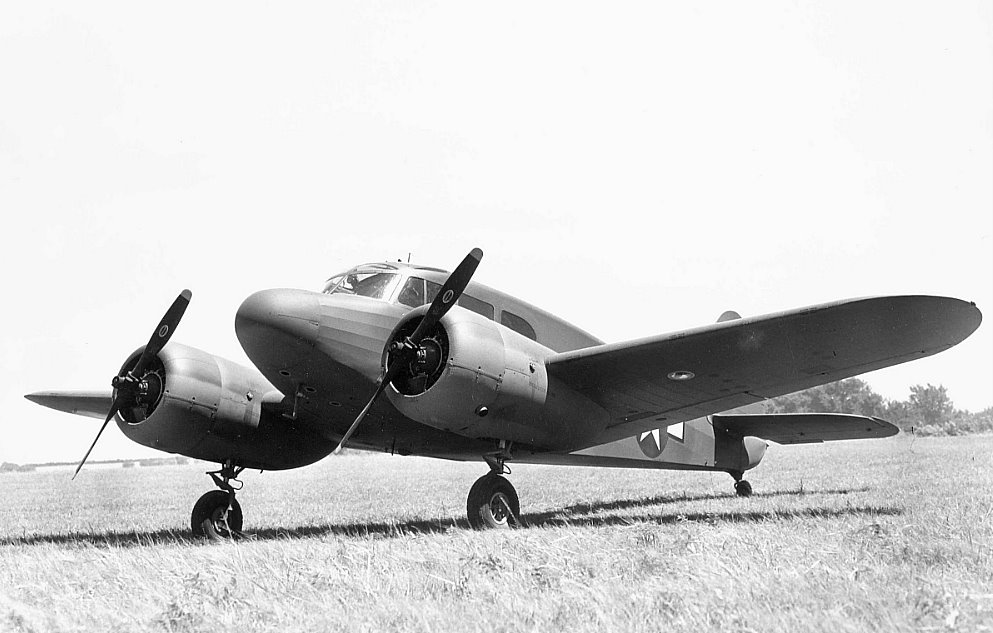
Ground view of Cessna
T-50 UC-78 Bobcat, 43-7522, Cessna c/n 5042. B&W, about 98K,
Added 05/19/12.
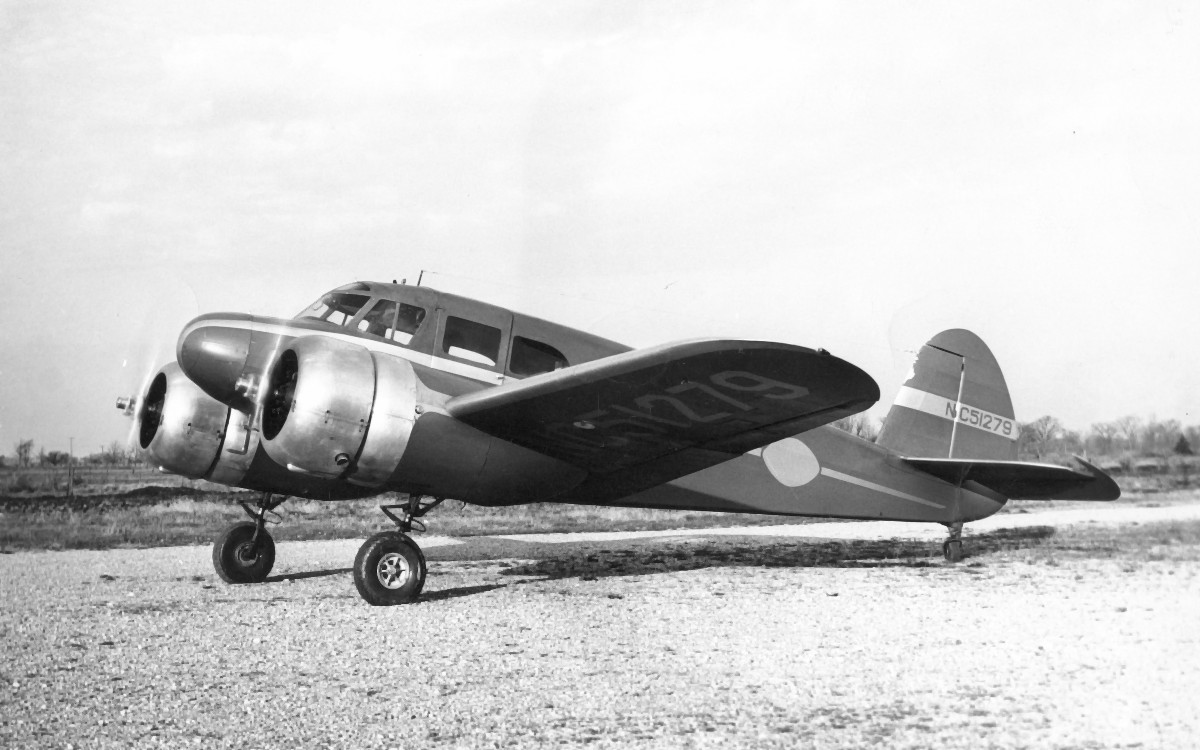
Ground view with engines running and nobody in cockpit of Cessna
T-50 UC-78 Bobcat, NC51279, Cessna c/n 5679, was USAF 43-8159.
B&W, about 169K, Added 02/28/19.
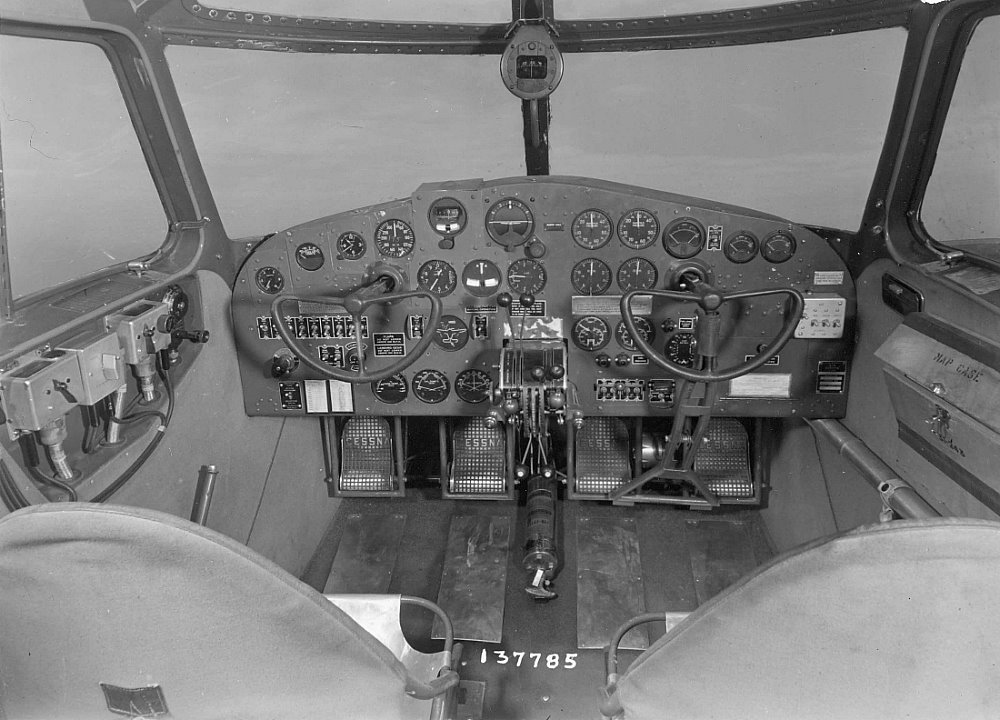
View of a Cessna
T-50 Bobcat, military UC-78, Instrument Panel. Unfortunately
I can't read the
radio call sign to identify this specific airplane. There are
some differences in this panel and the standard instrument panel
from Cessna. The flight instruments have been regrouped in front
of the pilot. All instruments to the right of the throttle
quadrant are in the standard position, as are all electrical
switches. B&W, about 138K,
Added 07/29/09.
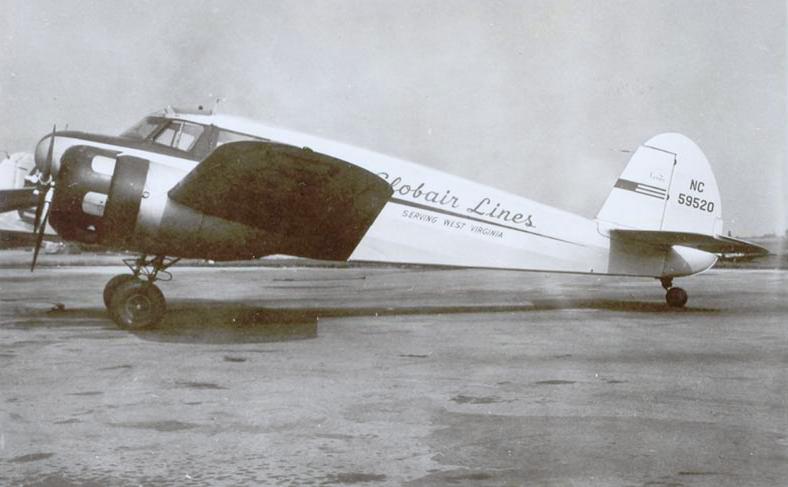
Ground view of Cessna
T-50 Bobcat, NC59520, c/n 6348, originally USAAF 43-32410,
an UC78B. This was one of many used as feeder liners after WWII.
You may also see the Cessna T-50 referred to as the "Bamboo
Bomber." Most of its contruction was spruce, not bamboo.
B&W, about 43K,
Added 01/01/02.
Ground view of Cessna
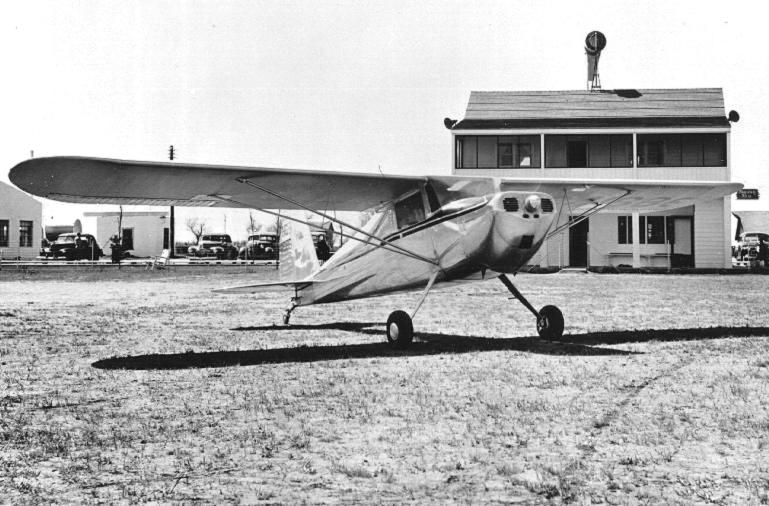
120, NC41686.
This was Cessna's post WWII trainer. The 120 did not have the
flaps, electrical or extra rear window of the similar model 140.
Some model 120's were modified to have these features later
in life. B&W, about 77K,
Added 01/01/02.
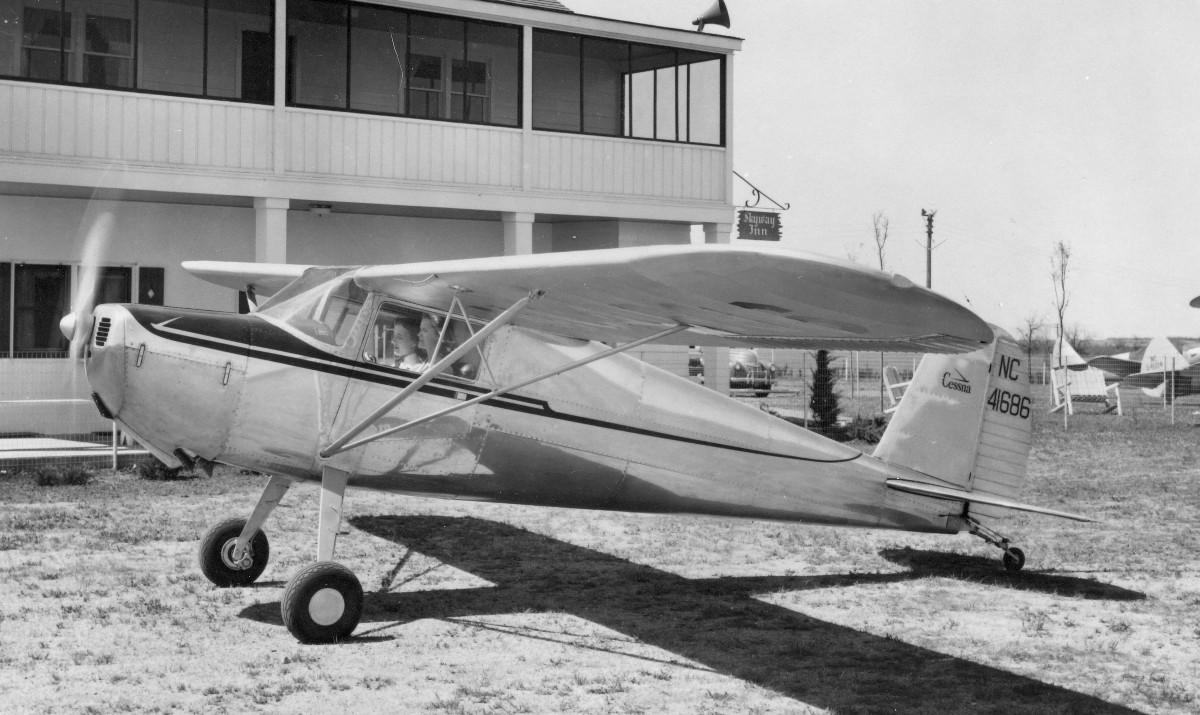
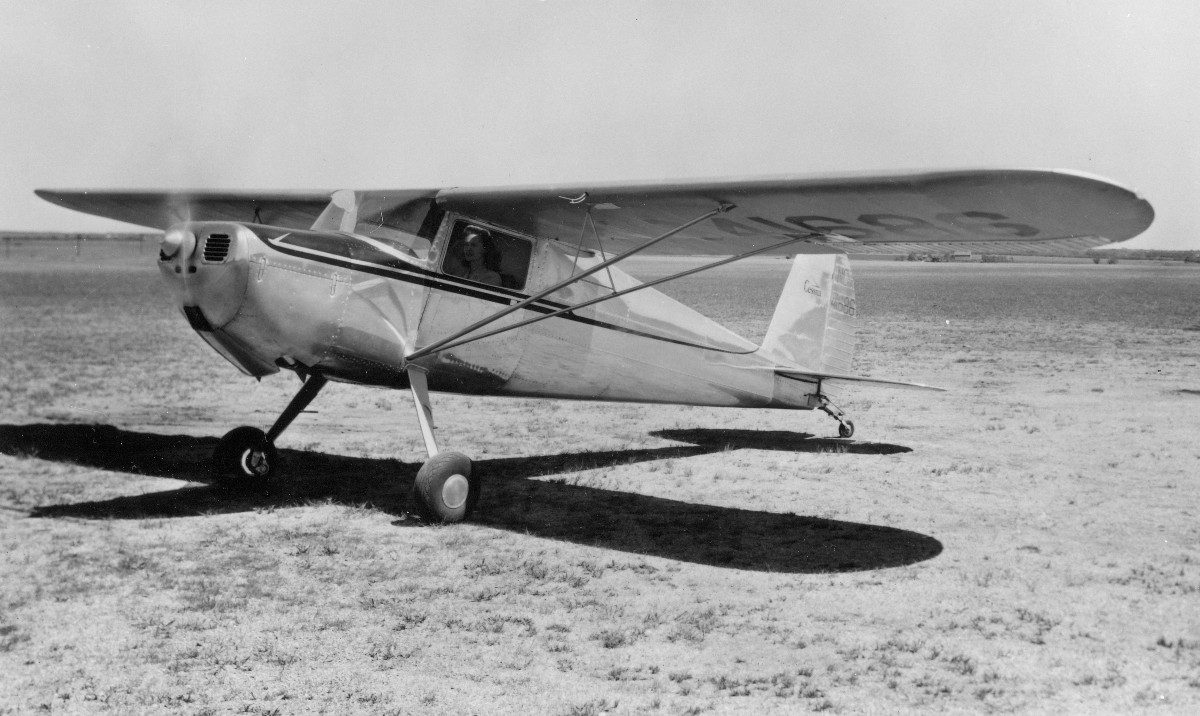
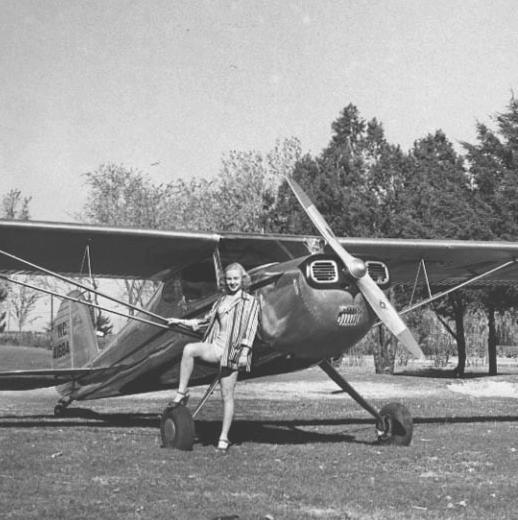
Two additional ground views of Cessna 120 NC41686 with lovely lady
pilots. view 1
of Cessna 120 NC41686 is a side view. NC41686 is Cessna
contruction number 8003, and I believe one of the model 120
prototypes.
view 2 of Cessna 120 NC41686 is a one half front view. Images
are both B&W, about 211K and 197K respectively.
Added 08/20/16.
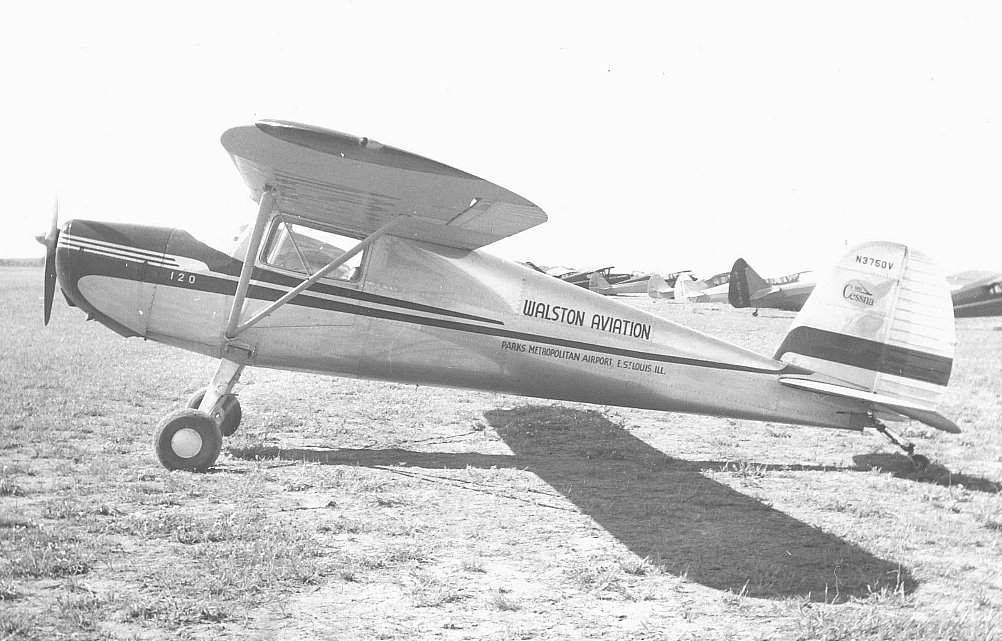
Ground view of Cessna
120, N3750V. From
this side view you readily see the missing rear window compared
to the Cessna 140. B&W, about 146K,
Added 03/30/02.
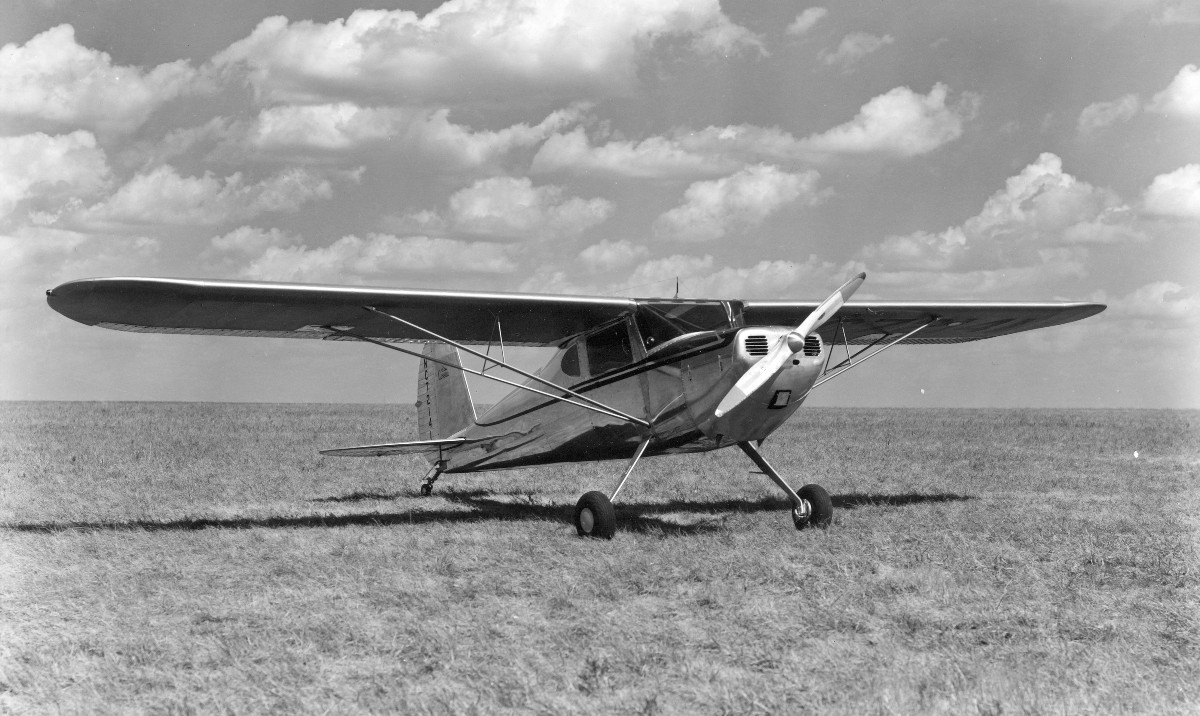
Ground view of Cessna
140, NC41684. Cessna construction number 8001, the second prototype 140.
This was Cessna's other post WWII trainer. The 140 was a
luxury version of the 120, with flaps, electrical and an extra
rear window. This particular image was a Cessna publicity shot
for an ad. Note the nose cowl which is in prototype configuration.
B&W, about 45K,
Added 01/01/02.
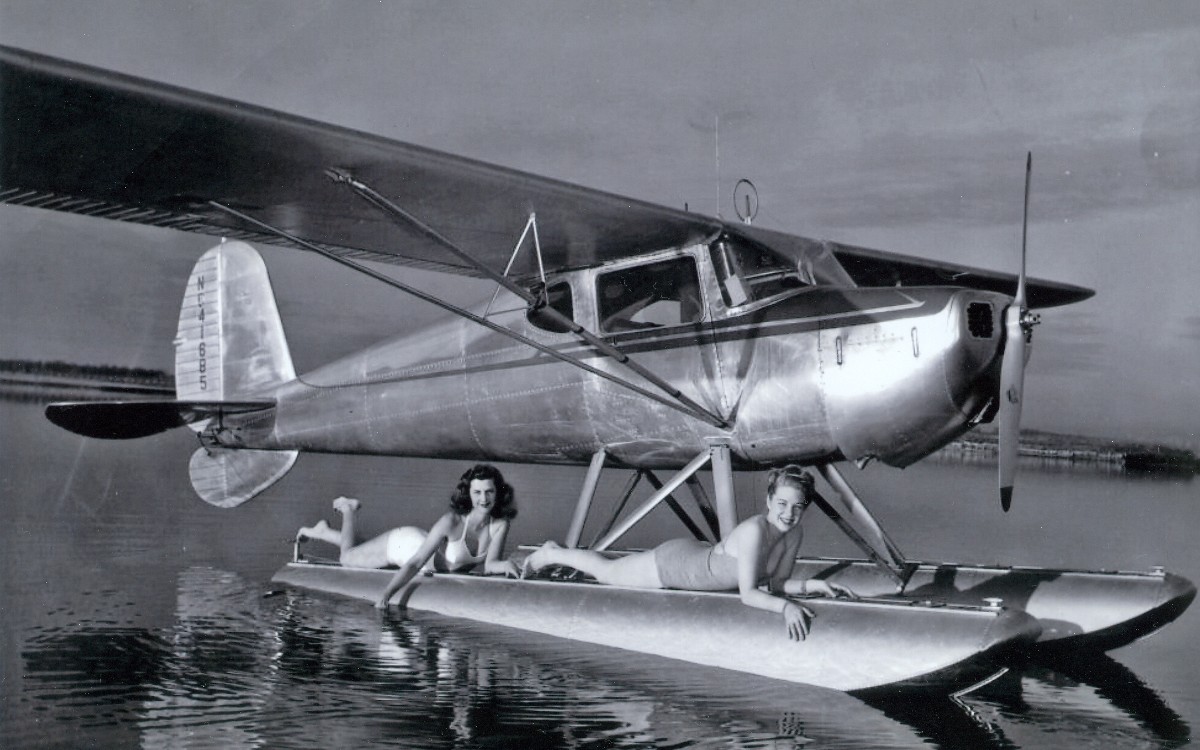
Water view of Cessna
140 on floats on the water, NC41685. Cessna construction number 8002.
This was the third prototype Cessna 140 shown with 2 ladies lying
on the floats. The fin under the tail is required on float
equipped Cessna 140's. The nose cowl now representative of
production 140's. B&W, about 183K,
Added 04/22/19.
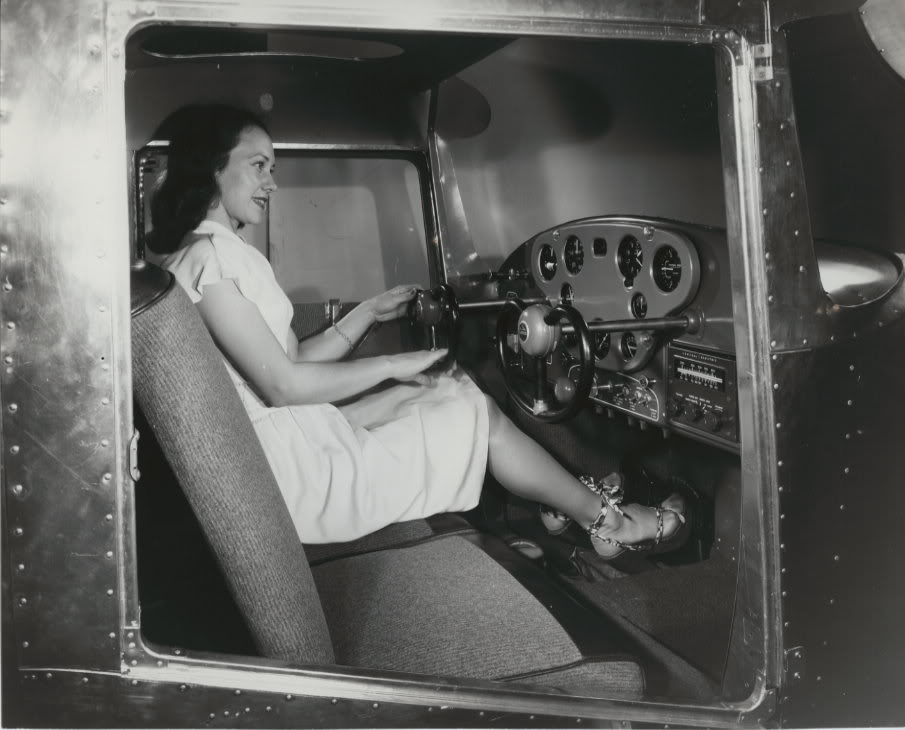
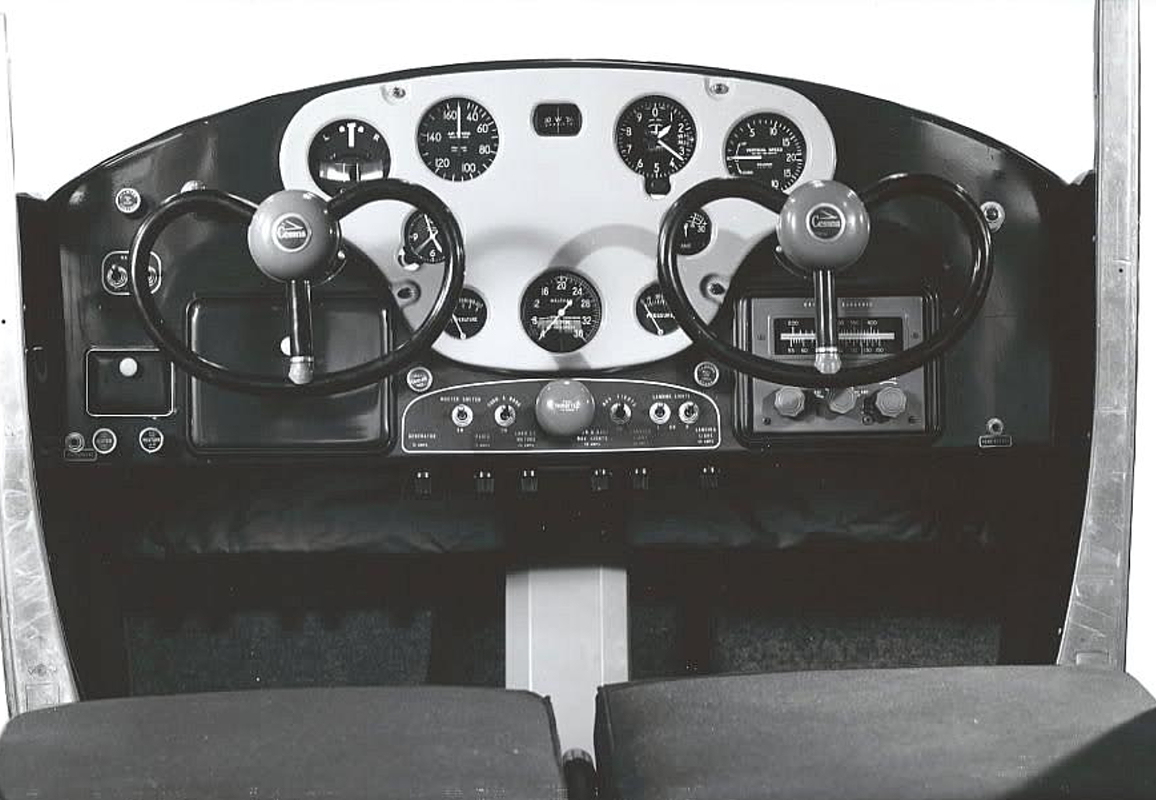
Early Cessna 140 instrument panel. This first view shows a
cockpit
view with a lady pilot. This second view is of the instrument
panel itself. The
radio, a General Electric AS-1B, is mounted in the standard
location for the time, at the lower right. B&W, about 76K and
370K respectively,
Added 01/01/10.
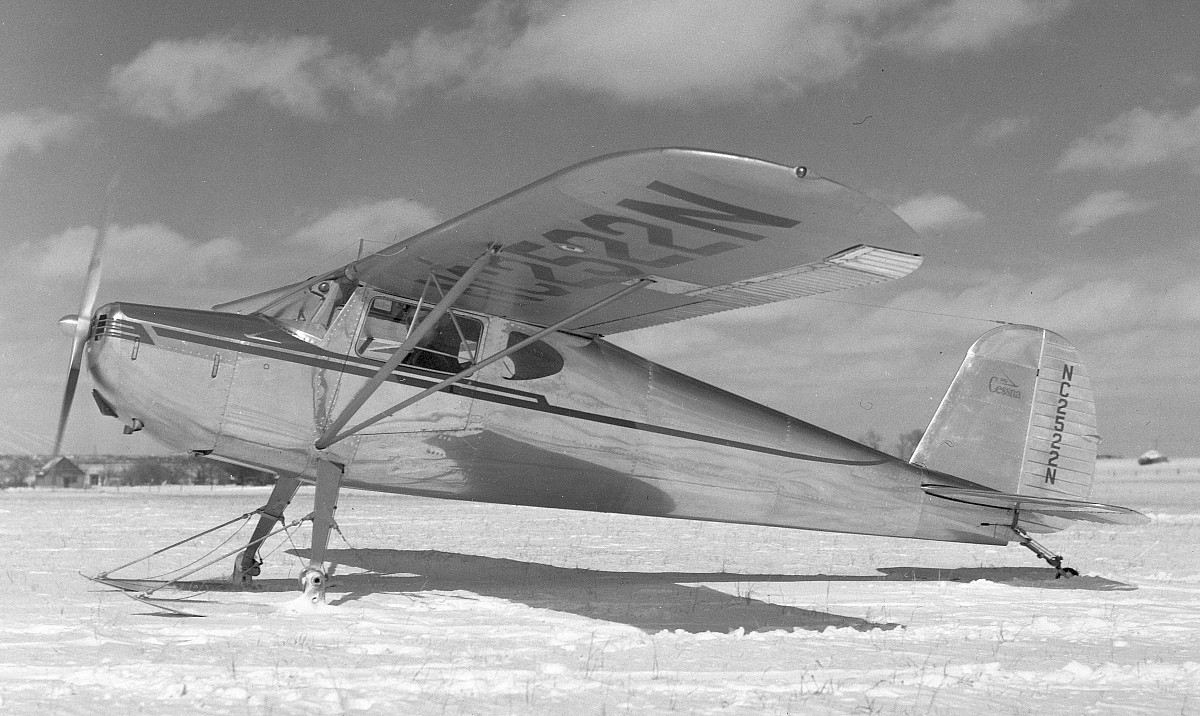
Ground view of
Cessna 140, NC2522N. Airplane on skiis. B&W, about 256K,
Added 08/20/16.
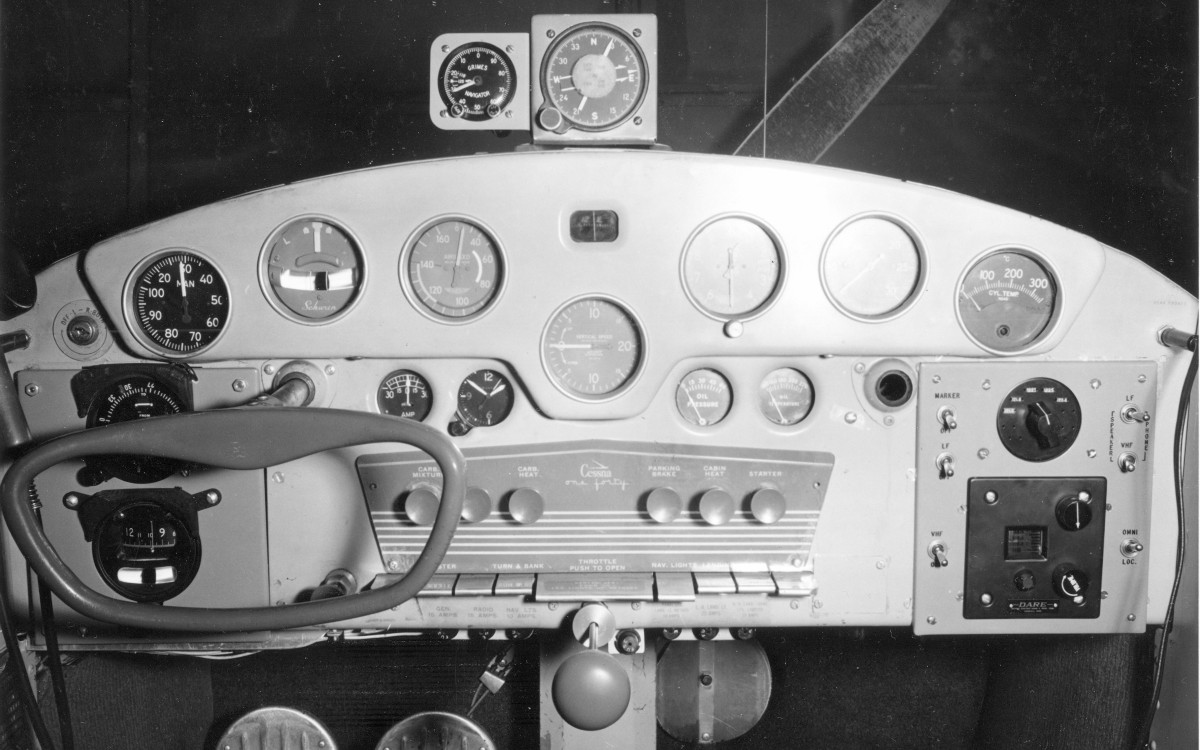
View of a 1947
Cessna 140 Instrument Panel, aircraft registered NC2921N, c/n 13182.
This is the second type Cessna 140 instrument panel which uses "piano
key" switches. This particular airplane has some electronics and
instruments not normally found in a Cessna 140. At the lower right is
a DARE Microtuner VHF receiver, above the Microtuner is a DARE T-3 10
channel VHF transmitter, with 5 crystals installed. At the top of the
instrument panel, to the left of the remote compass, is a "Grimes
Navigator." WEBMASTER NOTE - I have
been around light aircraft since a teenager in the mid 1950's and have
never seen a Grimes Navigator in person. B&W, about 186K,
Added 11/02/19.
Ground view of
Cessna 140, NC72141. Cessna c/n 9308. B&W, about 222K,
Added 08/20/16.
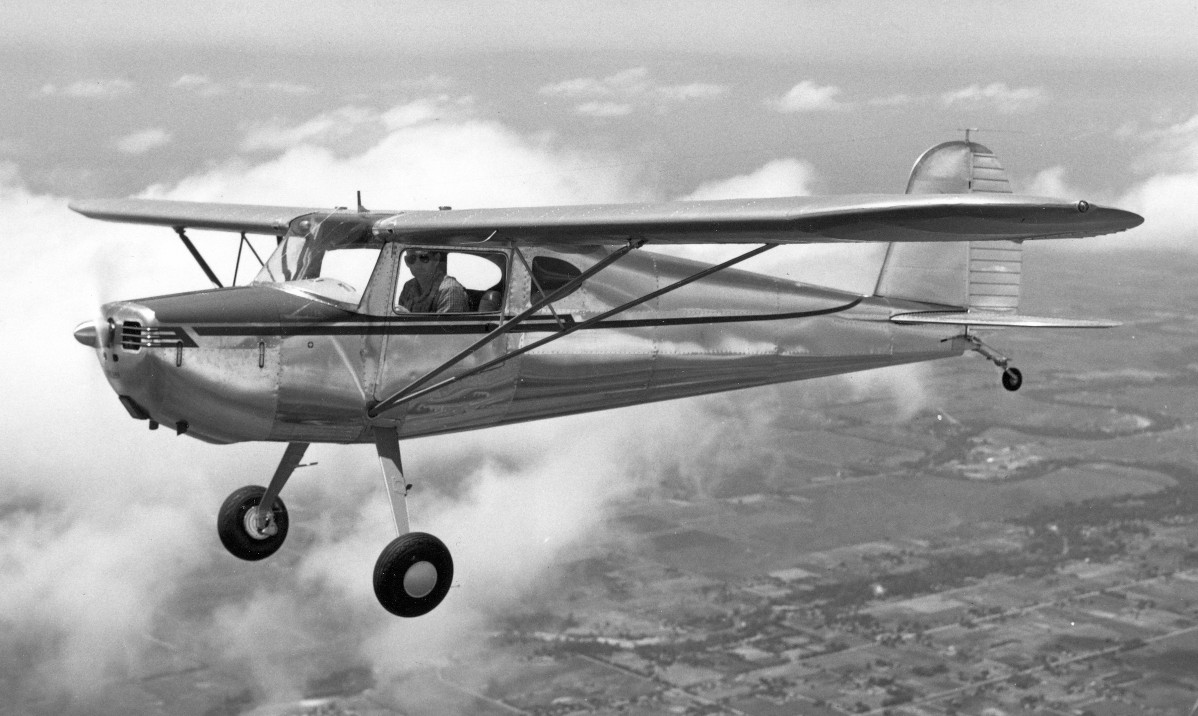
Very nice inflight view of
Cessna 140, unable to read the registration. B&W, about 181K,
Added 08/20/16.
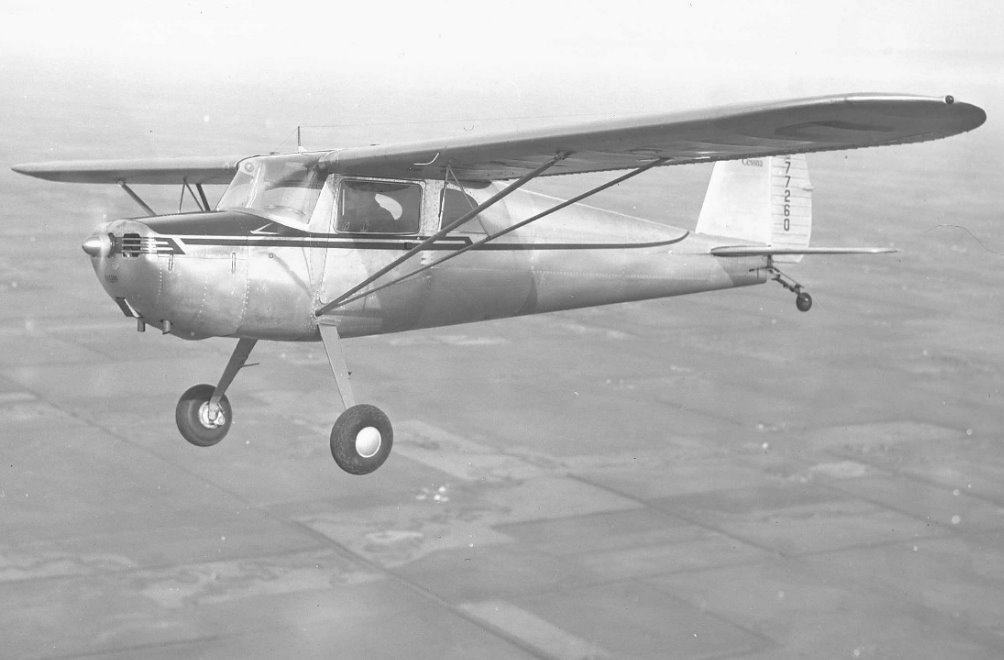
Inflight view of
Cessna 140, NC77260. Nice inflight view of the Cessna 140. Cessna
c/n 11722. B&W, about 68K,
Added 06/21/08.
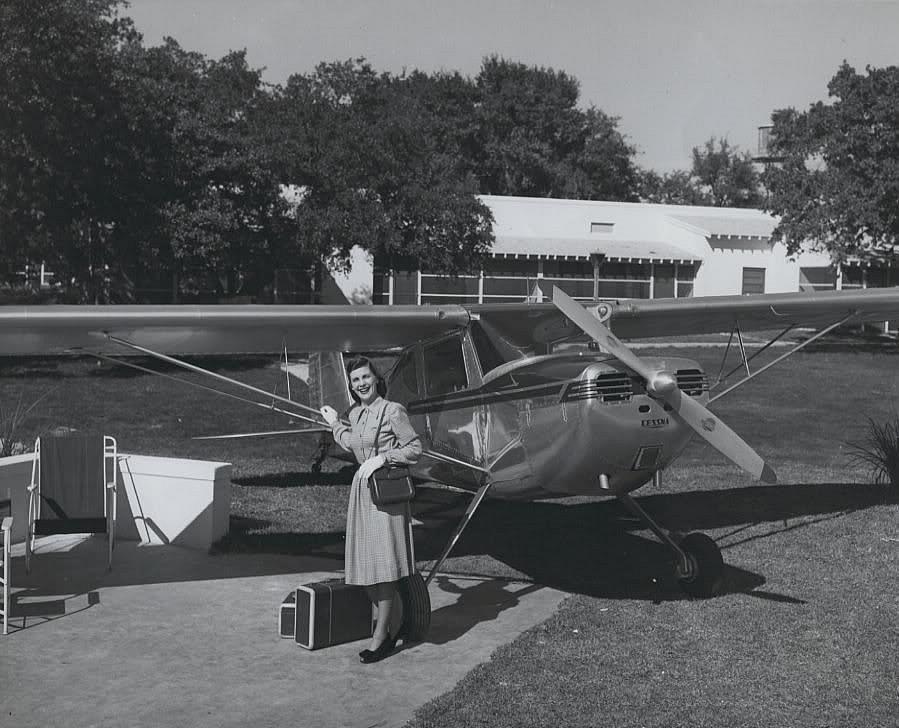
Advertisement view of
Cessna 140 with lady standing next to the ship. B&W, about 94K,
Added 01/01/10.
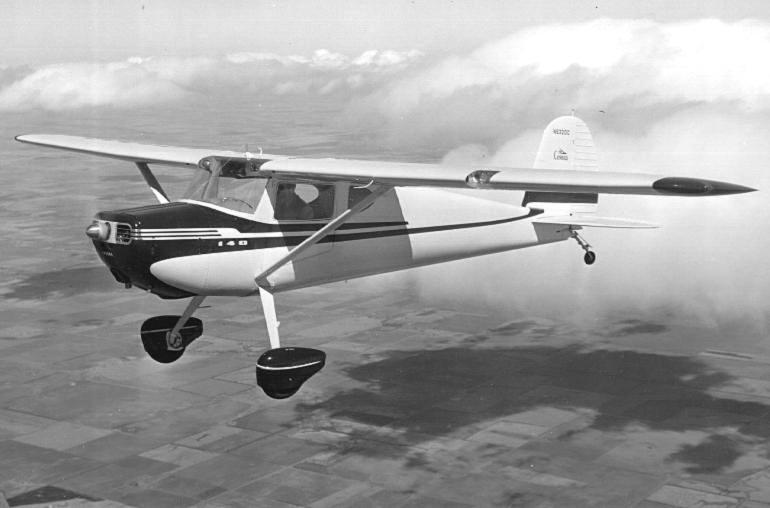
Inflight view of
Cessna 140A, N5320C.
This is the later "A" model 140 with single strut, the
wing being very similar in design to the Cessna model 170A.
B&W, about 38K, Added 01/01/02.
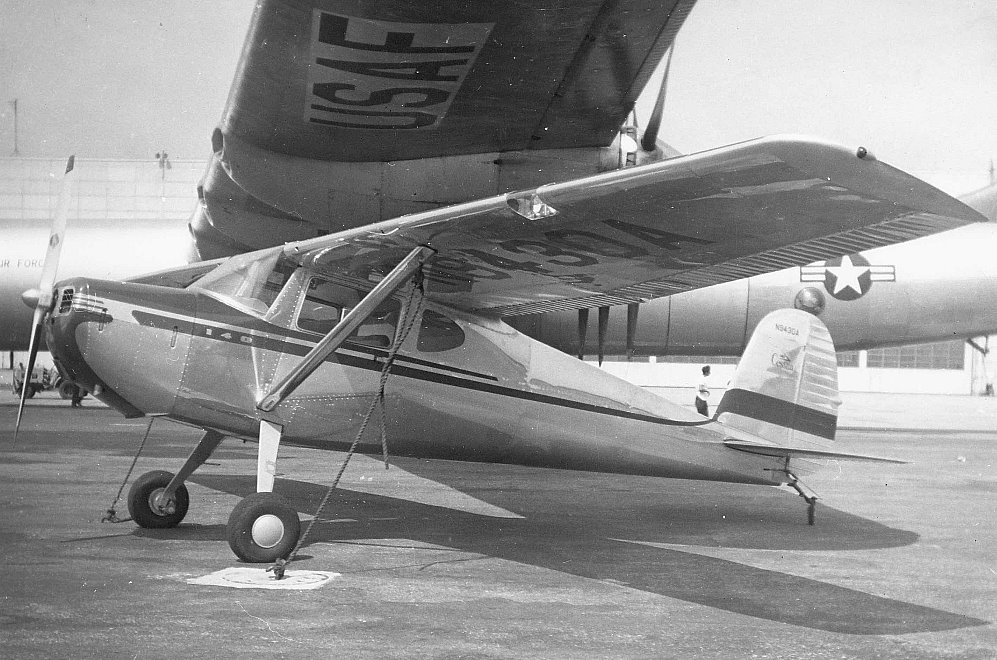
Ground view of Cessna
140A, N9430A,
c/n 15251. This 140A is tied down under the wing of a Consolidated
B-36 Peacemaker. B&W, about 159K,
Added 11/29/12.
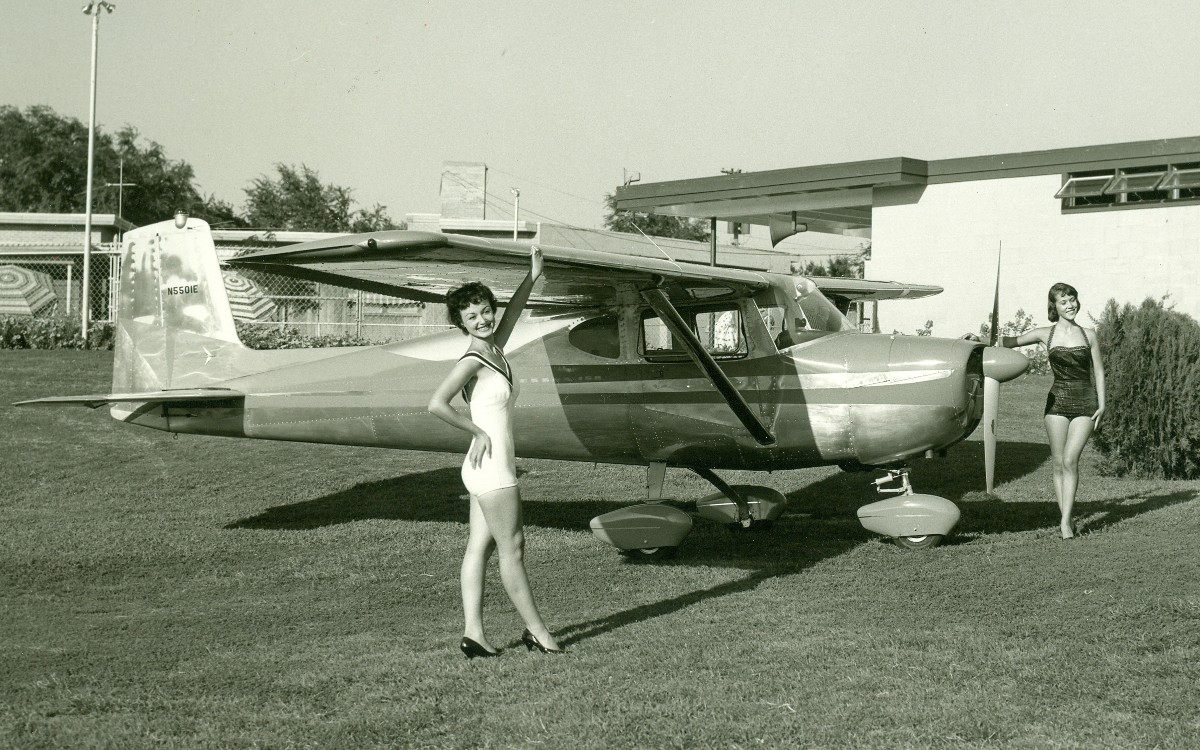
Ground view of Cessna
150, N5501E, c/n 17001. This was the first production
Cessna model 150 with standard paint and optional wheel
fairings. This view shows two ladies in everyday flying attire
of bathing suits with black patent leather high heel shoes
checking out the airplane. B&W, about 300K,
Added 04/22/19.
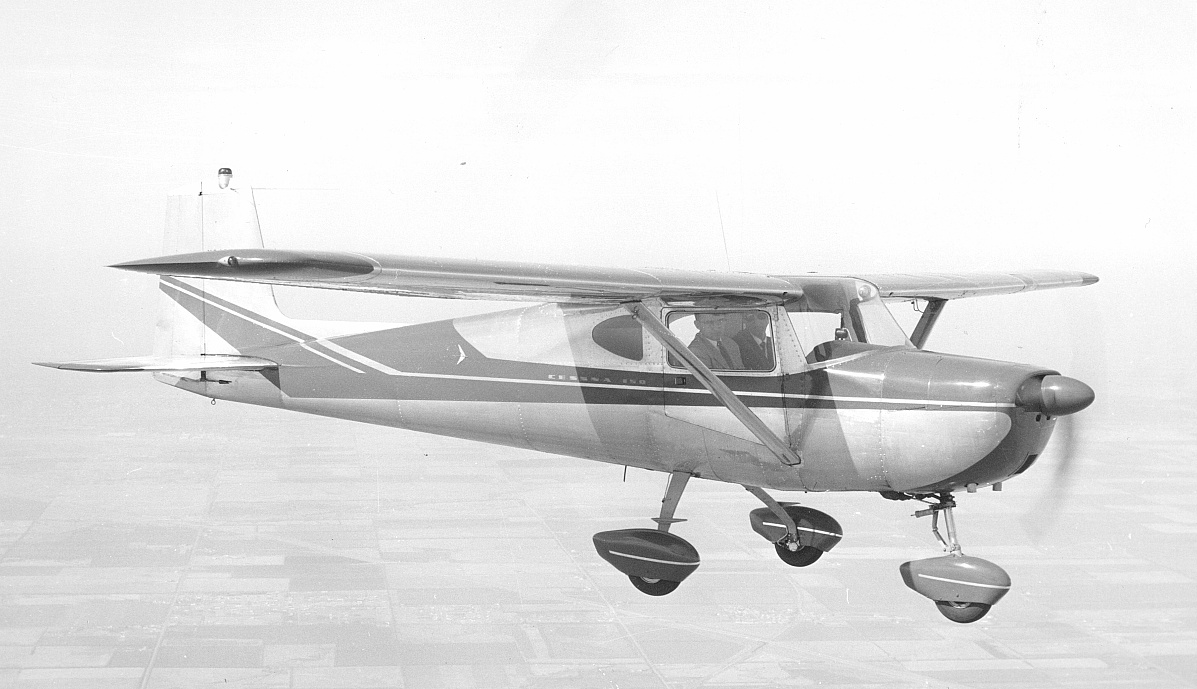
Inflight view of 1960 Cessna
150, which I believe this is c/n 17684, N7884E. The 1959 Cessna 150
marked Cessna's return to the training airplane market since Cessna
discontinued production of the model 140A. The 1959 and 1960 year model
150's both have the smaller rear window with a rounded back end.
B&W, about 239K, Added 01/30/15.
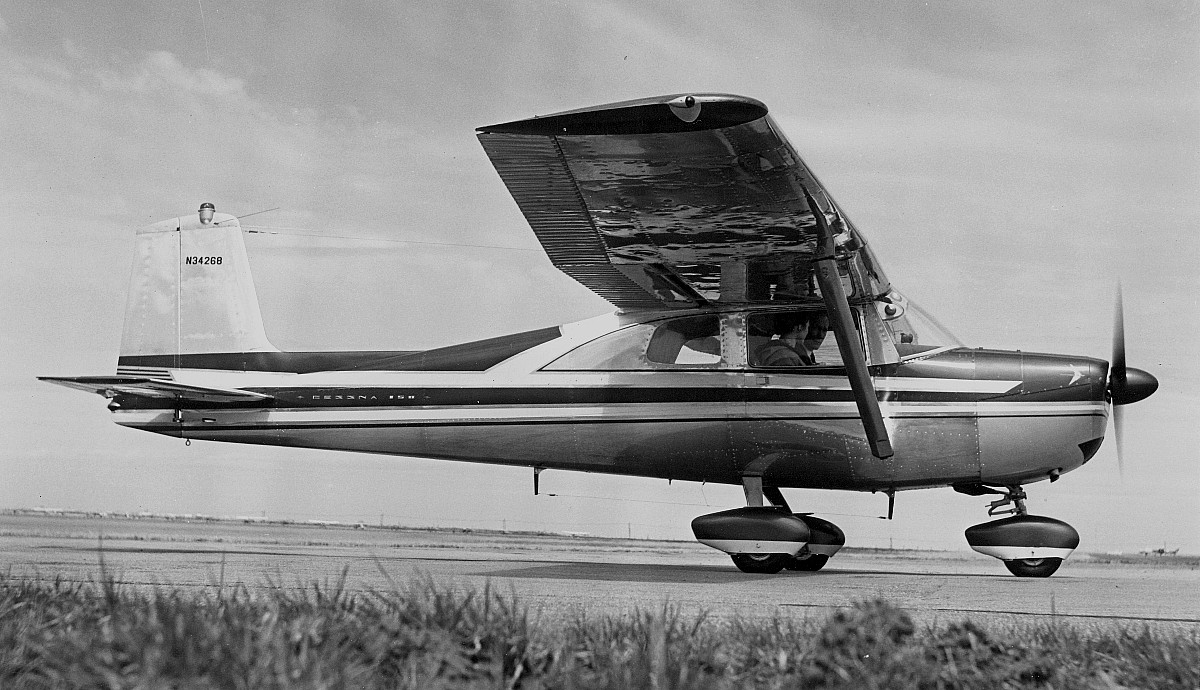
Ground view of Cessna
150A, N34268, c/n 628. This airplane is listed by the FAA as being built in 1959,
this is the prototype for the later 1961 "A" model 150. This is the first
model 150 having a larger, more square rear window, landing gear moved aft 2 inches
from the first Cessna 150, and empty weight reduced 12 pounds. B&W, about 239K,
Added 02/15/15.
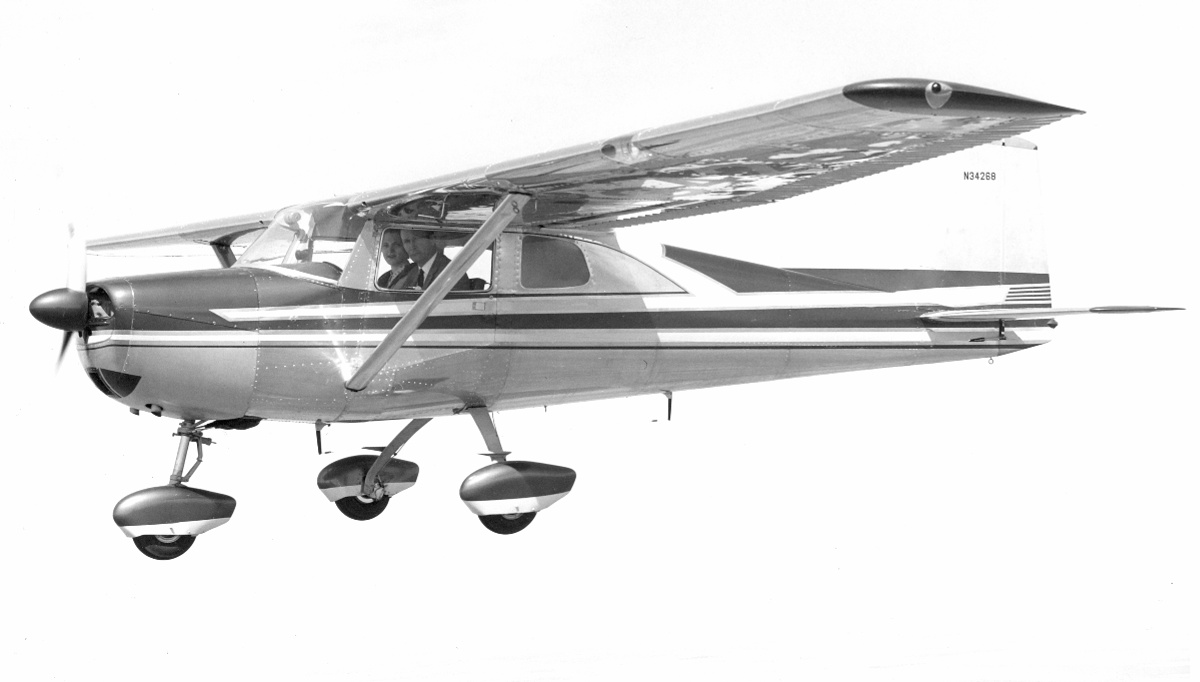
Inflight view of Cessna
150A, N34268, c/n 628.
This is the later 1961 "A" model 150 which differed
from the first model 150 in having a larger, more square rear
window. Airplane current on the FAA register. B&W, about 115K,
Added 04/12/06.
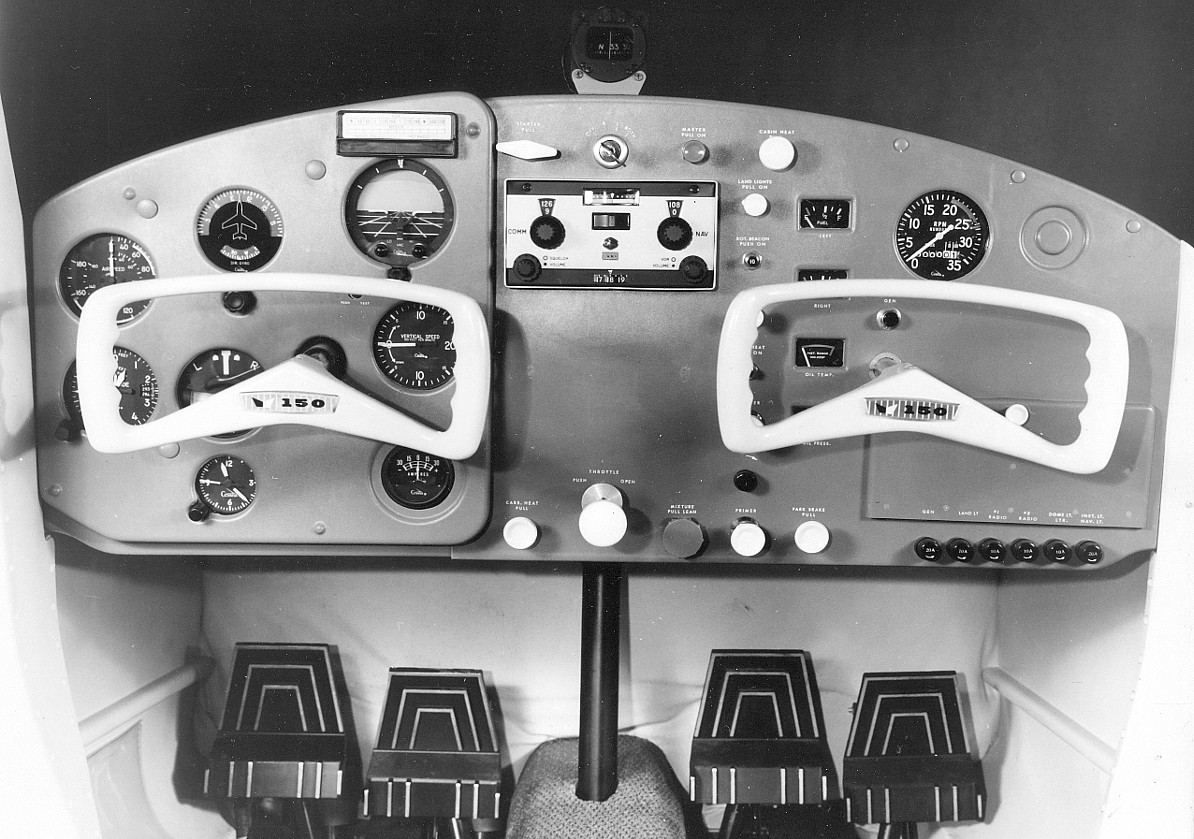
Cessna 150A through 150F Instrument Panel View. The
first Cessna 150 instrument panel used in the 1959 and 1960 model Cessna 150's had
center mounted instruments with radios at the lower left and lower right. This is
the second type Cessna 150 instrument panel with center mounted radios. This
instrument panel was used from the 1961 Cessna model 150A thorugh the 1966 Cessna
model 150F. This particular instrument was installed in a 1964 Cessna 150D.
B&W, about 259K, Added 07/10/16.
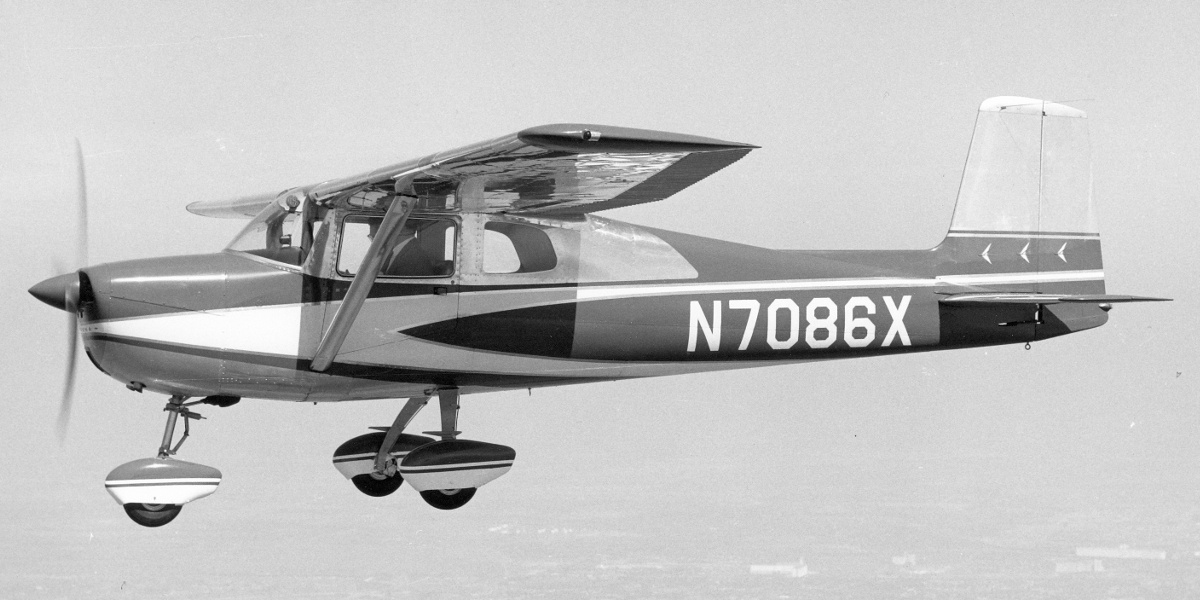
Inflight view of 1962 Cessna
150B, N7086X. The rear window is squared and the navigation
lights in the wingtip fairs into the tip fairing. B&W, about 217K,
Added 01/01/02.
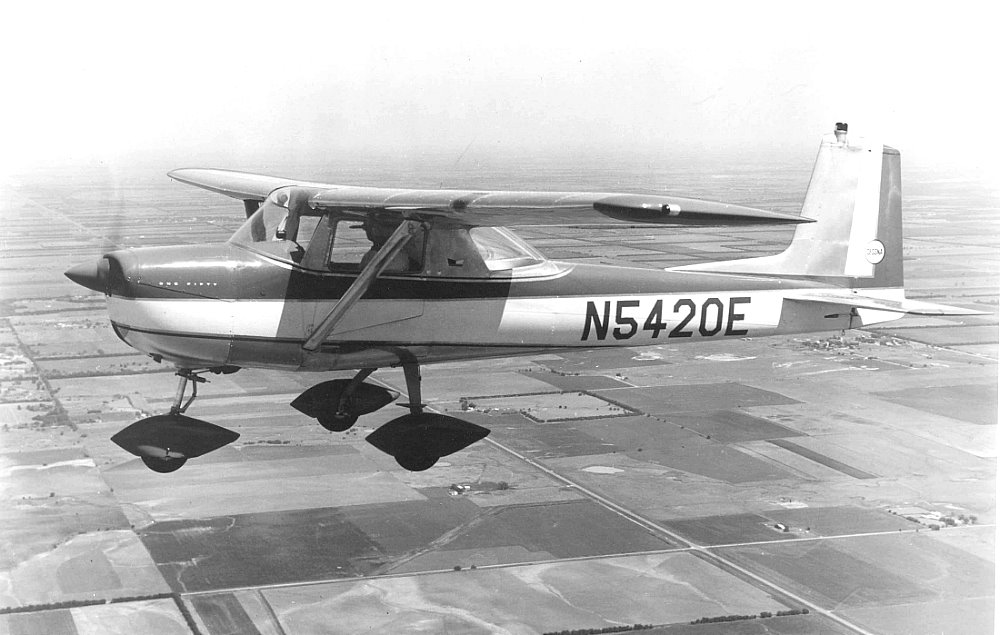
Inflight view of Cessna
150D, N5420E.
With the 1964 model year Cessna introduced a major change to the
150 series airplanes. The rear fuselage was cut down and a rear
window Added. This was called "Omni Vision" by Cessna.
The 1964 & 1965 years are the only model 150 with Omni Vision
and a straight vertical stabilizer. My thanks to
Tom Cowdogn for correcting the years of the
straight tail omni vision 150. This is Cessna construction number
644, it is still active on the FAA register. B&W, about 106K,
Added 09/17/08.
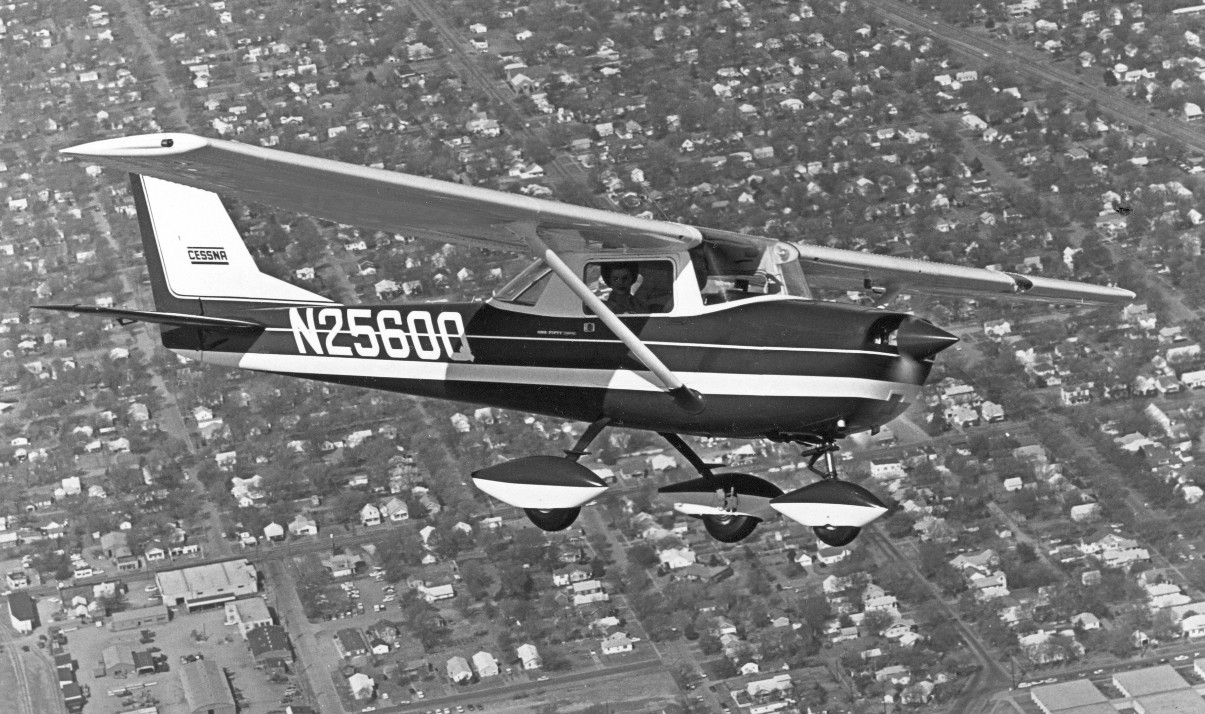
Inflight view of 1968 Cessna
150H, N2560Q. The vertical stabilizer and rudder are now swept with
"Omni Vision" back windows. Going forward Cessna 150 and 152
airplanes have this same configuration. B&W, about 267K,
Added 05/10/16.
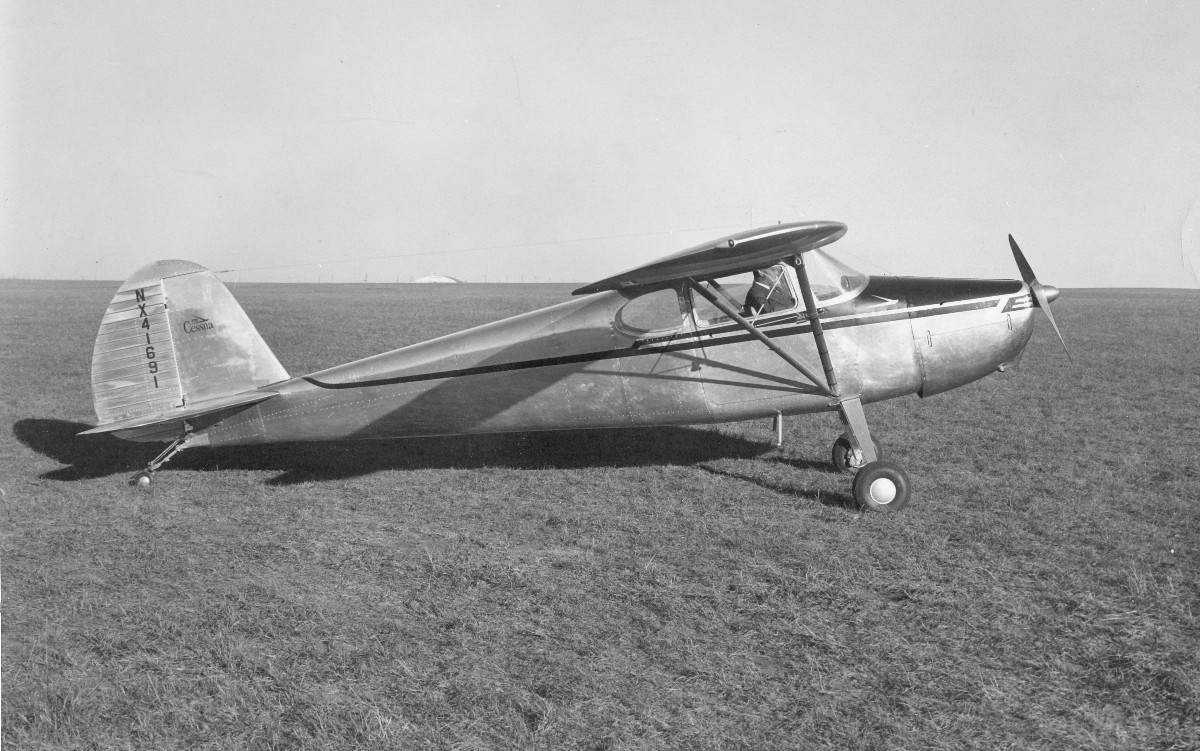
Ground view of Prototype Cessna
170, NX41691, construction number 18000, manufactured Nov. 5, 1947.
The model 170 is a four place airplane which, although it looks very
similar to the model 140, is an entirely new, larger airplane. The "straight
model 170" has two lift struts, wing structure of aluminum, with
the wings fabric covered. The straight model 170 was manufactured for
the 1948 model year only. B&W, about 254K,
Added 07/01/20.
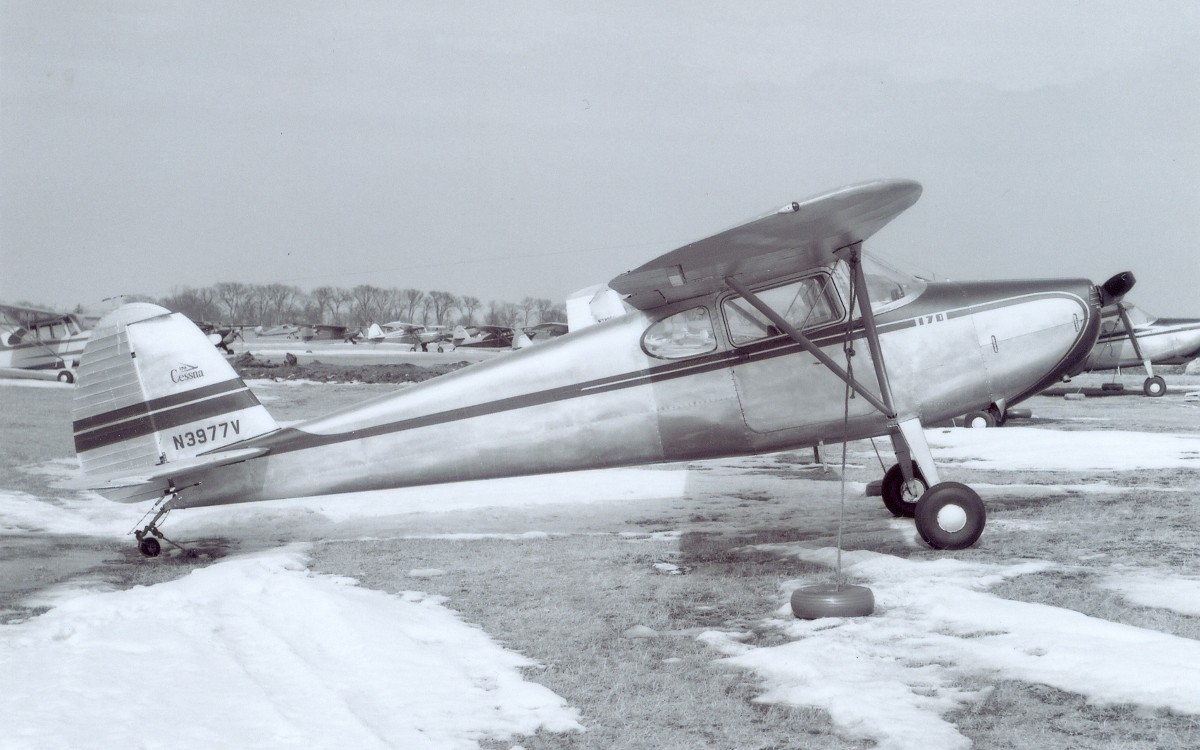
Ground view of Cessna
model 170, N3977V, construction number 18296, manufactured in 1948.
The first model 170 used wing construction similar to the model
120 and 140. All aluminum wing with fabric covering. Note the
"V" type lift struts Cessna used only with the first
model 170 having fabric covered wings. B&W, about 183K,
Added 04/22/19.
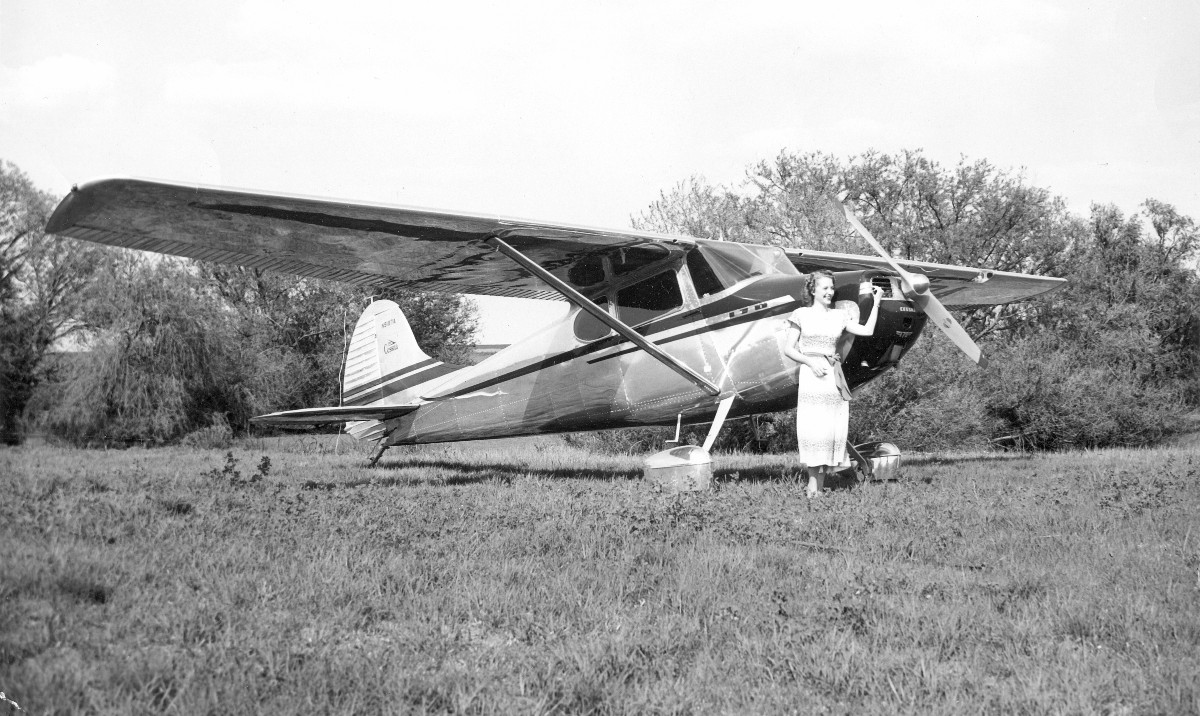
Ground view of Cessna
170A, N9197A, construction number 18958, manufactured in 1949.
Look closely to see the small metal flaps unique to the "A"
model 170. This is a Cessna publicity photo with a pretty lady.
Current on the FAA register. B&W, about 268K,
Added 06/14/16.
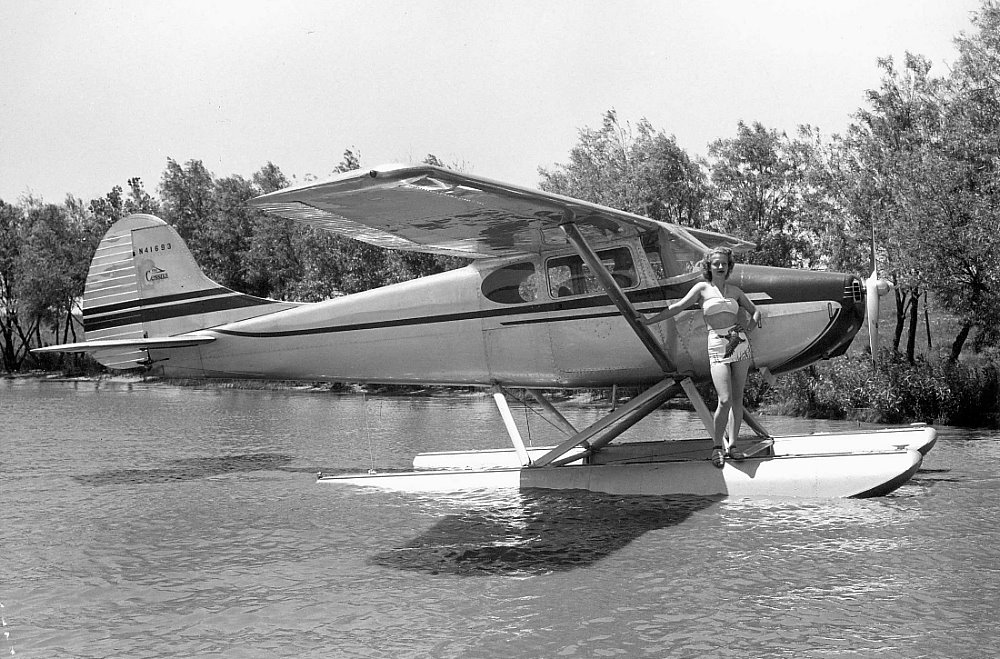
Water view of Cessna
170A, N41693.
This airplane is equipped with floats and is shown on the water.
The "A" model introduced the all metal wing with small
flaps. B&W, about 190K,
Added 01/07/02.
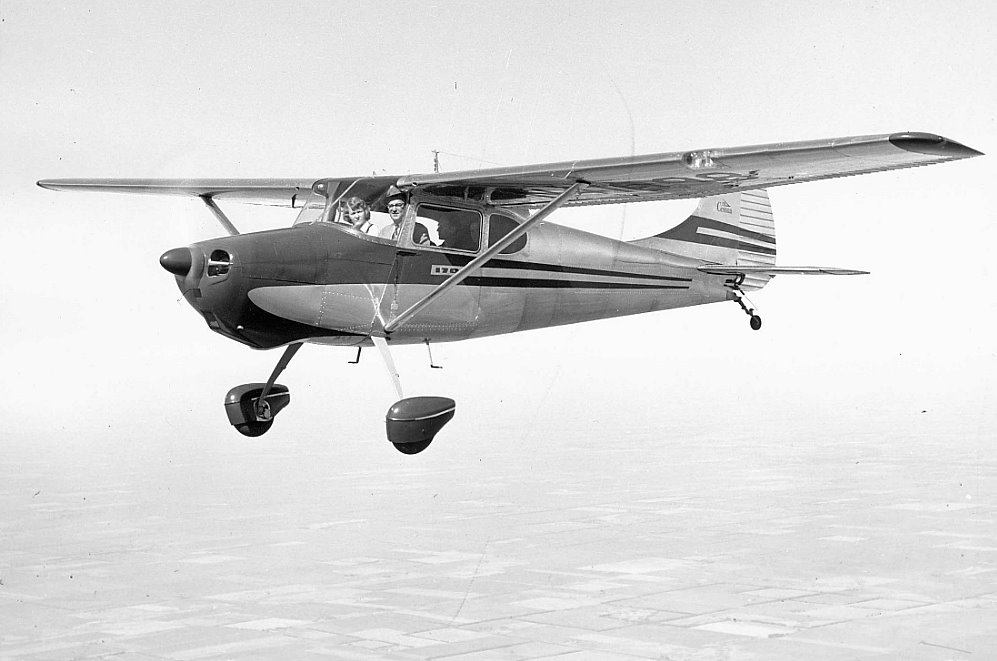
Inflight view of Cessna
170B, N41698. The
"B" model 170 introduced the large "Para
Lift" flaps found on all later Cessna single piston engine
airplanes. B&W, about 85K,
Added 01/01/02.
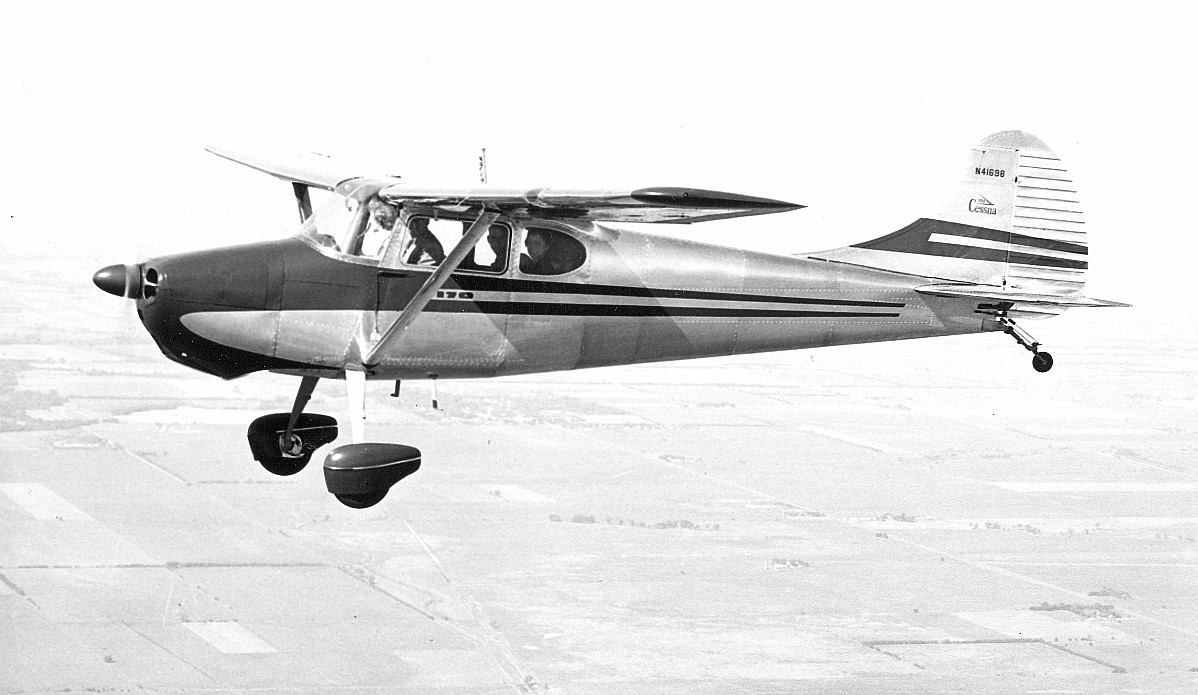
Inflight side view of Cessna
170B, N41698. B&W, about 164K,
Added 02/20/16.
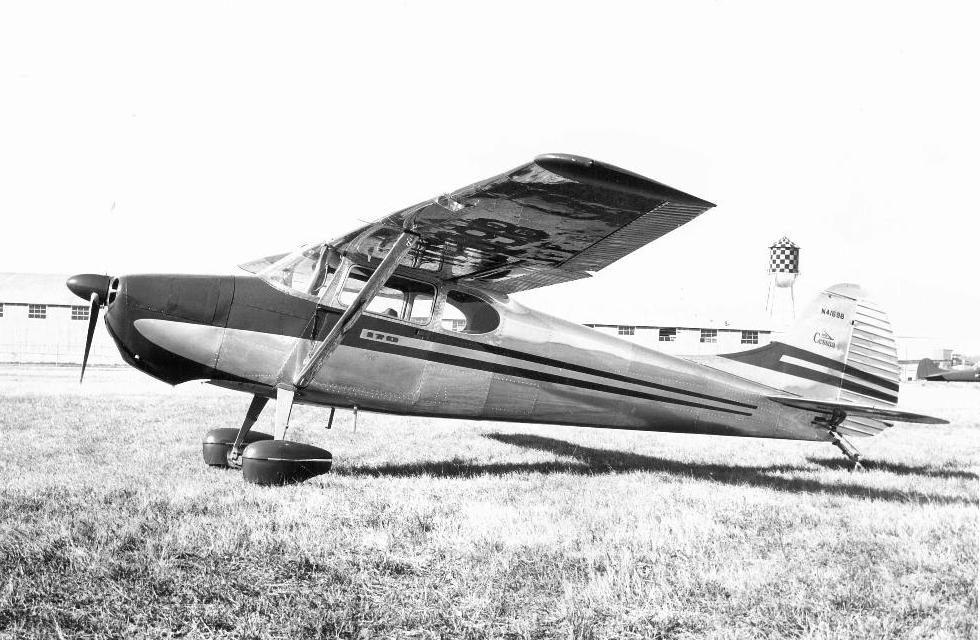
Ground side view of Cessna
170B, N41698.
B&W, about 111K,
Added 06/02/13.
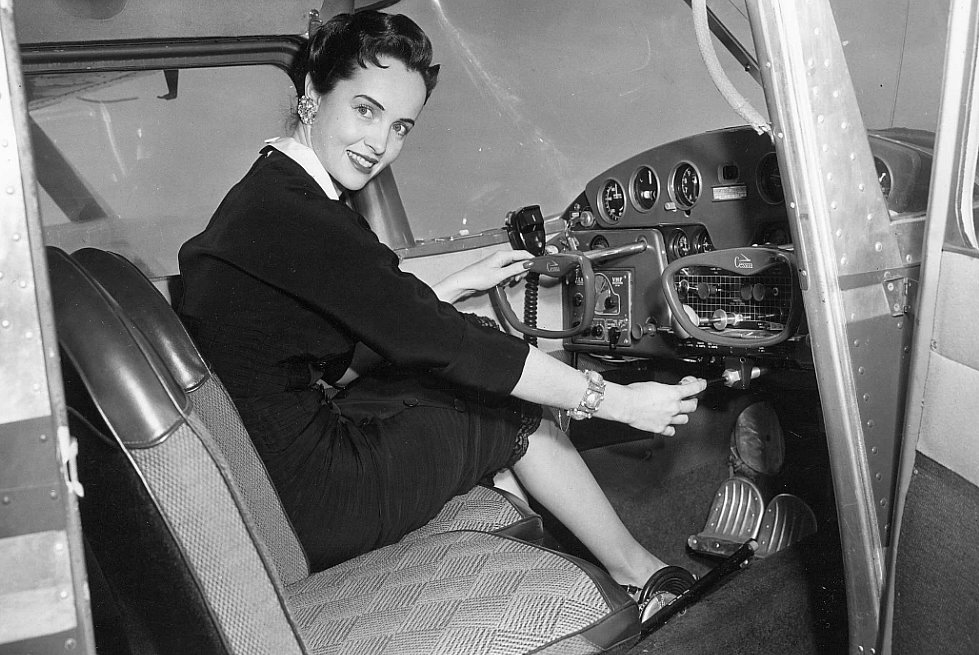
Cessna
170 Instrument Panel view. This
instrument panel view shows the "piano key" type
switches used shortly after WWII. Radio is a Lear LTRA-5, the
elevator trim wheel is on the floor between the seats along with
the flap handle. NOTE the lady has her hand on a venier propeller
control. Cessna 170's were delivered from the factory with
fixed pitch propellers, so this airplane apparently has a
controllable or constant speed propeller installed. The throttle
is standard push pull above the propeller control, obscured by
the co-pilot control wheel. B&W, about 144K,
Added 06/24/09.
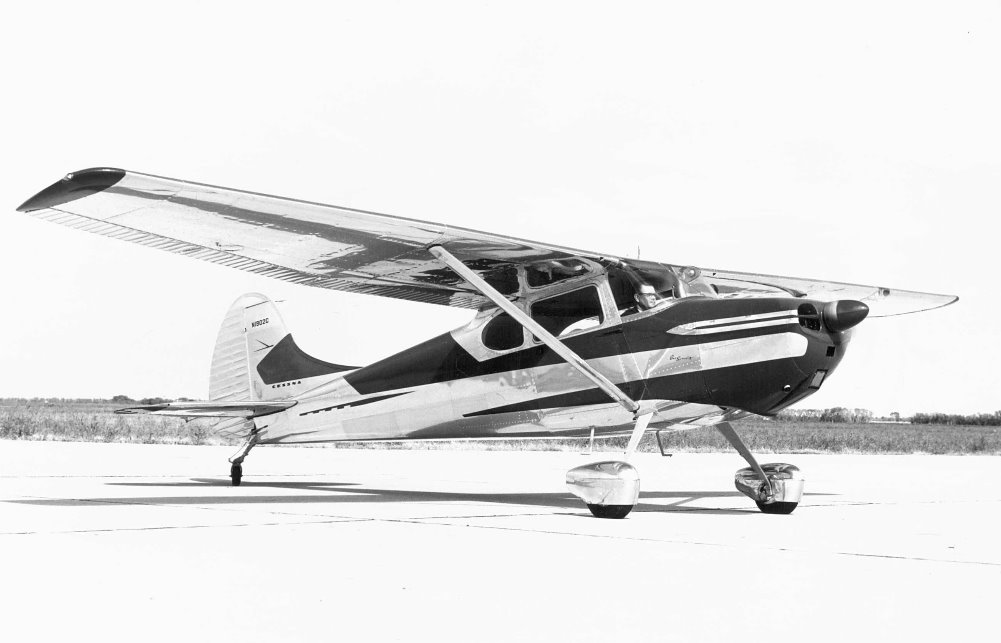
Ground view of Cessna
170B, N1902C.
This "B" model 170B is construction number 26047, built
very late 1953, or early 1954. B&W, about 64K,
Added 12/01/11.
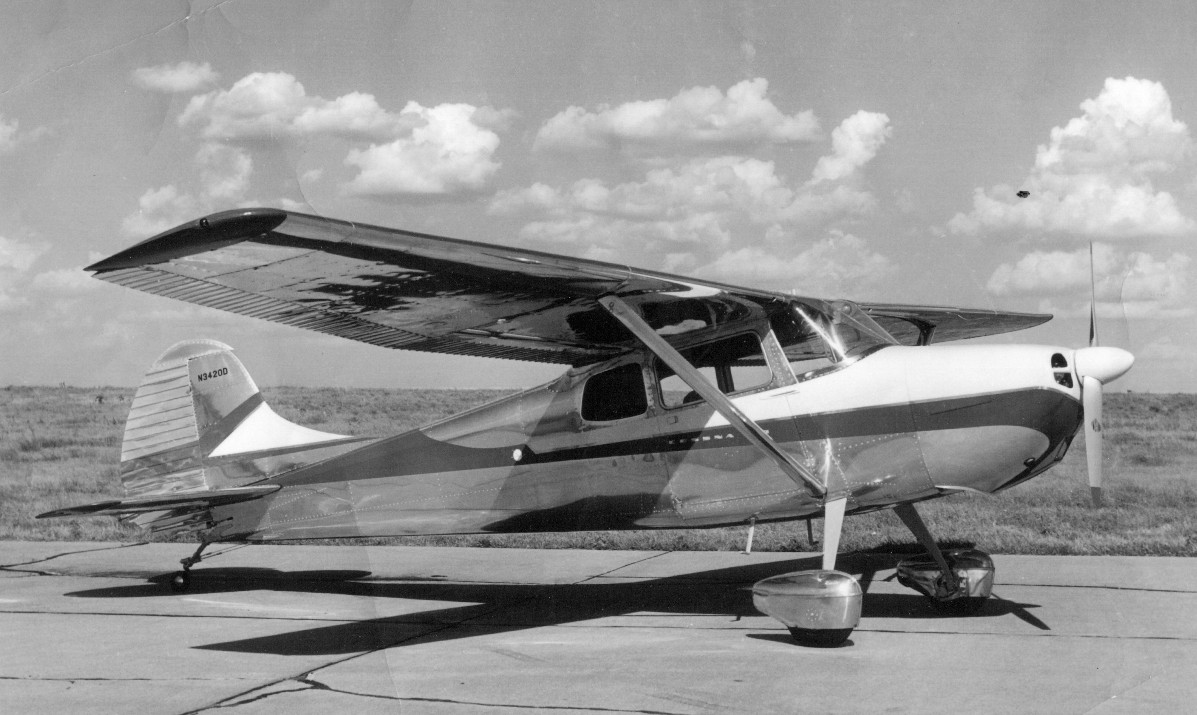
Ground view of Cessna
170B, N3420D. This "B" model 170B is construction
number 26963. You can see the larger cord metal "Paralift"
flaps introduced with the model 170B. More easily seen in this view
is the squared rear window introduced with the 1956 model Cessna
170B. B&W, about 185K,
Added 06/14/16.
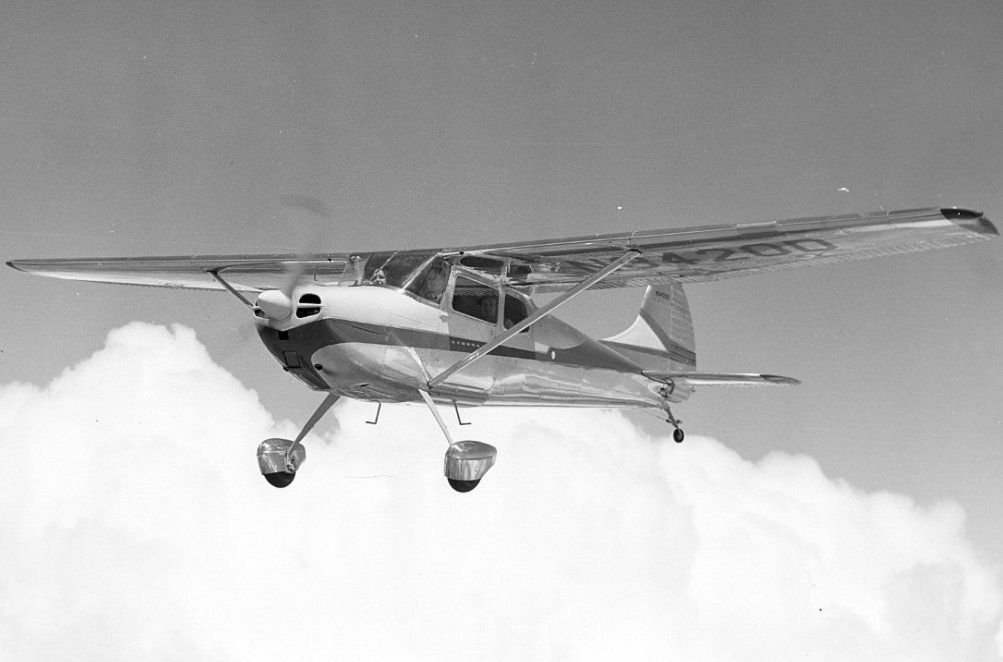
Very nice inflight view of Cessna
170B, N3420D.
This "B" model 170B is construction number 26963, built
in late 1955, it was painted by Cessna with the 1956 Cessna 170B
paint scheme and used by Cessna for marketing the 1956 model
170B. Not easily seen in this view is the more squared rear window.
B&W, about 65K,
Added 01/06/07.
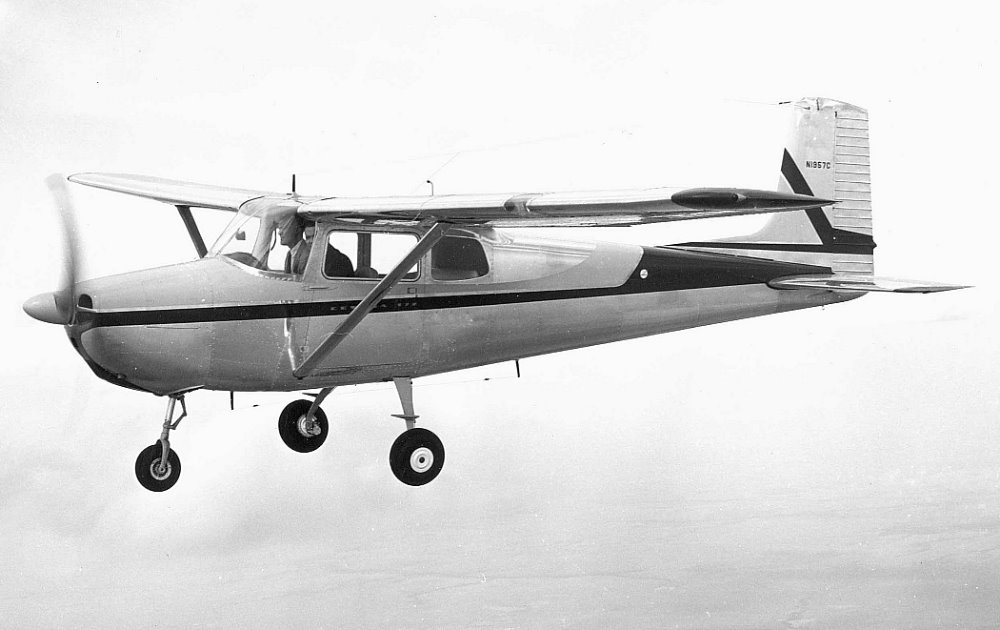
Inflight view of an early Cessna
172, N1957C. I
believe this is the 1957 model year 172 (note the registration
number), the first prodcution year for the 172. This is the basic
172 model without wheel pants or complete exterior paint.
B&W, about 75K,
Added 12/24/05.
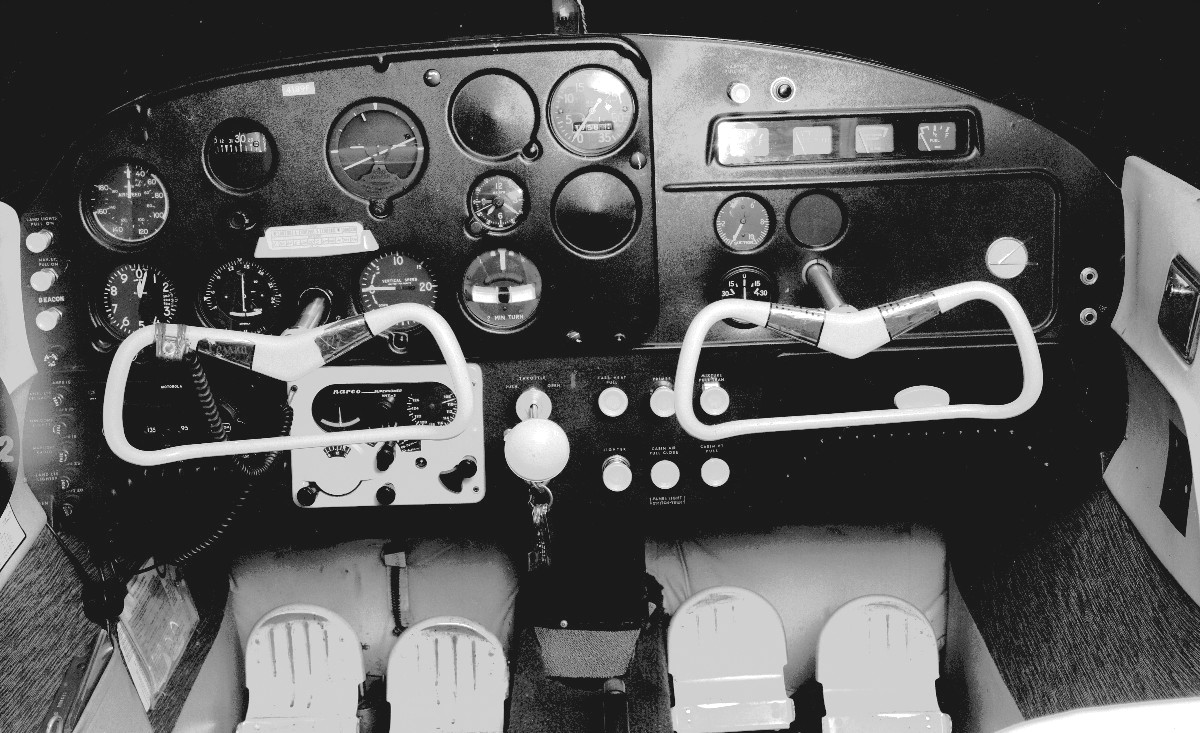
View of a 1958 Cessna
172 Instrument Panel installed on N4189F, contruction number
46089. Airplane is equipped for IFR flight with full gyro panel.
Pilot control wheel has a crudely installed radio transmitter
push to talk switch. Radio to the right and below the pilot control
is a Narco VHT-3 Superhomer (white face on the radio). The Narco
Superhomer has a 12 channel transmitter and a tunable receiver with
a built in VFR omni. Probably the most popular general aviation
radio in the 1950's. The radio to the left and below the pilot
ccontrol wheel is a Motorola M400 (I believe, it is difficult to see)
with an IFR omni indicator in the panel to the right of the altimeter.
This radio had a single frequency selector for both COM (360 channels,
118.00 to 135.95 MHz) and NAV (200 channels, 108.00 to 117.95 MHz). Once
the frequency selector was tuned to a NAV frequency the transmitter was
automatically set to 122.1 MHz to transmit to a Flight Service Station. The
single frequency selector kept the cost of the radio down. The Motorola M400
came out about 1964 when this photo was taken. B&W, about 237K,
Added 03/01/17.
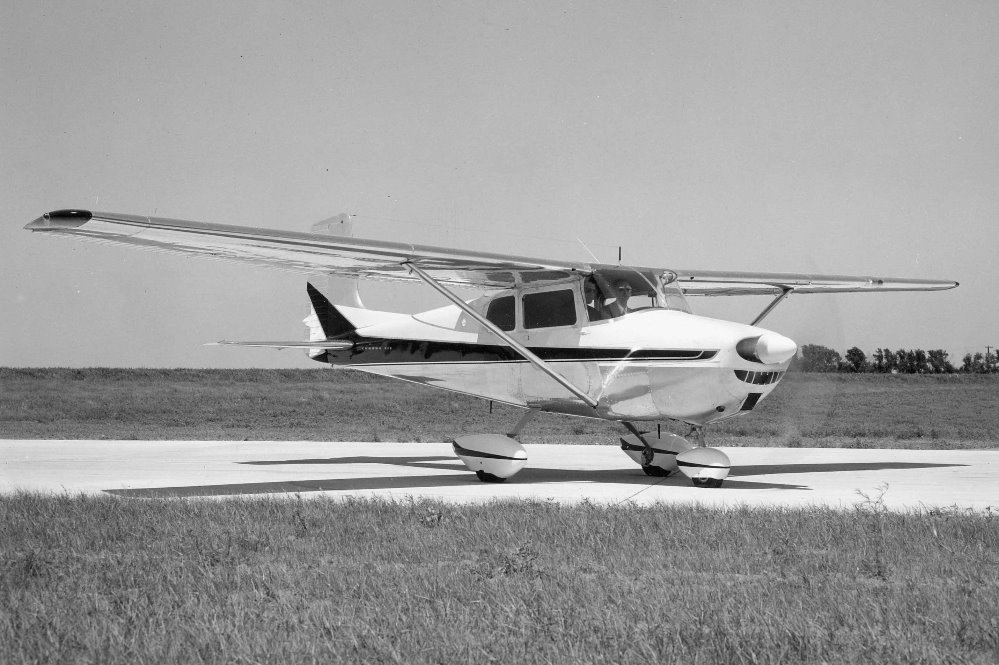
Ground view of Cessna
172, N8516B. This
airplane original built in 1957, was updated to the 1959 model year
172, the last with the square tail. This
airplane is serial number 36216. B&W, about 122K,
Added 12/26/12.
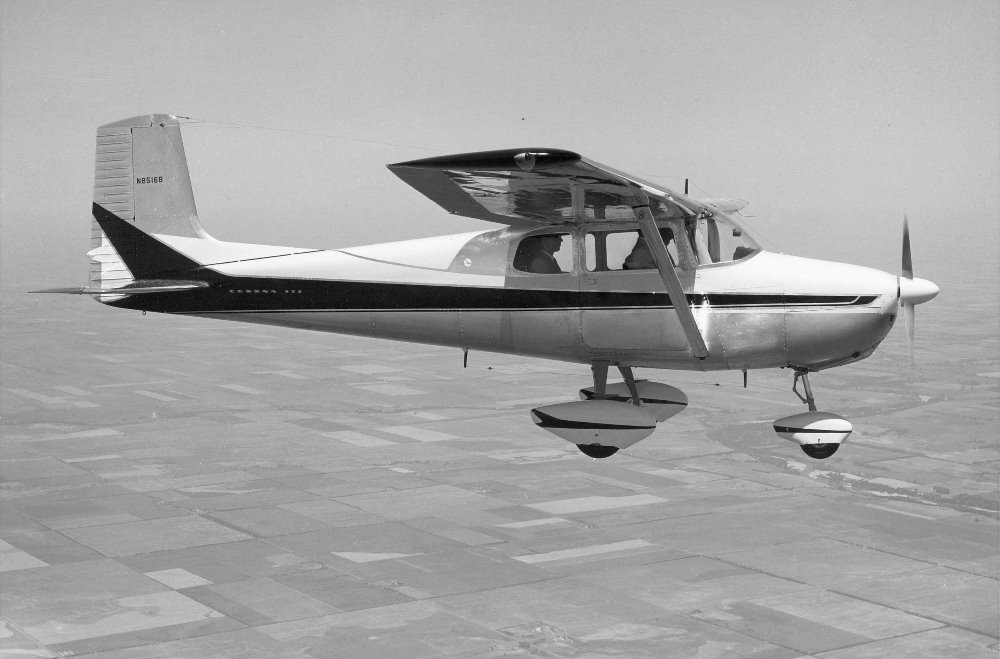
Inflight view of Cessna
172, N8516B. This
is the 1959 model year 172, the last with the square tail.
Airplane shown has wheel pants, which normally means it is the
Skyhawk version of the model 172. However without complete
overall paint, this is still the 172 and not the Skyhawk. This
airplane is serial number 36216. B&W, about 88K,
Added 01/01/02.
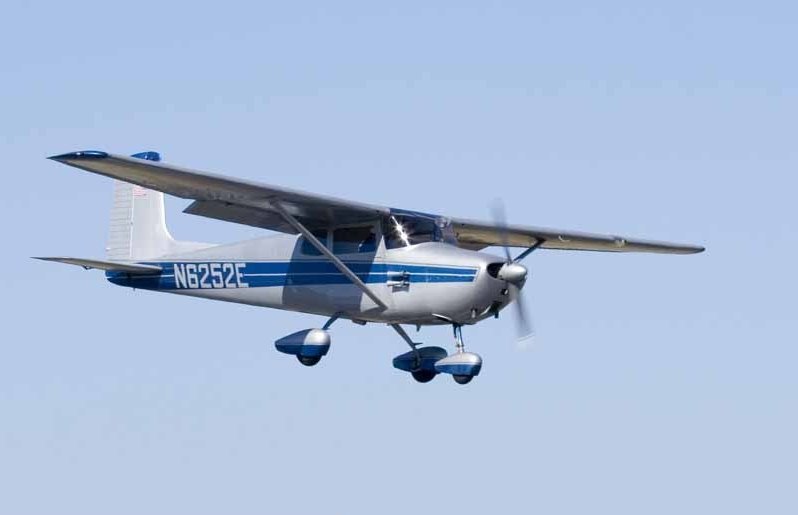
Inflight view of Cessna
172, N6252E,
serial number 46352. This is the 1959 model year 172. My thanks
to Charles Culp who owns
N6252E for this image. Color, about 26K.
Added 03/14/10.
View of Cessna
172B Skyhawk Instrument Panel. Aircraft is N7648X, a 1960 model configured
with the optional Skyhawk features. This is construction number
c/n 17248148, which was later reregistered and current on the FAA
register as N172NX. Airplane is well equipped for 1960 with a
full blind flying instrumentation, plus a King KX-130 radio
(radio on right) which has 360 communications frequencies, plus
100 navigation frequencies and a built in 10 channel glideslope
receiver. The KX-130 drives the KI210 VOR/LOC/ILS converter at
the bottom of the instrument panel partially blocked by the
control lock. Airplane also has a King KX-150B radio (left radio)
with 100 communications frequences, 100 navigation frequencies,
and a built in omni-localizer indicator. Below the KX-150B is a 3
light marker beacon, and to the right of the marker beacon a
radio switch panel. The 1960 Cessna 175 Skylark used the same
instrument panel. B&W, about 158K,
Added 07/18/09.
Inflight view of Cessna
172B Skyhawk,
N34270. This is the 1961 model year 172B, showing the swept tail
first introduced on the 1960 model. Airplane shown is serial
number 172630. A Skyhawk model of the model 172 which can be
identified externally by overall paint and wheel pants. This
airplane is currently on the US registry. Beginning in 1963
Cessna introduced the "Omni Vision" fuselage on the
172. B&W, about 63K,
Added 01/1/02.
Inflight view of Cessna
172G Skyhawk,
N5767R. Built in 1965, it is serial number 17253436, but is
considered the 1966 model year. This version of the 172 had all
the major changes including "omni vision" and swept
tail which Cessna has continued with ever since. The 172G still
uses the Continental O-300 engine of 145 HP, while later
airplanes would use Lycoming engines. This airplane is currently
on the US registry. B&W, about 65K,
Added 06/21/09.
Inflight view of Cessna
172M Skyhawk,
N5250R. Built in 1974 as a 1975 model 172 Skyhawk II, serial
number is 17263464. This 1975 year falls outside my original
intent, however the Cessna 172 Skyhawk is a most popular
airplane. At this time Cessna has switched to using the Lycoming
O-320 engine. Note the different, larger rear passenger windows.
B&W, about 113K,
Added 04/22/11.
Interior views of the 1975 Cessna 172M Skyhawk II. First interior
view is of the Instrument Panel.
This airplane is equipped with
Cessna, formerly ARC, radios, and modern, smaller gyros. B&W,
about 126K. Second interior view is of the seating
arrangement. B&W, about 79K.
Added 04/22/11.
Ground views of 1958 Cessna 175 Skylark N7114M.
Ground view 1 - 3/4 right front side, B&W, about 113K.
Ground view 2 - 1/2 left front side,
B&W, about 171K.
Added 08/09/13.
Inflight view of Cessna
175, N7114M.
Built in 1958, it is serial number 55414, but it is a 1959 model
year airplane. This is representative of the first model
175's with the straight vertical stabilizer. This airplane is
current on the FAA register. This is a model 175 rather than a
Sklark due to the lack of overeall paint, it does have, for the
model 175, the optional wheel fairings. Model 175's from the
factory were equipped with a geared Continental GO-0300 engine of
175 HP. This airplane is now equipped with a Franklin engine.
B&W, about 65K,
Added 03/31/10.
Inflight view of Cessna
175, N34260. This
is the 1960 model year 175. This image shows a 175 painted in the
standard paint scheme. This airplane is serial number 619,
originally built in 1959 with a straight vertical stabilizer, it
was the prototype swept tail 175. My thanks to
Richard Swartz who
provided the photograph, and detailed information about this
airplane which he now owns. B&W, about 101K,
Added 07/31/07.
Inflight view of Cessna
175, N34265. This
is the 1961 model year 175. This airplane is the deluxe version
named Skylark. Engine is a Continental geared GO-300 producing
175 HP. B&W, about 39K,
Added 01/07/02.
Inflight view of Cessna
177 Cardinal, N3766C, c/n 661. This is the second prototype shown
in the standard 1968 paint scheme. Full paint and wheel pants make this
a Cardinal model. The 1968 Cessna 177/Cardinal was equipped with a 150HP
Lycoming O-320 engine. Later year versions of the 177/Cardinal have the
Lycoming O-360 of 180HP. B&W, about 119K,
Added 01/11/15.
View of an early Cessna
180 instrument panel view. The radio is a Lear LTRA-6 positioned at the
lower left. Above the radio, immediately to the left of the
altimeter, is the Lear Omniscope. The Lear Omni scope was a
cathode ray tube (CRT) which displayed a circular pattern, with a
blip on the circle to show the omni station radial you were on.
B&W, about 98K,
Added 01/01/10.
Inflight view of Cessna
180, N5387D. This
is a 1959 model 180. B&W, about 58K,
Added 01/01/02.
Ground view of Cessna
180, N5387D. This
is the same 1959 model 180 airplane as above showing a ground
view. B&W, about 91K,
Added 10/05/05.
Inflight view of Cessna
180, N3752C. Believe this is a 1961 model 180, note
the windows are now the same as a model 185. B&W, about 490K,
Added 02/03/25.
Inflight view of Cessna
182 Skylane,
registration not visible. This is a 1958 model year Skylane.
B&W, about 43K,
Added 01/01/02.
Inflight view of Cessna
182B, N4054D.
This is a 1959 model year 182. Note this airplane was built in
1958 but is a 1959 model 182. Also note that with the model 182
Cessna applied only partial paint, remainder being natural
aluminum, and no wheel pants. See the next image, also of N4054D
but this time with the full paint scheme of the Cessna 182
Sklane, which also has the wheel pants. Airplane is current on
the FAA register. Right side view of the airplane. B&W, about
126K,
Added 08/14/10.
Inflight view of Cessna
182B Skylane,
N4054D. This is a 1959 model year Skylane, the last year with the
straight vertical stabilizer. This airplane is Cessna serial
number 34754, current on the US register. Note that this is the
same airplane as the previous image, however at this time the
airplane now has a full paint scheme and wheel pants of the
Sklane. In addition there is a Grimes rotating beacon on the top
of the vertical stabilizer which is not on the basic model 182.
Left side view of the airplane. B&W, about 79K,
Added 11/02/05.
Ground view of Cessna
182B Skylane,
N4054D. B&W, about 41K,
Added 05/07/13.
View of the 1959
Cessna 182B Skylane Instrument
Panel.
Registration identification not visible. Radio in center is a
Narco Mark V, with a CS-5 VOR/ILS indicator below the artifical
horizon, a Narco Mark 2 Omnigator in the middle, and a Narco
LFR-3 low frequency receiver (NOT an Automatic Direction Finder,
receiver only), on the right. Gyros are remanufactured WWII units
typical of all light general aviation aircraft of the period.
B&W, about 148K,
Added 05/19/12.
Inflight view of Cessna
182D Skylane,
N2323G. This is a 1960 model year Skylane, the first with the
swept vertical stabilizer. This year a third window was Added for
increased visibility. This airplane is Cessna serial number
51623, and it is current on the US register. B&W, about 67K,
Added 11/02/05.
Inflight view of Cessna
182H Skylane,
N2306X. This airplane was built in 1965, serial number 18256206,
one of 840 built by Cessna in 1965. This version of the Skylane
has all the major changes Cessna would make to the 182, swept
tail, "omni vision." This airplane is current on the
U.S. register. B&W, about 86K,
Added 06/21/09.
Inflight view of Cessna
185 Skywagon,
N34272. This is a 1961 model year Skywagon. Note the model 185
evolved from the model 180. Note the larger dorsal fin, and extra
window on each compared to the model 180. B&W, about 75K,
Added 10/05/05.
Inflight view of Cessna
185D Skywagon with cargo pack, N5877T, c/n 185-0777. This is a 1964 model
year Skywagon. The model 185 has a very good useful load, about 1,600 pounds.
To accomodate operators who haul cargo Cessna made the cargo pack an
optional extra. B&W, about 314K,
Added 07/19/17.
Ground view of a
Cessna 190, registration NC4318N, c/n 7092. The Cessna 190 and Cessna
195 are very similar airplanes, with the Cessna 190 powered by a Continental
W-670 radial engine, while the Cessna 195 is powered by a Jacobs radial engine.
B&W, about 173K,Added 09/01/19.
view of a
Cessna 195 on pontoons on the water. Believe this was a Cessna
advertising photograph. Lady standing on the pontoon didn't come with
the airplane. B&W, about 208K,
Added 04/02/15.
Inflight view of Cessna
195A, N1518D, c/n 7740,
built in 1951. The Cessna 195A uses the Jacobs L4 /R755-7 radial
engine. B&W, about 48K,
Added 06/12/13.
Inflight view of Cessna U.S. Army
LC-126C, s/n 51-6987, Cessna c/n 7830, built 1952. After use with the
U.S. Army this airplane went on the U.S. civil register as N4026A.
B&W, about 217K, Added 06/01/17.
Inflight view of Cessna
195, N30758. Back
of the photo I scanned this from says this is a 1953 A195. The
A195 was powered by a Jacobs R-755-9. Since Cessna's contract
with Jacob's was completed, the engine had to be furnished by
the customer! B&W, about 48K,
Added 01/07/02.
Inflight view of 1965
Cessna P206 Super Skylane,
N2501X, serial number P206-0001. Cessna developed the models 205
and 206 as utility airplanes, with the 206 called the Super
Skywagon. Later took the 206 and made it into the P206 which has
a passenger interior, lacks the double cargo door, instead has a
third left side passenger door. So changed into the P206 it is
named the Super Skylane, and accomodates 6 passengers.
Continental 285 HP engine. This is the 1965 model. B&W, about 86K,
Added 06/21/09.
View of a 1967 Cessna model U206
Super Skywagon Instrument Panel. At the top of the radio stack is a
Cessna 300 Comm radio, below that is a Cessna 300 Nav receiver,
below that a Cessna 300 Navmatic autopilot, and at the bottom of the
radio stack is a Cessna 300 Comm/Nav radio. To the right of the
co-pilot control wheel is a Cessna 300 Automatic Direction Finder
(ADF). Note the absence of a transponder. B&W, about 247K,
Added 02/01/16.
Inflight view of 1967
Cessna U206 Super Skywagon, N2458F. The Super Skywagon is an
utility airplane with the 42 inch wide double wide cargo doors, capable
of carrying 6 adults. B&W, about 137K,
Added 05/10/16.
Inflight view of 1960 Cessna
210, N1296.
Cessna began work on the model 210 by modifying 2 Cessna
182's with retractable landing gear in 1958. I have seen
photos of N1296 with 3 different vertical stabilizers. These
first prototypes had the straight tails of the 182's of the
time. Later a swept tail was Added, but different than that
shown. The photo here reflects the first prodcution year, 1960,
model 210. B&W, about 54K,
Added 12/24/05.
Inflight view of a 1961 Cessna
210A, N1296. As
you may notice this is the same registration number as the 1960
model 210 above, as well as the first prototypes with 182 type
tails. I suspect, but don't know, that Cessna retained N1296
for development work. The 1961 model has an additional side
window on each side. About 191K, B&W,
Added 11/04/06.
Inflight view of 1965 Cessna
210E, N2311F. The
model 210 now has "Omni Vision" window configuration,
and is now called "Centurion" by Cessna. Also the
original 260HP engine is now replaced by a 285HP Continental
engine. B&W, about 63K,
Added 12/24/05.
Inflight view of the Cessna
305 prototype with floats, N41694, c/n 601. At this point
the model 305 was in competition for the Army observation
aircraft. Later the Cessna would become the L-19 Bird Dog. B&W,
about 358, Added 04/22/19.
Inflight view of Cessna
305, better known as the L-19 Bird
Dog, Army serial
number 56-2647 is more
accurately a L-19E, and after the 1962 Department of Defense
standardized aircarft nomenclature between the services, it
became the O-1E Bird Dog. Equiped with a 213 HP Continental
O-470-11 engine and fixed pitch propeller. The O-1E was used
widely by the Air Force and Army in Vietnam. B&W, about 115K,
Added 12/24/05.
Inflight view of Cessna
CH-1A helicopter, registration N5156. This is the second
prototype helicopter built by Cessna. This view shows the helicopter
after the original horizontal stabilizer has been added. Note the
smaller size compared to the CH-1C production version in the image below.
This helicopter first flew in 1954. B&W, about 275K,
Added 06/01/15.
Inflight view of Cessna
CH-1C helicopter,
registration N5701. Cessna only built one type of helicopter,
approximately 40 aircraft total. While flight characteristics
were reported as very good, the CH-1C was not a commercial
success. Eventually Cessna bought back the helicopters from the
owners and scrapped them, which allowed Cessna to cancel the
Approved Type Certificate, 3H10 with the FAA. B&W, about 83K,
Added 12/21/11.
Nice Inflight view of 1954
Cessna 310,
N37879 (per the wing), but checking the vertical stabilizer with
a magnifying glass on the photograph indicates the registration
may be N37978. N37879 was the second prototype Cessna 310. This
photograph shows the airplane with the initial 1954 production
paint scheme. B&W, about 260K,
Added 05/17/02.
Very nice Inflight view of 1954
Cessna 310, N37879. Same airplane as the view immediately
above, however this photograph is taken at a slightly higher angle.
B&W, about 240K, Added 02/16/16.
Here is a ground view of 1954
Cessna 310,
N37879 the second prototype Cessna 310. This photograph shows the
airplane with the initial 1954 production paint scheme. My thanks
to Don Slape for scanning the
photograph. B&W, about 145K,
Added 3/05/05.
Very nice inflight view of 1957
Cessna 310,
N500E. B&W, about 78K,
Added 01/01/12.
Nice inflight view of USAF Cessna
L-27A, Cessna model 310A, USAF serial number 57-5847, Cessna
c/n 38002. The USAF renamed it the U-3A in 1958, well before the
Department of Defense renaming of 1962. Cessna built a total of 160
L-27/U-3A (a military version only) in two batches of 80 aircraft
each batch. The popular USAF name was "The Blue Canoe."
B&W, about 133K, Added 05/07/15.
Beautiful inflight view of 1958
Cessna 310B,
N5348A. This particular 1958 model year 310B became famous on the
television show Sky King, where it was named the "Song Bird
II," Cessna c/n 35548. B&W, about 92K,
Added 01/01/02.
Inflight view of 1959
Cessna 310C, N5350A. The Cessna 310 models 310B and earlier directed
the engine exhaust over wing exiting about 70 per cent of wing cord, while
using Continental carbureted engines of 240 HP. The Cessna 310C brought two
big changes. First the Continental engines were fuel injected, and the
exhaust exited at the trailing edge of the wing, which reduced interior
noise level. B&W, about 271K, Added 06/01/20.
Interior
view of a 1959 Cessna 310C. This interior view shows the optional lounge
first available on the 1959 310C. Lounge can seat 2, or 1 if
lying down. This airplane also has the optional wooden writing
table on the back of the co-pilot seat, as well as optional
adjustable head rests. Photo dated 12/07/58, B&W, about 175K.
Added 05/13/10.
Very fine inflight view of the 1960
Cessna 310D,
N34262. This is the first year the model 310 has a swept back
vertical stabilizer. Note the top of the engine nacelles.
Beginning with the 310C, the top of the nacelles extend all the
way to the trailing edge of the wing, which resulted in a quieter
cabin. Although never used in the television series that I am
aware of, Sky King would have a 310D, N6917T, as the "Song
Bird III." B&W, about 75K,
Added 12/24/05.
Instrument Panel
view of a 1960 Cessna 310D. The
310D usually had ARC crystal controlled radios. This airplane has
a Collins 618F-1 on top of the radio stack, with a DARE (Dayton
Aircraft Radio Equipment) ADF, with what appears to be at the
lower left of the radio stack a Collins control head for a nav
radio, and at the lower right an ARC tunable NAV radio. Below and
to the right of the pilot control wheel is a King KY-90
transiever. Below the throttle quadrant is a Lear Deluxe L-2
autopilot control head. B&W, about 163K,
Added 01/26/12.
Inflight view of USAF Cessna U-3B
Cessna model 310E, USAF serial number 60-6047, Cessna c/n 310M-0002
with the popular name of "The Blue Canoe." Cessna built 36 of the
310E (a military version only) which now has an extra window on each side.
Cessna included the small type extra rear side window beginning with the civil
model 310F. B&W, about 110K,
Added 05/07/15.
Ground view of 1961
Cessna 310F, N34262. I believe this was the prototype Cessna 310D (see
above) with an extra window on each side, a more "pointy" nose
and spinners. The more "pointy" of the nose, spinners ect.,
evolved into the "lets make everything pointy." The Cessna
310F was the last 310 to use the original straight wingtip tanks.
Beginning with the 310G Cessna began using canted wing tip tanks. B&W,
about 117K, Added 04/22/19.
Inflight view of
1961 Cessna 310F, registered N34262. B&W, about 225K,
Added 06/01/20.
Inflight view of 1965
Cessna 310J,
N3001L. The 310 has the extended rear window, wing lockers
for baggage, along with the canted wing tip tanks. This is Cessna
serial number 310J0001, and is current on the FAA register with
the registration N310EE. B&W, about 178K,
Added 10/03/10.
1962 Cessna 320 Skynight
Instrument Panel view, N34262. This is the first Cessna
320 Skynight which was converted from the 1961 Cessna 310F N34262. Other than
the logo on the control wheels the 310D and this 320 have the same instrument
panel. This panel is equipped with the high end ARC (Aircraft Radio Corporation)
avionics identified as a Group 1 electronics. At the top left of the radion stack
is an ARC Type 210 360 channel tranciever, on the top right is an ARC Type 25A 360
channel transmitter (no receiver), in the middle is the ARC Type 21A Automatic
Direction Finder, at the lower left is an ARC Type 15F Naviagation (covers
navigation and communications frequencies), at the lower right is a second ARC Type 15F.
Each ARC Type 15F included a VOR/ILS indicator although only one Type 15F was
equipped with an ARC R31A glide slope. Also incuded was an ARC type R33A marker
beacon with the marker beacon lights to the left of the airspeed indicator. This
electronic package weighed 156 pounds, and required 19 amps of continuous power
and added about $21,000 to the price. Below the throttles is a Lear L-2 autopilot
deluxe controller with an optional Glide Path approach coupler and altitude hold.
The Lear autopilot added 50 pounds and cost an extra $5,000 to the cost of the airplane.
B&W, about 350K, Added 07/10/16.
Ground view of 1961
Cessna 320, N5411E, c/n 635. The 320 was first marketed in 1962. B&W,
about 317K, Added 06/01/20.
Inflight view of 1961
Cessna 320, N5411E, c/n 635. The 320 was first marketed in 1962. Note the
nacelles don't have the baggage lockers found on later model 320's. B&W,
about 146K, Added 05/03/18.
Inflight view of 1963
Cessna 320A, N34262, c/n 623. The 320A was first marketed in 1963. Note the
nacelles now have the baggage lockers found on later model 320's, and
canted wing tip tanks. B&W,
about 164K, Added 06/01/20.
Inflight view of 1966
Cessna 320D,
N4102T. The 320 was developed from the 310 with turbo
superchargers to give the airplane high altitude capabiility.
This is Cessna serial number 320D0002. B&W, about 147K,
Added 10/03/10.
Second inflight view of 1966
Cessna 320D, N4102T showing the left side of the airplane.
B&W, about 159K,
Added 01/01/20.
Ground view of 1963
Cessna 336,
N3816U, construction number 336-0116, and is current on the FAA
register. The 336 was unique in having a "push pull" engine
arrangement. This arrangement provided "center line thrust"
which eliminated asymetric thust with one engine out. The FAA Added
a new multi engine rating "limited to CLT aircraft." The
model 336 has a fixed landing gear. The next Cessna CLT airplane was
the model 337 which has a retractable landing gear. B&W, about 52K,
Added 05/07/13.
Inflight view of 1963
Cessna 336,
N34273. B&W, about 50K,
Added 06/02/13.
Inflight view of 1963
Cessna 336, N34273, about to land with the front engine
shutdown and the propeller feathered. B&W, about 440K,
Added 02/03/25.
Inflight view of 1966
Cessna 337 Super Skymaster, Registration N6306F.
B&W, about 143K,
Added 12/06/19.
Inflight view of 1966
Cessna O-2A Super Skymaster, USAF 67-21295, Cessna c/n M337-001.
The O-2A and O-2B are the military versions of the Cessna 337.
Because of the extra weight of the military versions, performance
was reduced over the civilian equivilant Cessna 337 Super Skymaster.
Later the USAF sold this airplane to a civilian who registered
the airplane N16634. B&W, about 177K,
Added 12/06/19.
In flight view of 1965
Cessna 411 Prototype, N5418E, serial number 642. The 411
was the first of the Cessna 400 series twins. B&W, about 252K,
Added 06/01/20.
Ground view of 1965
Cessna 411 Prototype, N5418E, serial number 642. The 411
was the first of the Cessna 400 series twins, shown in this
with optional 3 blade propellers and 2 piece entry door open.
Note the passengers dressed in mid 1960's circa attire, ladies
in dresses with high heels, and the men in suits. B&W, about 234K,
Added 06/01/20.
Inflight view of 1965
Cessna 411,
N7301U, serial number 411-0001. This 411 was the first production
Cessna 411. Major differences from the 300 series included a larger
fuselage with a 2 piece air stair door, with 6 to 8 seats
depending on the interior selected by the customer. Gross weight
6,500 pounds, Continental 340 HP geared engines. B&W, about 89K,
Added 06/21/09.
Inflight view of the Prototype Pressurized
Cessna 421, N3758C. Believe this is Cessna c/n 657 which started
out as the first model 411 (which was Cessna's first series 400 airplane),
later converted to the first model 421. This airplane was lost when it
undershot a runway in high winds, no injuries. When it was converted from
the prototype 411, to the prototype 421, the type of airplane was listed
as (P)411. Believe the "P" in the model type stood for pressurized model 411.
B&W, about 148K, Added 09/18/16.
At the time, 1965, the model 421 was the top of the line of Cessna aircraft.
Here are some interior views of the model 421. Normal seating was for two in
the cockpit, with four seats in a club configuration in the cabin. This view
is taken from
behind the club seating looking forward toward the cockpit. Folding tables
between each set of club seats. B&W, about 312K, Added 09/18/16.
View taken from the front club seats
looking aft with
the privacy curtin open. B&W, about 312K,Added 09/18/16.
Another view taken from the front club seats
looking aft with
the privacy curtin closed. B&W, about 306K,Added 09/18/16.
View believe taken from the main door
looking aft into the toilet and
refreshment area behind the blub seats. The potty is why a privacy screen is needed.
B&W, about 367K,Added 09/18/16.
Inflight view of the Pressurized 1965
Cessna 421, N4001L, serial number 421-0001. The 421 was
the second pressurized airplane manufactured by Cessna. The first
pressurized airplane by Cessna was the four engine model 620 of which
only a single example was manufactured in 1956. The model 421 was first
flown in October 1965 with development during 1965 to 1966, with first
production deliveries in late 1967. The same airplane was then used
by Cessna to develope the model 421A for 1969. B&W, about 232K,
Added 02/20/16.
Ground view of the Pressurized 1956
Cessna 620, registration N620E, serial number 620. View shown with
all 4 engines operating. The press release indicates the photo was
taken berore taxi tests began. B&W, about 442K,
Added 01/03/25.
Ground view of the Pressurized 1956
Cessna 620, registration N620E, serial number 620. View shows
the nose test prob, and note the inner gear doors are down and open
with the gear dosn. The press release indicates the photo was
taken berore taxi tests began. B&W, about 431K,
Added 01/03/25.
Inflight view of the Pressurized 1956
Cessna 620, registration N620E, serial number 620. The Cessna
press release with this photo inddicates this photo was taken
during the first flight on August 11, 1956. Take off on this flight
was from McConnell Air Force Base which ajoints the Cessna Pawnee
plant. The Cessna 620 performed well, however in the late 1950's
as turbine engined airliners, such as the Viscount, replaced piston
engine airliners, the piston powered airliners became available at
low cost. Cessna estimated the cost of a four engine model 620
at $375,000 decided it couldn't compete with the now available
piston engine airliners that were coming on the used market. Cessna
decided to cancel the model 620 program. The model 620 was powered by
four Continental GSO-526-A engines each of 350 horse power, with a gross
weight of 13,650 pounds. B&W, about 445K, photo and initial
caption added 04/01/17, Updated 01/03/25.
Ground view of Champion
7FC Tri-Traveler.
This is c/n 7FC-245, N7537E, manufactured in 1958. The Tri-Traveler is
development of the Aeronca 7. Aeronca discontinued production in 1951 and
sold production rights to the model 7 to Champion Aircraft in 1954. Champion
developed the tri-cycle gear Champ in 1957, and continued production until
1964, with about 470 manufactured. This airplane is current
on the FAA register. B&W, about 130K,
Added 03/01/14.
Ground view of Champion
7FC Tri-Traveler, right side of the fuselage. This is c/n 387,
G-APYT, manufactured in 1960. B&W, about 189K,
Added 03/01/18.
A second ground view of Champion
7FC Tri-Traveler, left side of the fuselag. This is c/n 387,
G-APYT, manufactured in 1960. B&W, about 224K,
Added 05/03/18.
Ground view of Champion
402 Lancer.
This is c/n 402-14, N9956Y, manufactured in 1963. The Lancer was
designed to be a low cost multi engine trainer. Two Continental
O-200 engines with fixed pitch propellers. Airplane is current
on the FAA register. B&W, about 42K,
Added 10/13/13.
Ground view of Champion
7KCAB Citabria. This is c/n 124, N1621G, manufactured in 1968.
This airplane is now registered N63SA. The Citabria is a strengthened
Champ stressed for airbatic maneuvers. The word airbatic spelled backwards
is Citabria. Airplane is current on the FAA register. B&W, about 269K,
Added 10/01/16.
Inflight view of Bellanca (Champion)
8KCAB Decathlon. This is c/n 152-74, N86953, manufactured in 1974.
The Decathlon was designed by Champion Aircraft in 1970 and put into
production in 1972. Champion Aircraft was purchsed by Bellanca and later
sold to American Champion Aircraft Corporation. Airplane is current
on the FAA register. B&W, about 252K,
Added 02/17/19.
Ground side view of Culver
PQ-8-CL.
This is s/n 41-19539, manufactured in 1941. The PQ-8 was a manned target
aircraft which could also be flown as a drone. The PQ-8 originated from the 1939
Culver LFA, some 200 were built. Aircraft used a fixed tri-cycle landing gear
with an O-200 engine. B&W, about 87K,
Added 03/01/14.
Ground view of Culver
TD2C-1, U.S. Navy bureau number 75800. Some 1,348 PQ-14A's were ordered from
Culver by the USAAF. From the total 1,348 PQ-14A aircraft ordered by the USAAF, 1,201
PQ-14A aircraft were transferred to the Navy who designated it as the TD2C-1.
The PQ-14A/TD2C-1 was powered by a 150 hp Franklin O-300-11 engine, and with its
retractable landing gear had a top speed of 180 mph. B&W, about 65K,
Added 03/01/14.
Inflight view of Culver
Model V. This is c/n V-3, registered
NX44504. The model V was a post WWII development of the PQ-8 and used a
retractable tri-cycle landing gear with a Continental C-85 engine. B&W, about 85K,
Added 03/01/14.
Inflight view of Culver
Model V. This is c/n V-11, 1946 registered
NC44514. About 400 Culver model V aircraft were built after WWII. B&W, about 280K,
Added 03/01/14.
Take off view of Custer
Channel Wing Model CCW-5, this is c/n CCW-5-X, registered N6257C. During the early
1950s, Custer formed the Custer Channel Wing Corporation to develop and build the
five-seat CCW-5. The design which was intended for commercial sale. The first
example N6257C has a fuselage which was designed by Custer but built by the
Baumann Corporation of Santa Barbara, California, the same fuselage as the Brigadier
above. The wing utilizes an unique Custer design to increase lift and give a short
take off distance and good slow flight. Power was from two pusher 225 h.p. Continental
O-470 engines. The first flight was made on 13 July 1953. B&W, about 111K,
Added 08/01/19.
Take off view from the rear of
Custer Channel Wing Model CCW-5, this is c/n CCW-5-X, registered N6257C.
Photo courtesy of Custer Channel Wing Corp.,
Hagerstown, MD. B&W, about 368K, Added 08/01/19.
Ground view of de Havilland DH-82
Tiger Moth, first to the RAF as K2585 c/n 1757. I beleive this is the 20th
Tiger Moth built. My thanks to Colin Sayce
whose homepage is Airshowphotomania.com for
this photo. B&W, about 419K, Added 12/03/16.
Inflight view of de Havilland DH-82A
Tiger Moth, c/n 3858. First to the RAF N6545, then G-AMTV at one time Belgium registration
OO-SOE, once again G-AMTV. My thanks to Colin Sayce
whose homepage is Airshowphotomania.com for this
photo. B&W, about 290K, Added 12/03/16.
Ground view of de Havilland
Australia DHA-3 Drover, registration
VH-DHA. This is the prototype DHA-3 Drover which first flew in 1949. The Drover is
most famous with its use by the Australlian Royal Flying Doctor Service, who used
the Drover to provide medical services to those in living the Australian outback.
B&W, about 125K,
Added 04/28/14.
Ground view of de Havilland
Canada DHC-1 Chipmunk 22A. Registered G-ARMC, c/n C1/0151,
manufactured in 1950. Previously RAF WB703. More than 1,200 Chipmunks
were manufactured in Canada, the United Kingdom and Portugal. Powered by
a de Havilland Gipsy Major 10 Series 2 engine. B&W, about 263K,
Added 01/23/18.
Inflight view of de Havilland
Canada DHC-2 Beaver.
This is c/n 1317, U.S. Army serial number 58-1993. The Beaver is
probably the most recognized bush plane in the world. B&W, about 95K,
Added 07/20/13.
Ground view of Ercoupe
Model 415C,
NC86966. This airplane is serial number 139, an early post WWII
production airplane built in late November 1945. The Ercoupe
would later be sold as the Forney Aircoupe. Almost all Ercoupes
were manufactured as a two control airplane. Moving the control
wheel fore and aft moved the elevator. Turning the control wheel
left and right simultaneously operated the mechanically linked
ailerons and rudders. A kit was made available in the late
1940's to remove the interlink and add rudder pedals. Ercoupe
rudders move out 20 degrees, but only 3 degrees in, so there
limited area is of marginal effectiveness at normal landing
speed, so a "crab" landing was still the norm. Most
Ercoupe owners decided to retain the normal two control
operation. My thanks to William Bayne,
director of the Texas Ercoupe Museum for additional information on the
Ercoupes images on this page. B&W, about 84K,
Added 03/30/02.
Ercoupe Instrument
Panel view 1. Note there are
only 3 flight insturments, a compass at the top middle, the
airspeed indicator immediately to the left of the compass, and a
non-sentive altimeter immediately to the right of the compass.
Four engine instruments, a tachometer, oil pressure and oil
temperature, plus an ammeter. My thanks to
William Bayne, director
of the Texas Ercoupe Museum for this instrument panel view.
B&W, about 148K,
Added 02/18/07.
Ercoupe Instrument
Panel view 2. This
instrument panel is very similar to the view 1 above. Differences
are this airplane is equipped with a radio which replaces the
left side glove compartment box. This airplane has an unusual
airspeed indicator which wraps around. Take a look at book
instrument panel views and you can see the Ercoupe did NOT have
any rudder peddals. My thanks to
William Bayne, director
of the Texas Ercoupe Museum for this instrument panel view.
B&W, about 132K,
Added 02/18/07.
Ground view of Ercoupe
Model 415C,
NC15692. This particular example has a Beech controllable pitch
propeller. The Beech propeller was controled either by an
electric motor, or in this case by a hand crank above the
windshield. This is serial number 1, presently owned by the
Smithsonian and under restoration for future display. B&W,
about 76K,
Added 04/12/06.
Very nice inflight view of Ercoupe
Model 415C,
NC93315. This is a 1946 model Ercoupe, serial number 638. This
airplane is a two control airplane, that is elevator and aileron,
there are no rudder pedals. B&W, about 84K,
Added 11/28/04.
Ercoupe
Model 415C,
NC94182. This is a 1946 model Ercoupe, photo is dated 7/15/46.
Note that the side windows are completely lowered, giving air
flow during a summer day. B&W, about 141K,
Added 05/13/10.
Ground view of Fairchild model
24R9, the R in the designation
indicates this Fairchild 24 is equiped with a Ranger inlline engine, while the 9 after
the W indicates it is a 1939 model, registration NC19179. B&W, about 82K,
Added 06/30/13.
Ground view of Fairchild model
24W9, the W in the designation
indicates this Fairchild 24 is a Warner Scarab radial engine, while the 9 after
the W indicates it is a 1939 model, registration NC18684. The Fairchild 24 was manufactured
between 1938 and 1947, with either the Warner Scarab radial engine of 200HP, or the
Ranger 6-410-B3 inline engine of 175HP. This particular 24 has
the Warner Scarab radial engine. B&W, about 148K,
Added 06/30/13.
Inflight view of Fairchild model
24R40, this is a
1941 model, serial number 424. The Fairchild 24 was manufactured
with either the Warner Scarab radial engine of 200HP, or the
Ranger 6-410-B3 inline engine of 175HP. This particular 24 has
the inline Ranger engine. B&W, about 82K,
Added 06/21/12.
Ground view of Funk
F-2B model B85C, registration NC81123, serial number 253,
this is a 1946 model, current on the FAA register. B&W, about 205K,
Added 12/08/14.
An inflight view of Funk
F-2B model B85C, registration NC81123, this
is a 1946 model, serial number 253, current on the FAA register.
B&W, about 36K,
Added 02/01/11.
Ground view of Globe
Swift, NC3322K.
Caption is now updated from information from
Mr. Cotton Conder e-mail
FiveNoTrmp@aol.com,
a former Globe employee, via
Denis Arbeau,
e-mail arbeau@napanet.net,
of the Globe Temco Swift Homepage.
"This view was taken taken in 1947 in the high bay area of
the Temco Grand Prairie, Texas Plant. This building was built for
North American Aviation so they could build T-6 and P-51 aircraft
during WWII. I believe this shot was taken shortly after Temco
took over Globe and we had delivered some of the of the airplanes
from the Globe 'pea patch' to Temco. I believe the planes
in the background were in line waiting for the 'Temco
Inspection and Renewal Plan.' You can see the crates and
boxes stored just to the right of NC3322K which contained the
parts and assemblies furnished by Globe earlier for assembling
the standard model Swift per the Globe contract." B&W,
about 57K,
Added 01/01/02.
Ground view of Globe
Swift, N3222K.
B&W, about 33K, Added 03/30/02.
Ground view of Goodyear
GA-2B Duck, NC5504M, c/n 4023 manufactured in 1947. This
airplane is an amphibian similar in design to the later Colonial,
which later became the Lake LA-4. Although the Goodyear design has
a conventional tail wheel landing gear, the Colonial and Lake both
have a tricycle landing gear. Color, about 201K,
Added 10/01/19.
Ground view of Goodyear
GA-2 Duck, NC5505M. I show this as a GA-2 Duck because that is
what is painted on the vertical stabilizer. Believe this airplane
was later converted to a GA-2B. Under the cockpit is
written "GOODYEAR CROSS-WIND WHEELS." B&W, about 175K,
Added 10/01/19.
Inflight left side view of Grumman-American
AA-5A Cheetah, N9581U, c/n AA5A-0081, manufactured in 1975. This is a
four place airplane powered by a 150HP Lycoming engine. Developed from the
American Aviation AA-1. American Aviation then built the AA-5 Traveler with a 150HP
Lycoming, some 820 built, then Grumman purchased American Aviation and upgraded to
the AA-5A Cheetah with about 900 built, finally the AA-5B Tiger which has a 180HP
Lycoming engine with 1,320 built. B&W, about 106K,
Added 09/28/15.
Ground view of Harlow
PJC-2, NC18978.
This airplane started as the PJC-1, c/n 1, the first airplane built by the
students at the Pasadena Junior College aeronautics department, thus the "PJC" identifier.
During test flying the PJC-1 crashed and was rebuilt with some changes, at which time the model
changed to PJC-2. The airplane retained the same c/n 1, and same registration NC18978, and externally
the PJC-1 and PJC-2 look identical. Designer Max Harlow standing by the airplane. Harlow built 11 PJC-2
aircraft in the 1938 to 1941 time frame, some purchased by the CAA (predecessor to the FAA). The PJC-1
and PJC-2 are certified under type certificate A-659, although on the type certificate it says that
no model PJC-1 remains in existence. This example is current on the FAA register. I could not locate
any information on a PJC-3, however one PJC-4 was built which became the Atlas H-10, and Harlow built
four two place tandem PJC-5 training airplanes which were sold to India. B&W, about 35K, image added
09/01/13, caption updated 03/14/16 by webmaster
Larry Westin after having an opportunity to review the
existing records of Harlow Aircraft.
Inflight view of Harlow PC-5A Basic Trainer, NC19979. One
source says this is c/n 3, while the FAA database indicates it is c/n 503. The PC-5A is a development
of the Harlow PJC-1. Max Harlow was an aeronautics instructor at Pasadens Junior College who, with
some of his students, started Harlow Aircraft at Alhambra Airport. In 1941 Max Harlow sold Harlow
Aircraft, through Intercontinent Aviation Corp. of New York, to Hindustan Aircraft Ltd. (HAL) of
Mysore, India (some references refer to the larger nearby city of Banalore, India). About half
of the staff of Harlow Aircraft moved to India to get production started at HAL. Some 50 production
PC-5A aircraft were manufactured in India. The RAF used serveral PC-5A in India with RAF s/n's. Photo
courtesy of Harlow Aircraft. B&W, about 337K, added
04/16/21.
Ground view of Helio
H-295 Super Courier, N5462E, c/n 1203, manufactured in 1965. Engine is
a Lycoming GO-480. Helio built 173 model 295's.
Photograph taken at Santa Monica Airport, May 1970.
B&W, about 331K,
My thanks to Stephen Ruby for correcting my
original incorrect description. Added 08/01/14,
caption corrected 08/24/14.
Inflight view of Helio H-295 Super Courier,
N6327V, c/n 1401, manufactured in 1967. This particular airplane first registered as N6327V,
per the FAA this airplane was deregistered in the US on 05/23/1974 and is now registered as
C-GHDT in Canada. Heilio built 173 model H-295 aircraft. B&W, about 203K.
My thanks to Stephen Ruby for correcting my
original incorrect description. Added 08/01/14,
caption corrected 08/24/14.
Ground view of Helio
H-395 Super Courier, USAF 58-7026, c/n 506, manufactured in 1958. The
USAF purchased 3 of these aircraft, which some reports indicate were used in
SEA. Helio built 138 model 395 aircraft. When these aircraft were purchased
in 1958 the USAF designated them as L-28A-HE Super Courier, until the Department
of Defense redesignations of 1962 when the designation was changed to U-10A.
B&W, about 354K,
Added 08/01/14.
Inflight view of Helio
H-500 Twin Courier, N10036. Sources indicate that the USAF purchased 3
aircraft as such: c/n 03, 63-8072 with later registration N10033, c/n 04,
63-8073 with later registration N10034, c/n 05, 63-8074 with later registration N10035.
Aircraft was issued FAA Approved Type Certificate A2EA with approval from
c/n 2 on. Based on that little information I can find I believe this is H-500 c/n 06 as
N10036. Other sources indicate only about 7 model H-500 Twin Couriers were built.
B&W, about 154K.
Added 08/01/14.
Takeoff view of Hiller
12B helicopter,
registration not visible. B&W, about 105K,
Added 05/19/12.
Instrument panel view of Hiller
12E hellcopter, no
registration identification visible. Radios are a Collins 51X3
receiver on left, and a Collins 17L-8A transmitter on the right.
Radio power supply below the compass, and I beleive the aircraft
battery below the radio power supply. B&W, about 164K,
Added 05/19/12.
Inflight view of Hockaday
Comet, NX18933, construction number 1001. Engine was a
Continental Motors C-125 of 125HP, gross weight 1,800 pounds.
From what I have learned this was the only Hockaday Comet
built completed May 1946, and I don't believe it every achieved
an approved type certificate. The Hockaday Aircraft Corp was located
in Burbank, California. At one time it was planned to build
production airplanes in Oakland, California, however I don't
believe any production airplanes were built. B&W, about 303K,
Added 07/10/12.
Ground view of Howard
DGA-15P, NC5414N.
Howard manufactured the DGA-15 with 3 different engine options. The
DGA-15P used the 450HP Pratt and Whitney R-985 Wasp Jr. engine, The
DGA-15J used the 330HP Jacobs L-6MB engine, and the DGA-15W used the
350HP Wright R-760-E2 engine. The largest number of DGA-15 airplanes
used the Pratt and Whitney R-985 engine. B&W, about 161K,
Added 07/26/13.
Ground view of Howard
DGA-15P, NC75751. The
DGA-15 airplanes were manufactured between 1940 and 1944. The DGA
stands for "Dammed Good Airplane." This airplane is c/n
765, manufactured in 1943. B&W, about 110K,
Added 07/26/13.
Ground view of Howard 350,
N208S. This airplane was built by the Vega division of Lockheed as
a PV-1 Ventura, Navy Bureau number 38304, c/n 5694. Vega built some
1,600 PV-1 Ventura aircraft during WWII. Dee Howard during the 1950's and
1960's converted some 18 PV-1 Ventura airplanes into the Howard 350
Executive configuration. This photo was taken by webmaster
Larry Westin at Santa Monica
Airport in May 1970. B&W, about 109K, Added 08/21/18.
Ground view of Intermountain
CallAir B-1, registration G-AWPT, c/n 10002. This particular airplane
was also registered in Sweden as SE-EWA and is currently registered in
Ethiopia as ET-ADE. The original design was by the CallAir Co. of Afton,
Wyoming. Later the rights were sold to Intermountain Manufacturing Company,
later yet to Aero Commander. Aero Commander sold the airplane as the
Snipe Commander. Engine of this airplane is a Lycoming IO-540-K1A-5.
B&W, about 204K, Added 12/01/19.
Ground view of Interstate L-6
Grasshopper, USAAF serial number 43-2680. Prior to WWII Interstate
began building light aircraft, the S-1A1 Cadet. The airplane was
designed for the Civilian Pilot Training Program (CPTP). When the USAAF
decided to use light aircraft Interstate put forward a version of the
Cadet. Changes included more power, a 100HP Franklin engine, and
extensive glazing for better visibility. Overheating problems with the
Franklin engine limited production of the L-6 to 250 examples. This
example is now displayed at the National Museum of the United States Air
Force at Wright-Patterson AFB, Dayton, Ohio. After WWII Interstate sold
out to a company in Anchorage Alaska who built some as the "Artic Tern"
model S-1B2.B&W, about 196K,
Added 10/18/14.
Ground 1/2 front view of Johnson
Rocket 185, N33339. Image B&W, about 272K. Photo is dated June 11, 1946.
Added 10/23/15.
Caption update - photo taken at Felts Field, Spokane,
Washington. My thanks to David Lehman for
updating the caption. Caption updated 01/28/16.
Ground view of Johnson
Rocket 185, N32R.
Only 18 or 19 Johnson Rockets were built at Fort Worth, Texas.
N32R is serial number 6, now registered N33341, being restored.
Click here for information about the
Johnson Rocket, now Rev. E, 111/22/14, and here is a List of
owners, Rev. C, 11/22/14. Image B&W, about 43K, info article PDF,
about 81K, owner list PDF, about 13K. Added 01/01/02,
updated 11/22/14.
Ground view of 1964
Lake LA-4 Amphibian. This is C/N 295, built in 1964. Originally it
carried registration N1133L. It was exported to Southern Ireland
as EI-ANR. It was as EI-ANR when this photograph was taken at
Biggin Hill airport, which is located about 14 miles south
southeast of London, United Kingdom. Later this airplane was sold
in England as G-BOLL. The Lake LA-4 began as the Colonial
Skimmer, an early 3 place version. Later developed into the LA-4
which is 4 place, with a 180 HP Lycoming engine. Photo taken by
Richard Eling, via
Randall Betki. B&W, about 144K,
Added 06/10/09.
Another ground view of 1964
Lake LA-4 Amphibian. This is C/N 295, built in 1964. Exported
to Southern Ireland as EI-ANR. B&W, about 329K,
Added 05/26/18.
Inflight view of 1943 Langley
Twin 2-4-90, registration NX29099. All wood construction using
the "Vidal" process of plastic bonded plywood. Finish on
this first example is clear varnish to emphasize its wood construction.
Powered by two Franklin 4AC-199-E3 engines of 90HP each driving fixed
pitch propellers. Could seat 4 people, however the useful load was better
suited for 2 or maybe 3 people. First example built in 1943, then after WWII
ended there were 2 or 3 additional examples manufactured. Langley's built
after WWII had the wood covered with fabric for protection from
the elements. B&W, about 311K,
Added 01/01/16.
Nice inflight view of Lockheed 18-08 Lodestar,
NC25636, serial number 18-2028. Lockheed built some 625 Lodestar airplane, however only
a few served in airline use in the U.S. Most were built for the USAAF during WWII. After
WWII large numbers were sold as surplus, however because of the more popular Douglas DC-3
which could carry more passengers, and especially far more cargo, not too many were used by airlines.
Where the Lodestar became popular in the general aviation field is with compaines who needed
executive transportation. See next entries. B&W, about 189K,
Added 08/21/18.
Ground view of a surplus Lockheed C-60A Lodestar,
Built as a Lockheed C-60A Lodestar, USAAF serial number 42-32218, Lockheed c/n 18-2412. After
WWII sold surplus given U.S. registration NC60191, then N60191, later N191P. The Lodestar became,
when modified, a favorite executive airplane. Bill Lear modified the Lodestar into the Learstar
(1,200 HP Wright engines), and by Dee Howard's Howard Aero into the Howard 250 (1,200 HP Pratt
and Whitney engines) or the Howard 350 (2,500 HP Pratt and Whitney engines). B&W, about 161K,
Added 08/21/18.
Instrument panel view of a Lockheed Lodestar
modified to executive configuration after WWII. Note the post WWII radios including both tunable
and crystal controlled with omni and glideslope. B&W, about 350K,
Added 08/21/18.
Ground view of Luscombe "50",
NC1327, serial number 801, manufactured August 1938. This airplane started life as a Luscombe 50
and was first flown 6/6/1938, initially with a 50 horse power engine, however the model 50
was never certified. This airplane then became the second prototype for the model 8 still with
the 50 HP Continental engine. This airplane had several different engines both Continental and
Lycoming. The Luscomb 8 received Approved Type Certificat 694 on 8/11/1938. Today this airplane
is still on the FAA register as a model 8A with a Continental A-65 engine. Note this airplane
has a tail skid rather than a tail wheel. This original model 8 has a max gross weight of 1,130
pounds, beginning with s/n 833 the max gross weight increased to 1,200 pounds.
B&W, about 290K, Added 08/01/21.
Ground view of Luscombe 8A,
N1350K, serial number 4077, manufactured 1946. Note this airplane
has a single lift strut on each side which indicates it has a
metal wing built by Luscombe. Earlier model 8A aircraft used a
metal wing with fabric covering. Fabric covered wings use two lift
struts on each side. Below the fuselage is a wind driven electrical
generator. The right cowling is not fully secured. B&W, about 214K,
Added 12/01/19.
Inflight view of
Luscombe 8C Silvaire Deluxe, NC28722, believed to be serial number 1483,
manufactured 1940. The model 8C was the first Luscombe to use Silvaire
and included the stylized "S" on the cowling. The model 8C is
equipped with the Continental A-75 engine of 75HP, which incorporated
dual ignition and fuel injection as standard. This Luscombe has the
original fabric covered wing with two lift struts. Model 8C were built
in 1940, 1941 and the last 5 in 1942, total built 278. B&W, about 266K,
Added 12/01/20.
Very nice inflight view of Luscombe 8E,
N71645, serial number 3072.
Airplane is current on the FAA register. B&W, about 112K,
Added 11/24/10.
Ground side view of Luscombe 8E,
N1980K. In this image the Luscombe
has standard wheel landing gear. Peter M. Bowers Collection.
B&W, about 41K,
Added 03/30/02.
Inflight view of Luscombe 8E as a
Seaplane, N1980K.
In this beautiful image the Luscombe is equipped with float
landing gear installed. This view shows Peter M. Bowers flying
the Luscombe over a bridge. Peter M. Bowers Collection. B&W,
about 81K,
Added 03/30/02.
Ground view of
1949 Luscombe 11 Sedan, N167B, c/n 11-173. This was Luscombe's 4
place airplane. B&W, about 182K, Added 12/27/18.
Ground side view of Maule
M-4-210C Rocket,
N51229, c/n 1087C, a 1973 model. Current on the FAA register. B&W, about 57K,
Added 11/11/13.
Ground side view of Meyers
200A, N459C.
Airplane has a 260HP Continental IO-0470-D engine. Later Aero
Commander would purchase the rights to the Meyers 200 airplane
and market it as the Aero Commander 200. See above for an
inflight view of an Aero Commander 200. B&W, about 67K,
Added 03/30/02.
Inflight view of 1945
Miles M65 Gemini 1, G-AGUS, construction number 4701.
Believe this is the prototype Miles Gemini 1. B&W, about 396K,
Added 10/01/16.
Ground view of 1947
Miles M65 Gemini 1A, G-AJWH, construction number 6293. The Gemini
is a four place twin engine airplane. Equipped with Blackburn
Cirrus Minor II engines each of 100HP. Some 134 aircraft of this
model were built between 1945 and 1947. B&W, about 208K,
Added 09/18/16.
Ground view of 1947
Miles M65 Gemini 1A, G-AKKB, construction number 6537.
B&W, about 200K,
Added 10/14/16.
Inflight view of 1937
Monocoupe 90, N18051, c/n A760. Engine is a Lambert R-266
90 HP, 5 cylinder radial of 266 cu.in. B&W, about 309K,
Added 10/01/21.
Ground view of
Monocoupe-Monocoach H, NX15433, c/n 1, (only one built)
1938. Power by two 150hp Menasco D-4S engines. Five place
low wing cabin land plane monoplane. B&W, about 251K,
Added 10/01/21.
Inflight view of Mooney
Mark 18C Mite,
N4157, c/n 323, built in 1955. This was Mooney's airplane. Note this
is a single place airplane! Powered by either a Lycoming or Continental 75 HP
engine. B&W, about 85K,
Added 01/07/02.
Inflight view of Mooney
Mark 20, N4199.
This is c/n 1001, built in 1955, and may be the prototype M20.
This was Mooney's entry into the 4 place retractable gear
airplane field. To keep cost down the landing gear retracted
manually as did the flaps, with a large handle in the cockpit.
Wings were built of wood, fuselage of metal. B&W, about 136K,
Added 01/01/02.
Ground view of
Mooney Mark 20A, N1052B, s/n 1279, manufactured 1958. In flight
view of this same airplane immediately below. No longer active on
the FAA register. B&W, about 296K,
Added 04/16/21.
Inflight view of Mooney
Mark 20A, N1052B.
This is a 1958 model, serial number 1279, no longer current on
theUS register. B&W, about 116K,
Added 10/05/05.
Instrument panel view of
a Mooney Mark 20B, N74541 manufactured 1961. The Mooney M20B is the
first Mooney with a metal wing. Earlier Monney's were manufactured with
wooden wings. View shows the handle for raising and lowering the landing
gear. Radio is a King KX-100. B&W, about 296K,
Added 03/01/25.
Inflight view of Mooney
Mark 20C Ranger, N3457X, c/n 3412.
This is a 1967 model. B&W, about 96K,
Added 11/18/05.
Ground view of Mooney
Mark 20F Executive 21, G-AVWW, c/n 670501. Note the
additional side window. This is a 1967 model. B&W, about 246K,
Added 01/05/18.
Being an aviation enthusiast since a young boy in the 1950's,
I remember Mooney using the Mark 22 designation twice. The first
time Mooney used the Mark 22 designation was for a twin engine
airplane based on the Mark 20. I've found very little
information available about the Mooney Mark 22 twin. What I
present here are two images of the Mooney Mark 22 Twin. Both are
views from the ground. Mooney
Mark 22 Twin head on view, and Mooney
Mark 22 Twin side view. The registration is N5299B. These images are
from about 1958. Power was two Lycoming O-320 150 HP engines. A
1959 aircraft book I have indicates "Mooney continues flight
testing the twin engine Mark 22." Both images are B&W,
head on view is about 213K, side view is about 216K. As far as I
know Mooney did not get the airplane certified. Not the best
quality images, but all I have of the Mooney Mark 22 Twin.
Added 12/24/05.
Mooney used the Mark 22 designation a second time when they built
and certified the Mark 22 Mustang airplane. This inflight view
show a Mooney
Mark 22 Mustang,
Registered as N9122L, the door says "Experimental." I
believe this was the first prototype. Mooney built about 30 of
the Mark 22 Mustang, beginning in 1964. The airplane uses a 310HP
engine, and was an early general aviation single engine
pressurized airplane. B&W, about 145K,
Added 12/24/05.
Webmaster Note -
Navion's were built by several companies including North
American, Ryan and multiple other companies. For this reason
Navion's are listed together here.
Inflight view of North
American Navion,
NC91103. North American designed the Navion at Inglewood,
California. Later North American sold the rights to the Navion to
Ryan. Shown is a 1946 North American built Navion, serial number
NAV-4-5. B&W, about 111K,
Added 01/01/02.
Inflight view of Ryan
Navion, N4566K.
Ryan purchased the rights to the Navion from North American
Aviation in the late 1940's. This Navion is serial number
NAV-4-1566, a 1948 model. B&W, about 94K,
Added 03/30/02.
Another Inflight view of Ryan
Navion, N4566K.
This photo may have been taken during the same flight as the view
above. In this view you can see San Diego and the bay, with
Lindberg Field below. This airplane is currently on the US
register. B&W, about 109K,
Added 10/05/05.
Ground side view of Ryan
Navion with the sliding canopy open, N5119K, serial number NAV-4-2019.
This airplane is current on the FAA register. B&W, about 135K,
Added 01/01/12.
Both North American and Ryan sold Navions to the U.S. military.
This image is a Ryan
L-17B Navion inflight, serial number 48-921, c/n NAV-4-1627.
At one time N4627K, no longer registered. B&W, about 158K,
Added 01/01/12.
After Ryan discontinued production, Navion's were built by
other manufactures who made design changes. Shown here is
a Navion
Model H Rangemaster, registration N2500T. Note the sliding canopy
of the original design is gone with the more common cabin and
side door. After Ryan, TUSCO was the next Navion builder, then
the Navion Aircraft Company, and finally the American Navion
Society built the Navion in Seguin, Texas. This aircraft
built by the American Navion Society of Seguin, Texas, the last
company to build the Navion. Date is about 1965. B&W, about 124K,
Added 01/15/12.
Inflight view of a
North American AT-6, USAAC s/n 40-2081, North American charge number 59-
m/n 59-1907, built in the Inglewood, CA North American plant. This
AT-6 was part of the first batch for the USAAC. The rudder has a vertical
blue stripe on the leading edge, with red and white horizontal bars on
the trailing edge. This rudder insignia was in use by the USAAC until
20 June 1941, when the USAAF removed this insignia from the rudder on
camouflaged aircraft from July 1940 and all other aircraft in 1942.
B&W, about 249K, Added 05/01/20.
Ground view of a
North American AT-6F-NT, USAAF s/n 44-81750, North American charge
number msn 121-42472. built in the Dallas, TX North American plant. B&W,
about 273K, Added 06/01/20.
Beautiful inflight view of a
North American T-6G Texan, which was not a new build, rather a Texan
remanufactured from earlier AT-6 aircraft. USAF 49-3143, m/n 168-247 remanufactured
in 1949 at Dallas, TX. Under the North American charge number NA168- some 691 AT-6
aircraft were remanufactured to T-6G standard in Dallas, plus another 59
remanufactured to LT-6G standard, which were T-6G modified specifically for observer
duty in Korea. Under the North American charge number NA182- North American remanufactured
an additional 824 AT-6 airplanes to T-6G standards at Columbus, OH, plus a
further 107 remanufactured under charge number NA188- charge number at Long
Beach, CA, plus 11 T-6G's under the NA195-, and 110 T-6G's under the NA-197-
charge numbers at Fresno, CA. USAF Buzz Number prefix for the T-6G was TA,
and for the LT-6G LTA. B&W, about 249K,
Added 05/01/20.
Ground side view of Noorduyn
UC-64A Norseman USAAF serial number 44-70370, c/n 635. Later
this airplane went on the civil register as NC58689, and later
yet registered in Canada as CF-IRE. Engine is a Pratt and Whitney
R-1340 engine of 600 HP. B&W, about 168K,
Added 11/11/14.
Inflight view of Noorduyn
UC-64A Norseman USAAF serial number 44-70526, c/n 791. Later
this airplane went on the civil register in India as VT-CBW. After
WWII Canada Car and Foundry purchasedd the rights to the Norseman.
Altogether more than than 900 Norseman aircraft were. B&W, about 123K,
Added 11/11/14.
Ground view of
Oberlerchner JOB15-150/2 registered OE-DOD. Believe this is c/n 72.
Josef Oberlerchner first designed gliders, then designed powered aircraft.
Approximately 24 production versions of the JOB 15, JOB 15-150 and JOB 15-150/2
aircraft were built at Spittal an der Drau, Austria in the 1960 to 1966
time period. The JOB 15-150/2 is a 3 seat airplane. B&W, about 214K,
Added 12/08/14.
Instrument panel view of the
Oberlerchner JOB15-150/2 registered OE-DOD. Believe this is c/n 72.
B&W, about 197K,
Added 12/08/14.
Ground land rear view of a Piaggio
P.136-L1 Royal Gull Amphibian, registration N221A, c/n 198.
Eighteen of the L-1 version built in Italy, this airplane in 1955. In the
U.S. it was marketed as the "Royal Gull." Equipped with Lycoming
GO-480 engines in a pusher arrangement. Piaggion built a total of 63
P.136 amphibians. B&W, about 299K,
Added 07/19/14.
Ground land front view of a Piaggio
P.136-L1 Royal Gull Amphibian, registration N221A, c/n 198.
Eighteen of the L-1 version built in Italy, this airplane in 1955. In the
U.S. it was marketed as the "Royal Gull." Equipped with Lycoming
GO-480 engines in a pusher arrangement. Piaggio built a total of 63
P.136 amphibians. B&W, about 214K,
Added 07/19/14.
Inflight view of a Piaggio
P.166A-L1, registration G-ARUJ, c/n 376. This airplane
has a land plane fuselage with the wings and engines of the P.136
amphibian. Twenty nine of the A-L1 version were builit in Itlay
beginning in 1961. Two pilots and 6 to 8 passengers. Equipped with Lycoming
GSO-480-B1C6 engines in a pusher arrangement. B&W, about 183K,
Added 07/19/14.
Ground view of the Pierce-Arrow
model U-2, registration N6622A, serial number 1. The Pierce-Arrow
model U2 is a one off airplane using the fuselage of a Stinson 108,
and the wings of a Langley. You can view the Langley in original configuration
at 1943
Langley Twin 2-4-90. My thanks to
Mike Wilburn for the photo.
Photo was taken in 1966, with 90 hp. Franklin engines. Person in the cockpit
is John Pierce the guy that mated the Stinson fuselage to the Langley wings.
Photo taken at the annual fly in at Fairfax Oklahoma. Later the Franklin
engines were replaced by 125 HP Lycoming O-290D engines, and later yet with
150 HP Lycoming O-320 engines. B&W, about 138K,
Added 03/24/19.
Inflight view of Piper
J-3 Cub, NC42047.
The Piper J-3 Cub is probably the most recognized name for an
American general aviation airplane. Piper built more than 20,000
J-3's. Shown is a 1942 model, serial number 10332. B&W, about 106K,
Added 01/01/02.
Piper
J-3 Cub Instrument Panel. Piper J-3 Cub's came from the factory with
minimum instrumentation. This panel has, left to right,
tachometer, airspeed, magnetic compass, non sensitive altimeter,
and combination oil pressure oil temperature guage. B&W, about 118K,
Added 12/01/08.
Ground view of Piper
J-3 Cub, NC87992.
Piper J-3 Cub's came from the factory with either a
Continental, Franklin or Lycoming engine. This example is powered
by a Continental A-65 engine. B&W, about 49K,
Added 01/07/02.
Inflight view of Piper
J-4A Cub Coupe,
NC25892. The Piper J-4A Cub Coupe an improved version of the J-3
with side by side seating (J-3's used tandem seating). The
Piper J-4 had an open cowling, the J-4A cowling is closed as
shown. Airplane shown is a 1939 model, B&W, about 68K,
Added 10/14/07.
Piper
J-4 Cub Coupe Instrument Panel. Piper J-4 Cub Coupe's have a somewhat more
advanced instrument panel than the earlier J-3. This panel has,
left to right top, airspeed, turn and bank, and rate of climb,
left to right bottom, tachometer, non sensitive altimeter, and
combination oil pressure oil temperature guage. On the right side
of the instrument panel is a RCA two way radio. B&W, about 132K,
Added 12/01/08.
Inflight view of Piper
J-4A Cub Coupe, registration NC30340, c/n 4-1169, manufactured
1940. Even though the airplane was built in 1940, and shows a "NC"
registration, this photo was taken on August 2, 1984. The airplane
continues in it's original form, except for the broadband VHF
communication antenna on the fuselage. Airplane is active on the FAA
register. B&W, about 234K, Added 08/02/19.
Inflight view of Piper
J-4A Cub Coupe,
NC30440. The Piper J-4 Cub Coupe an improved version of the J-3
with side by side seating (J-3's used tandem seating). Piper
built 1,251 J-4's between 1939-1942. Airplane shown is a 1940
model, serial number 4-1227. B&W, about 57K,
Added 01/07/02.
Inflight view of Piper
J-5A Cub Cruiser,
NC40796. The Piper J-5 Cub Cruiser is a 3 seat version of the
J-4. Piper built 1,507 J-5's between 1940-1946. B&W, about 60K,
Added 01/07/02.
Ground view of the Piper
PT-1 Trainer, c/n 1, registered NX4300, built 1942. Piper's first retractable
landing gear airplane, tail wheel was fixed and also Piper's first low wing
airplane. Designed for use by the Civilian Pilot Training Program (CPTP), the
two place airplane could be flown solo from either seat position. Only one built.
Fuselage welded steel tube, wings wood. Forty gallons of fuel in the center
section. Top speed 150 mph, cruise speed 135 mph, range 700 miles. Airplane is
still registered with the FAA as N4300 to the Piper Aviation Museum Foundation
in Lock Haven, PA. Powered by a Franklin 6AC-298-D3 of 130 HP. Only 1 built.
B&W, about 193K, Added 03/01/21.
Inflight view of Piper
PA-6 Sky Sedan,
NX580. The Piper PA-6 Sky Sedan was a design initiated after
WWII. Airplane had stressed skin fuselage, with a fabric covered
wing, retractable conventional landing gear, with an Continental
E-165 engine. Originally this was identified at the PWA-6 (Post
War Airplane), 2 were built in 1945. The second with a 205 HP
engine. B&W, about 111K,
Added 08/02/12.
Inflight view of Piper
PA-8 Skycycle, NX47Y, c/n 2. Airplane first built at the PWA-8 Cub Cycle using
a two cylinder Franklin engine as c/n 1. Piper then installed a Continental
A40-3 engine of 37HP, identified it as the PA-8, same registration NX47Y, now c/n 2
and renamed Skycycle. Built during 1944 the fuselage was a modified Navy F-4U drop
tank. B&W, about 371K, Added 03/01/22.
Ground view Piper
PA-11 Cub Special, NC4587M. This is c/n 1190, manufactured
1947 with a Continental A-65 engine. B&W, about 94K,
Added 07/26/13.
Ground view Piper
PA-11 Cub Special, NC4629M. This was Piper's first post WW II
airplane that was put in production (there were some prototypes
which did not enter production). Piper built 1,541 PA-11's
between 1947-1949. B&W, about 65K,
Added 01/07/02.
Inflight view Piper
PA-12 Super Cruiser, NC87803. This was the 4th PA-12 built, cn
12-4, built in 1946. Later in 1946, for a short period, Piper
equipped this particular airplane with a 100 HP Frankling engine.
Early PA-12 had the 100 HP Lycoming O-235, later PA-12's have
the 108 HP Lycoming O-235C1. This PA-12 remains current on the
FAA register. B&W, about 100K,
Added 05/16/07.
Ground view Piper
PA-12 Super Cruiser, NC3899M. This was an updated J-5C, 3 place.
Piper built 3,760 PA-12's between 1946-1948. Airplane shown
is a 1947 model, serial number 12-2804. B&W, about 81K,
Added 01/07/02.
Ground view Piper
PA-12 Super Cruiser taken June 1958. This is a color view with the
lady next to the airplane having her purse and shoes color
coordinated with the trim color of the airplane. Color, about 151K,
Added 10/24/11.
Water view Piper
PA-12S Super Cruiser, NC2900M. Note the ventral fin under the
vertical stabilizer for additional directional stability. These
are very common for light aircraft equipped with floats. The S in
the designation indicates this is a seaplane version of the
PA-12. While the landplane PA-12 has a Lycoming O-235 of 108HP,
the PA-12S seaplane has a Lycoming O-290 of 135HP. B&W, about 161K,
Added 02/18/07.
Ground view Piper
PA-14 Family Cruiser, NC5193H. This was Piper's first 4 place
airplane. Piper built 238 PA-14's between 1948-1949. B&W, about 62K,
Added 01/07/02.
Inflight view of Piper
PA-15 Vagabond,
NC4123H. The Piper PA-15 was the airplane which saved Piper from
bankruptcy after the disasterous 1947 light plane recession. This
was the first Piper "Short Wing airplane." Piper built
387 Vagabonds. Airplane shown is a 1948 model, serial number
15-6. B&W, about 74K,
Added 01/01/02.
Ground view Piper
PA-15 Vagabond,
N4138H. This is c/n 15-21, manufactured in 1948. B&W, about 119K,
Added 07/26/13.
Ground view Piper
PA-16 Clipper,
N5200H. Shown is construction number 16-2, the first production
PA-16. This was an updated PA-15, 4 place. Piper built 736
PA-16's between 1949-1950. B&W, about 55K,
Added 01/07/02.
Inflight view of 1950
Piper PA-18-105 Super Cub, N5474H, serial number 18-66, a 1950 model. I
believe Piper delivered this as a PA-18-105 with a 105HP Lycoming
O-235 engine. This airplane is current on the FAA register which
indicates is now has a Lycoming O-320 engine, which is 150 to
160HP. B&W, about 135K,
Added 12/16/07.
Inflight view of 1951
Piper PA-18-105 Super Cub with the door open, N1144A, serial number
18-737. Airplane is current on the FAA register. B&W, about 83K,
Added 02/06/10.
Inflight view of 1960
Piper PA-18-150 Super Cub, N3898Z, serial number 18-7343. Airplane is
current on the FAA register. Piper built a total of 10,222 PA-18
Super Cubs. B&W, about 66K,
Added 01/01/02.
Ground view Piper
PA-20 Pacer,
N7100K. This is sereial number 20-1, actually the second PA-20
built. Piper built a prototype with the serial number 20-01. This
airplane was built in 1949, a place airplane with a Lycoming
115HP engine. This airplane is still current on the FAA register
although the FAA says it now has a Lycoming O-320 engine.
B&W, about 120K,
Added 01/12/08.
Here are various different views of the PA-20, left
rear side door for the rear passengers, in this case the rear
seat is moved out of the way and cargo is being loaded. right
front seat has a stretcher installed, a rather unusual
stretcher in design. A view of an early PA-20
intrument panel.
Note the very basic instrumentation. Radio on left side, in front
of the pilot, is a General Electric GE AS-1B radio. This radio
has two tunable receiver bands, one in the 200 to 400 KHz range,
the other in the 550 to 1600 KHz range, the standard broadcast
band. The standard aircraft listening frequency for a control
tower was 278 KHz. The transmitter has a single frequency,
originally 3105 Khz, later the FCC changed this to 3023.5 KHz.
The airplane transmitted to the tower, en route radio on 3105 or
later 3023.5 KHz. Quite a difference from today's 760 channel
crystal controlled synthesized VHF communications radios. There
was no radio navigation unless the optional manual loop was
installed. B&W, about 125K, B&W, about 86K, and B&W,
about 96K respectively.
Added 01/12/08.
Ground view Piper
PA-20 Pacer,
N7332K. This is an updated PA-16 Clipper with more power. Piper
built 1,120 PA-20's between 1950-1954. Airplane shown is a
1950 model, serial number 20-242. B&W, about 48K,
Added 01/07/02.
Inflight view of 1951
Piper PA-20 Seaplane, N1590A, serial number 20-826. Airplane is
current on the FAA register. B&W, about 132K,
Added 02/06/10.
Ground view of 1952 Piper PA-22-135 Tri-Pacer,
N2374A, c/n 22-736. Airplane is current on the FAA register. The first Tri-Pacers
used the Lycoming 0-290 Series engine of 135HP. B&W, about 132K,
Added 09/18/16.
Inflight view of 1959 Piper PA-22-150 Tri-Pacer,
N2848P, c/n 22-3148. The 1959 model the engine was changed to a Lycoming O-320
of 150HP. B&W, about 226K, Added 03/01/22.
Inflight view of Piper
PA-22 Tri-Pacer view 1, N6844B, s/n 22-4143. The PA-22 Tri-Pacer was
an updated PA-20 with tri-cycle landing gear. The same PA-22 model
designation also brought the Caribbean, a lower cost Tri-Pacer,
and the Colt which was a two place airplane designed for
training. This was the last of the Piper "Short Wing"
fabric covered airplanes, Piper built 9,490 of the PA-22 series
between 1951 and 1960. The Tri-Pacer was replaced by the all
metal PA-28 Cherokee line. B&W, about 50K,
Added 01/01/02.
Inflight view of Piper
PA-22 Tri-Pacer view 2, N6844B. Believe this is serial number 22-4143.
B&W, about 85K,
Added 01/01/10.
Inflight view of 1957 Piper
PA-22 Tri-Pacer, N7353D. This is serial number 22-5139. Current
on the FAA register. B&W, about 28K,
Added 12/09/13.
Ground view of 1957 Piper
PA-22-150 Tri-Pacer, N7822D. This is serial number 22-5468.
Current on the FAA register. B&W, about 190K,
Added 12/01/19.
Ground view of 1959 Piper
PA-22-150 Caribbean, N2869Z. This is serial number 22-6785. The
Caribbean was a lower cost version of the Tri-Pacer. Current on the
FAA register. B&W, about 37K,
Added 12/09/13.
Inflight view of Piper
PA-22-160 Tri Pacer, N2868Z. This the 1960 model Tri Pacer with a
160HP Lycoming O-320 engine. B&W, about 80K,
Added 10/28/07.
Piper Tri Pacer Instrument
Panel view. This is the
instrument panel of N2868Z, an inflight view of which is
immediately above. This is the second type instrument panel for
the Piper Tri Pacer. The first instrument panel had radios on
each outboard side of the instrument panel, with flight
instruments arranged inbetween. In 1959 Piper redesigned the
instrument panel with center mounted radios and flight
instruments in front of the pilot. This airplane is equipped with
the Narco VHT-3 Superhomer. While the VHT-3 Superhomer has space
for 12 transmitters crystals, the radio in this airplane has 9
crystals installed. The Narco VHT-3 Superhomer was probably the
most popular radio of the period. Also installed in this airplane
is a Narco LFR-3 low frequency radio. B&W, about 106K,
Added 10/28/07.
Inflight view of Piper
PA-22-108 Colt, N4501Z. The PA-22-108 Colt is a two place
trainer version of the Tri-Pacer. Differences are it is only 2
place rather than 4 place, one wing fuel tank instead of two
wing fuel tanks, and the rear window is not present on the Colt,
and a lower horsepower Lycoming engine of 108HP rather than 160HP.
This airplane is serial number 22-8001, a 1960 model, the second
Piper Colt manufactured. B&W, about 228K,
Added 04/21/16.
Inflight view of Piper
PA-22-108 Colt,
N5088Z. The PA-22-108 Colt has the 108 HP Lycoming O-235 engine,
and is a two place version of the 4 place Tri-Pacer intended for
the the training role. This airplane is serial number 22-8722, a
1961 model, and is current on the FAA register. B&W, about 74K,
Added 05/16/07.
Inflight view of Piper
PA-23 Apache, N23P, serial number 23-1, the first prototype
Apache, built in 1953. Note the individuals in the front seats
are wearing parachutes. This airplane was completed
in late July 1953, with FAA certification achieved in early
February 1954. B&W, about 205K,
Added 10/01/19.
Very nice Inflight view of Piper
PA-23 Apache,
N1000P, serial number 23-2, the pre production airplane, built in
1953. The PA-23 Apache was, in my opinion, a milestone airplane
for Piper. It is the airplane which took Piper from tube and
fabric puddle jumpers to the world of all metal business
airplanes. The original design came to Piper when the assests of
Stinson were purchased in late 1948. Among those assests were the
drawings of a twin engine airplane, initially named the Twin
Stinson, which evolved into the Apache. The Apache was the first
Piper airplane to carry the now famous American Indian names.
B&W, about 266K, added 12/01/02, rescanned 09/01/21.
Ground view of Piper
PA-23 Apache, N1000P, serial number 23-2. B&W, about 130K,
Added 12/26/12.
View of the original style Piper
PA-23 Apache Instrument Panel, The Piper Apache's built from 1954 to 1959
used this type instrument panel with the radios on each side and
the flight and engine instruments in the middle. Apache's
built beginning in 1960 and later have a center mounted radio
stack with flight instruments to the left in front of the pilot,
and engine instruments to the right side. Photo courtesy of
Ron Dupas who tells me the photo was taken by
himself at Edmonton, Alberta, Canada in the late 1950's or
early 1960's. Ron maintains a very nice homepage with many
images, please take a look at 1000AircraftPhotos.com
for many other aircraft images. B&W, about 82K,
Added 07/25/04.
Inflight view of Piper
PA-23 Apache "C", N2000P, serial number 23-229, a 1956 model.
The Apache later evolved into the Piper Aztec. B&W, about 194K,
Added 01/01/02.
Ground view of Piper
PA-23 Apache "C", a 1956 model. Difficult to read the
registration, it may be OO-CCW which, if correct, means it was registered
in Belgium. B&W, about 36K,
Added 06/02/13.
Piper
PA-23 Apache Instrument Panel. This is serial number 23-596, 1956 Piper
Apache, registered N2022P at the time, now registered in the UK
as G-ATKA. This may be the most sophisticated Apache panel
I've seen. Note on the left side are dual ARC ADF-21
ADF's, with an ARC 210 communications radio above the
ADF's, and on the right side on top a Narco VC-27 Simplexer
with a VOR, and right bottom a Sunair HF. This airplane also has
the optional two vacumm pumps, with a valve on the instrument
panel to check each vacuum pump. B&W, about 173K,
Added 12/01/08.
1956
Piper PA-23 Apache Instrument Panel. This is serial number 23-709.
Two radios on the left side, a Narco Mark II Omnigator and a Lear
ADF-12, on the right side a Narco Mark V with 90 transmitter, and
190 receiver crystal controlled frequencies. B&W, about 240K,
Added 03/14/10.
Inflight view of Piper
PA-23 Apache "D", N1000P, a 1957 model. The registration is a
mystery as N1000P was used earlier for the second Apache, serial
23-2. It may be that Piper updated the earlier airplane as the
prototype 1957 model. B&W, about 132K,
Added 01/01/10.
Inflight side view of Piper
PA-23 Apache "D" N2154P, serial number 23-756,
a 1957 model. B&W, about 65K,
Added 01/01/10.
Instrument Panel
for a 1957 Piper PA-23 Apache "D", N3059P, s/n 23-972.
This is a higher resolution view of
the early type Apache instrument panel with the radios on each
side. This airplane has a Narco MK II and Lear ADF-12 on the left
side, a Lear L-2 Deluxe autopilot immediately to the left of the
throttle quadrant, a Lear 3 lite marker beacon above the
altimeter, a Narco VC-27 Simplexer, and a Narco Omniplexer on the
right side of the instrument panel. The Bonanza seen through the
windshield is N3306V, a straight 35 model, serial number
D-765. B&W, about 571K,
Added 03/01/12.
Inflight view of Piper
PA-23 Apache "E", N3100P, c/n 23-1068. Piper built
this airplane as a 1957 Apachee D, took it from production and
modified it to the 1958 Apache E prototype. Big changes were the
installation of Lycoming O-320 engines of 160 Hp, although the
Apache E was optionally available with Lycoming O-320 engines
of 150 HP. With the increase horse power Piper was able to increase
the gross weight from 3,500 pounds to 3,800 pounds with a net
increase in useful load of 250 pounds. This was the last Apache
model to have the original center flight instruments with radios
on the left and right of the flight instruments. B&W, about 418K,
Added 10/02/24.
Inflight view of Piper
PA-23 Apache "F", N3454P, serial number 23-1426, a
1959 model. The Apache "F" was the first Apache to
feature center mounted radios, see intrument panel view below.
B&W, about 55K, Added 02/18/06.
Instrument panel view of Piper
PA-23 Apache "F". I photographed this instrument
panel from the 1959 Apache "F" sales brochure rather
from a print. This image shows the improved 1959 Apache instrument
panel with center mounted radios. Top radio is a Lear ADF-12E,
middle is a Narco VTR-2 Mark II Omnigator, bottom radio is
a Narco VC-27 simplexer. Color photo, about 149K,
Added 10/01/21.
Ground view of Piper
PA-23 Apache "F", N3454P, serial number 23-1426,
a 1959 model. See above for an inflight view. B&W, about 206K,
Added 09/26/14.
Inflight view of Piper
PA-23-160 Apache "G", registration N4371P, c/n
23-1872, manufactured in 1960. The G model now included a third
side window on each side of the fuselage to give the passenger in
the fifth seat a better view. Maximum landing gear down, and flap
down speeds increased. B&W, about 294K,
Added 09/01/21.
Ground view of Piper
PA-23-160 Apache "H", registration VH-IMB, serial
number 23-2039, a 1962 model. Note the third cabin windows on each
side that first appeared with the Apache G. This window configuration
would continue into the Piper Aztec aircraft. This airplane was built
at the end of the Apache 160 HP prodcution. B&W, about 187K,
Added 03/18/20.
Ground view of Piper
PA-24 Comanche,
N2024P, serial number 24-1, built in 1956. This is the first
prototype Comanche, the first of 4,717 Piper Comanche
180/250's. Piper built 148 more as the Piper Comanche 400,
for a total of 4,865 Piper Comanches, all built at Lock Haven,
Pennsylvania. B&W, about 84K,
Added 03/30/02.
Inflight view of Piper
PA-24 Comanche, N6000D, serial number 24-02, the second
prototype built in 1956. Initially the Comanche was available
with the 180 HP Lycoming engine. B&W, about 191K,
Added 05/07/15.
Inflight view of Piper
PA-24 Comanche,
N5000P, serial number 24-3, a 1957 model. This is the first
production Comanche. The Comanche was available with either the
180 HP or 250 Hp Lycoming engine. This particular airplane has
the 180 HP engine, but is externally identical to the 250 HP
engine model. B&W, about 43K,
Added 01/01/02.
Inflight view of Piper
PA-24 Comanche,
N5100P, serial number 24-105, a 1958 model. This is the first
production 250HP Comanche. The Comanche was available with either
the 180 HP or 250 Hp Lycoming engine. This particular airplane
has the 250 HP engine, but is externally identical to the 180 HP
engine model. This airplane is currently still on the US
registery. B&W, about 124K,
Added 10/05/05.
Inflight view of Piper
PA-24 260 Comanche, N8383P, serial number 24-3642, a 1964 model.
This airplane is currently still on the US registery. B&W,
about 99K,
Added 05/16/07.
Inflight view of Piper
PA-24 400 Comanche, N8400P, serial number 26-3, a 1964 model.
Piper built 148 Comanche 400's, all during 1964. The Comanche
400 is powered by the Lycoming IO-720 eight cylinder, 400 horse
power engine. Because of the heavier ngine the wing is moved
forward slightly from the 180 and 250/260 horse power Comanche.
Note the serial number is 26-3, yet the model is still PA-24,
specifically the PA-24-400. B&W, about 74K,
Added 01/01/12.
Inflight view of Piper
PA-25 Pawnee, registration N74829, c/n 25-02, a 1962
model, with a Lycoming 235HP engine. The Pawnee was the
first purpose built agriculture airplane manufactured by
Piper. B&W, about 202K,
Added 09/26/14.
Inflight view of a 1959 Piper
PA-27 Aztec,
N4501P, serial number 27-3. The Aztec is an upgraded Apache. The
major change is uping the horsepower from the Apache's 160 to
the Aztec's 250, plus redesigned horizontal and vertical
stabilizers. Significantly improved performance resulted from the
additional horse power. The first production Aztec's are
configured to seat 5, and have a shorter nose than does the next
version, the Aztec B. This photographs shows the Aztec flying
with the right propeller feathered as would done if an engine
failed. B&W, about 45K.
Added 02/18/06.
Inflight view of a 1961 Piper
PA-27 Apache 235,
N4914P, serial number 27-460. This Apache 235 started life as an
Aztec which was re-engined with a lower horse power Lycoming
O-540 engine of 235 horse power. The redesigned horizontal and
vertical stabilizers of the Aztec remain on this Apache. Reason
for the reduced horse power Aztec was to lower cost. B&W, about 111K.
Added 01/15/12.
Ground advertising view of a 1961 Piper
PA-27 Apache 235 N4914P. This photo was taken in 1961, note the clothing
worn. Women wearing either a dress or skirt and blouse with high
heels, men wearing suits. B&W, about 160K.
Added 01/15/12.
Inflight view of Piper
PA-27 Aztec "B", N5000Y, serial number 27-2000, a 1962 model.
Although Piper construction numbers for the Aztec begin with 27,
the official FAA designation is PA23-250. Piper built a total of
4,929 Aztecs (this total includes 118 airplanes with the 27
construction number built as the Piper Apache 235). The PA-27
Aztec is the definitive version of the Apache, which itself
originated from the Twin Stinson. B&W, about 95K,
Added 01/01/02.
Inflight view of Piper
PA-27 Aztec "B", N5000Y, serial number 27-2000, a
1962 model. This is the prototype "B" model Aztec.
Note the longer nose with extra baggage capacity. B&W, about 226K,
Added 07/01/22.
Typical Piper
PA-27 Aztec "B" Instrument Panel, N5010Y. Piper switched from
side mounted radios to center mounted radios in 1959. This is a 1962
Piper Aztec "B" instrument panel. Top radio is a Bendix
ADF-T12B, 2nd down is a Narco Mk-10, 3rd down is a Narco Mk-5,
and lowest is a Narco UDI-2 DME. Both the MK-10 and Mk-V drive an
omni, but there is no glideslope. The autopilot control is lower
left of the control wheel, there is no transponder. Photo
courtesy of David Gill, B&W, about 225K,
Added 10/03/10.
Inflight view of Piper
PA-27 Aztec "C", N5430Y, serial number 27-2507, a 1965 model.
The "C" model Aztec introduced "Tiger Shark"
nacelles. The propellers were now further ahead of the engine.
This gave a quieter cabin. B&W, about 92K.
Added 09/09/07.
Ground view of Piper
PA-27 Aztec "C", N5430Y, serial number 27-2507, a 1965 model.
B&W, about 172K, Added 02/01/17.
Beautiful inflight view of Piper
PA-27 Aztec "C", N5449Y, serial number 27-2531, a 1965 model.
B&W, about 219K.
Added 04/16/18.
View of a Piper
PA-27 Aztec "D" 6 place Cabin. Airplane is registered
N6540Y, c/n 27-3837, a 1968 model. The well dressed lady was
not included. B&W, about 156K.
Added 09/26/14.
Inflight view of Piper
PA-27 Aztec "E", N13775, c/n 27-4426, a 1969 model.
Nose more pointed. B&W, about 102K.
Added 09/26/14.
Piper made a major change in 1960 from tube and fabric to all
metal design for single engine airplanes. This inflight view
shows an 1960
PA-28-160 Cherokee 160, N2800W, serial number 28-3. Fixed gear Piper
aircraft built immediately prior to the Cherokee were the
PA-22-160 Tripacer, PA-22-108 Caribean, and the PA-18-150 Super
Cub. B&W, about 92K,
Added 04/12/06.
Here is an image of the slightly later 1963
PA-28-180 Cherokee 180B, N5447W, serial number PA28-524. This airplane
is still on the US registry. Externally this Cherokee is
identical with the earlier models 1961-1962. B&W, about 93K,
Added 10/05/05.
Instrument
panel view 1964 PA-28-180 Cherokee 180B,
N7821W, serial number PA28-1830. Primary VHF radio is a Narco
Mark 12 with VOA-4 indicator, a Narco ADF-31, a Narco Mark 8 back
up VHF, and a Narco UDI-4 DME. This airplane is still on the US
registry. B&W, about 122K,
Added 10/05/05.
Very nice inflight view of 1964
PA-28-180 Cherokee 180C, N7613W, serial number PA28-1573. The Cherokee
"C" has a new fiberglass engine cowling. This airplane
is still on the US registry. B&W, about 112K,
Added 01/01/11.
Ground view of 1964
PA-28-180 Cherokee 180C, N7613W, serial number PA28-1573. This view
shows the new fiberglass engine cowling of the Cherokee
"C." B&W, about 151K,
Added 12/26/12.
Ground view of 1969
PA-28-180 Cherokee 180D, N7923N, serial number PA28-5334. This view
shows the new 3rd side window. B&W, about 164K,
Added 03/24/19.
An inflight image of the 1963
PA-28-235 Cherokee 235, serial number PA28-10004. Originally registered
as N8503W as shown in the image, currently on the U.S. register
as N812JS. B&W, about 142K,
Added 12/26/12.
Here is an image of the 1965 Piper
PA-28-235 Cherokee 235B, N9076W, serial number 28-10676. This
airplane is still on the US registry. B&W, about 108K,
Added 10/05/05.
Inflight view of the 1968 Piper
PA-28-235 Cherokee 235C, N9352W, serial number 28-1104. This
airplane is still on the US registry. B&W, about 193K,
Added 03/01/22.
Inflight image of the 1971
PA-28-235 Cherokee 235 F, registration N5125S, I believe this
is c/n 28-721016 the Cherokee 235 used to develop the 1972 model.
The Cherokee 235 now has a third side window. B&W, about 404K,
Added 09/26/14.
Inflight view of a Piper
PA-28R-200 Arrow II, registration N1972T, a 1971 model. The
Arrow II is retractable gear Cherokee, now with 200 HP, and the
Arrow II is 5 inches longer leg room between the back of the front
seats then the original Arrow, and the back seats. B&W, about 163K,
Added 09/26/14.
Inflight view of 1963
Piper PA-30 Twin Comanche, N7001Y, serial number 30-2. This was the
second production Twin Comanche. B&W, about 47K,
Added 06/02/13.
Instrument panel view of 1967
Piper PA-30 Twin Comanche B, N8348Y, serial number 30-1495. B&W,
about 263K, Added 03/01/22.
Inflight view of 1967
Piper PA-30 Turbo Twin Comanche B, N8416Y, serial number 30-1567. This Twin
Comanche has tip tanks and is current on the FAA register.
B&W, about 49K,
Added 06/02/13.
Inflight view of 1969
Piper PA-30 Twin Comanche , registration N8823Y,
c/n 30-1981, a 1969 model with tip tanks. B&W, about 268K,
Added 09/26/14.
Inflight view of 1969
Piper PA-32-260 Cherokee Six D, registration N4875S,
c/n 32-1280, a 1970 model. B&W, about 292K,
Added 03/01/22.
Ground view of 1936
Porterfield 35W, registration NC16401, c/n 301. This version of
the Porterfield is powered by a Warner Scarab SCA JR Series 90HP
five cylinder radial engine. The Porterfield is a two place
cabin monoplane. This airplane is current on the FAA register. B&W,
about 187K, Added 07/29/18.
Inflight view of 1940
Porterfield CP-65 Collegiate, unable to see registration. The Collegiate
now used a flat four cylinder engine in place of the Scarab radial, which
lowered the cost of the airplane. The Collegiate was
available with a Continental engine as the CP-65, a Franklin engine
as the FP-65 or a Lycoming engine LP-65. Porterfield built
aircraft until late 1941 when Porterfield concentrated on military
production of gliders. B&W, about 76K,
Added 04/14/14.
Ground view of 1941
Porterfield FP-65 Collegiate, registration N34746, construction number 899.
This Porterfield used the Franklin 4AC-176-B2 4 cylinder engine.
B&W, about 247K,
Added 07/07/14.
Water view of the Republic RC-1
Thunderbolt Amphibian,
NX41816. This airplane was the prototype seaplane which would
later be developed into the Republic RC-3 Seabee Amphibian. The
Thunderbolt Amphibian and was constructed with different,
conventional manufacturing techniques. Repubic eventually used
simlified manufacturing techniques for the Seabee production.
First flight of the RC-1 was November 13, 1944. B&W, about 150K,
Added 10/24/11.
Ground view of Republic RC-3
Seabee Amphibian,
NX87451. Republic offered the first RC-3's at $3,995! The
price was far too low and Republic was forced to raise the price
quickly. B&W, about 72K,
Added 03/30/02.
Ground view of Republic RC-3
Seabee, NC87479.
A very unique post WWII amphibian built by Republic. This
airplane is serial number 29, still current on the FAA register.
B&W, about 52K,
Added 01/01/02.
Two interior views of the Seabee - Republic
RC-3 Seabee Instrument panel, and Republic
RC-3 Seabee showing the seating to the rear. B&W, about
129K and 168K respectively,
Added 09/04/06.
Inflight view of Republic RC-3
Seabee, NC8754B.
This isn't a real high quality image, but it is what I have
of a Republic Seabee inflight. B&W, about 44K,
Added 09/04/06.
Another inflight view of Republic RC-3
Seabee, NC87461.
This is serial number 12. Better quality than the view above.
B&W, about 106K,
Added 10/06/06.
Inflight view of
Saturn Meteor II, registration N9700C, c/n 25 manufactured in
1960. Monocoupe began design of this airplane in 1954, later the
design was taken over by Saturn Aircraft and Engineering. As far
as I know the airplane never received a FAA type certificate. It
is current on the FAA registered listed as experimental. As far as
I can learn only 1 airplane was built. Two 180HP Lycoming engines.
B&W, about 118K,
Added 11/11/14.
Inflight view of a Swedish
Saab 91B Safir of the Royal Swedish Air Force. This aircraft with the number 5 on
the fuselage was the first of the 76 Saab 91B for the Swedish AF. It had c/n 91201 and the
Swedish AF serial 50001. The Swedish AF designated the type Sk 50, the Sk stands for skolan
(school or training). The aircraft served for only five months with the Swedish AF at Ljungbyhed, after
test flights and type approval it was sold back to Saab. It was registered SE-BWB and eventually
sold to Japan, registered JA3055 it was offered to the JASDF as a trainer, but not selected.
Eventually the aircraft ended up with the Technical Research and Development Institute of the
JASDF, serialed TX-7101 it was used under various X1G designations as a research aircraft.
By 1977 the aircraft was converted to a four-seater and was used as a liaison aircraft.
Since 1996 it is on display at the Kakamigahara Aerospace Museum.
Photo courtesy of Saab,
B&W, about 210K, Added 10/14/16. My thanks to
Johan Visschedijk for correcting and
updating my caption. Caption updated 10/15/16.
View of a Swedish
SAAB 91 Instrument Panel
view. Unable to read a registration or serial number on the original photograph. The
photo is dated August 25, 1957. Left side radio is a Lear ADF-12D, on the right side
are two Lear RT-10 transmitters (each transmitter has 12 crystal controlled frequencies),
on the far right is a Lear LR-6AN tunable VHF receiver. B&W, about 318K,
Added 09/01/20.
Inflight view of a Swedish
Saab 91C Safir of the Royal Swedish Air Force. This aircraft with the number 8 on the
fuselage was a Saab 91C Sk 50C four-seater with serial 50087 and c/n 91402. Fourteen were
built by Saab between 1960 and 1962. Coded 8-86 it was allotted to F 8, also at Ljungbyhed.
Photo courtesy of Saab,
B&W, about 150K, Added 10/14/16. My thanks to
Johan Visschedijk for correcting and
updating my caption. Caption updated 10/15/16.
Inflight view of a Swedish
Saab 91D Safir, c/n 91-412, registered in Finland as OH-SFJ. Saab
flew the first model 91A in 1945, followed by the 91B in 1951, both
being 3 seaters. Next the 91C in 1953, and the 91D, the definitive model,
both 4 seaters. SAAB sold most to air forces as trainers, many later sold
to individuals. About 470 Saab 91 Safir's were built between 1945 and
1965. All metal airplane with fabric covering on the wing from the main wing spar aft to
the wing trailing edge, with the control surfaces also fabric covered. My thanks to
photographer Lasse Kaila for permission to use
this image. Color, about 154K. Added 07/23/14.
Instrument panel view of Saab 91D Safir. This airplane is c/n 91-412, registered
in Finland as OH-SFJ. My thanks to photographer
Lasse Kaila for permission to use
this image. Color, about 544K. Added 07/23/14.
SAAB manufactured the
Saab MFI 15 Safari registered SE-301 as a 2 to 3 seat trainer with a 150HP Lycoming engine.
The Saab MFI 15 was first flown on 11 July 1969 with a low set horizonatal stabilizer.
This image was taken later after the airplane was modified to have a "T" tail
configuration to prevent damage when flown from rough fields. In this photo the airplane
is shown with the original tri-cycle landing gear configuration. B&W, about 217K.
Later Saab made a change to the
Saab MFI 15 Safari shown with the optional conventional landing gear still registered
registered SE-301. Saab built approximately 250 for civilian owners, then sold the
rights for licence production of this aircraft to Pakistan during 1976. B&W, about 128K.
Both photos courtesy of Saab.
Added 10/14/16.
Ground view of
Spartan 7W Executive, N13PH,
c/n 13, manufactured in 1938. Thirty four Spartan 7W Executive's were built between 1936 and 1940.
Airplane has conventional retractable landing gear and is powered by the Pratt & Whitney
R-985 Wasp Junior radial engine of 450HP. During WWII Spartan 7Ws served as executive transports for
military staff as the UC-71. B&W, about 236K. Added 07/01/18.
Ground view of
Spartan 12W Executive, NX21962,
c/n 1, manufactured in 1945. Only one Spartan 12W Executive's was built. Airplane was originally
built with magnesium alloy wings and tail surfaces and wing tip-tanks. Check the wing tips in the
photo, it appears the tip tanks have been removed when this photo was taken. Later the wings were
reskinned with aluminum. This was Spartan's attempt to reenter the light airplane market after
WWII. Changes from the Spartan 7W Executive is it has tri-cycle retractable landing gear, still
powered by the Pratt & Whitney R-985 Wasp Junior radial engine of 450HP. Airplane couldn't
compete with newer airplanes such as the Beech Bonanza with a horizontally opposed engine. Spartan
never got the model 12W Executive certified, however the single airplane built is still airworthy
as an experimental airplane still registered N21962. B&W, about 203K.
Added 07/01/18.
Inflight view of
Shinn 2150A N5103V
c/n FP-3, manufactured in 1960. This airplane was designed by W. J. Morrisey and built by
Morrisey Aviation Inc. Later models manufactured by Shinn. There is a second airplane
shown, however I can't see the registration to provide more information. B&W, about 265K.
Added 10/01/20.
Ground view of
Shinn 2150A N5129V
c/n SP25, manufactured in 1961. This airplane was designed by W. J. Morrisey and built by
Morrisey Aviation Inc. Later models manufactured by Shinn. Two place in tandem. The model 2150A uses the
Lycoming O-320 engine of 150HP. B&W, about 165K. Added 02/15/15.
Several images of Stinson
Airplanes. This
link takes you to my Stinson photo page. Several Stinson's
are available. Added 01/01/02,
updated often.
Inflight view of Taylorcraft
BL12-65, registration NC29548, c/n 2501. This is the
Deluxe version with full cowling. I don't know the year for
certain, believe this airplane was manufactured in 1940 or 1941.
On the back of the photo is a stamp that the WWII censor had
release the photo for publication on July 17, 1942. B&W,
about 191K,
Added 04/22/11.
Ground view of a Taylorcraft
BC-12D, N96386. This particular airplane
has, for an airplane, unusual white side wall tires. There was
some experimenting with white side wall tires during the late
1940's as an aide to seeing the airplane at night by air
traffic controllers (tower operators). White side walls
didn't seem to catch on, so apparently it did not provide any
big improvement. B&W, about 47K,
Added 01/01/02.
Water view of a Taylorcraft
BF Seaplane at the
dock. Registration is N5010M, airplane serial number is 10310.
This airplane is current on the FAA register. B&W, about 164K,
Added 09/02/10.
Inflight view of a Ted Smith
Aerostar 600, registration N588TS, c/n 60-0001, first flown in 1967.
Later rights were sold to Butler Aviation, who owned the Mooney Airplane
Company. The new company was named Aerostar Aircraft Corporation with
the plan to produce the Aerostar at the Mooney plant at Kerrville, Texas.
Ted Smith purchased the Aerostar rights from Aerostar Aircraft Corp.
in 1972 and began manufacturing at Santa Maria, California. In 1978
Piper aircraft purchased the rights to the Aerostar who built the
Piper Aerostar versions with their designation PA-60 until 1984. Some
1010 Aerostars of various versions were built. B&W, about 200K,
Added 09/26/14.
Ground view of a Temco
Riley D-16 Twin Navion, N8680H, serial number NAV-4-680. Airplane is
still on the FAA register. This is a major modification to the
North American / Ryan Navion. The single Continental engine is
removed from the nose, and two Lycoming engines Added to the
wing. Center section is strengthened, and the vertical tail is
enlarged to achieve adequate control for single engine flight.
B&W, about 74K,
Added 12/01/02.
Inflight view of Wing
Derringer D-1,
registration is N88941, airplane serial number D-1. Only about 12
Drringers were built, it is a two place, twin engine airplane
with Lycoming O-320 150 HP engines. This airplane was built in
1964 at Torrance, California. B&W, about 114K,
Added 10/01/12.
 to Larry & Sue Westin's
homepage
to Larry & Sue Westin's
homepage